Key takeaways
- ChatGPT citation trackers collect data in one of two ways: by capturing answers from the real user interface, or by calling an API with web search switched on. The two often produce different citations.
- A preprint covered by Search Engine Journal on Oct 18, 2026 found that Google results plus OpenAI's API together surfaced only 26.2% of the pages ChatGPT cited and 48.7% of the sites.
- Citations are noisy. Promptwatch Data shows ChatGPT cited about 27% fewer sources per response after the GPT-5.3 rollout, and a single prompt rarely tells you much.
- Ask every vendor three questions: UI or API, how many repeat runs per prompt, and whether numbers are reported at page level or site level.
- Treat any citation share number as directional, and trend it over weeks rather than reading a single day.
Why two tools give you two different numbers
You run the same 50 prompts through two tracking tools. One says your domain is cited in 18% of answers. The other says 7%. Neither is lying, and neither is necessarily broken.
The gap usually starts with where the answer came from. Some tools drive the real ChatGPT web interface, the thing your buyers actually type into. Others call OpenAI's API, sometimes with a search tool enabled, sometimes without. Those are different systems with different search configurations, different synthesis steps and sometimes different models. Same prompt, different output.
This guide explains the mechanics, shows what the research says about the size of the gap, and gives you a checklist for evaluating vendors without needing to take their word for it.
What a citation tracker actually measures
Every tool in this category does roughly the same job. It runs a fixed set of prompts against AI engines on a schedule, captures the answers, and extracts two signals.
- Mentions: did the answer name your brand, and in what context?
- Citations: which source URLs did the answer link to or draw from?
Roll those up and you get citation share, the percentage of tracked prompts where you appear compared with competitors. It is the closest thing the AI channel has to a ranking. The winston digital write-up on tracker selection says it plainly: treat any tool's numbers as directional, not gospel. I agree with that, and the rest of this guide is about why.
Real UI data vs API data
What UI-based collection means
UI-based tracking loads the actual product, such as ChatGPT Search, and records what a user would see: the answer text, the citations panel, shopping cards, sometimes the searches the model ran. Promptwatch describes its approach as real UI monitoring across ChatGPT, Gemini, Perplexity, Claude and Google AI Overviews, and it tracks each in specific countries and languages.

The upside is fidelity. What you measure is what users get, including product features that never exist in an API, like shopping carousels or ads. The downside is that it is harder to build and run at scale, which is one reason some vendors skip it.
What API-based collection means
API-based tracking sends the prompt to a model endpoint. If the vendor enables the web search tool, the model fetches sources and cites them, which gets closer to the consumer experience. SatelliteAI puts it carefully: API calls with search tools enabled are closer to consumer product behavior but may still differ in search configuration and synthesis. That is a vendor statement, but it matches what you would expect from how the systems are built.
APIs are cheap, stable and easy to scale. They are also a different product. Without search enabled, the model answers from training data, and citations are either missing or invented. That tells you what the model believes, which is useful, but it is not what a user sees when ChatGPT goes to the web.
Quick comparison
| Factor | Real UI collection | API with search on | API without search |
|---|---|---|---|
| Matches what users see | Closest | Partly | No |
| Shows citations and source lists | Yes | Yes, as configured | Usually not reliable |
| Captures shopping cards, ads | Yes | No | No |
| Cost to the vendor | Higher | Lower | Lowest |
| Best for | Visibility reporting | Rough directional checks | Training-data perception |
What the research says about the gap
The most useful recent evidence is a preprint from the National University of Singapore and Xi'an Jiaotong University, reported by Search Engine Journal on Oct 18, 2026. It has not been peer reviewed, so hold it loosely. The researchers recorded the data flow of ChatGPT's web app in their own sessions and compared what ChatGPT cited with Google organic results and with the OpenAI Responses API with web search on.
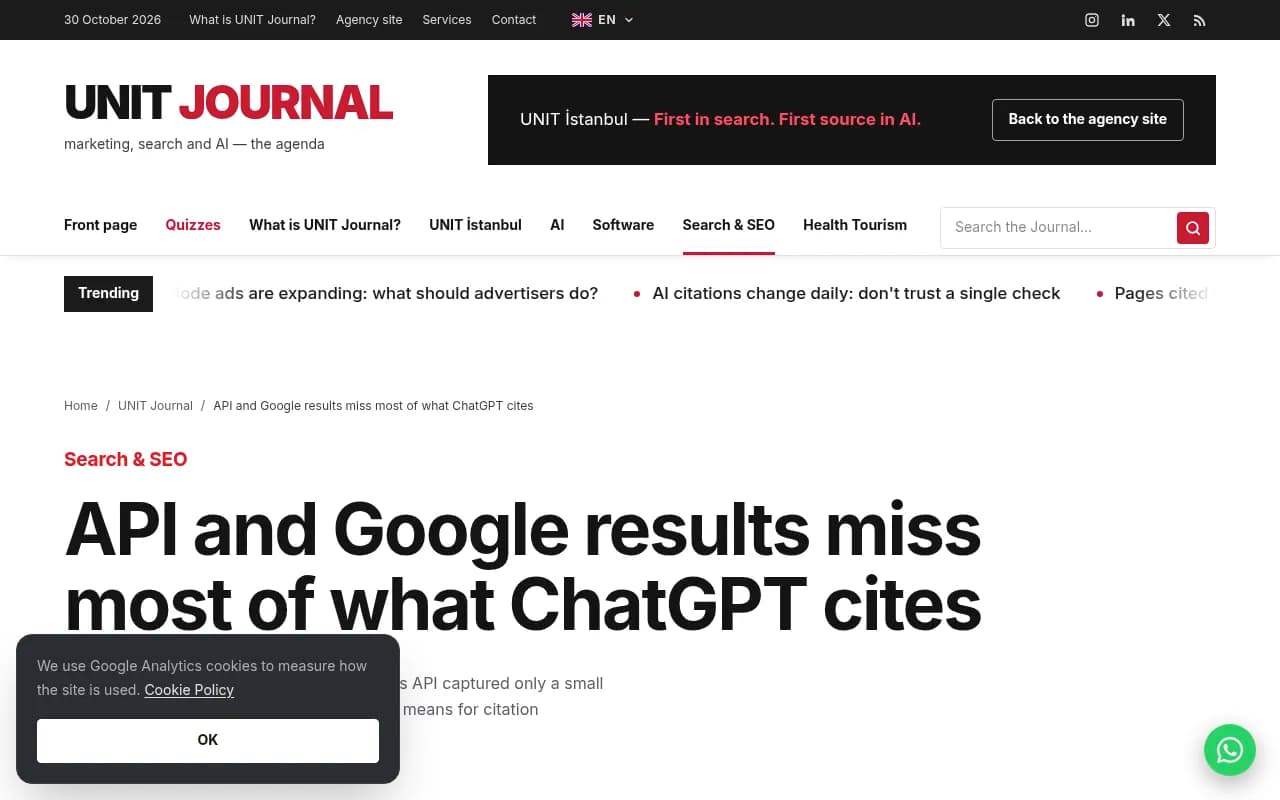
The numbers, from the GPT-5.5 Instant setting with 80 questions each run 20 times:
- Google results and the API together found 26.2% of the pages ChatGPT cited and 48.7% of the sites.
- In runs where searches were visible, ChatGPT never searched the exact wording of the question. It rewrote it.
- For Chinese questions, 69.6% of the runs with visible searches used only English.
- 44.5% of the distinct pages returned for a question appeared in only one of the 20 runs.
The report did not test commercial tracking tools, so it does not tell you that a specific vendor is wrong. What it tells you is that approximating ChatGPT with Google plus an API misses a lot at page level, and somewhat less at site level. That matters if your tracker measures "is this exact URL cited".
The authors recommend tracking at both page and site level, running each prompt several times and reporting appearance frequency, asking vendors whether data comes from the web app or the API, and avoiding month-over-month comparisons in weeks when the model changes. That is solid advice and I will build the checklist below on it.
Why citations are noisy even with perfect collection
UI data fixes one source of disagreement. It does not make ChatGPT deterministic. Three things keep moving.
Query rewriting
ChatGPT turns your prompt into its own searches, often several. Promptwatch Data on ChatGPT query fanouts shows an average of 2.15 distinct searches per response in early December 2025, easing to about 1.84 by early March 2026, with average query length falling from roughly 117 characters to the high 80s. Behavior changes in steps tied to model updates. On Aug 8, 2026, ChatGPT started using the site: operator at scale, going from about 0.4% to about 17% of fanout queries overnight. Your tracked prompt is not the query that hits the index.
Platform-level shifts
Promptwatch Data on the ChatGPT citation drop found that ChatGPT cited about 6.4 sources per search-enabled response the week before the GPT-5.3 rollout on Mar 4, 2026, then settled around 4.7 to 4.9 by late March, roughly 27% fewer. It hit GPT-5.3, GPT-5.4 and GPT-5-Mini within a day. If your citation count dropped that week, your content probably did not get worse. Check the date against model releases before rewriting anything.
Run-to-run variation
Qvery's July 2026 records, a vendor dataset, show 48.80% of ChatGPT-cited pages appeared on only one day, while 13.30% were seen on seven or more days. The pages that stick are a minority. Promptwatch's content half-life report points the same direction: pages ChatGPT cited on July 6, 2026 were tracked for 90 days, landing pages and docs stayed cited longest, and news lost half its pages within 36 days.
It is also worth knowing how many sources are in play. In Promptwatch's unique domains data for Sep 28 to Oct 4, 2026, 47.6% of responses cited 10 or more domains, and 66.1% cited at least 8. With that many sources per answer, a single prompt tells you little. Measure across many organic prompts.
What to ask any tracking vendor
Before you buy, send these questions. A good vendor answers them directly. A vague answer is information too.
- Does the data come from the real ChatGPT web interface or from the API? If API, is web search enabled and which model?
- How many times is each prompt run per period, and do you report appearance frequency rather than a single snapshot?
- Can I see citations at both page level and domain level?
- Do you break results out by engine? A gain in ChatGPT can hide a loss in Perplexity or AI Overviews.
- Do you show sample size next to each number, so a three-point wobble is not read as news?
- Do you annotate model changes, so I know when to distrust a week-over-week comparison?
- Which countries and languages are covered, given that ChatGPT sometimes searches in English even for non-English questions?
Tool landscape
I have not verified which vendors use UI collection versus API, and the research here does not include a confirmed feature matrix, so treat the table as a starting point for your own questions rather than a verdict. Pricing is left out for the same reason. Check each vendor's site.
| Tool | Positioning | Worth asking about |
|---|---|---|
| Promptwatch | Real UI monitoring across ChatGPT, Gemini, Perplexity, Claude, AI Overviews; crawler logs, visitor analytics, content tools | Breadth of the stack beyond tracking |
| Otterly.AI | Tracks domains and URLs cited, checked daily, with position changes over time | Data source and run frequency |
| Knowatoa | Reruns answers daily and sends a weekly digest | Data source and prompt limits |
| Profound | Enterprise tracking across many engines | Cost against prompt volume |
| Ahrefs Brand Radar | AI tracking inside an SEO suite | Prompt set flexibility |
| Gauge | Citations, mention rate and source analysis tied to content workflows | Collection method |
Otterly.AI

Profound


Promptwatch is the one I would look at first if you need more than a dashboard. Beyond prompt tracking it includes IP-verified AI crawler logs, visitor analytics for AI-referred traffic and a Content Agent that writes and publishes against your gaps, so you can connect a citation change to what the crawlers actually did. Prompt trackers that stop at monitoring leave you guessing at the why. For a wider survey of the category, the GEO software directory at bestgeosoftware.com lists more options, and ai-rank-tools.com focuses on rank trackers.
A measurement setup that survives the noise
Build the prompt set
Start with 20 to 50 prompts that reflect real buyer intent, across at least two engines. Mix organic prompts, brand-specific ones and competitor comparisons. Promptwatch's unique-domain data shows brand-specific prompts behave differently: 21.3% cite 10 or more domains, and the most common count is 5 domains, so do not average them together with organic prompts.
Repeat and trend
Run each prompt multiple times and report how often you appear, not whether you appeared once. Compare weeks, not days. Mark model release dates on the chart.
Use two levels
Track the domain and the page. Domain-level overlap between sources is higher than page-level, so domain share is the steadier number, while page-level data tells you what to fix.
Close the loop with real traffic
Citation share is a means, not a result. Pair it with AI referral traffic in your analytics and with crawler data, so you can tell "we lost visibility" from "ChatGPT cites fewer sources overall". Google Analytics can segment referrals from AI platforms, and server-side crawler logs show whether the bots can even read your pages.
Sanity-check manually
For a handful of money prompts, ask them yourself on ChatGPT on the same days, paste the cited links into a sheet with the date, and compare to your tool. If the tool and your manual check disagree consistently, that is the moment to ask the vendor about its data source.
Common mistakes
- Comparing a UI-based tool and an API-based tool as if they measured the same thing.
- Reading one day's drop as a content problem when the model just changed.
- Judging performance on a single prompt.
- Ignoring non-English behavior. If you operate in other languages, check that the tool tests in each market, since ChatGPT may search in English anyway.
- Counting mentions as citations. A mention names your brand. A citation links to your content, which is the stronger signal.
The practical takeaway
If two tools disagree, check the collection method before you check anything else. UI data and API data are different measurements, and the research suggests the API route misses a large share of what ChatGPT really cites at page level. Pick a tool that tells you where its data comes from, runs prompts repeatedly, and flags model changes. Then read the numbers as a trend line. The market for these tools is crowded, so make every vendor answer the seven questions above before you sign anything.
For first-party numbers on how ChatGPT behaves, the Promptwatch Data hub is updated regularly and covers citations, fanouts and crawler traffic.