Key takeaways
- Peec AI is a mid-market monitoring platform with strong regional tracking and a clean interface, but it stops at measurement -- it doesn't help you act on what it finds.
- The three-stage GEO test (find gaps, create content, track results) exposes a clear divide between monitoring tools and full-stack platforms.
- Peec AI passes stage one, partially passes stage two, and largely fails stage three compared to platforms built around the full optimization loop.
- For teams that only need citation tracking, Peec AI is a reasonable choice. For teams that need to actually improve their AI visibility, the gap becomes a real problem.
- Full-stack platforms like Promptwatch close all three stages in one workflow -- from gap discovery through content generation to traffic attribution.
The problem with "monitoring-only" GEO tools
The GEO tools market has split into two camps, and the divide matters more than most buyers realize before they sign up.
Camp one: monitoring dashboards. They tell you where your brand appears in AI-generated answers, how often, and against which competitors. Good data. Clean charts. Then the session ends and you're left figuring out what to actually do.
Camp two: full-stack optimization platforms. They combine the same monitoring data with content gap analysis, AI-assisted content creation, crawler logs, and traffic attribution. The data feeds directly into action.
Peec AI sits firmly in camp one. That's not a knock -- it's just the reality of what the product is. The question is whether camp one is enough for your team in 2026, when AI search is generating real traffic and real revenue decisions.
To answer that, I'm running Peec AI through a three-stage test that mirrors how a real GEO program actually works.
The three-stage GEO test
Stage 1: Find the gaps
The first job of any GEO platform is to show you where you're invisible -- which prompts your competitors are getting cited for that you're not, which topics AI models are pulling from competitor pages instead of yours, and which questions your content simply doesn't answer.
This is where Peec AI is genuinely strong. Its regional prompt tracking is one of the better implementations in the mid-market. You can segment AI citation data by country and region, which matters for brands running campaigns across multiple markets. The interface is clean and accessible to non-technical marketers, and it surfaces source URLs so you can see which domains are actually driving citations.
Peec AI also offers competitive share-of-voice dashboards -- you can see how your citation rate stacks up against named competitors across different AI models. For a team that's just starting to understand their AI visibility position, this is useful context.
Where stage one gets complicated: Peec AI's prompt coverage is limited compared to enterprise platforms. You're working with a fixed or semi-fixed prompt set, which means you may not be tracking the specific questions your actual customers are asking. Prompt volume estimates and difficulty scoring -- the kind of data that helps you prioritize which gaps to close first -- aren't part of the picture.
Stage 1 verdict: Peec AI passes, with caveats around prompt depth and prioritization.

Stage 2: Create content that closes the gaps
This is where the monitoring-only model breaks down.
Once you know which prompts you're invisible for, the next question is: what do you publish to change that? This requires understanding not just that a gap exists, but why it exists. Which specific angle is the AI model looking for? What format does it prefer? What sources is it currently citing, and what do those sources have in common?
Peec AI doesn't generate content. It doesn't produce content briefs grounded in prompt data. It doesn't analyze what the currently-cited sources have that your pages lack. You get the gap data, and then you're on your own.
That's a meaningful workflow break. Your team has to manually interpret the monitoring data, decide what to write, brief a writer or use a separate AI writing tool, and hope the resulting content addresses what the AI model actually wants. There's no feedback loop connecting the monitoring data to the content creation process.
Compare this to platforms built around the full optimization loop. Promptwatch, for example, uses its Answer Gap Analysis to identify the specific prompts where competitors are visible and you're not, then its Content Agents generate articles, listicles, comparisons, and briefs grounded in that same prompt data -- including citation data, prompt volumes, persona targeting, and competitor analysis. The gap and the fix live in the same workflow.

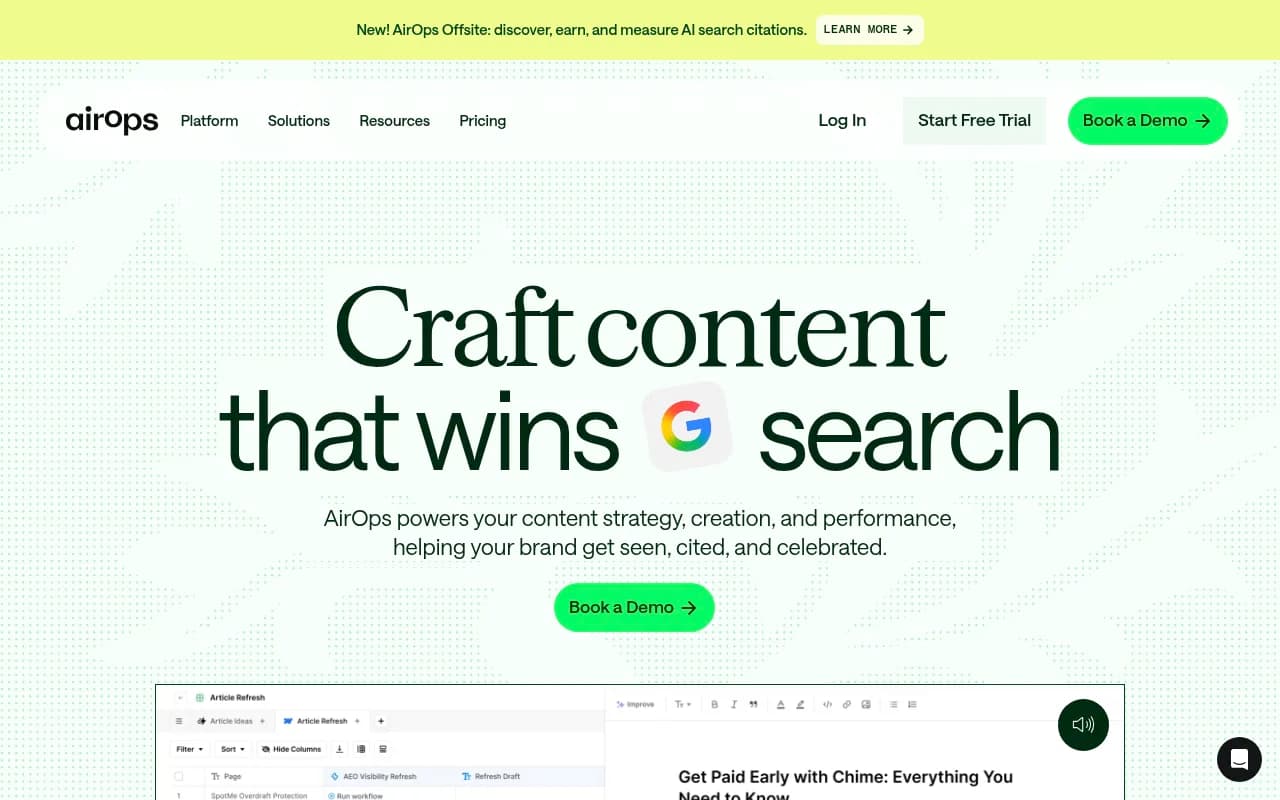
Other tools in the catalog take different approaches to the content problem. AirOps is built specifically around content engineering for AI search visibility, connecting prompt research to content production. Search Atlas combines AI-powered SEO automation with content publishing. These aren't perfect substitutes for a unified GEO platform, but they illustrate that the market has moved well beyond "here's your data, good luck."
Stage 2 verdict: Peec AI fails. No content generation, no briefs, no optimization guidance. You're exporting data and starting over in a different tool.
Stage 3: Track the results
The third stage is where most monitoring tools -- not just Peec AI -- have the biggest gaps.
Tracking results in GEO means more than watching your citation rate go up over time. It means knowing which specific pages are being cited, by which AI models, how often. It means understanding when a page moves from "crawled" to "cited" and how long that takes. It means connecting AI visibility to actual website traffic and, ideally, to revenue.
Peec AI tracks citation rates and competitive share of voice over time. That's the basic version of stage three. But it doesn't offer:
- AI crawler logs showing which pages AI bots are actually reading and what errors they encounter
- Page-level citation tracking that shows exactly which URLs are driving your AI visibility
- Traffic attribution connecting AI citations to real sessions and conversions
- The timeline from content publish to crawl to citation
Without these, you can't close the loop. You publish new content, your citation rate maybe improves a few weeks later, but you don't know if it was the new content, an algorithm change, a competitor's page dropping, or something else entirely.
This matters because GEO is still a young discipline. Teams need to build institutional knowledge about what actually works -- which content formats get cited, which topics AI models favor, how long the crawl-to-citation cycle takes for their domain. That knowledge only accumulates if you have the tracking infrastructure to capture it.
Stage 3 verdict: Peec AI partially passes on basic trend tracking, but fails on the deeper attribution and crawler-level data that makes GEO programs learnable over time.
How Peec AI stacks up against the field
Here's an honest comparison across the main GEO platform tiers:
| Platform | Stage 1: Gap finding | Stage 2: Content creation | Stage 3: Result tracking | Best for |
|---|---|---|---|---|
| Peec AI | Strong (regional focus) | None | Basic trend data only | Regional monitoring, early-stage programs |
| Otterly.AI | Basic | None | Basic | Lightweight monitoring on a budget |
| AthenaHQ | Good | None | Moderate | Monitoring-focused enterprise teams |
| Profound | Very strong | None | Strong data export | Enterprise BI teams with dedicated analysts |
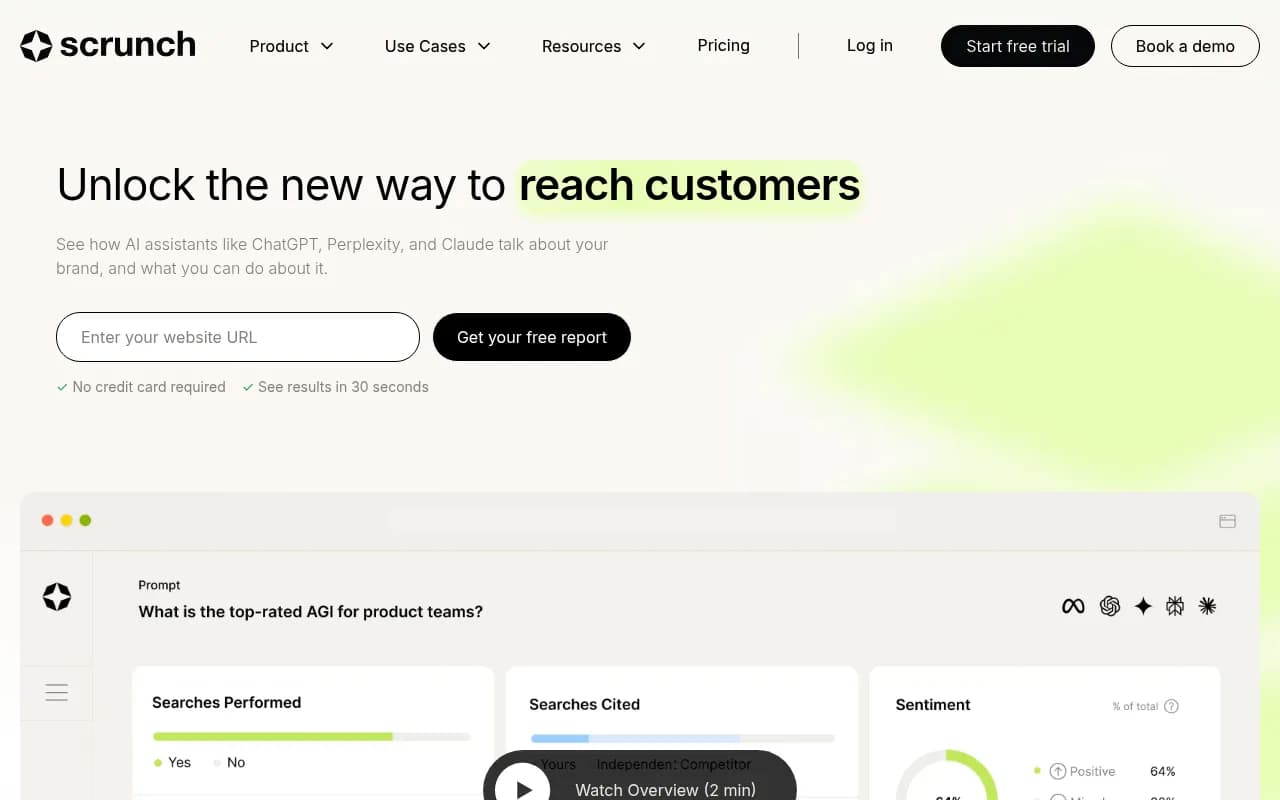
| Scrunch AI | Moderate | None | Moderate | Mid-market monitoring |
| Promptwatch | Strong + prompt intelligence | Full content generation | Full attribution + crawler logs | Teams that need the complete optimization loop |
| Search Atlas | Moderate | Strong (SEO-focused) | Moderate | Content-heavy SEO teams |
Otterly.AI


Profound

A few things worth noting about this table. Profound has genuinely strong data depth -- if you have a dedicated analytics team that can work with detailed exports, it's a serious platform. The limitation is that it's expensive, complex, and still doesn't close the content gap. You get excellent monitoring data and then, again, you're on your own for what to do with it.
Otterly.AI and Scrunch AI are simpler tools that make sense for teams with limited budgets or teams that are just starting to track AI visibility. They're not trying to be full-stack platforms, and that's fine -- but they're also not where you want to be if AI search is a meaningful traffic channel for your business.
What Peec AI actually does well
It's worth being specific about where Peec AI earns its place in the market, because the monitoring-only critique can obscure genuine strengths.
Regional segmentation is real. If you're a brand operating across multiple European markets, or tracking how AI citations differ between the US and UK, Peec AI's geographic prompt execution is one of the better implementations available. Most platforms treat "multi-region" as a checkbox feature. Peec AI built it as a core capability.
The interface is genuinely accessible. Non-technical marketers can navigate it without a learning curve. That matters for teams where the GEO program is owned by a content or brand manager rather than an SEO specialist.
Source URL tracking is useful. Knowing which domains AI models are pulling from when they cite competitors gives you a starting point for understanding the citation landscape -- even if you have to do the analysis yourself.
The case for a full-stack platform
The monitoring-only model made sense in 2024, when most teams were just trying to understand whether AI search was relevant to their business. The answer is now clearly yes for most categories, and the question has shifted to: how do we actually improve our position?
That question requires the full loop. Find the gaps. Create content that closes them. Track whether it worked. Repeat.
Platforms built around this loop -- where the gap analysis feeds directly into content generation, and the content generation connects to citation tracking and traffic attribution -- compress the time from insight to action. They also build institutional knowledge faster, because every piece of content you publish becomes a data point in a system that tracks what happens to it.
For teams evaluating their options in 2026, the practical question is: how much of the GEO workflow do you want to manage across separate tools, and how much do you want in one place?
If you're comfortable exporting Peec AI data, interpreting it manually, briefing content in a separate tool, publishing through your CMS, and then going back to Peec AI to see if anything changed -- that workflow is possible. It's just slow and hard to scale.
If you want the gap analysis, content generation, and result tracking to talk to each other, you need a platform designed for that from the ground up.
Who should use Peec AI in 2026
Peec AI makes sense for:
- Teams in the early stages of building a GEO program who need to understand their current position before investing in optimization
- Brands with strong regional marketing needs where geographic prompt segmentation is a priority
- Organizations where AI search monitoring is one input into a broader analytics stack, and content decisions happen through a separate process
- Smaller teams that need a clean, accessible interface without a steep learning curve
It's probably not the right fit for:
- Teams where AI search is already a meaningful traffic channel and they need to actively improve their position
- Marketing organizations that want to close the loop between monitoring data and content production
- Agencies managing multiple clients who need page-level citation tracking and attribution data to demonstrate results
- Enterprise teams that need crawler logs, traffic attribution, and prompt intelligence to build a defensible GEO program
The bottom line
Peec AI is a solid monitoring tool. It passes stage one of the three-stage GEO test with reasonable marks, particularly for regional tracking. It fails stage two entirely -- there's no content creation or optimization capability. And it only partially passes stage three, offering trend data without the deeper attribution and crawler-level insights that make a GEO program learnable over time.
That's not a fatal flaw if your needs match what it offers. But in 2026, with AI search driving real traffic and real revenue decisions, most teams need more than a dashboard that shows them where they're invisible. They need a system that helps them become visible -- and tracks whether it worked.
The tools that do all three stages in one workflow are where the category is heading. Peec AI is a useful starting point, not a destination.