Key takeaways
- AI answers are now where many B2B buyers shortlist vendors, so how models describe you against competitors is a positioning input, not just an SEO metric.
- Almost half of ChatGPT responses cite 10 or more domains, so you always share the answer with competitors. Position and framing matter more than a simple mention.
- Product pages, landing pages, listicles and comparisons make up most commercial-prompt citations. Your own pages are the first lever for fixing positioning.
- Treat each AI engine separately. A social-driven competitor lead in AI Overviews says little about ChatGPT.
- Run the same prompt set for you and 3 to 5 competitors, then feed the gaps into messaging, comparison pages, review strategy and sales battlecards.
Why this belongs to product marketing
Most AI visibility work lands on the SEO team's desk. That is a mistake, or at least half of one. SEO teams care whether you are cited. Product marketers care about something harder: what the model says you are, who it says you compete with, and why it says a rival is the better fit.
That is positioning. And it is being written by a machine, at scale, in thousands of buyer conversations you never see.
Omnibound's 2026 piece on B2B AI search makes the funnel point well: procurement teams and economic buyers now use AI to validate choices, compare alternatives and build business cases. The comparison step, the one product marketing has always owned, increasingly happens inside a chat window.
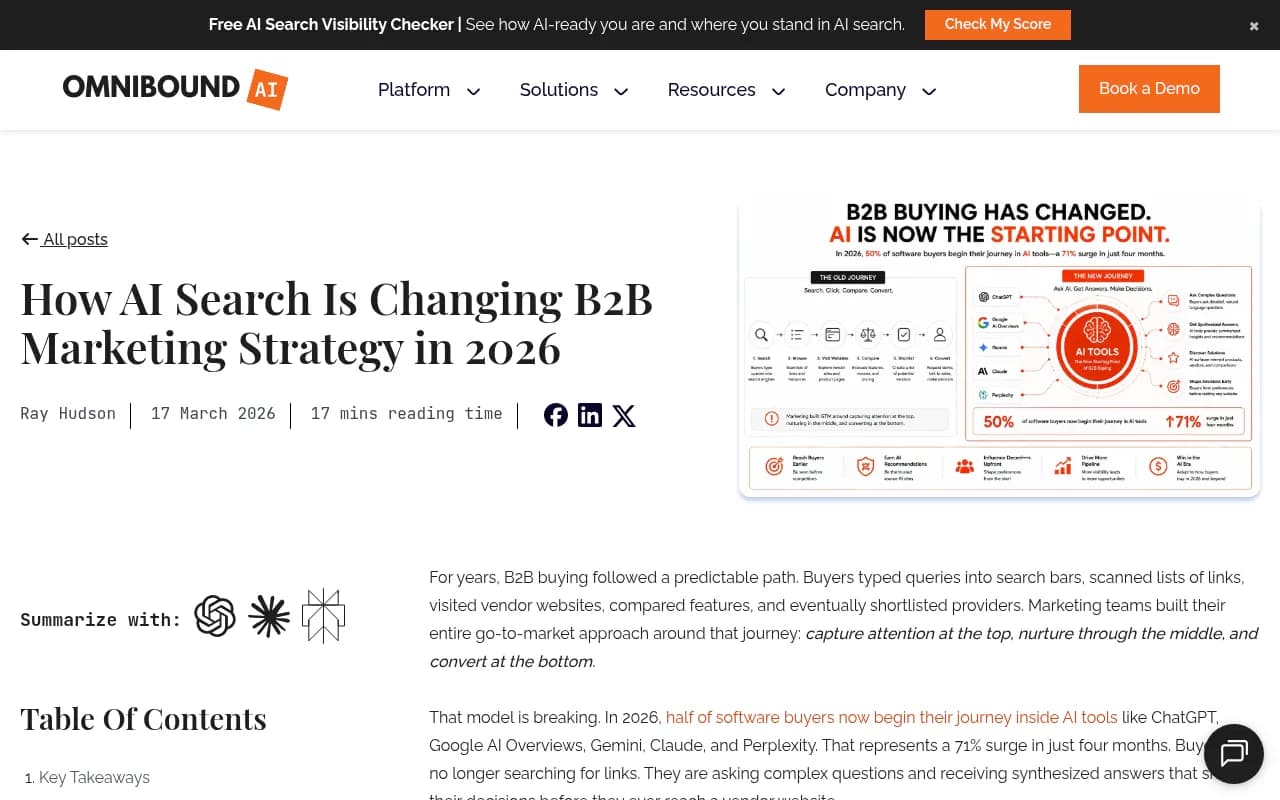
So the useful question changes. Not "are we visible?" but "how are we framed, next to whom, and based on which sources?"
What AI visibility data actually contains
Before using the data, know what the metrics mean. Most platforms report some version of these:
| Metric | What it tells a PMM | Typical misread |
|---|---|---|
| Visibility or mention rate | Are you in the consideration set at all? | Treating it as a ranking |
| Share of voice | Your share of mentions against named competitors | Ignoring which prompts drive it |
| Position in answer | Whether you are the first recommendation or an afterthought | Averaging across unrelated prompts |
| Sentiment | Tone of how the model describes you | Reading one score as the full story |
| Citation sources | Which pages and sites shape the answer | Looking only at your own domain |
| Competitor co-mentions | Who appears in the same answers as you | Assuming your named rivals are the real ones |
Read together, these locate the problem. Low share of voice is a coverage problem. Late position is a prominence problem. Mentions without citations to your own site point at content or crawlability. Weak sentiment is a reputation problem. Each one goes to a different owner, and product marketing should own at least two of them.
Step 1: Build a prompt set around positioning, not keywords
Keyword lists do not transfer. Buyers ask AI full questions, and the question shape decides which kind of answer you get. Build your set in four buckets:
- Category prompts, such as "best [category] for mid-market SaaS". These show whether you make the shortlist.
- Competitor-anchored prompts, such as "alternatives to [competitor]". These show whether you are the alternative.
- Comparison prompts, such as "[you] vs [competitor]". These show how your differences are described.
- Brand prompts, such as "is [you] good for startups". These show your reputation as the model sees it.
Add persona and use-case variants. "Best CRM for a 10-person agency" and "best CRM for enterprise compliance teams" will crown different vendors, and that split is exactly the segmentation insight you want.
Thirty to fifty prompts is a workable start. A single prompt tells you almost nothing, which is also the main warning from Promptwatch's own data. Run them daily or weekly, since answers move.
Step 2: Understand the answer structure you are competing in
Promptwatch's unique domains per response data (Sep 28 to Oct 4, 2026) changes how you should think about a "win":
- 47.6% of ChatGPT responses cite 10 or more domains, and 66.1% cite at least 8.
- On competitor-comparison prompts, 49.1% cite 10 or more domains, and only 0.35% cite a single one.
- Brand-specific prompts are different: five domains is the most common count (14.9%), and only 21.3% cite 10 or more.
The positioning reading is direct. In category and comparison answers, you are never alone. You share the response with competitors and a crowd of third-party sources. In brand prompts, the model leans on a short list of sources, so the review sites and forums on that list shape how you are described.
Two practical consequences. First, measure where you sit in the response and how you are characterized, not just whether you appear. Second, check which competitors are cited in the same responses as you. Those are your real AI-era competitors, and they may not match the list in your sales deck.
Step 3: Find out which content types are doing the positioning
If you want to change how you are framed, you need to know which pages feed the answer. Promptwatch's content type data for Sep 28 to Oct 4, 2026 is useful here:
| Content type | All prompts | Commercial prompts | Branded prompts |
|---|---|---|---|
| Product pages | 22.4% | 26.0% | 23.3% |
| Landing pages | 16.8% | 20.6% | 22.8% |
| Listicles | 13.6% | 15.0% | n/a |
| Comparisons | 5.9% | 7.9% | n/a |
| Reviews | 1.7% | n/a | 5.6% |
| Social posts | n/a | n/a | 3.0% |
Product and landing pages together account for 39% of all citations, and four types (product pages, landing pages, listicles, comparisons) make up almost 70% of commercial citations. That is good news for product marketing, because those pages are yours. You control the claims, the pricing clarity and the comparisons.
It also points to a trap. If your product page is vague about who it is for, the model will fill the gap with whatever third parties say. Complete pricing, specs and positioning on product pages, and pages that are easy to compare, are the cheapest positioning fix available.
One more detail worth noting: news pages lose half their citations within about 36 days, while landing pages and docs stay cited for months (content half-life data). A press-release-driven positioning strategy decays fast. Evergreen pages hold.
Step 4: Run a competitor source audit
This is the step most teams skip, and the one that pays off most. For each competitor, ask: which sources does the model rely on when it recommends them?
Sort the answer into buckets:
- Their own product, comparison and docs pages
- Best-of roundups and listicles
- Review sites such as G2 or Trustpilot
- Analyst, media and partner pages
- Forums and social platforms
Dageno's guide to AI visibility products puts the underlying logic plainly: if competitors are recommended because AI repeatedly cites review sites, partner directories, media articles or user-generated content, you need to know that before deciding what to publish. Without source analysis, teams create random content that does not address the actual reason the competitor is winning.
A caution on social. Promptwatch's October 2026 social citation data shows ChatGPT drew just 0.46% of its citations from social platforms (Sep 28 to Oct 4), while Google AI Overviews drew 12.2%. Reddit's share of ChatGPT citations collapsed from about 4% to 0.5% on August 14, 2026. If a competitor looks strong because of Reddit threads, that lead is engine-specific and, in ChatGPT, stale. Do not build a community strategy to chase it without checking which engine your buyers use.
For software categories specifically, Promptwatch's software citation report shows GitHub, Microsoft's docs and G2 leading ChatGPT citations, with documentation and help centers taking the largest share. For a B2B software PMM, that is a hint to look at docs and review presence before blogging.
Step 5: Turn gaps into positioning decisions
This is where the data becomes product marketing work. Map each pattern to an action:
| What the data shows | Likely cause | Positioning response |
|---|---|---|
| Competitor named first in category prompts, you appear late | Their category claim is clearer | Sharpen your category statement and the first paragraph of your product page |
| You appear in comparisons but described generically | Differences not stated on your pages | Publish explicit comparison pages with specific tradeoffs |
| Strong mentions, few citations to your site | Third parties describe you, not you | Fix crawlability, add FAQ and brand pages, refresh product pages |
| Weak sentiment on brand prompts | Review sites and forums on the short source list | Review collection, response programs, fix recurring complaints with product or messaging |
| Competitor dominates one persona prompt | Their use-case content is better | Build persona-specific landing pages |
| You are absent from roundups ChatGPT cites | Not in the listicles | Outreach and PR toward those specific articles |
That last row matters. Listicles are 13.6% of ChatGPT citations overall, and the promptwatch recommendation to get into the best-of roundups ChatGPT cites for your category is simply good PMM-plus-PR work. If you need support with outreach for that, an agency like 1001 SEO Media handles digital PR and GEO alongside traditional SEO.
Step 6: Feed the findings into battlecards and messaging
AI visibility data is also competitive intelligence for sales. A few concrete uses:
- Add a "how AI describes us vs them" section to battlecards. Buyers arrive having already read a model's summary, and reps should know what it said.
- Use recurring model phrasing as a messaging test. If the model keeps calling you "affordable but limited," that is the objection you need to pre-empt.
- Pair it with win-loss data from tools like Clozd or Crayon. When a lost deal mentions a competitor you rarely see in sales calls, check whether it keeps showing up in AI answers.
- Brief your launch team. Before launch, run the prompt set. After launch, run it again and see whether the model's description moved.
Keep your claims consistent across your site, docs, review profiles and press. Models triangulate across sources, and contradictions between your pricing page and a third-party listing produce muddy answers.
Tools for the job
The category is crowded. A rough split helps.
Promptwatch tracks the real interfaces of ChatGPT, Google AI Overviews, Gemini, Perplexity, Claude and others, with prompt volumes, competitor heatmaps, citation source analysis and crawler logs. Its Action Board and content tools then help close the gap you find, which suits PMMs who want positioning insight and execution in one place.

Profound is an enterprise option with custom dashboards and a projects feature that turns data into ranked opportunities.
Profound

Semrush suits teams that want AI visibility next to traditional SEO data in one workspace.
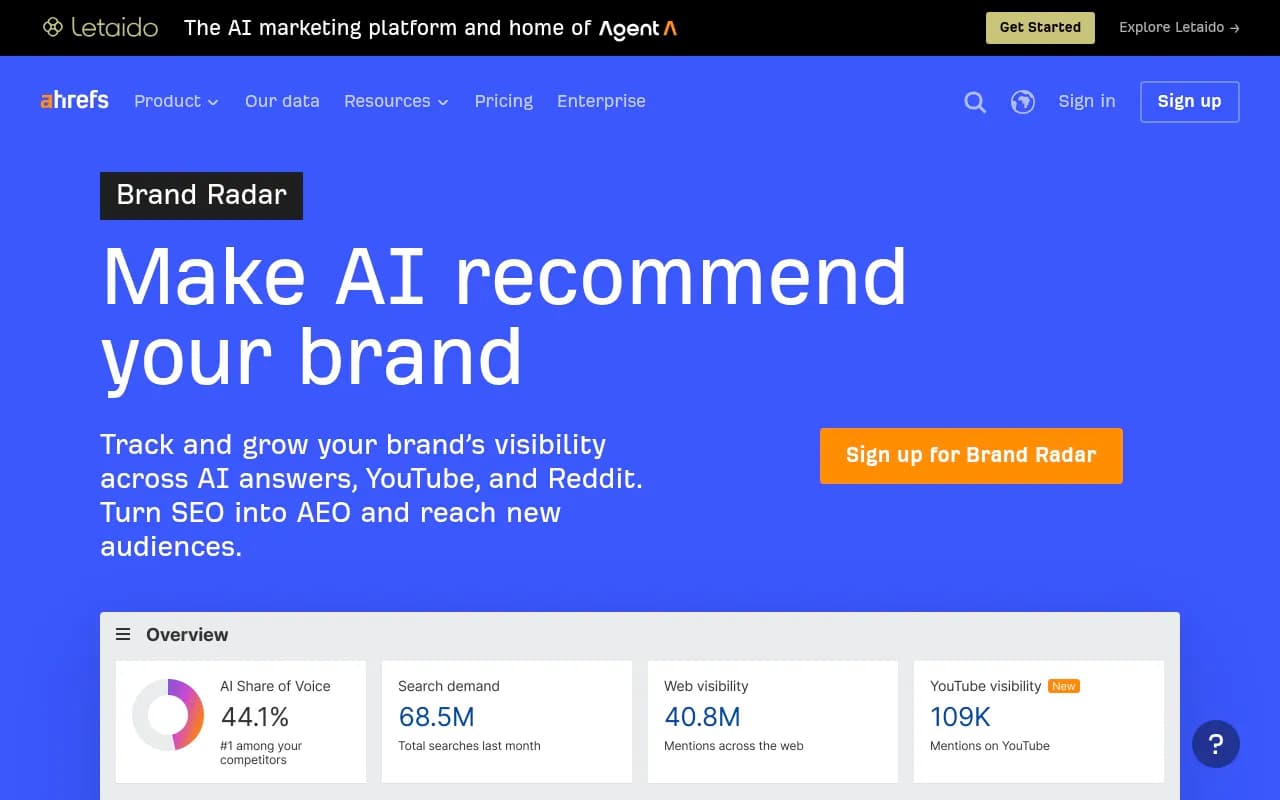
Ahrefs Brand Radar does similar work for teams already living in Ahrefs.
Otterly.AI and Peec AI are lighter prompt trackers, fine for basic monitoring on a small budget.
Otterly.AI


Dageno AI pairs tracking with an integrated optimization workflow.

| Tool type | Best for | Watch out for |
|---|---|---|
| End-to-end GEO platform (Promptwatch) | Insight plus content and technical fixes | More depth than a solo marketer may need |
| Enterprise monitoring (Profound) | Large brands, many stakeholders | Cost, and less emphasis on execution |
| SEO suite add-ons (Semrush, Ahrefs) | Existing SEO workflows | Shallower AI-specific data |
| Lightweight trackers (Otterly.AI, Peec AI) | Basic mention tracking | No crawler or traffic attribution |
For wider lists, the GEO software directory and AI rank tracking directory compare more options. Confirm pricing on each vendor's site before you commit.
Common mistakes
- Using one prompt as evidence. Answers vary run to run. Measure across many prompts.
- Blending engines. ChatGPT and AI Overviews cite very different source mixes, so report them separately.
- Reporting only mentions. Position and framing change deals; a bare mention does not.
- Chasing the competitor's tactics blindly. Check the sources first. Their lead may come from a channel that is already fading.
- Skipping the owner conversation. Visibility data touches content, PR, product and sales. Without a named owner per finding, it stays a dashboard.
- Forgetting to check mid-authority sources. Promptwatch's August 2026 data showed sites with domain rank 46 to 75 earned almost half of ChatGPT citations, while DR 91 to 100 sites fell to about 3%. You do not need to be a giant to be cited. See the domain rank report.
A 30-day plan
- Week 1: build 30 to 50 prompts across category, competitor, comparison and brand buckets. Pick 3 to 5 competitors.
- Week 2: baseline visibility, position, sentiment and co-mentions per engine. Pull the top cited sources for you and each rival.
- Week 3: write the gap list. Assign each gap to messaging, content, PR, reviews or product.
- Week 4: ship the quick wins (product page clarity, a comparison page, a brand FAQ), update battlecards, and set a monthly re-run.
Then re-measure. Positioning that does not get checked against the answers models give is just a guess about what buyers see.
For more first-party numbers on how AI engines pick sources, browse Promptwatch Data.