Key takeaways
- Real browser-based monitoring and API-only sampling produce different results — ask every vendor which one they use before you buy anything.
- Prompt volume claims vary wildly; some platforms use real conversational queries, others quietly derive numbers from keyword data.
- Citation share moves fast. Promptwatch's data shows Reddit's share of ChatGPT citations fell from roughly 3.8% to under 1% in about a week in August 2026, so a monthly snapshot tool will miss changes that matter.
- Pricing on prompt-based plans can scale badly once you add extra engines or regions. Ask for a quote at 2x and 5x your expected volume before signing.
- Coverage matters less than what happens after you find a gap. A tool that shows declining visibility without a way to act on it is measuring the problem, not fixing it.
Why this got harder to shop for in 2026
Two years ago "AI visibility tool" meant a handful of startups running the same 20 prompts through ChatGPT once a week. Now there are 30-plus vendors, each claiming multi-engine coverage, each pricing differently, and several quietly using different data collection methods that produce noticeably different numbers for the same brand on the same day.
That last part is the trap. I've seen practitioners on forums like r/GEO_optimization report that an API-based tool placed their brand at "position 2" for a prompt where the brand didn't appear at all in the real ChatGPT interface. That's not a rounding error. That's a tool telling you something false about your business.
So before you get to feature checklists and pricing tables, you need to ask a more basic question: is this tool actually watching what your customers see?
Item 1: real UI monitoring vs API sampling
Most LLM providers offer an API that developers can query programmatically. It's convenient for vendors to build on. It's also frequently not what a human sees when they open ChatGPT, Perplexity, or Google and type a question — the consumer-facing product often runs different retrieval, ranking, and personalization logic than the raw API.
Ask every vendor point blank: "Is your data collected from the real browser interface, or from an API?" Then ask for a side-by-side example. A vendor that can show you a screenshot matching their reported data is worth trusting more than one that can't.
This is one of the areas where Promptwatch differentiates itself — it monitors the actual user interfaces of ChatGPT, Gemini, AI Overviews, AI Mode, Perplexity, and Claude rather than relying solely on API outputs, because user-facing answers and citations regularly diverge from what the API returns.

Item 2: citations vs mentions
A "mention" is your brand name appearing in AI-generated text. A "citation" is a linked reference to your website that a user could actually click. These are not the same thing, and conflating them is one of the most common ways buyers get misled by a dashboard.
Citations are the ones that can drive traffic. Mentions are useful for sentiment and framing, but they won't show up in your analytics. Any platform you evaluate should clearly separate the two in its reporting, not blend them into a single "visibility score" that hides which is which.
Item 3: how prompts get discovered, not just tracked
Manual prompt entry is fine for a start, but it caps your monitoring at whatever you already thought to ask. The stronger platforms suggest prompts based on real search demand and query patterns, surfacing questions you hadn't considered tracking.
A reasonable starting point, per prompt-tracking research from SE Ranking, is 20 to 40 prompts split roughly into 10-20 awareness prompts, 20-30 consideration prompts, and 5-10 brand-name prompts tracked separately. Brand-name prompts almost always show high visibility and will skew your averages if you mix them in with category prompts where you're actually competing.
Also worth checking: does the tool let you narrow prompts with qualifiers like geography, industry, or budget? Fighting for visibility on "best CRM" is a losing game against ultra-authoritative sources. Narrower prompts mirror how AI actually personalizes answers and give you a realistic shot at showing up.
Item 4: real prompt volume vs modeled estimates
This one gets glossed over in a lot of comparison pages. Some vendors report prompt or query volume figures that come from an undisclosed estimation model, or that are keyword-derived from traditional SEO data and relabeled as "AI prompt volume." That's a meaningfully different thing from tracking real conversational queries people type into ChatGPT or Perplexity.
Ask directly how the volume numbers are generated and how often they refresh. If a vendor can't explain their methodology in a sentence or two, treat the number with suspicion.
Item 5: content type classification
AI engines don't cite content evenly across formats, and that mix is shifting. Promptwatch's July 2026 data on ChatGPT citation types found product pages accounted for 32.8% of all citations that month, nearly double their March 2026 share of roughly 18%, while listicles were the fastest-growing format within the month, climbing from about 8% to over 10%. A monitoring tool that just tells you "you were mentioned" without breaking down what kind of page got cited is giving you a headline without the story.
Google AI Overviews shows a different pattern, with product pages overtaking listicles as the most cited format in late July 2026, per Promptwatch's Google-specific breakdown. If your tool doesn't classify citations by content type and by engine separately, you can't tell whether your product pages or your blog posts are doing the work.
Item 6: engine and platform coverage, matched to where your buyers actually are
Cross-platform citation overlap between engines is reportedly low — the same query on ChatGPT and Perplexity often surfaces a different set of cited sources. A tool that only tracks one engine misses most of your real visibility picture.
The engine mix also matters by content type. Promptwatch's social citation data shows ChatGPT behaves almost like a "Reddit specialist," with Reddit accounting for around 5% of its citations versus under 0.25% for any other social platform, while AI Overviews and Grok lean toward YouTube instead. X/Twitter barely registers anywhere, even on Grok despite the shared ownership. If a vendor is heavily weighting X coverage as a selling point, that's probably not solving the problem you actually have.
Check how many engines are included at the entry price versus locked behind add-ons. Otterly's Lite plan is advertised at $29/month, but Google AI Mode, Gemini, and Claude tracking cost extra on top of that — stack all the add-ons onto a higher tier and the real monthly cost can climb past $1,200. Peec AI caps its self-serve brand plans at three of seven engines, with a fourth costing $35 to $165 extra depending on tier. Read the fine print before comparing sticker prices.
Otterly.AI


Item 7: crawler logs and technical readiness
A lot of visibility problems start upstream of any prompt: AI crawlers can't reach or read your pages in the first place. OpenAI accounted for roughly 79.8% of verified AI crawler requests in early September 2026, down from 94.8% in early June, which tells you the crawler mix moves fast enough that a robots.txt rule that seemed harmless a year ago could now be blocking a dominant crawler without you knowing.
Few monitoring tools log this at all. If yours does, through CDN integrations with Cloudflare, Fastly, or similar, that's a meaningful advantage: it tells you when AI systems visit your pages, what they read, and whether they hit errors, which explains the "why" behind a visibility score rather than just reporting the score.
Item 8: does it help you fix anything
This is where a lot of otherwise solid tools stop short. A dashboard that shows your visibility declining without recommending specific content changes is measuring the problem, not helping you solve it. Ask what the tool does after it finds a gap: does it generate content briefs, suggest specific page updates, or just export a spreadsheet?
Tools like Promptwatch build this into the product with content gap analysis, automated content agents that draft and publish directly to a CMS, and a prioritized action list generated from the underlying visibility and crawler data.
Item 9: pricing at scale, not just at entry
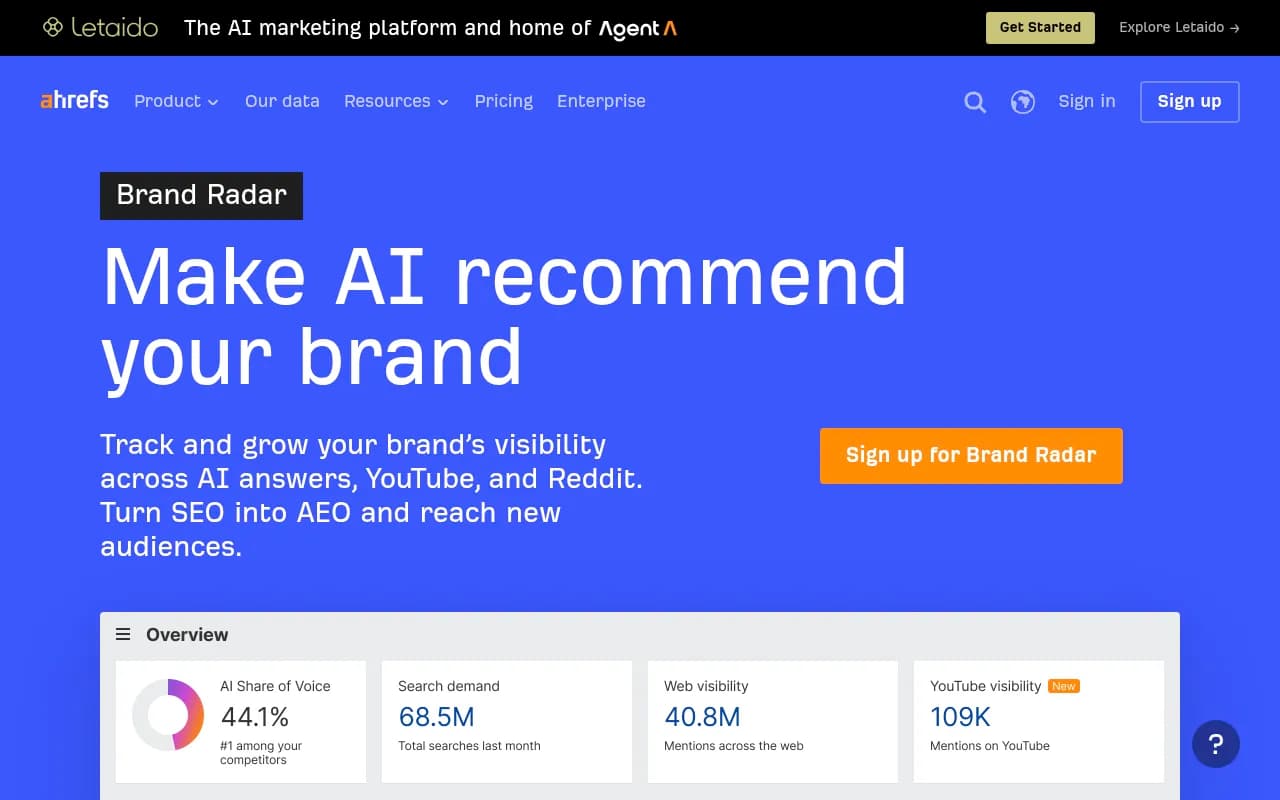
Prompt-based pricing sounds simple until you actually need more prompts. Ask every vendor for pricing at your current volume, then at double, then at five times that volume, before you sign anything. Profound's entry tier gives one seat on the $99 plan and only three seats even at $399; teams larger than that need a custom quote. Ahrefs Brand Radar's per-platform pricing means full six-platform coverage runs about $699/month on top of a required $129/month base Ahrefs plan, plus another $199/month if you want video visibility tracking.
Comparison table: what to check before you buy
| Platform | Real UI monitoring | Crawler logs | Content generation/CMS publishing | Entry price | Engine coverage at entry |
|---|---|---|---|---|---|
| Promptwatch | Yes | Yes (Agent Analytics) | Yes, with CMS publishing | $95/mo (Essential) | All major LLMs on Professional+ |
| Profound | Not disclosed | Limited | Credit-based agents | $99/mo | ChatGPT only at entry |
| Otterly.AI | Partial | Agent Analytics on higher tiers | No | $29/mo (add-ons extra) | 1 engine, others cost extra |
| Peec AI | Not disclosed | No | No | $95/mo | 3 of 7 engines |
| Ahrefs Brand Radar | API-based | No | No | $199/mo per platform | Google-ecosystem focused |
| Semrush AI Visibility Toolkit | API-based | No | Add-on only | $99/mo | ChatGPT, Google AI, Gemini, Perplexity |
Profound

Matching the checklist to your team
If you're a solo marketer or small team validating whether AI visibility matters at all for your brand, start cheap and manual. A free tool like Promptwatch's Explore tier or a basic tracker gets you a baseline without commitment.
If you're an SEO or content team that needs to turn findings into published pages, prioritize content workflows and CMS integration over raw prompt volume — a bigger dashboard you never act on is worse than a smaller one you use every week.
If you're an agency managing multiple client accounts, unlimited seats and white-label reporting matter more than any single feature. Peec AI and Otterly both offer unlimited seats on paid plans, which is genuinely unusual in this category and worth factoring into total cost of ownership.
If you're an enterprise brand comms or SEO department, crawler logs and technical readiness checks stop being optional. At that scale, an undetected robots.txt block against a crawler that suddenly represents 40% of AI traffic (as Meta-WebIndexer did between mid-July and early August 2026, per Promptwatch's crawler data) can cost more visibility than any content gap.
For a broader look at platforms in this category, the GEO software directory at bestgeosoftware.com and the rank-tracking comparisons at ai-rank-tools.com are useful places to keep tabs on new entrants as the market keeps shifting.
The one question that cuts through the noise
If you only ask vendors one thing, ask this: "Show me a real example where your data matched what I would see if I opened the app myself right now." Everything else, engine count, pricing tiers, dashboard polish, is secondary to whether the underlying data is true. A tool that gets that right and helps you act on the findings is worth paying for. One that doesn't is just a nicer-looking guess.