Summary
- Private ChatGPT conversations can leak into public search results through shared URLs with the /c/ pattern (e.g., chatgpt.com/c/[unique-id])
- You can't read the actual content of private chats, but you can detect when your brand appears in AI-generated responses using visibility tracking tools
- Google has indexed ~26,200 ChatGPT /c/ URLs, Bing shows over 72,000 -- many were never intentionally shared
- Monitoring your brand's AI visibility is legal and ethical; it tracks what AI models say about you publicly, not what users type privately
- Tools like Promptwatch track brand mentions across ChatGPT, Perplexity, Claude, and other AI engines without accessing private user data

The Privacy Paradox: ChatGPT Conversations Aren't as Private as You Think
You probably assume that when someone asks ChatGPT about your product in a private session, that conversation stays private. That's mostly true -- but there's a catch that's been quietly exposing thousands of supposedly private chats to search engines.
When you start a new ChatGPT session in a browser, the URL changes from the generic landing page (chatgpt.com/?model=gpt-4o) to a unique session link like chatgpt.com/c/68913f3c-1a9c-8320-9ef1-c470c489c55f. That /c/ stands for "conversation." OpenAI doesn't publicly share these links unless you explicitly click "Share" and enable discoverability. But here's the problem: search engines have already indexed tens of thousands of these URLs -- even for chats that were never intentionally shared.
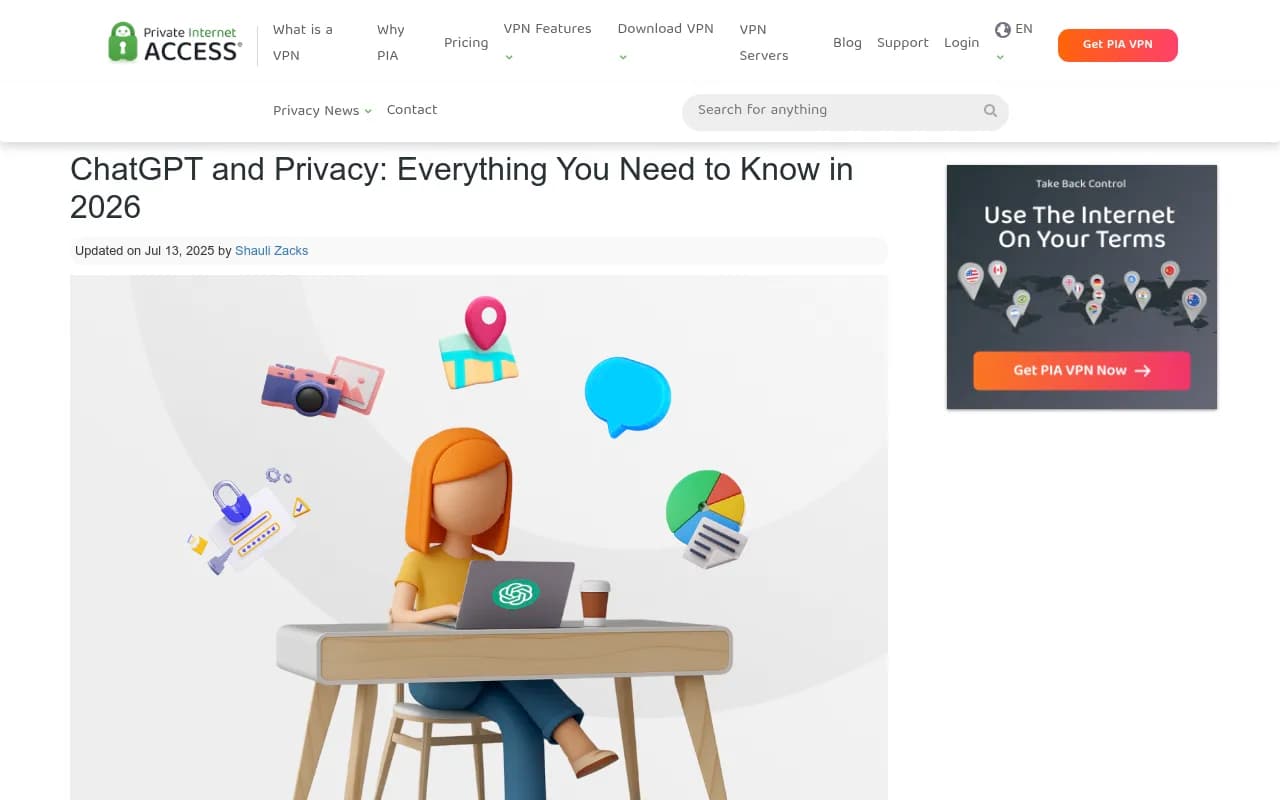
Recent analysis shows Google has indexed around 26,200 /c/ chat URLs, while Bing shows over 72,000. This isn't a breach or a hack -- it's a structural visibility issue baked into how ChatGPT URLs work and how search engines crawl the web. For businesses relying on AI tools without understanding these visibility risks, it's a wake-up call.
What Data Does ChatGPT Actually Collect?
Before we talk about detection, you need to understand what ChatGPT collects in the first place. When you use ChatGPT, the platform gathers:
- Account details: Your name, email address, and any third-party accounts you connect to your subscription
- Prompt content: Everything you type into the chat window, including files or images you upload
- Technical information: Your IP address, browser, device type, and general location
All of this helps OpenAI monitor performance, detect abuse, and improve the model. If you're logged in, it's tied to your profile. For free and Pro accounts, OpenAI uses your prompts to train future versions of the AI by default. That means your questions, responses, and data can directly shape how the model behaves -- and potentially appear in responses to other users.
For businesses, ChatGPT Enterprise and Team plans offer slightly better privacy: no data is used for training, data is encrypted when stored, and admins can decide how long data is retained. But even then, the fundamental issue remains: if someone shares a chat link (intentionally or not), that content can become publicly accessible.
How to Check If Your Brand Appears in Shared ChatGPT Conversations
You can't read private ChatGPT conversations. That would be illegal and unethical. But you can detect when your brand appears in publicly shared or indexed chat URLs. Here's how:
Method 1: Google Search Operators
Use this search command in Google:
site:chatgpt.com/share "your brand name"
Or to find any shared ChatGPT links that might mention you:
site:chatgpt.com/share [your business name or unique phrase]
If nothing comes up, you're likely fine. If something does, you're seeing publicly shared conversations where your brand was mentioned. You can also search for the /c/ pattern:
site:chatgpt.com/c/ "your brand name"
This reveals session URLs that search engines have indexed, even if they weren't explicitly shared.
Method 2: Use Google Alerts
Set up a Google Alert for:
site:chatgpt.com "your brand name"
You'll get email notifications whenever Google indexes a new ChatGPT page mentioning your brand. This is a passive monitoring approach that requires no manual checking.
Method 3: Use SEO Crawlers
Tools like Ahrefs, Screaming Frog, or Semrush can periodically scan for suspicious URL patterns or references to your brand on chatgpt.com. Set up a project to monitor the domain and filter for /c/ or /share URLs that mention your brand.
The Right Way to Track Brand Mentions in AI Search (Without Violating Privacy)
Here's the key distinction: you're not trying to read private conversations. You're tracking what AI models say about your brand when users ask them questions. This is fundamentally different from snooping on user data.
When someone asks ChatGPT "What are the best project management tools?" and your brand appears in the response, that's a public-facing AI-generated answer. You have every right to know if your brand is being recommended, ignored, or misrepresented. This is no different from tracking how your brand appears in Google search results or on social media.
The ethical and legal way to do this is through AI visibility tracking platforms. These tools don't access private user conversations. Instead, they simulate real user queries across AI engines like ChatGPT, Perplexity, Claude, Gemini, and others -- then track which brands appear in the responses.
Promptwatch is the market-leading platform for this. It monitors over 10 AI models (ChatGPT, Perplexity, Google AI Overviews, Claude, Gemini, Meta AI, DeepSeek, Grok, Mistral, Copilot) and tracks when your brand gets cited in AI-generated answers. You're not reading user prompts -- you're monitoring the public-facing output of AI models when they respond to queries relevant to your industry.
How AI Visibility Tracking Works (The Technical Side)
AI visibility platforms like Promptwatch work by running a set of predefined prompts across multiple AI engines on a regular schedule (daily, weekly, or on-demand). These prompts are designed to match real user queries in your industry. For example:
- "What are the best CRM tools for small businesses?"
- "How do I track my brand's visibility in AI search?"
- "What's the difference between Salesforce and HubSpot?"
The platform captures the AI's response and analyzes it for brand mentions, citations, and recommendations. It tracks:
- Citation frequency: How often your brand appears in responses
- Citation context: Whether you're recommended, compared to competitors, or mentioned neutrally
- Source attribution: Which pages, domains, or content pieces the AI cites when mentioning your brand
- Competitor visibility: How your brand stacks up against competitors in the same prompts
This data is aggregated into visibility scores, heatmaps, and trend reports. You can see exactly which prompts you're winning, which ones you're losing, and what content gaps are causing your invisibility.
The key point: this is all based on the AI's public output, not private user data. You're monitoring what ChatGPT says about you, not what users say to ChatGPT.
What You Can (and Can't) Do With This Data
What You CAN Do:
- Track your brand's visibility across AI engines and see how it changes over time
- Identify which prompts your competitors dominate and reverse-engineer their content strategy
- Find content gaps where AI models can't find information about you
- Optimize your website content to increase the chances of being cited by AI models
- Monitor for misinformation or negative sentiment in AI-generated responses about your brand
- Attribute traffic and conversions to AI visibility improvements
What You CAN'T Do:
- Read the actual private conversations users have with ChatGPT
- Access user account details, IP addresses, or personal information
- Track individual users across sessions or identify who asked what
- Subpoena ChatGPT's conversation history (unless you're a court with a valid legal reason)
- Use ChatGPT as a therapist and expect HIPAA compliance (generic ChatGPT is not HIPAA compliant)
The line is clear: you can monitor public AI output, but you can't spy on private user input.
The OpenAI vs. New York Times Case: What It Means for Privacy
In 2024, the New York Times sued OpenAI and demanded access to 20 million private ChatGPT conversations as part of their copyright infringement case. OpenAI fought back hard, calling it an "invasion of user privacy" and accelerating new security and privacy measures.
This case highlights two things:
- Private conversations are legally protected: Even in a high-stakes lawsuit, OpenAI refused to hand over user data without a fight. Courts generally respect user privacy unless there's a compelling legal reason to breach it.
- Public-facing AI output is fair game: The lawsuit wasn't about monitoring what ChatGPT says publicly -- it was about accessing private user prompts. Tracking AI-generated responses (what we're discussing here) is perfectly legal.
For businesses, this means you can confidently track your brand's AI visibility without worrying about legal or ethical violations. You're not accessing private data; you're monitoring public-facing AI behavior.
How to Optimize Your Brand's Visibility in AI Search
Once you're tracking your brand's AI visibility, the next step is optimization. This is where most monitoring-only tools (like Otterly.AI, Peec.ai, or AthenaHQ) fall short. They show you the data but leave you stuck with no clear path to improvement.
Promptwatch solves this with an action loop:
- Find the gaps: Answer Gap Analysis shows exactly which prompts competitors are visible for but you're not. You see the specific content your website is missing -- the topics, angles, and questions AI models want answers to but can't find on your site.
- Create content that ranks in AI: The built-in AI writing agent generates articles, listicles, and comparisons grounded in real citation data (880M+ citations analyzed), prompt volumes, persona targeting, and competitor analysis. This isn't generic SEO filler -- it's content engineered to get cited by ChatGPT, Claude, Perplexity, and other AI models.
- Track the results: See your visibility scores improve as AI models start citing your new content. Page-level tracking shows exactly which pages are being cited, how often, and by which models. Close the loop with traffic attribution (code snippet, GSC integration, or server log analysis) to connect visibility to actual revenue.
This cycle -- find gaps, generate content, track results -- is what makes Promptwatch an optimization platform, not just another tracker. Most competitors stop at step one.
Comparison: AI Visibility Tracking Tools in 2026
| Tool | Models Tracked | Content Gap Analysis | AI Content Generation | Crawler Logs | Pricing |
|---|---|---|---|---|---|
| Promptwatch | 10 (ChatGPT, Perplexity, Claude, Gemini, etc.) | Yes | Yes | Yes | From $99/mo |
| Otterly.AI | 3 (ChatGPT, Perplexity, AI Overviews) | No | No | No | From $99/mo |
| Peec.ai | 3 (ChatGPT, Perplexity, Claude) | No | No | No | From $99/mo |
| AthenaHQ | 5+ | Limited | No | No | From $149/mo |
| Search Party | 4+ | No | No | No | Custom pricing |
| Profound | 9+ | Yes | No | No | From $299/mo |
Otterly.AI



Search Party
Profound

The table makes it clear: if you want to actually improve your AI visibility (not just watch it decline), you need a platform that helps you create optimized content and track the impact.
Privacy-First Best Practices for AI Visibility Tracking
If you're going to track your brand's AI visibility, do it the right way:
- Never try to access private user data: Stick to monitoring public AI output, not private user input.
- Use a VPN when testing prompts manually: If you're manually testing ChatGPT or Perplexity to see how your brand appears, use a VPN to mask your IP address and avoid creating a detailed digital fingerprint.
- Respect GDPR and data privacy laws: If you're tracking AI visibility in the EU, make sure your tool provider is GDPR-compliant. Promptwatch is a Dutch company (Promptwatch B.V., KVK: 97074756) and fully compliant with EU data protection laws.
- Don't share sensitive business information in ChatGPT: Even on Enterprise plans, avoid typing confidential data, trade secrets, or personal information into AI chat windows. Assume anything you type could be used for training or accidentally exposed.
- Audit your shared chat links: If you've ever used ChatGPT's Share feature, go back and check which links are still live. Delete any that contain sensitive information.
What About ChatGPT Shopping and Product Recommendations?
In 2026, ChatGPT has expanded into product recommendations and shopping carousels. When users ask "What's the best laptop for video editing?" or "Where can I buy running shoes?", ChatGPT now surfaces product links and affiliate recommendations.
This is a new frontier for brand visibility. If your product appears in these shopping recommendations, you're getting direct exposure to high-intent buyers. If you're invisible, you're losing sales to competitors.
Promptwatch tracks ChatGPT Shopping visibility as part of its core feature set. You can see when your brand appears in product recommendations, compare your visibility to competitors, and optimize your product pages to increase your chances of being cited.
AI Crawler Logs: The Hidden Signal of AI Visibility
Most businesses don't realize that AI engines like ChatGPT, Claude, and Perplexity actively crawl their websites to gather information for responses. These crawlers (GPTBot, ClaudeBot, PerplexityBot) read your pages, extract content, and use it to inform AI-generated answers.
If AI crawlers aren't visiting your site, you're invisible by default. If they're hitting errors or getting blocked, you're missing citation opportunities.
Promptwatch includes AI Crawler Logs that show real-time activity from AI bots on your website -- which pages they read, errors they encounter, how often they return. This is a critical signal that most monitoring-only tools ignore entirely. You can see if your robots.txt is blocking AI crawlers, if your pages are returning 404 errors, or if crawlers are hitting rate limits.
The Bottom Line: You Can Track AI Visibility Without Violating Privacy
Private ChatGPT conversations are private -- but the AI's public-facing responses are fair game. You have every right to know if your brand is being recommended, ignored, or misrepresented in AI-generated answers. The key is using the right tools and methods:
- Use Google search operators and alerts to find publicly shared ChatGPT links mentioning your brand
- Use AI visibility platforms like Promptwatch to track brand mentions across ChatGPT, Perplexity, Claude, and other AI engines
- Focus on optimizing your content to increase AI citations, not on accessing private user data
- Respect privacy laws and ethical boundaries -- monitor public AI output, not private user input
The brands that win in AI search in 2026 are the ones that understand this distinction and act on it. They're not trying to spy on users; they're optimizing their content to be the best answer AI models can find. That's the future of search visibility.