Key takeaways
- A fair test needs one frozen prompt list, one shared set of engines, one region and language, and the same run window for both tools.
- Both vendors let you start without a paid plan. Profound's trial runs 50 prompts daily for 7 days, and Scrunch Core has a 7-day trial. Check the pricing pages first, because older comparisons quote tiers that are gone.
- Profound's trial locks you to a recommended prompt set based on your industry and has no export. Plan for that before you start.
- The engines both trials share are ChatGPT and Google AI Overviews. Judge the tools on that overlap and treat everything else as a bonus.
- Score the tools on agreement with each other, on stability across days, and on whether the output tells you what to fix.
Why a same-prompts test is worth the trouble
Most Profound vs Scrunch articles are written by a vendor or an affiliate. Profound's own comparison says the two platforms "aren't in the same category." ContentMonk, AirOps and GetMint all have a product to sell next to the comparison. I wouldn't treat any of their visibility percentages as neutral evidence. One post claims Profound sits at 47.1% AI visibility and Scrunch at 4.7%, and that number says more about whoever ran the query than about either product.
So run your own test. It costs a week and no budget, and you'll see how each tool handles your brand, your competitors and your category.
One thing to know before you read further. Sitecore acquired Scrunch in June 2026 and is integrating it with SitecoreAI, according to Profound's comparison page. That page is Profound-authored and dated May 2026, which is earlier than the acquisition it describes, so confirm the date yourself before you repeat it. Scrunch still sells standalone with public pricing.
What you're actually comparing
The two tools measure different things, and that shapes how you read results. ContentMonk's summary is a decent shorthand, even though it's vendor content: Profound instruments the answers, Scrunch instruments your site and the agents crawling it.
Profound is an enterprise AI visibility platform with Prompt Volumes demand data, Conversation Explorer and agent analytics.
Profound

Scrunch leans toward technical diagnostics: site audits, AI bot traffic from your CDN logs, funnel stages, personas and, on Enterprise, an edge layer that serves agent-friendly pages.
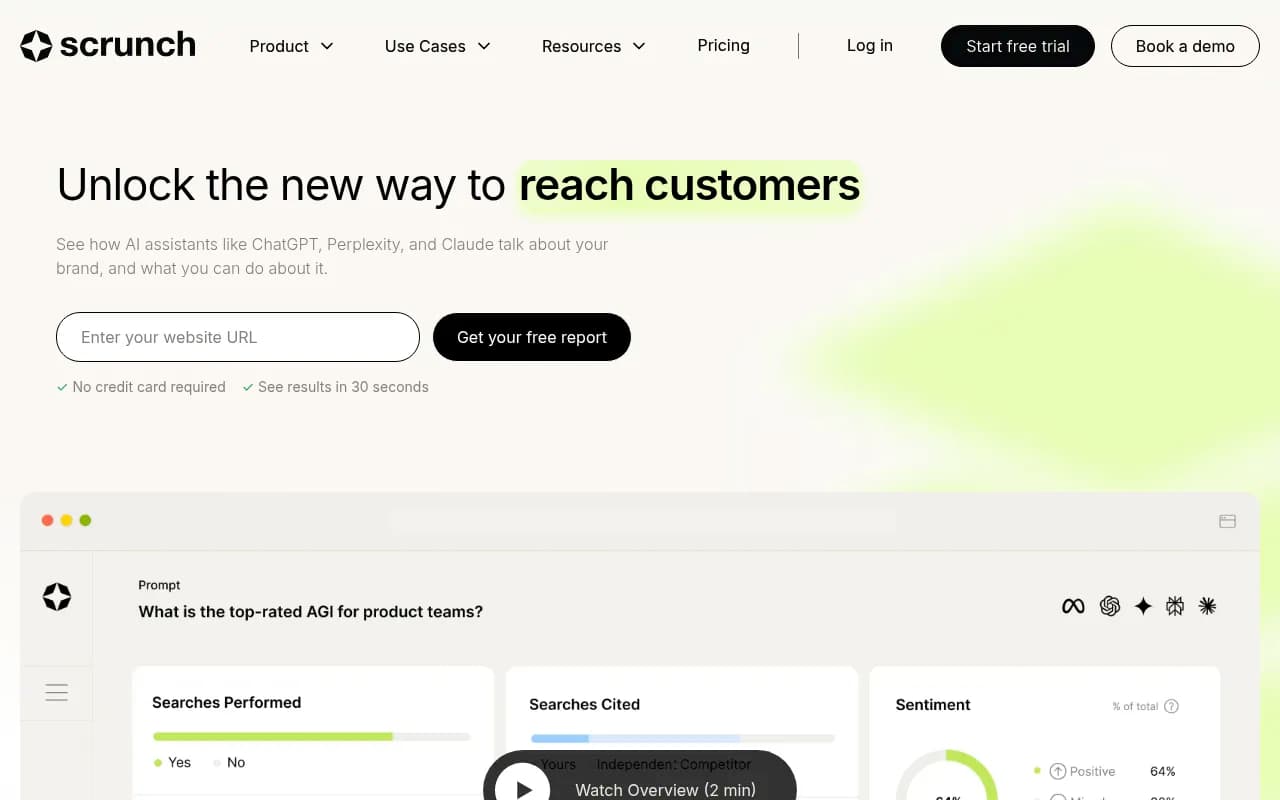
For a test about prompts, the part that matters is the answer-tracking side. You can still note the site audit output as a secondary finding.
Step 1: check what each trial allows
Pricing changed, and the third-party comparisons are stale. GetMint's January 2026 piece quotes Scrunch at $100 and $500 tiers, and the $99 and $399 Profound tiers appear in older roundups. Neither set appears on the vendors' current pricing pages. Here is what the pages list today.
| Profound | Scrunch | |
|---|---|---|
| Entry route | Free Trial (brands), or Custom Enterprise | Core at $250/mo with 7-day free trial |
| Prompts | 50 unique prompts, run daily for 7 days | 125 unique prompts, 5,000 responses a month |
| Engines | ChatGPT, Gemini, Google AI Overviews | ChatGPT, Perplexity, Google AIO, Copilot |
| Regions and languages | 1 region, 1 language | 1 country, 1 persona, 1 language |
| Custom prompts | No, trial uses a recommended set by industry | Yes |
| Export | None on trial | Not listed on Core |
| Fan-out | Not specified | Limited |
| Seats | Unlimited | 5 licenses |
Three consequences follow.
- A 50-prompt test fits inside both trials, so you don't need to pay anything.
- Profound's trial doesn't let you customize prompts. You get a recommended set based on your industry. Your "same 50 prompts" plan only works exactly if you can add your own, so check inside the trial what you can edit. If you can't, see the workaround below.
- The shared engines are ChatGPT and Google AI Overviews. Profound adds Gemini, and Scrunch adds Perplexity and Copilot. Those extras can't be compared head to head.
A caveat from my research: I couldn't find neutral documentation on exporting per-prompt results from either tool. Plan on screenshots or manual copying for anything the UI won't export.
Step 2: build the 50-prompt set
You want a set that reflects how real people ask, not a list of keywords. A reasonable split for 50 prompts:
| Prompt type | Count | Example pattern |
|---|---|---|
| Category discovery | 10 | "what is the best [category] for [use case]" |
| Comparison | 10 | "how does [your brand] compare to [competitor]" |
| Alternatives | 8 | "best alternatives to [competitor] for [segment]" |
| Pricing and buying | 7 | "how much does [category] cost for a small team" |
| How-to and problem | 8 | "how do I [task your product solves]" |
| Brand-specific | 7 | "is [your brand] worth it", "[your brand] reviews" |
This mix matters because of how ChatGPT searches. Promptwatch Data on ChatGPT query fanouts shows ChatGPT averaging about 2.15 web searches per prompt in early December 2025, falling to about 1.84 by early March 2026, with query length shrinking over the same period. Your content has to match one of the generated sub-queries, not only the prompt a user typed. Including comparison, pricing, alternatives and how-to variants gives both tools a chance to surface different parts of that fan-out.
Rules for writing the prompts
- Write each prompt the way a buyer would type it. Skip keyword fragments.
- Cover the same funnel stages. Scrunch tags funnel stages, and the ContentMonk sample shows Profound-style tables tagging TOFU and BOFU too, so tag your own set to match.
- Name your top 3 to 5 competitors consistently. Both tools let you track competitors, and Scrunch Core caps you at 5.
- Freeze the list in a spreadsheet with a column for prompt, type, funnel stage and intended engine. Don't edit it mid-test.
The workaround if Profound's trial won't take custom prompts
Profound's trial gives you a recommended set by industry. Two honest options:
- Ask Profound's sales team whether a trial or demo workspace can load your list. This works best if you're a serious buyer.
- Reverse the direction. Take whatever 50 prompts Profound generates for your industry and load those exact strings into Scrunch Core's trial, where custom prompts are allowed. Then you're running Profound's 50 on both.
Option 2 needs no negotiation, though your set won't reflect your own priorities. Note this in your write-up so nobody over-reads the result.
Step 3: lock the variables
Any difference you can't explain will end up blamed on the tool. Fix these before the first run.
- Region: pick one country on both. Both trials restrict you to one anyway.
- Language: one language, same on both.
- Brand and competitor list: identical, including aliases. If one tool counts "Acme" and "Acme Inc." as one brand and the other doesn't, your mention rates will diverge for a dull reason.
- Start date: begin both trials on the same day so the 7-day windows match.
- Engines: ChatGPT and AI Overviews are your head-to-head pair. Record the others separately.
- Persona: Scrunch Core allows one. Set it to a neutral buyer profile and leave it.
Step 4: run the test for the full week
Set both tools to run daily. Profound's trial runs prompts daily for 7 days. For Scrunch, I didn't verify how often each prompt runs, and its quota is 5,000 responses a month. Do the arithmetic before you rely on it: 50 prompts across 4 engines at one run per day for 7 days is 1,400 responses, which fits easily. Daily runs for a month would be about 6,000, which would not. Check the dashboard counter after day one.
Don't change your site during the week. If you publish a new page mid-test and visibility moves, you won't know whether the tool or your content caused it.
Step 5: build a scoring sheet
Pull the same fields from both tools for each prompt and engine. Use a table like this one.
| Field | Tool A value | Tool B value | Match? |
|---|---|---|---|
| Brand mentioned (yes/no) | |||
| Position in answer | |||
| Sentiment label | |||
| Competitors named | |||
| Your domain cited | |||
| Top cited domains |
The sample prompt table on ContentMonk shows the sort of columns these dashboards produce: visibility, sentiment, position, mentions and brand citation rate per prompt. Expect each vendor to define "visibility" differently, so don't compare raw visibility percentages. Compare the plain facts, such as mentioned or not, and which domains appeared.
Citation counts differ by engine
Account for the engine before judging either tool. Promptwatch's average sources per response data, dated September 2025, found ChatGPT citing about 5 sources per web-search answer and Google AI Overviews about 10. Perplexity sat near 10 daily, and Copilot swung from under 2 to nearly 17 before settling low. If one tool reports 5 citations for ChatGPT and 10 for AI Overviews, that is normal. If it reports 10 for ChatGPT, ask why. If you use Copilot at all, judge it on monthly trends, not a weekly snapshot.
Step 6: score the tools on five questions
After day seven, answer these for each tool.
- Agreement: on the shared engines, how often do both tools say the same thing about whether you were mentioned? Below roughly 70% agreement on a binary mention, look for a definitional cause, such as aliases or how each handles partial brand names.
- Stability: did a given prompt flip between mentioned and not across days? Some flipping is normal in AI answers. A tool that never flips may be smoothing data.
- Ground truth: pick 10 prompts and run them by hand in ChatGPT and Google. Does the tool's record match what you see? Differences between UI and API outputs are a known issue, so ask each vendor which one it uses. Profound's comparison says it queries the front end. ContentMonk describes Scrunch as using browser automation plus official platform APIs.
- Actionability: does the output tell you which page to fix or which source to chase? Scrunch's per-page site checks and Profound's citation and agent analytics are different answers to this question.
- Friction: setup time, quality of support, and whether you hit limits like the missing export.
A tool-by-tool read of the results
What typically separates the two once the data is in:
| Dimension | Profound | Scrunch |
|---|---|---|
| Strongest on | Answer measurement, prompt demand data, up to 9 engines on Enterprise | Site audits, bot analytics, AI-readiness fixes |
| Weak spot in a trial | No custom prompts, no export, no history | Fewer engines on Core, limited fan-out |
| Buying path | Sales-led Enterprise | Self-serve Core, Enterprise custom |
| Ownership | Independent | Part of Sitecore since June 2026 (verify) |
If your team already runs Sitecore, Scrunch's roadmap is a feature. If not, weigh how much of it will be built for Sitecore customers.
Add a third column
A two-tool test can tell you which of the two is closer to reality, but not whether either is the right category of tool. Consider running a third tracker on the same 50 prompts as a tiebreaker. Promptwatch tracks the real interfaces of ChatGPT, Google AI Overviews, Gemini, Perplexity and others, and also adds crawler logs and content gap analysis, which tells you what to do about the gaps the test finds.

Other options in the same category include Peec AI and Otterly.AI, which are lighter prompt trackers.

Otterly.AI

For a wider shortlist, the GEO software directory at bestgeosoftware.com lists dozens of options by category.
Common mistakes
- Editing prompts halfway. Every change breaks the comparison.
- Comparing visibility percentages. They're proprietary formulas.
- Reading one day of data. Look at the seven-day pattern.
- Trusting vendor comparison pages. Even this guide's sources are written by companies with something to sell. Your own run beats them.
- Forgetting the acquisition. A tool's ownership affects its roadmap, and roadmap is part of what you buy.
Write up the result
Keep the final document short. Include the frozen prompt list, the variables you locked, the agreement rate on shared engines, the five-question scores and one paragraph on which tool you'd pay for and why. Send it to whoever signs off on budget with the raw spreadsheet attached.
If you'd rather hand the vendor evaluation to specialists, 1001 SEO Media runs AI visibility audits as part of its GEO work, and can set up the same test for you. Otherwise, the process above is enough to make a defensible pick in about a week.