Key takeaways
- A general assistant like ChatGPT, Claude or Google AI Pro costs about $20 a month and covers most small business writing on its own.
- Rytr at $9 a month is the cheapest dedicated writer, but it is built for short copy, not long articles.
- Writesonic (now about $79 a month on annual billing) and Jasper Pro ($59 to $69) no longer fit under $50, so older roundups are out of date.
- Copy.ai prices conflict across sources, from $15 to $36 a month. Check the vendor page before paying.
- Watch billing terms. Annual plans are charged upfront and some trials auto-charge.
What you actually need from an AI writer
Most small business owners don't need thirty features. They need a handful of things written well: a blog post now and then, product descriptions, a few emails a week, social captions, and the occasional awkward customer reply. That's it.
So the useful question isn't "which tool has the most templates." It's "which tool removes the hour I personally can't afford to spend." One of the sources I read, a Storyflow article from September 2026, frames it the same way: buy AI where the owner is the bottleneck, and nowhere else. Storyflow sells its own product and ranks it tenth in its own list, so take the framing with some salt, but the principle holds up.
A warning before the list. Much of the "best AI tools under $50" content online is written by vendors or affiliates. Claims like "60 to 80% time saved" or "20 to 40% email ROI" show up in listicles with no source behind them. I've stuck to prices I could trace and flagged the ones that conflict.
Quick comparison
| Tool | Typical price | Free plan | Best for | Under $50? |
|---|---|---|---|---|
| ChatGPT | Free / $20 mo Plus | Yes | Everything: replies, posts, drafts | Yes |
| Claude | Free / $20 mo Pro | Yes | Long-form writing and editing | Yes |
| Rytr | $9 mo Unlimited, $29 mo Premium | Yes (10,000 characters) | Short copy, product descriptions | Yes |
| Copy.ai | $29 mo Chat (conflicting reports) | Unclear | Quick marketing copy | Yes, verify first |
| Writesonic | From about $79 mo annual | 7-day trial | Brand tracking plus articles | No |
| Jasper | $59 to $69 mo | 7-day trial (auto-charged) | Brand voice, agents | No |
Prices come from vendor pages and third-party roundups published in 2026. They move often, so confirm on the vendor site before you pay.
The general-purpose assistants: the real default
Honestly, most small businesses should start here. ChatGPT Plus is $20 a month. Claude Pro is $20 on monthly billing. Google AI Pro is $19.99. Any one of them handles drafting, rewriting and summarizing from day one, and you also get research help, spreadsheet analysis and brainstorming in the same window.
ChatGPT
ChatGPT is the safest pick if you only want one subscription. The free tier is enough to test whether AI helps you at all, and Storyflow's minimum $0 stack leans on it. At $20 you get the stronger models and more usage.
Claude
One roundup from Easy Design Solutions called Claude the strongest of the general tools for writing. I'd agree it tends to produce calmer, less salesy prose, which matters when you're writing in your own voice. It's a good fit for blog posts, long emails and rewriting your rough notes.
The catch with both: they start from a blank page. You have to tell them about your business, your tone and your audience every time, or set up reusable instructions. That's the gap dedicated writing tools try to fill.
Dedicated AI writers that fit the budget
Rytr
Rytr is the cheapest dedicated option. The free plan gives you 10,000 characters a month. Unlimited is $9 a month ($7.50 billed yearly), and Premium is $29 ($24.16 yearly) with multi-language writing and 100 plagiarism checks a month. Refunds are case by case, so don't assume you can bail out.
AI Creator Picks calls the $9 plan "the clear budget pick" but notes it lacks sophisticated long-form output. That matches how it works: you give a short brief and get product descriptions, ad copy or a blog section back. Longer pieces work best assembled section by section with your own editing on top.
Good for: a shop owner writing 40 product descriptions, or a local business needing ad variations. Not great for: a 2,000-word guide you want to publish untouched.
Copy.ai
Copy.ai is where the pricing data gets messy. One comparison lists Copy.ai Chat at $29 a month, or $24 billed yearly ($288 upfront), with refunds within 5 days of first purchase. theStacc lists it at $15 with a 2,000-word free tier. A Reddit thread says $36. The enterprise Growth plan is reportedly $1,000 a month, and the old Pro plan was $49 for five users.
I can't tell you which number is right today. Every figure sits under $50 except the enterprise tier, but check copy.ai directly before you commit. LaunchKit AI describes it as an easy platform built for quick content generation, which is a fair summary.

Writesonic and Jasper: no longer budget tools
These two keep showing up in "under $50" lists, and they shouldn't.
Writesonic rebuilt its plans around tracking brands in AI search. Its cheapest plan went from Lite at $49 a month in October 2025 to Starter at $99 a month ($79 billed yearly), with 3 AI platforms tracked and 15 AI articles. Even AI Creator Picks had to update its own list in July 2026 after Writesonic retired its $16 plan. Any review quoting $16 is stale.
Jasper Pro is $69 a month, or $59 billed yearly, for one seat with brand voices and marketing agents. The 7-day trial is charged automatically and there's no refund on cancellation. That's a trap for anyone who forgets to cancel.
Both are capable products. They're just aimed at teams with real marketing budgets now.

Supporting tools worth the money
Writing is rarely the whole job. You also have to edit, design and publish. These add-ons are cheap and fill real gaps. Prices are from theStacc's roundup, updated July 2026.
| Tool | Price | What it does |
|---|---|---|
| Grammarly Premium | $12 mo | Grammar and tone checking |
| Canva Pro | $15 mo | Design and social graphics |
| Notion AI | $10 mo | Notes and drafting inside docs |
| Buffer | $6 per channel, free for 3 channels | Social scheduling |
| Brevo | From $9 mo, free plan | Email marketing |
| HubSpot | Free CRM | Contact management |

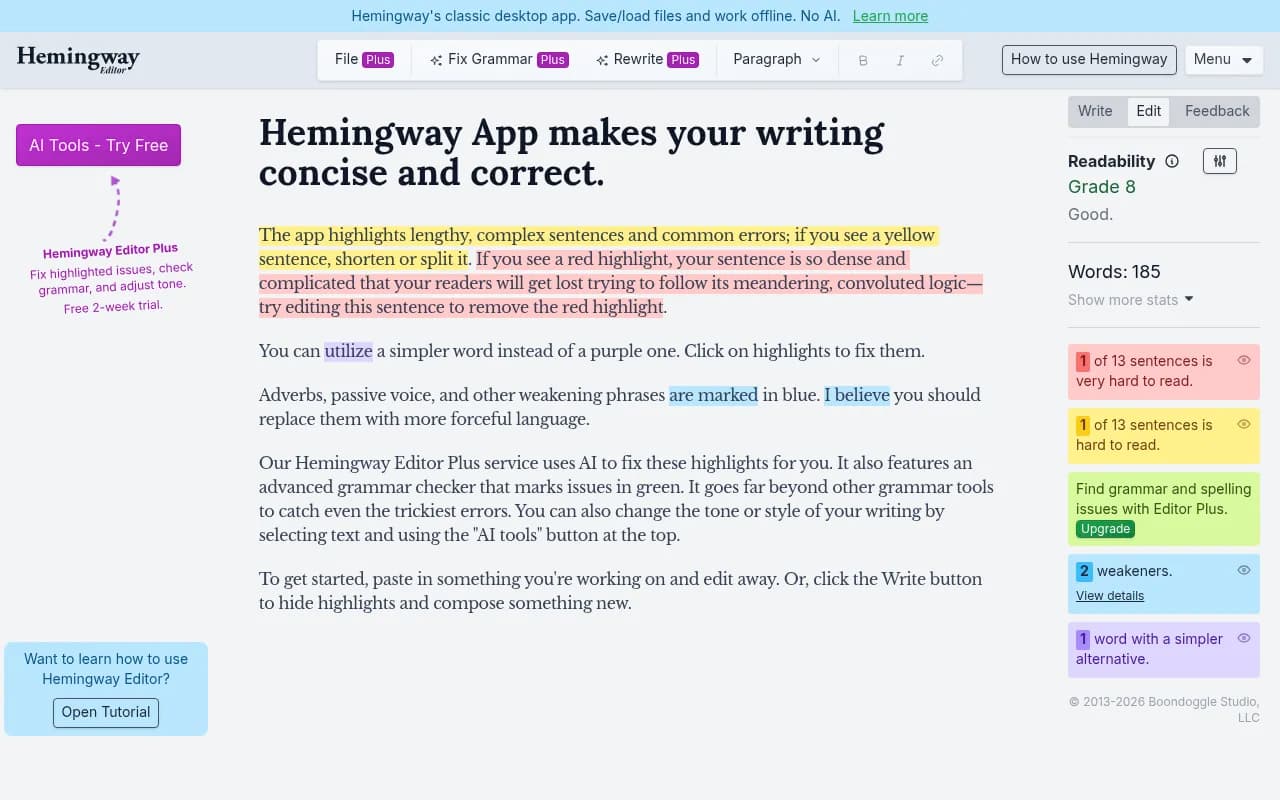
For a free or near-free editing pass, the Hemingway Editor is worth knowing about too, and it's a good second pair of eyes on anything an AI wrote.
Three stacks that stay under $50
Here are combinations I'd actually consider, built from the prices above.
| Stack | Tools | Monthly cost |
|---|---|---|
| Minimum that works | ChatGPT free, Google Business Profile, Buffer free plan | $0 |
| Cheapest paid | ChatGPT Plus plus Canva Pro | about $35 |
| Content-heavy shop | ChatGPT Plus ($20), Canva Pro ($15), Buffer one channel ($6), Brevo free | about $41 |
| Short-copy specialist | Rytr Unlimited ($9), Grammarly ($12), Canva Pro ($15) | about $36 |
The $41 stack comes straight from theStacc's sample and the $35 stack matches Storyflow's cheapest paid recommendation. Both leave headroom under $50.
Pitfalls that make "under $50" a lie
This is the part most roundups skip.
- Annual billing hides the real price. A $24 a month plan billed yearly means $288 charged on day one. If you want to stay flexible, price the monthly option.
- Trials can auto-charge. Jasper's does, with no refund on cancel. Put a calendar reminder in the day you sign up.
- Refund policies vary a lot. Copy.ai offers 5 days, Rytr decides case by case.
- Per-seat pricing adds up. Most of these plans are for one user.
- Many "AI marketing tools" are wrappers around ChatGPT. theStacc makes this point itself. If a tool charges $40 for what a $20 assistant does with a good prompt, skip it.
- Word and character limits can bite. Rytr's free tier of 10,000 characters is only a few short posts.
Treat statistics in these roundups cautiously too. The claim that 81% of small businesses plan to use AI marketing tools by the end of 2026, or that micro-businesses spend $3,800 a year on average, comes from theStacc's own figures with no independent source.
How to choose
Pick by the job, not the brand.
- If you write a bit of everything, start with ChatGPT or Claude at $20. Spend a month on it before buying anything else.
- If you mostly need short, repeatable copy like product descriptions or ad variants, Rytr at $9 is hard to beat on price.
- If you want templates and a guided interface rather than a chat box, test Copy.ai after confirming its current price.
- If you publish on social, add Buffer and Canva before you add a second writer.
- If you need SEO-focused long-form with keyword guidance, you'll probably outgrow these tools. Look at the broader catalog at surferstack.com, where optimizers like Frase and NeuronWriter are listed, though several cost more once you scale up.
A practical test: write the same three things with each tool you're considering. A customer email, a product description and a 300-word blog intro. Read them out loud. The one you edit least wins.
One more thing: getting found in AI answers
Writing content is half the job. The other half is whether ChatGPT, Perplexity or Google's AI Overviews ever mention your business. That's a separate problem from drafting, and an AI writer won't solve it. If it becomes relevant to you, tools like Promptwatch can show how your brand appears in AI answers and which content gaps to fill. It's priced above this guide's budget (paid plans start at $95 a month), so it's a later-stage consideration, and the free tools on its site are a reasonable first look.

For now, the sensible path is simple. Pick one $20 assistant, add a $9 short-copy writer only if you need it, and keep your total under $50. Check every price on the vendor's own page the day you sign up, because 2026 has already shown how quickly those numbers change.