Key takeaways
- A solo seller and a team with 2,000 SKUs need different tools. Writing quality matters less than bulk generation, data enrichment, store connections and brand rules once you pass a few dozen products.
- ChatGPT and Claude are the best flexible drafters. Jasper suits brand-heavy teams. Describely and Hypotenuse AI are built for catalog scale.
- Product pages are the most cited content type in ChatGPT (22.4% of classified citations, Sep 28 to Oct 4, 2026), so factual, spec-complete copy matters for AI search too.
- Give the model real inputs: features, materials, target buyer, banned claims. Feed it nothing and you get generic fluff.
- Always spot-check AI copy for invented specs. I did not find independent hallucination data, so treat accuracy as your job, not the tool's.
What makes an AI writer good for product descriptions
Most comparison articles test tools by pasting in a product name and scoring the prose. That is the wrong test. Writing quality is the easy part now. Almost every tool in 2026 produces readable sentences.
The hard part is workflow. Describely makes this point well in its own comparison (it is a vendor, so read it with that in mind): the real question is how to generate accurate, on-brand descriptions for 500 products without spending a month on it.
So here is what I would evaluate:
- Bulk generation. Can it process a whole catalog in one run, or one product at a time?
- Data handling. Does it use your spec sheet or feed, or does it improvise?
- Store connectivity. Can it publish back to Shopify or WooCommerce without copy-pasting?
- Brand consistency. Can you enforce tone, vocabulary and banned claims across every SKU?
- Keyword awareness. Does it respect Amazon character limits or search terms?
- Pricing model. Does cost scale sensibly with catalog size?
One framing I like from ustechautomations.com: ecommerce AI writing is feed-faithful, unique product and category copy, not a blog chatbot. Your descriptions should say only what your data supports.
Quick comparison table
| Tool | Best for | Bulk output | Store integrations | Pricing (verify before buying) |
|---|---|---|---|---|
| ChatGPT | Flexible drafting, custom GPTs | Manual / via API | None native | Free tier, paid plans |
| Claude | Natural-sounding prose | Manual | None native | Free tier, paid plans |
| Jasper | Brand voice, marketing teams | Limited | Via workflows | Pro $59/mo yearly, $69/mo monthly |
| Describely | Large catalogs | Yes, full catalog | Shopify, WooCommerce, Wix | $0.75 per product, pay as you go |
| Hypotenuse AI | Ecommerce content at scale | Yes | Varies | Check vendor |
| CopyMonkey | Amazon listings | Yes | Amazon-focused | Check vendor |
| Copy.ai | Short-form marketing copy | Yes | Limited | Check vendor |
| Writesonic | Web and blog content | Yes | Limited | Subscription, free tier |
| Rytr | Budget drafting | Limited | None | Around $29/mo unlimited (third-party figure) |
I could not verify current pricing for ChatGPT, Claude, CopyMonkey, Copy.ai, Writesonic or Rytr, so confirm on each vendor's site.
The best AI writers for product descriptions
ChatGPT
If I could keep only one tool, it would be this one. It writes bullets, long descriptions, meta titles, FAQ blocks and ad variants, and the free tier is usable. Custom GPTs are the underrated feature: build one loaded with your brand voice, banned claims and a few descriptions you like, then reuse it for every product.
The catch is scale. Pasting products in one at a time gets old around SKU 30. You can work around it with the API, a spreadsheet and an automation tool like Zapier, but that is DIY plumbing.
Claude
Claude gets repeated praise for natural-sounding prose, which helps when your category is lifestyle, fashion or home goods and the copy needs to read like a person wrote it. Paste in two descriptions you love and ask it to match rhythm and sentence length. The results are often noticeably less robotic.

Like ChatGPT, it is a general assistant. No catalog management, no store sync.
Jasper
Jasper is the pick for marketing teams that care about consistency. Pro is $59/month billed yearly or $69/month billed monthly, and includes 1 seat, 2 Brand Voices, 5 Knowledge assets and 3 Audiences. Business is custom-priced. You may still see a $49 Creator plan quoted on third-party sites, but it is not confirmed on Jasper's live pricing page, so ignore it.
Brand Voice learns from samples, which saves editing time. It is less suited to churning through thousands of SKUs cheaply, since bulk is limited by comparison with catalog-first tools.
Describely
Describely is built for catalog operations. You connect a store, enrich sparse product data, apply content rules, generate in bulk and publish back. Pricing is pay as you go: $0.75 per product, $0.55 per enrichment credit and $0.05 per image credit. The Shopify App Store listing shows unlimited generations at $0.75 per product, though with only 3 reviews it is thin evidence.
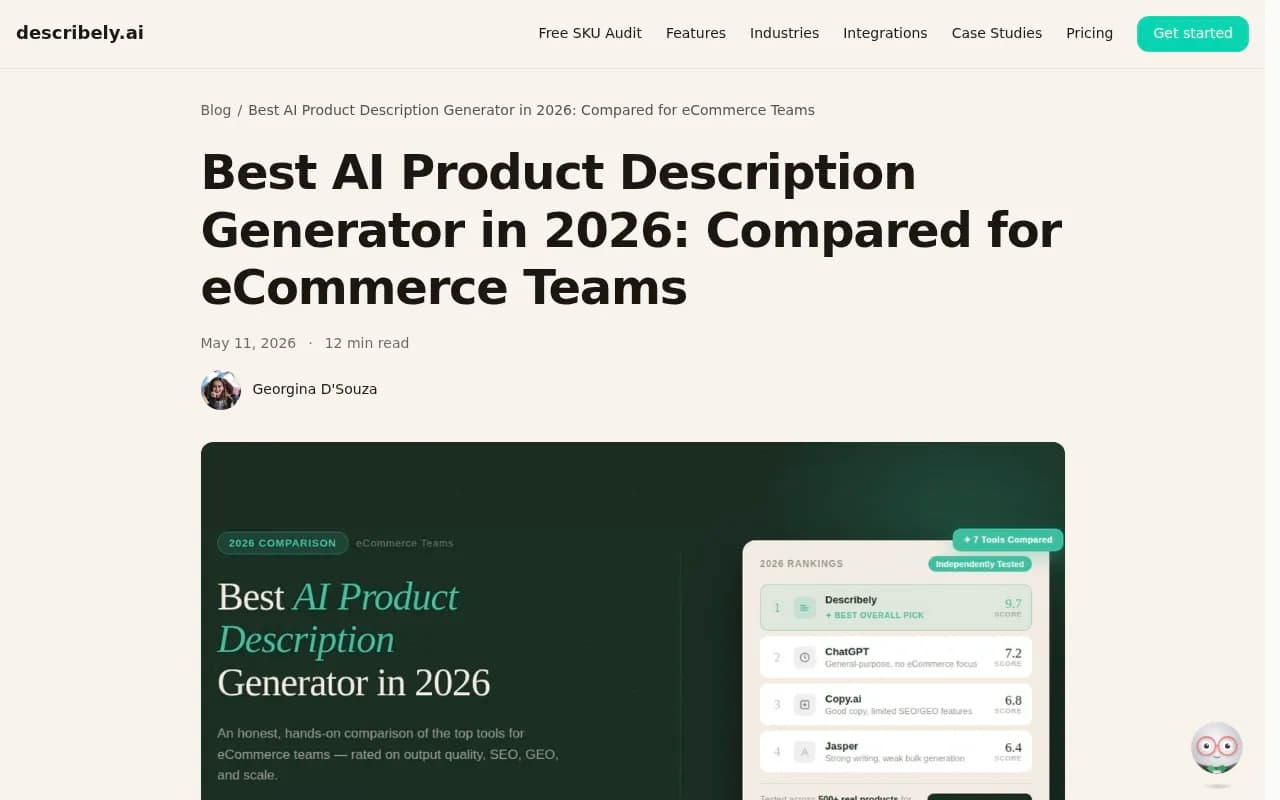
Describely claims Target Australia generates over 1,000 product descriptions a week at 98% first-pass accuracy. That is a vendor claim, not independent testing. Still, the data enrichment step (filling missing attributes before writing) addresses the real problem with supplier feeds, which are usually sparse.
Hypotenuse AI
Hypotenuse positions itself as a content engine built for ecommerce at scale. It sits in the same category as Describely: bulk generation with an ecommerce focus rather than a general chat window. If you are comparing catalog tools, put it on the shortlist next to Describely and test both with 20 of your messiest products.
CopyMonkey
CopyMonkey is purpose-built for Amazon sellers: titles, bullets and descriptions with search terms woven in, in bulk. Its own comparison ranks itself first, so discount that, but the Amazon focus is real. Generic writers do not respect Amazon's character limits and bullet structure by default.
Copy.ai, Writesonic and Rytr
These are the budget and generalist options. Copy.ai is fast for short-form marketing copy. Writesonic leans toward blog and web content. Rytr is a cheap, structured drafting tool (around $29/month unlimited, per a third-party source).


Any of them can handle a first draft. None of them solves the feed-accuracy or store-sync problem on its own.
Writer and Anyword
Writer is an enterprise platform with governance features, which matters if legal reviews your claims. One roundup flags it as slow for high-volume work. Anyword scores copy by predicted performance, but a score is not the same as uniqueness, so do not treat it as a duplicate-content check.
Shopify-specific apps
A third-party roundup lists several Shopify apps. Vendor prices were not verified, so check each listing:
- Profitonium: Basic $19/month (2,000 credits), Standard $49, Pro $249
- Youssify: $10, $25 and $35/month tiers, plus a free tier of 100 descriptions
- ShopGPT: free, $5, $25 and $100/month
- Descrii: a single $29/month plan for 900 descriptions
- SEO Autopilot: $129/month
These are cheap and convenient if you live inside Shopify. Test output quality on your own products before committing, since I found no independent comparisons.
Pick by situation
| Your situation | Start with |
|---|---|
| Under 50 products, tight budget | ChatGPT or Claude with a custom prompt |
| Strong brand voice, small marketing team | Jasper |
| 500+ SKUs, sparse supplier data | Describely or Hypotenuse AI |
| Amazon-first seller | CopyMonkey |
| Shopify store, minimal setup | A Shopify app, tested on 20 products first |
| Regulated claims, enterprise review | Writer |
A workflow that works
1. Build the brief before you write
Do not ask AI to "write a product description." Give it three to five real features, materials, dimensions, the target customer and a competitor link. One more thing from the ustechautomations approach: include banned claims. "Never say waterproof" is the kind of rule that prevents a returns problem.
2. Use a repeatable prompt
You are writing a product description for [brand].
Product: [name]
Specs: [paste exact specs]
Buyer: [who it is for]
Tone: [2-3 adjectives + example description]
Rules: use only the specs above. Do not invent materials,
certifications, or dimensions. No claims about [banned list].
Output: 1 short intro sentence, 4 bullets, 1 meta description
(under 155 characters).
3. Edit for polish
A grammar pass catches slips before copy goes live. This matters most for anything used in paid ads.

4. Add SEO on top
For category pages and longer content, an optimizer like Surfer or Frase helps check keyword coverage against what ranks.
5. Spot-check every batch
Pull 10% of generated descriptions and compare them to the spec sheet. I found no independent data on hallucination rates, so I would not trust any tool blindly. Duplicate content is a second risk: if every product in a category gets near-identical phrasing, differentiate with real attributes.
Why accuracy matters beyond your own site
AI assistants now quote product pages directly. In Promptwatch's data for Sep 28 to Oct 4, 2026, product pages were the most cited content type in ChatGPT at 22.4% of classified citations, with landing pages next at 16.8%. For commercial prompts, where people compare options before buying, product pages hit 26.0% and landing pages 20.6%.
That changes what good copy means. Persuasive adjectives are not enough. ChatGPT quotes specs, prices and positioning, so complete and factual beats clever. A few practical consequences:
- Put specs, dimensions, materials and price in plain text, not only in images.
- Make pages easy to compare: who the product is for, what it costs, what is included.
- Add FAQ sections. FAQ pages are 3.3% of ChatGPT citations overall and 4.8% for branded prompts.
- Refresh landing and product pages when details change. According to Promptwatch's content half-life data, landing pages and docs stay cited longest, while news loses half its pages within 36 days.
If you want to see whether your product pages are being cited and which prompts trigger them, tools like Promptwatch can track that, and it can also show what AI crawlers see on your site.

For more options in that category, the GEO software directory at bestgeosoftware.com lists alternatives.
Common mistakes
- Feeding the model nothing. Product name only produces filler. Spec-rich inputs produce usable copy.
- Publishing unreviewed bulk output. Speed is the point of AI, but one invented warranty claim costs more than the hour you saved.
- Choosing on price alone. $0.75 per product sounds cheap until you compare it to a $5 flat app on a 100-item catalog. Do the math for your actual volume.
- Ignoring existing data quality. If the supplier feed is wrong, the AI repeats it fluently.
- Writing the same template for everything. Customers and search engines both notice near-duplicate pages.
My recommendation
For most small stores, start with ChatGPT or Claude and a tight prompt, and spend your effort on the brief rather than shopping for a tool. Once you pass a few hundred SKUs, or your supplier data is thin, move to a catalog tool such as Describely or Hypotenuse AI, and run a 20-product trial with your worst data. Judge by how many descriptions you can publish unedited, not by how nice the best one sounds.
For broader software comparisons, browse the directory at surferstack.com.