Key takeaways
- Surfer SEO is still the benchmark for real-time, SERP-based content scoring while you write. Frase is stronger at the research-to-brief-to-draft pipeline. Scalenut bundles drafting and AI visibility tracking at a lower list price.
- Most of the "best of" lists on this topic are published by the vendors themselves. Scalenut's guide ranks Scalenut first, and RankUp's ranks RankUp first. Treat them as inputs, not verdicts.
- Every major tool now sells an AI visibility add-on or tier (GEO scores, prompt tracking). A classic content score tells you how you compare to Google's top ten, not whether ChatGPT will cite you.
- Budget $39 to $99 a month to start. Pricing below is list pricing from each vendor's page in October 2026, and Scalenut in particular discounts heavily, so check the live page.
- Whatever tool you pick, the draft still needs a human with an actual point of view. Scores measure coverage, not originality.
What "SEO scoring built in" actually means
The phrase covers three different jobs, and tools are good at one or two of them, rarely all three.
- Live scoring while you write. A sidebar compares your draft to top-ranking pages for a keyword: word count, headings, related terms, entities. Surfer SEO, Clearscope and NeuronWriter are built around this.
- Research and briefs before you write. The tool pulls the SERP, extracts headings and questions, and hands you an outline. Frase, MarketMuse and Content Harmony lean this way.
- A full chain from brief to AI draft to score. One tool does all of it. Frase, Scalenut and Outranking try to be this.
A framework from Rework's 2026 roundup maps neatly onto those three jobs, and I think it's the right way to shop. Don't ask "which tool is best". Ask which step of your process is slowest.
One honest caveat before the list. A content score is a proxy. It tells you that your draft covers terms the current top results cover. It does not tell you the piece is good, and it can push everyone toward the same average article. I've seen writers chase a 90 score and produce something that reads like a worse version of whatever already ranks. Use the number as a checklist, not a goal.
Quick comparison
| Tool | Strongest at | Starting price (list) | AI drafting | AI visibility tracking |
|---|---|---|---|---|
| Surfer SEO | Real-time Content Editor scoring | $49/mo (Discovery, annual) | Yes (Surfer AI) | Yes, tiered or $82/mo standalone |
| Frase | Research, briefs, drafts in one flow | $39/mo annual, $49 monthly | Yes | Yes, on every plan |
| Scalenut | Drafting plus GEO tracking at a lower price | $59/mo list | Yes | Yes, bundled |
| NeuronWriter | Cheaper SERP-based scoring | Check vendor | Yes | Limited |
| Clearscope | Editorial-grade term guidance | Check vendor | No | No |
| MarketMuse | Topic modeling and content strategy | Check vendor | Limited | No |
| Jasper | Brand voice at volume | Check vendor | Yes | No |
Pricing for NeuronWriter, Clearscope, MarketMuse and Jasper was not verified for this guide, so I've left those cells open rather than guess.
Surfer SEO: the scoring benchmark
Surfer built its reputation on the Content Editor. You type, and a score updates against the pages currently ranking for your keyword, covering word count, headings, keyword usage and related terms. Almost every competitor in this category gets compared to it.
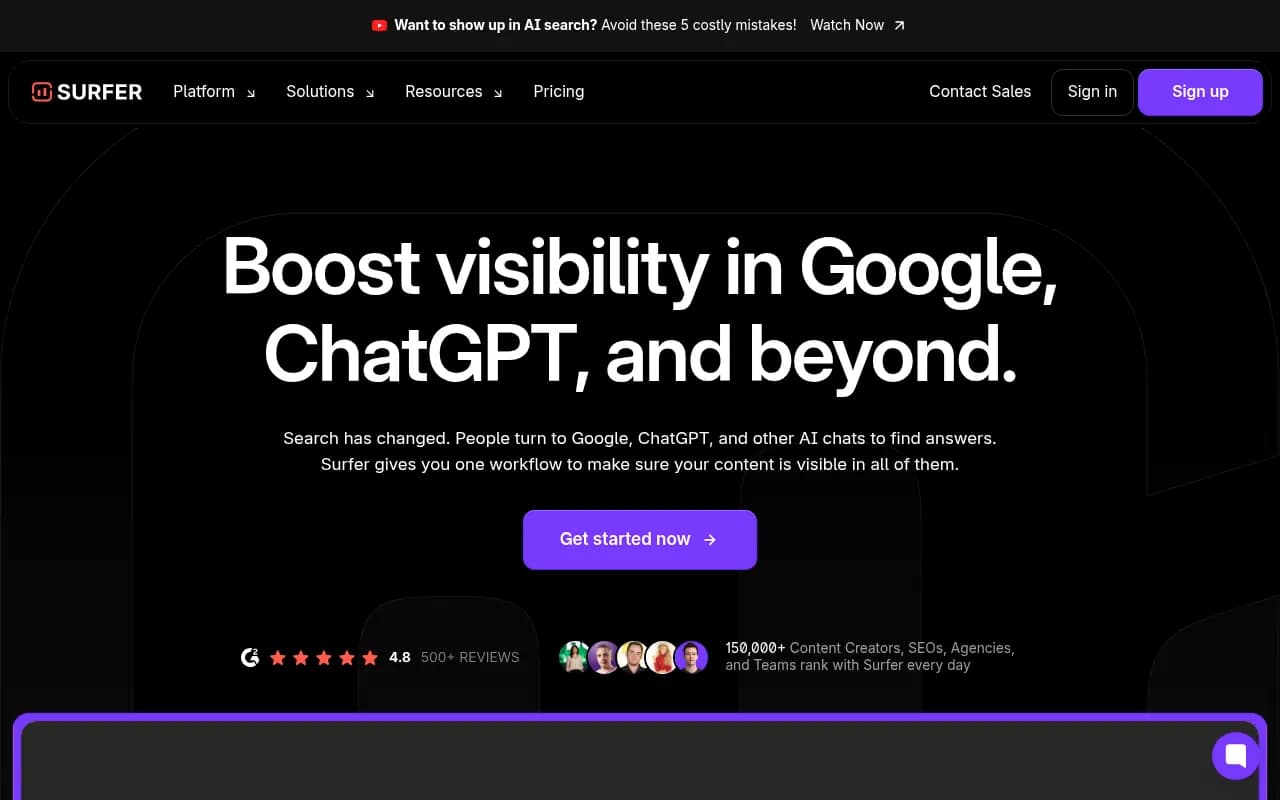
The 2026 pricing is built around AI search. From Surfer's pricing page (annual billing):
- Discovery, $49/mo: 120 documents created or optimized, 10 tracked pages, the Surfy assistant and a Humanizer.
- Standard, $99/mo: 360 documents, 25 AI prompts tracked weekly, plagiarism checker, rank drop detection, WordPress and Google Docs integrations.
- Pro, $182/mo: 50 prompts tracked daily, 1-click internal linking, Content Ideas and Coverage Gap, cannibalization report, custom-voice templates.
- Peace of Mind, $299/mo: unlimited documents, 100 prompts, API access, a dedicated success manager.
- A standalone AI Search Analytics plan runs $82/mo for 50 prompts daily across ChatGPT, Perplexity, Google AI Overviews and Gemini.
Where it shines: optimizing a draft that already exists. Where it doesn't: Surfer is not really a research or brief tool, so many teams pair it with Frase or their own editorial calendar. A Rework review also notes Surfer AI articles beyond plan limits cost extra per article.
Best for teams that already have a drafting process and want a hard, SERP-backed gate before publishing.
Frase: research, brief and draft in one flow
Frase now calls itself "the content operating system for AI search". The core job is still turning SERP research into a brief and then a draft, which it does quickly. Scalenut's own review of Frase (admittedly a competitor writing) cites a 4.8/5 G2 rating from 305 reviews and says briefs that take hours by hand take minutes. It also says the AI drafts are a starting point that needs real editing. That matches what I'd expect.
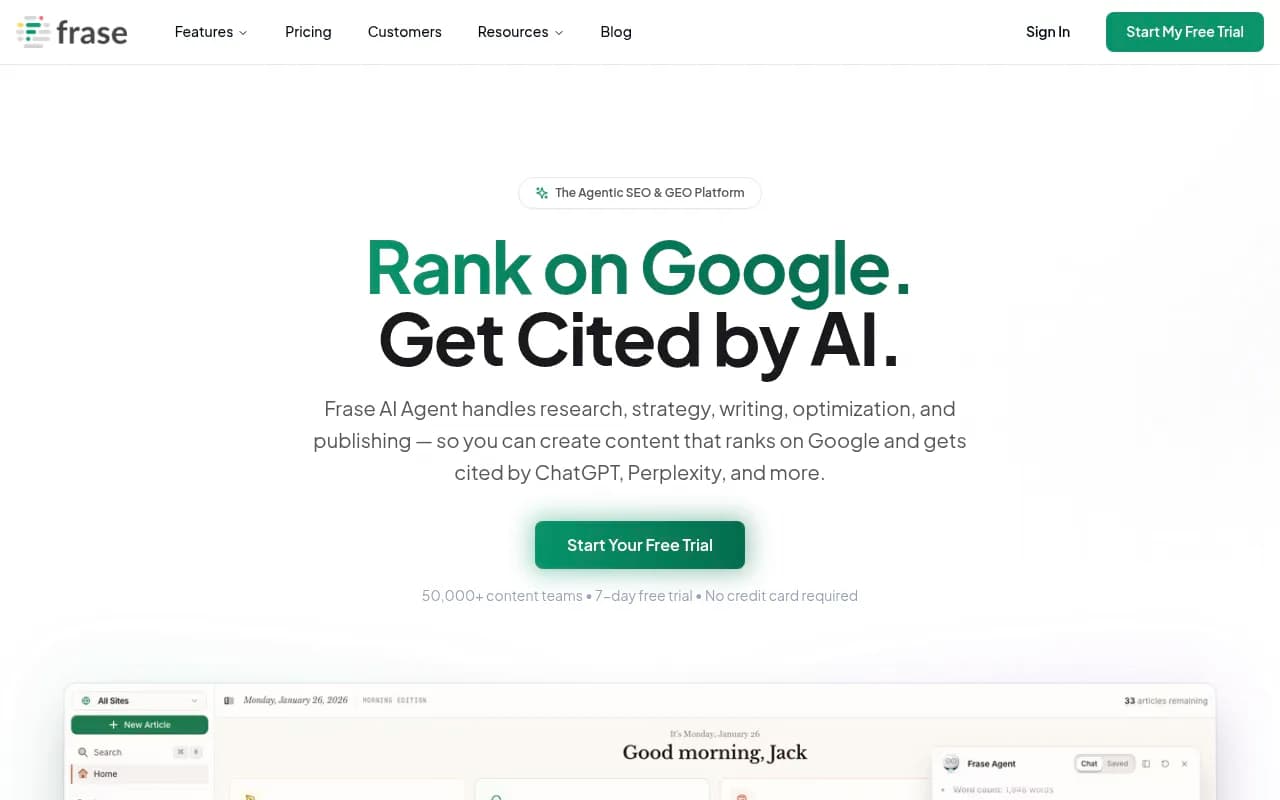
Current plans, from Frase's pricing page:
| Plan | Monthly (annual / month-to-month) | Articles per month | Notable inclusions |
|---|---|---|---|
| Starter | $39 / $49 | 10 | SEO and GEO scores, AI Visibility on ChatGPT and Google AI, Content Guard on 10 pages, publishes to WordPress, Webflow, Sanity, Wix |
| Professional | $103 / $129 | 40 | 3 seats, 5 sites, content calendar, internal linking, AI crawler monitoring, Perplexity tracking |
| Scale | $239 / $299 | 100 | 5 seats, up to 10 domains, Claude and Gemini tracking, client-ready reports |
| Enterprise | Custom | Custom | SSO/SAML, white-label reports, SLA |
There's a free 7-day trial with no card. Two features are worth noting. Content Guard watches pages for Google rank decay, rewrites them, and republishes after you approve. And an MCP server and CLI ship on every plan, which matters if your team works inside Claude or Cursor.
The Starter plan stops at its limits, so there are no surprise overage bills. That's a small thing that I appreciate.
Best for lean teams who want the research-to-draft handoff without copy-pasting between tools.
Scalenut: drafting plus AI visibility, bundled
Scalenut has repositioned around GEO and AI visibility. Its product pages are now GEO Action Center, AI Visibility, Social Upreach and a Backlinks Marketplace, on top of the writing and optimization modules it was known for.

List pricing from its pricing page:
- Starter: $59/mo list. Tracks 10 prompts weekly on ChatGPT and Google AI Overviews, 1 workspace.
- Plus: $89/mo list. 25 prompts, 2 workspaces, 4 team members, internal linking, topic gaps, unlimited tone of voice, auto-publish to WordPress and Shopify.
Scalenut was running a heavy early-access Black Friday promotion when I looked, with a 65%-off annual price near $21 a month for Starter. Promo prices are temporary, so budget against list. I couldn't confirm the older "Cruise Mode" branding on the current pricing page either, so ignore that if you see it in older reviews.
RankUp's critique is that research depth is shallower than dedicated tools and that the writing and SEO research modules live separately, so moving from a keyword report to a draft means switching contexts. It's a competitor's view, but it's a plausible weak spot for small teams who want one continuous flow.
Best for solo marketers and small teams who want drafting and AI visibility tracking at the lowest list price.
Other tools worth a look
NeuronWriter
It uses real SERP data for scoring and is usually positioned as the cheaper alternative to Surfer and Clearscope. Rework lists it as the budget pick for real SERP-based scoring.
Clearscope
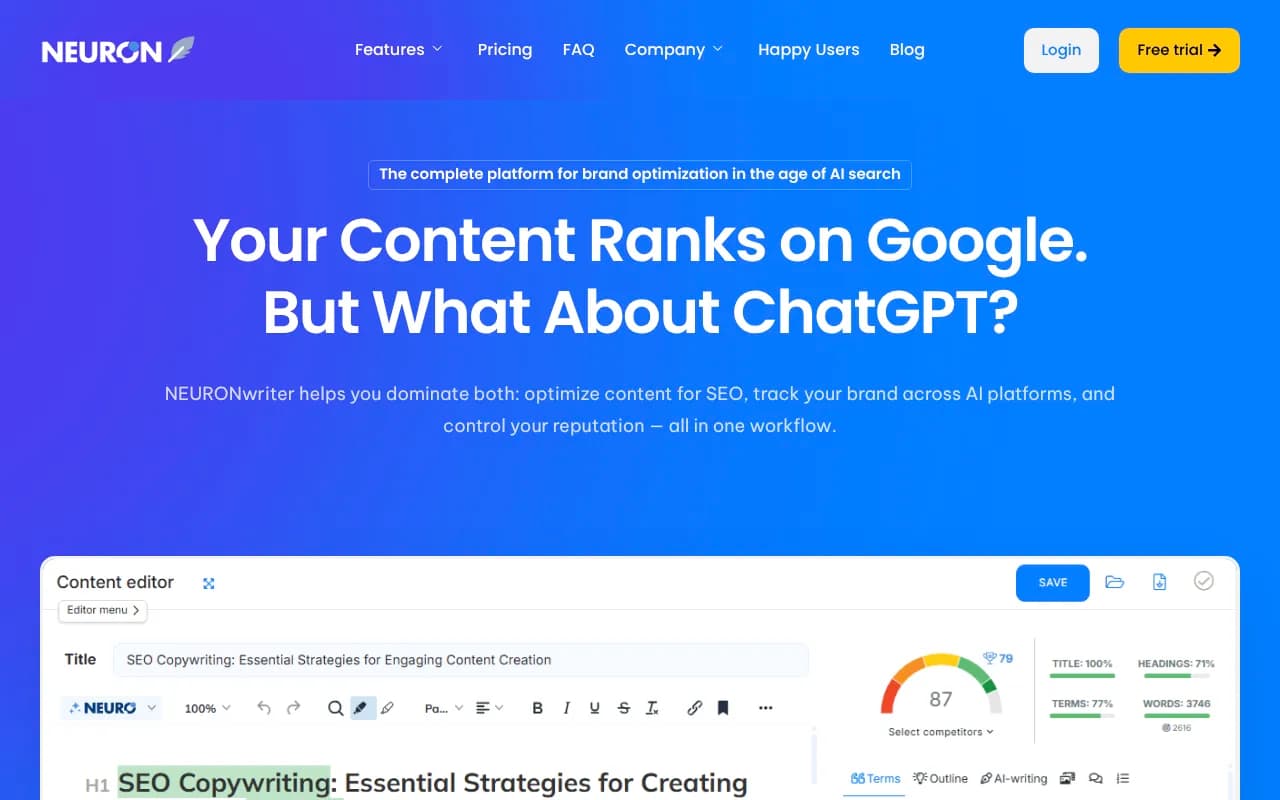
Clearscope is a content optimization platform that editors tend to like because it stays out of the way. It guides term coverage and doesn't try to write the article for you.

MarketMuse
MarketMuse is better for strategy than line-by-line scoring: topic modeling, content inventory, finding where you lack authority. Pair it with a drafting tool.
Jasper
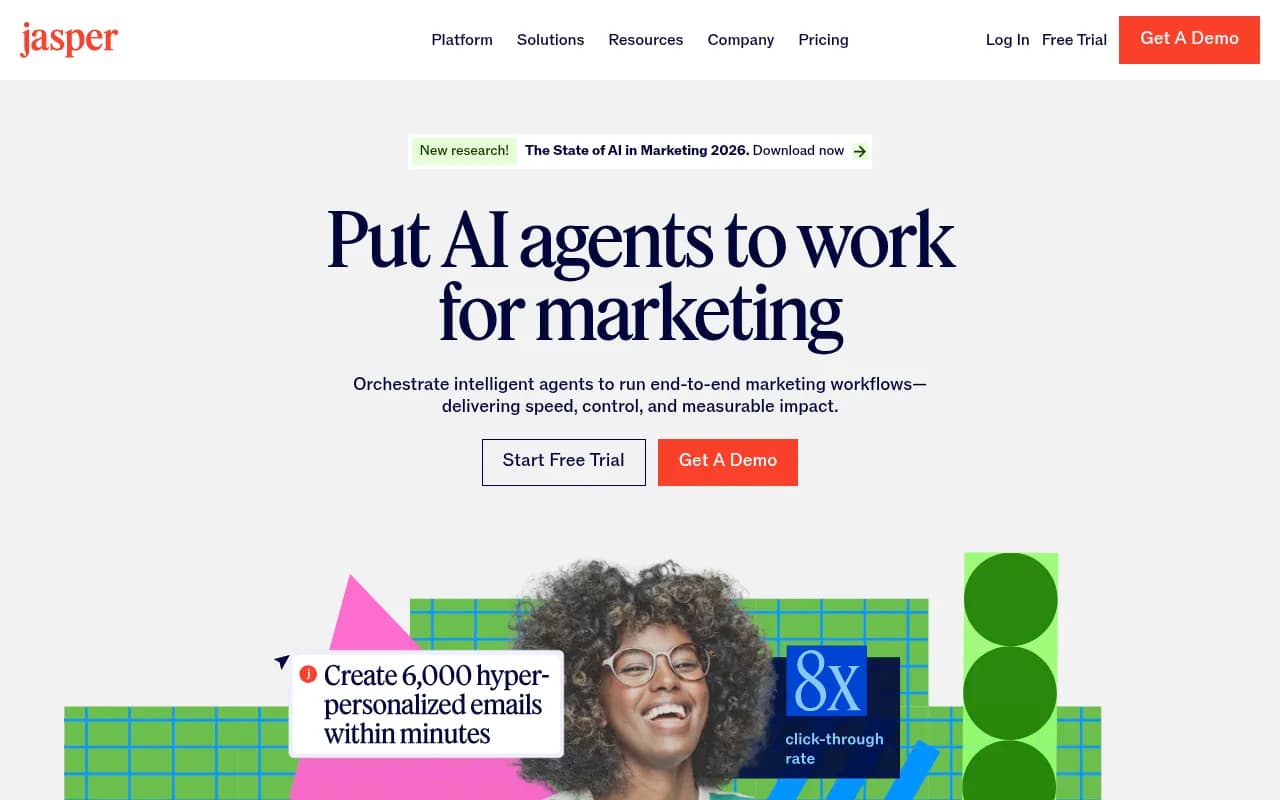
Jasper is the pick when brand voice at volume matters more than score precision. Rework notes a native Surfer integration, which is a sensible combination: Jasper for voice, Surfer for the gate.
Outranking and Writesonic
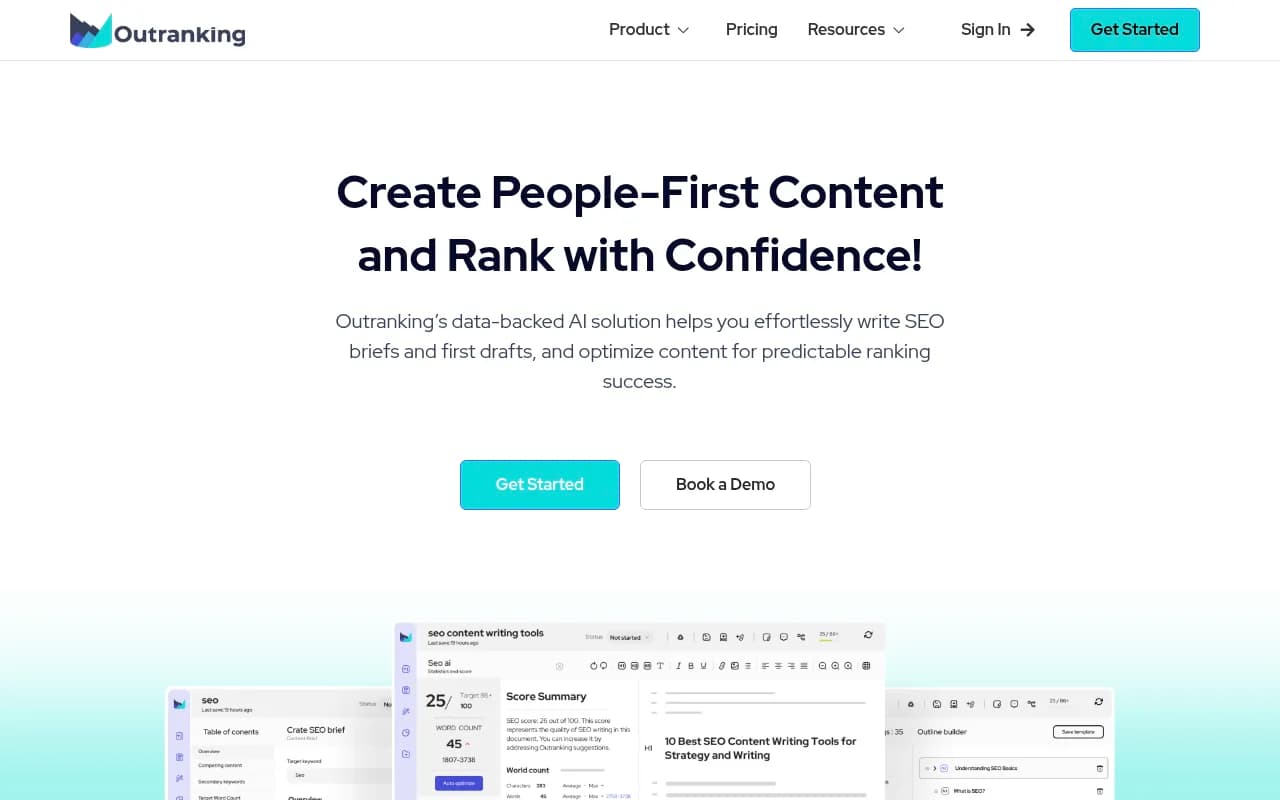
Outranking chains research, brief, draft and score in one tool, like Frase. Writesonic is a fast drafter across blogs, ads and landing pages, but expect human editing before you publish.

Semrush Writing Assistant
If you already pay for Semrush, its Writing Assistant gives real-time optimization against competitors inside the suite you have.
For a wider catalog, the software directory at surferstack.com lists many more AI writers and optimizers with reviews and alternatives.
Which one should you pick?
| If your situation is... | Pick | Why |
|---|---|---|
| You write in Google Docs and need a score before publishing | Surfer SEO | Best-known live scoring against real SERPs |
| Briefing is your bottleneck | Frase | Fast SERP research into brief into draft |
| One person, tight budget, want drafting and AI tracking | Scalenut | Lowest list entry price with GEO tracking bundled |
| You want SERP scoring but Surfer is too pricey | NeuronWriter | Cheaper, still real SERP data |
| You publish at volume and brand voice slips | Jasper plus a scorer | Voice controls, then score with Surfer |
| You're an editorial team that hates bloated tools | Clearscope | Clean term guidance, no AI drafting |
My own take: if I had to start from scratch with one subscription, I'd start with Frase for the workflow and add Surfer only when the team genuinely needs a stricter pre-publish gate. Paying for both from day one is usually duplicate spend. Many teams do end up there anyway, and that's fine once the volume justifies it.
Why a content score isn't enough anymore
Classic scoring was built around one question: how do I look next to the Google top ten? That's still worth asking. It just isn't the only question.
Promptwatch Data looked at which content types ChatGPT cited between September 28 and October 4, 2026. Product pages were 22.4% of citations and landing pages 16.8%, so about 39% of citations go to pages describing what a company sells. Listicles were 13.6%, how-to guides 8.7% and documentation 7.5%. For commercial prompts, product pages, landing pages, listicles and comparisons made up almost 70% of citations.
That has two practical consequences for anyone leaning on a content score:
- A blog post optimized to a score of 95 may be the wrong format for the prompt. If the prompt is commercial, ChatGPT is mostly citing product and landing pages, not blog posts.
- Freshness matters differently by type. In Promptwatch's content half-life data, news lost half its cited pages within 36 days, while landing pages and docs stayed cited for months. A time-sensitive article needs a refresh plan. A solid landing page doesn't.
This is why every vendor above has added GEO scores or AI prompt tracking. Frase includes AI Visibility on every plan, Surfer sells AI Tracker tiers, Scalenut bundles it. They're useful for a first look at whether you show up.
If AI visibility is a real goal rather than a side metric, a dedicated platform goes further than an add-on. Promptwatch tracks how brands appear across ChatGPT, Google AI Overviews, Perplexity, Gemini and others, shows which pages AI cites, and has a content agent that writes against the gaps it finds. Writers typically use it next to a scoring tool, not instead of one.

For more tools in that category, the GEO software directory at bestgeosoftware.com is a decent place to compare.
How to evaluate a tool in a week
Don't trust a demo. Run this test.
- Pick three keywords you actually need: one informational, one commercial, one where you already rank.
- Write or paste a draft for each into two tools and note where the scores disagree. Disagreement is the interesting part.
- Time the research and brief step. If a tool saves an hour per article, that pays for itself fast.
- Check what the "AI visibility" feature really shows: which models, how many prompts, how often it refreshes. Frase Starter and Scalenut Starter track ChatGPT and Google AI. Claude and Gemini tracking sits on Frase's top tier.
- Read the draft out loud. If it sounds like everything else on page one, the tool did its job and yours isn't done.
A note on sources
Most of the comparison content online comes from vendors. Scalenut's guide to AI content tools puts Scalenut first and claims it is the best AI tool for SEO-rich blog content. RankUp's Scalenut alternatives article puts RankUp first. Their feature descriptions are useful. Their rankings are marketing. Check pricing on the vendor pages, since list prices and promotions move around, and confirm anything that matters to you in a trial.

The short version
Pick the tool that fixes your slowest step. Surfer for a strict pre-publish score, Frase for the research-to-draft pipeline, Scalenut for the cheapest bundled option. Then accept that a score is a checklist. The content still has to say something the top ten don't, in a format AI systems actually cite."}