Key takeaways
- Frase is the broadest tool of the four: briefs, full AI drafts, CMS publishing and AI visibility tracking, starting at $39/mo billed yearly.
- Content Harmony is the best pure brief tool. It charges per workflow, has unlimited users, and has no AI drafting or AI visibility tracking.
- Dashword is the fastest route to a brief for agencies running many freelancers. Scoring is unlimited and free, reports are metered, and plans start at $99/mo.
- MarketMuse is the strategy pick. It has topic modeling, nine brief types on its top tier, and demo-only pricing.
- Brief quality now depends on the prompt intent you target. Promptwatch Data shows product pages, landing pages and listicles earn most ChatGPT citations, so match the brief format to the intent.
What a content brief tool actually has to do
A brief is a handoff document. A writer opens it and should know what to cover, in what order, for which reader, and what the page is supposed to accomplish. Most tools in this category get the first part right and stumble on the rest.
I judge them on five things:
- How much SERP research they automate (headings, questions, entities, word counts).
- How much control you keep over the outline.
- Whether the brief survives a handoff to a freelancer who never touches the tool.
- How pricing scales when you go from 10 briefs a month to 100.
- Whether the tool says anything about AI search, which now matters because your brief is increasingly written for a language model as well as for Google.
The four tools here sit at different points on those axes, so there is no single winner. There is a right pick for your situation, though.
Quick comparison
| Dashword | Content Harmony | Frase | MarketMuse | |
|---|---|---|---|---|
| Entry price | $99/mo (30 reports) | $50/mo (5 workflows) | $39/mo yearly, $49 monthly | Free tier, paid plans by demo |
| Pricing unit | Reports (scoring is free) | Content workflows | Articles per month | Briefs and tracked topics |
| Brief style | SERP outline builder, manual or AI | Customizable block editor, standardized | AI brief from SERP data | Topic-model briefs, up to 9 types |
| AI drafting | AI Writer (100k words on Startup) | Suggested headings and questions only | Full AI drafts | Limited |
| AI search tracking | Not available | None | ChatGPT, Google AI, more on higher tiers | Not a core feature |
| Users | 5 on Startup | Unlimited | 1 to 5 by plan | 1 to 5 by plan |
| Best for | Agencies with freelancers | Brief-centric editorial teams | Lean teams wanting brief to publish | Enterprise strategy |
Prices come from the vendors' pricing pages. Check them before you buy, because all four change plans often.
Frase: the all-in-one option
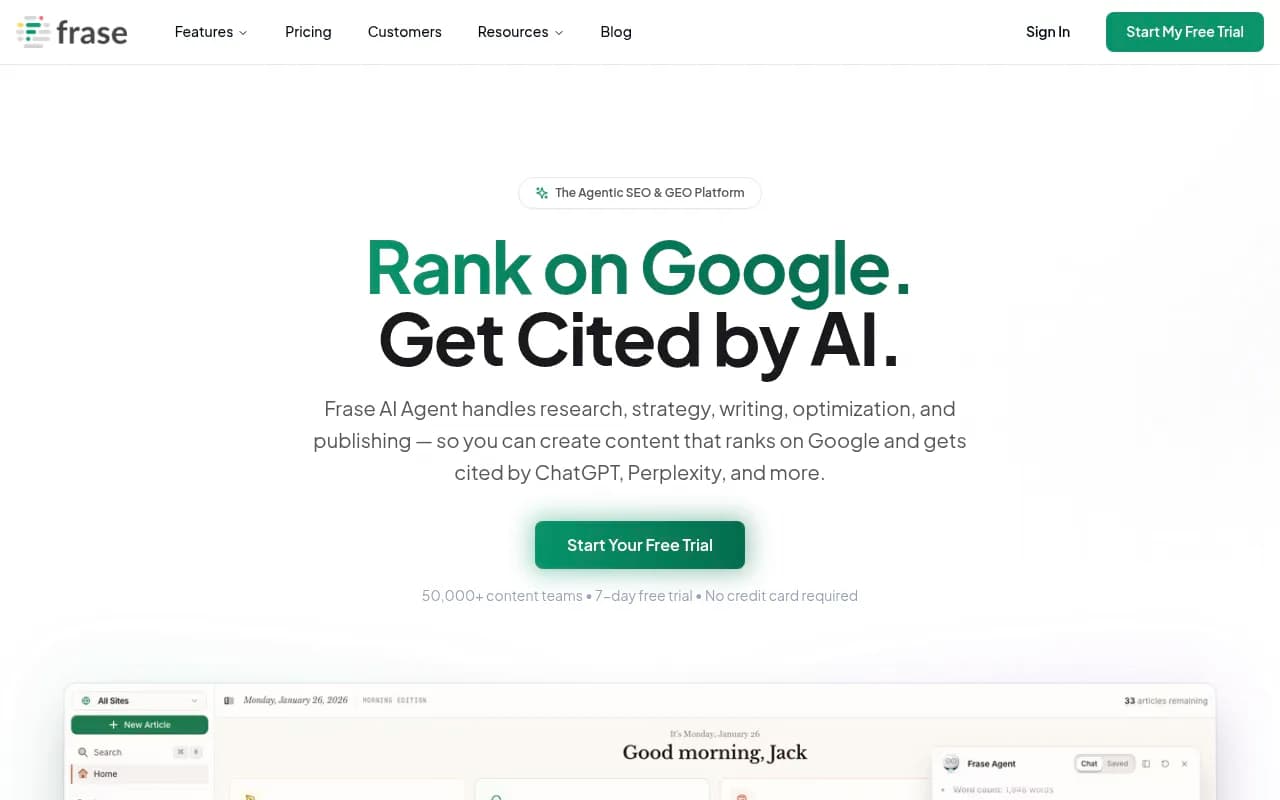
Frase has changed the most of the four. It started as a research and brief tool and now positions itself as a content operating system for AI search. It drafts full articles, can auto-publish to WordPress, Webflow, Sanity, Wix or its own hosted FraseCMS, and tracks visibility across AI platforms.
How the brief works
You enter a keyword and Frase pulls the top-ranking pages: headings, word counts, domain authority and the topics that appear most often. You can then take an AI-generated outline, or go manual and drag the competitor headings you want into your own structure. Question research pulls from People Also Ask boxes and related searches, which is where I have seen it surface subtopics I would not have thought of. One reviewer at One Little Web described a productivity software article growing from 1,200 to 2,100 words from the questions Frase found, which matches my experience with PAA-driven outlines.
Briefs can be saved as templates, which helps when you produce the same content type repeatedly (comparisons, how-tos, reviews).
Pricing
- Starter: $39/mo yearly or $49 monthly. 1 seat, 10 articles a month, SEO and GEO scores, AI Visibility on ChatGPT and Google AI.
- Professional: $103/mo yearly or $129 monthly. 3 seats, 40 articles, content calendar, internal linking, AI crawler monitoring.
- Scale: $239/mo yearly or $299 monthly. 5 seats, 100 articles, Claude and Gemini tracking, client reports.
- Enterprise: custom, with SSO and white-label reports.
Every plan has a 7-day free trial with no card. That alone makes it easy to test against the others.
Where it falls short
Breadth means less depth in any one area. If your editorial process depends on a heavily structured brief that several people sign off on, Frase's brief is a starting point rather than a finished handoff document. And I would treat the auto-publish feature with care. A brief tool that also writes and ships the article is convenient, but a human should still own the facts.
Content Harmony: the brief specialist
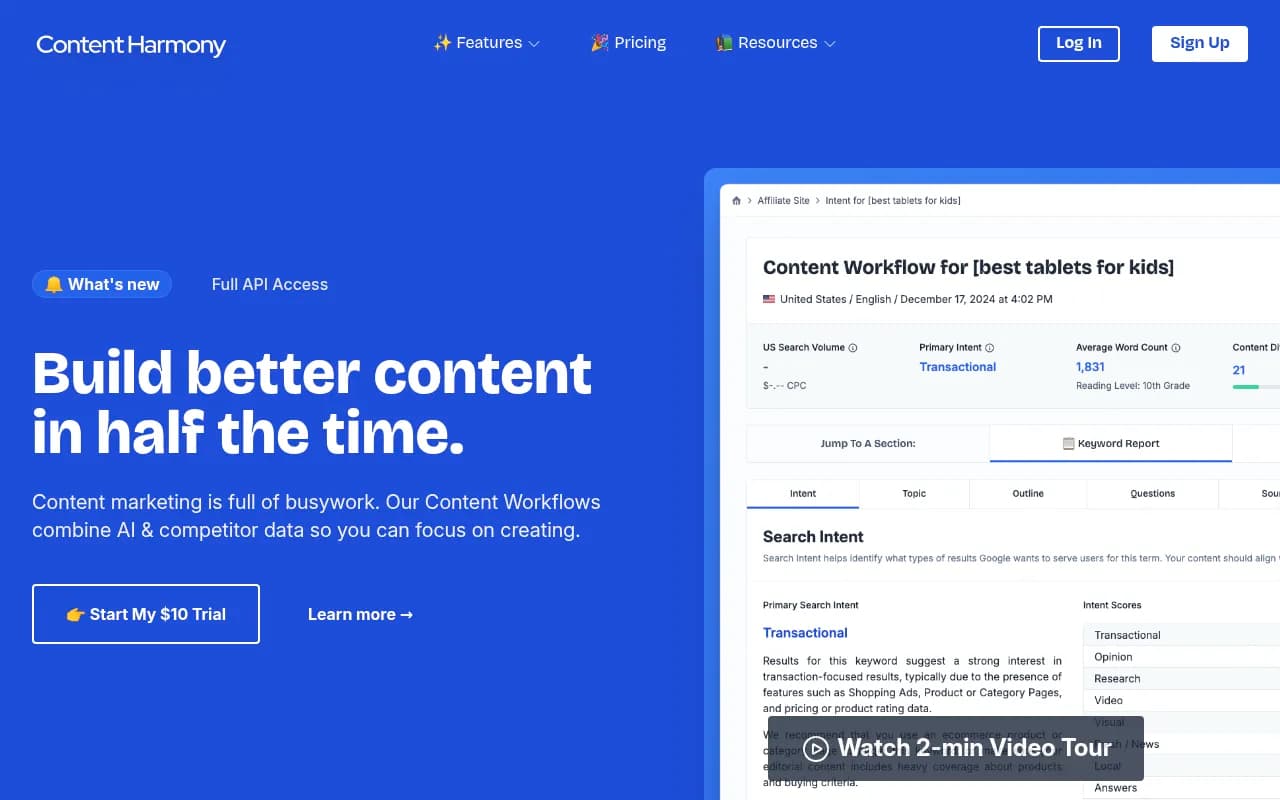
Content Harmony does one job and sticks to it. It bundles a Keyword Report, a Content Brief and a Content Grader into a single unit it calls a content workflow, and that is what you pay for.
What makes the brief good
The brief is a customizable block editor. It aggregates research into a standardized format: search intent, competitor headings, questions, sources, visual guidance and a writer-ready outline. It is built for strategists, editors, writers and clients to pass work between each other. If you have ever sent a freelancer a messy Google Doc of pasted SERP notes, you know why that matters.
The Content Grader checks the finished draft against the brief, so the loop closes without a separate scoring tool.
Pricing
It is the most transparent of the four:
| Plan | Monthly | Annual equivalent |
|---|---|---|
| 5 workflows | $50 | ~$42/mo |
| 12 workflows | $99 | ~$89/mo |
| 25 workflows | $199 | ~$179/mo |
| 50 workflows | $299 | ~$269/mo |
| 100 workflows | $599 | ~$539/mo |
| 150 workflows | $799 | ~$719/mo |
Enterprise starts at $1,000/mo for 200+ workflows. Every plan has unlimited users and projects, and team training is free. Credits last 90 days. The trial is $10 for 10 workflow credits, with no time limit and no auto-billing, which is a refreshingly honest way to try software.
Where it falls short
It does not auto-write full drafts and has no AI visibility tracking. If you want one tool to take you from keyword to published page, this is not it. It is a tool for teams where humans write and the brief is the product.
Dashword: fast briefs for agencies
Dashword is built around speed and simplicity. The pitch is that many teams work with freelancers who need a clear brief, and that producing one should take minutes.
How it works
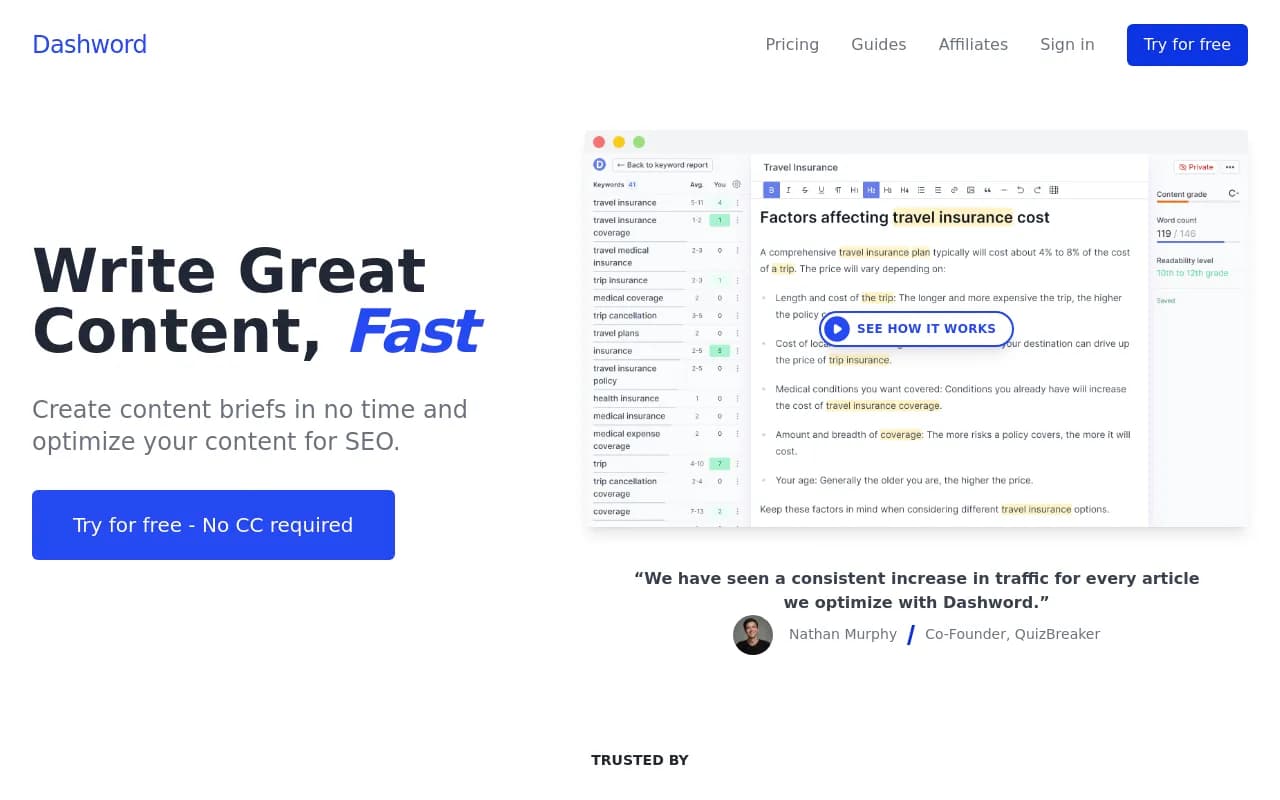
Analyze a keyword and Dashword pulls headings from the top results. You pick the ones you want or let AI assemble an outline. The brief includes keyword targets, a suggested structure and competitor insights. The editor then scores drafts in real time and recommends terms and word count. It also connects to Google Analytics so you can see how published content performs.
One Little Web's reviewer claims a brief takes 10 to 15 minutes against 45 to 60 minutes of manual SERP work. That is one reviewer's number and I would expect your mileage to vary, but the direction is believable. The manual control over which competitor headings to keep is the feature I like most. Fully automated outlines tend to read like an average of the top ten, and manual selection is how you avoid that.
Pricing
- Startup: $99/mo. 30 reports, 5 seats, content briefs, AI Writer (100k words), API and MCP server, unlimited free scoring.
- Business: from $349/mo. 100 reports, 10 seats, bulk report creation, SSO.
- Annual billing takes 20% off. The first report is free with no card.
Only reports use credits. Scoring is free and unlimited, so editors can grade drafts all day without burning anything. API and MCP access are on every plan now.
Where it falls short
No AI search tracking, according to the third-party comparison from Slate and MADX. Keyword research is basic next to a full SEO suite. And I could not find independent 2026 hands-on reviews, so most of what is known comes from the vendor and a couple of agencies. Treat the claims about time savings as directional.
MarketMuse: strategy first, briefs second
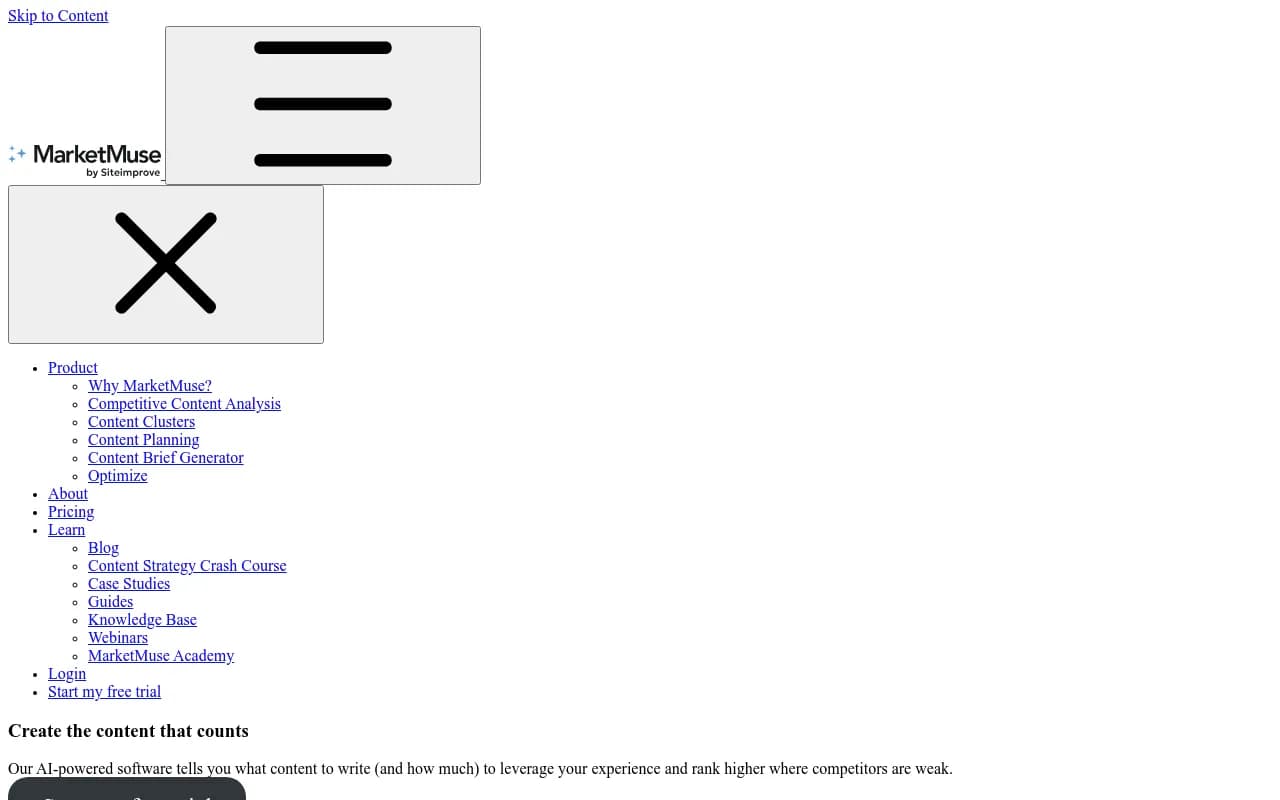
MarketMuse is the odd one out. It is less a brief generator than a content strategy platform that happens to produce briefs. It models your site's topical authority, finds gaps and recommends clusters, and the brief inherits that context.
Brief types and metrics
The top tier unlocks nine brief types: Article, Comparison, FAQ Collection, Guide, How-to, Listicle, Local, News/Event and Product Review. Lower tiers get Article only. It also gives you Personalized Difficulty (1 to 100), Topic Authority, Competitive Advantage and a Content Score. MarketMuse describes its method as patented topic modeling rather than TF-IDF.
The brief types matter more than they used to, which I get to below.
Plans
The pricing page now lists four tiers: Free (1 user, 10 queries, no briefs), Optimize (5 briefs a month), Research (10 briefs, 3 users) and Strategy (20 briefs, 5 users, all brief types). There are no dollar prices on the page. You book a demo.
Where it falls short
The volume of briefs is low. Twenty a month on the Strategy plan is not enough for a content team publishing daily. It also has a steeper learning curve than the other three, and hidden pricing means you cannot easily compare it to them. It earns its place if you manage a large site and the real question is what to write, not how to brief it.
Match the brief to the prompt, not just the keyword
This is where I think most brief tools, all four included, are still a step behind. A brief used to answer one question: what does Google want for this keyword? Now it also has to answer: what will an AI assistant cite for this prompt?
Promptwatch Data has a useful answer. In its report on which content types ChatGPT cites the most, covering Sep 28 to Oct 4, 2026, product pages made up 22.4% of classified citations, landing pages 16.8% and listicles 13.6%. How-to guides were 8.7%, documentation 7.5%, comparisons 5.9% and FAQ pages 3.3%.
The split by intent is the part worth putting into a brief template:
| Prompt intent | Top cited formats (Promptwatch Data, Sep 28 to Oct 4, 2026) |
|---|---|
| Commercial | Product pages 26.0%, landing pages 20.6%, listicles 15.0%, comparisons 7.9% |
| Informational | Product pages 19.1%, landing pages 13.9%, listicles 13.6%, how-to guides 10.7%, docs 8.5% |
| Branded | Product pages 23.3%, landing pages 22.8%, reviews 5.6%, FAQ pages 4.8% |
The practical lesson: put the target format and prompt intent at the top of every brief. A "best X tools" brief should say listicle or comparison. A "how do I configure X" brief should say how-to, docs or FAQ. MarketMuse's nine brief types and Content Harmony's customizable blocks both make that easy. Frase and Dashword can do it with templates.
Freshness matters too. Promptwatch's content half-life data shows news pages losing half their citations within about five weeks, while landing pages and docs last for months. If a brief is for a news piece, schedule the refresh at the same time.
Do you need to track AI visibility separately?
Only Frase has AI visibility tracking built in, and it is limited to a score and a short list of platforms depending on your tier. For the other three you need something separate. Teams that care about how the content performs in ChatGPT, Perplexity and AI Overviews usually pair a brief tool with a dedicated platform. Promptwatch does this and goes further than tracking, since it shows which prompts your pages are missing from and can write content against those gaps.

For a wider look at the category, the directory at bestgeosoftware.com lists GEO tools side by side.
Which one should you pick?
| Your situation | Pick |
|---|---|
| Solo or lean team, want brief, draft and publishing in one place | Frase |
| Agency with many freelancers, brief quality and standardization matter most | Content Harmony |
| Agency running high volume, want quick briefs and free scoring | Dashword |
| Large site, need topic strategy and cluster planning | MarketMuse |
| Tight budget, want to try before committing | Frase (free 7-day trial) or Content Harmony ($10 trial) |
| Need AI search tracking in the same tool | Frase |
A few honest caveats
None of these tools replaces an editor. They give you consistent research, and consistency is valuable, but a brief assembled from the top ten results is by definition a brief for a page that looks like the top ten results. The best use I have found is treating the output as a floor: take the questions and headings, then add the original angle, data or experience that the competitors lack.
If you also need help deciding what to publish and how to earn citations, an SEO and GEO agency such as 1001 SEO Media can handle the strategy while your team keeps using the brief tools above for execution.
Alternatives worth a look
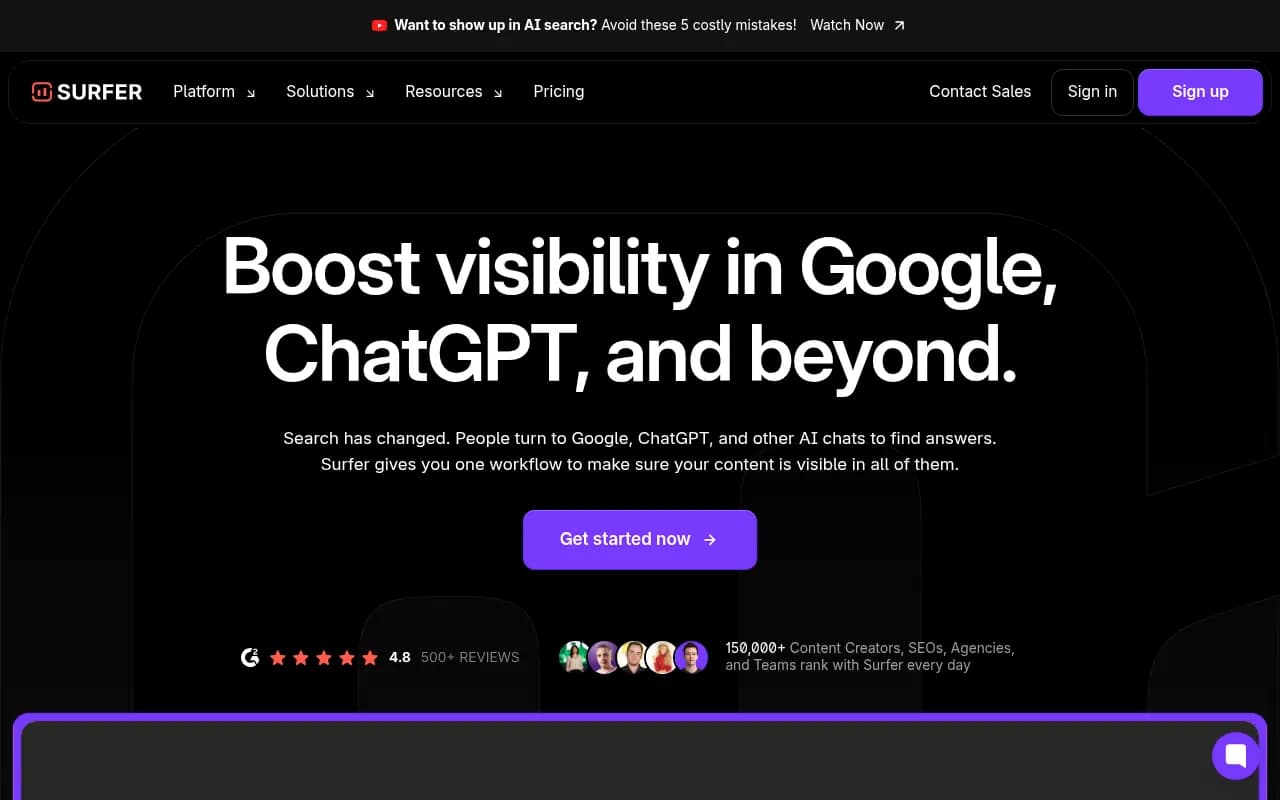
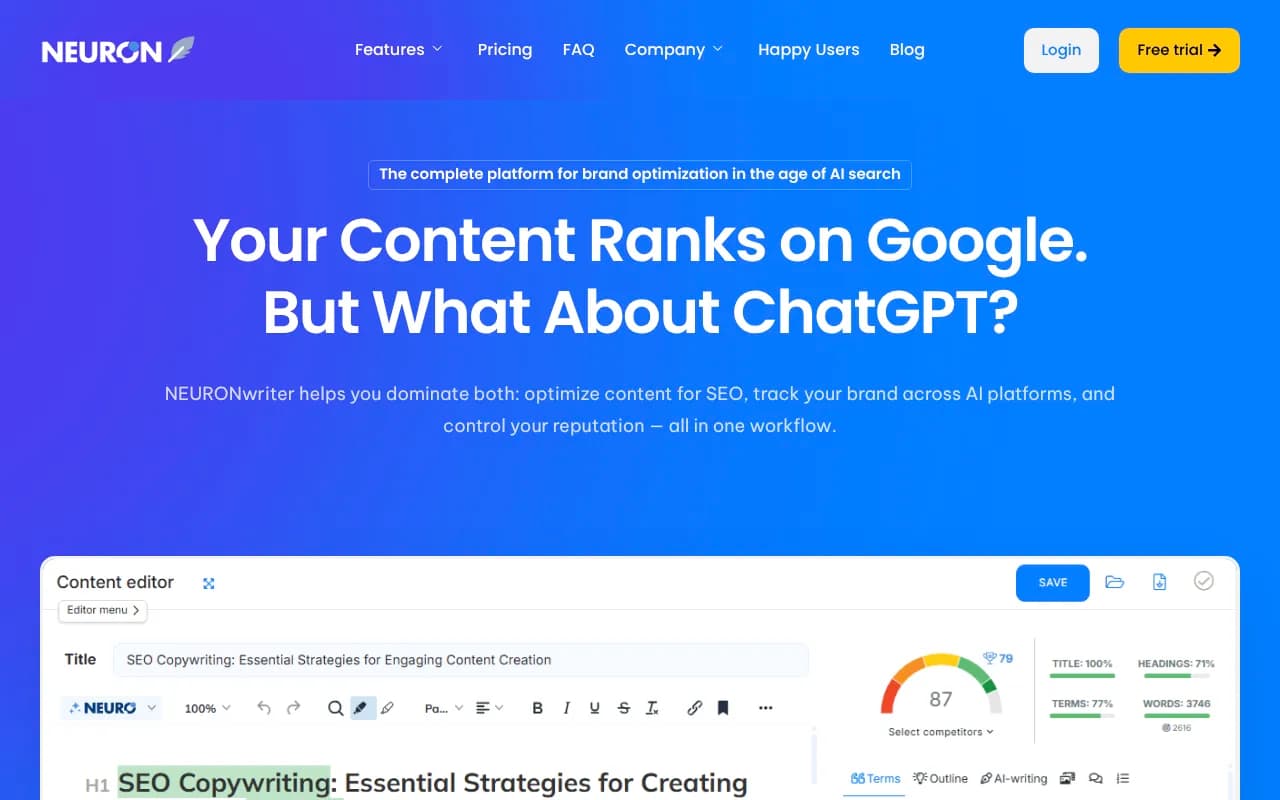
If none of the four fits, consider Clearscope for clean editorial grading, Surfer SEO for real-time on-page scoring, or NeuronWriter for a lower-cost option. For a broader list of software, surferstack.com has reviews and comparisons.

Bottom line
For most teams in 2026 I would start with a Frase trial and a $10 Content Harmony trial side by side, brief the same three keywords in each, and hand both briefs to a writer. Whichever one the writer needs fewer questions about is your answer. Pick Dashword if volume and speed beat everything else, and MarketMuse only if your problem is strategy across hundreds of pages rather than the brief itself.