Key takeaways
- AI content platforms don't hurt rankings by themselves. Publishing at a pace you can't review, with nothing original on the page, does.
- Google's scaled content abuse policy targets many pages made "for the primary purpose of manipulating search rankings and not helping users," regardless of whether a human or a machine wrote them.
- AirOps itself says the bottleneck has moved from production to quality, brand context and consistency. That is the honest diagnosis.
- Promptwatch Data shows durable pages (landing pages, docs, comparisons) keep their ChatGPT citations, while generic and news-style pages decay fastest.
- The fix is a process: human review, a named author, something the model couldn't know, and a publishing pace your editors can match.
The problem is not the tool
I want to be fair to platforms like AirOps. They exist because teams were drowning in repetitive SEO work, and workflows that turn messy tasks into predictable ones are useful.

But there is a pattern I keep seeing. A team gets access to a platform that can produce 50 or 500 articles a month. They turn it on. Six months later traffic is flat or falling, and someone writes a post titled "AI content doesn't work."
That conclusion is wrong, but so is the opposite one. What happened is simpler. The team removed the constraint that used to keep quality up, which was the cost of writing, and put nothing in its place.
AirOps University says this directly. In its brand governance lesson, it states that AI gave every team the ability to produce content at scale, but that speed without governance produces generic output that weakens the brand in both search and AI-powered discovery. It also notes that a skilled content marketer produces roughly four articles a week, around 150 a year, and that volume was never the real constraint.
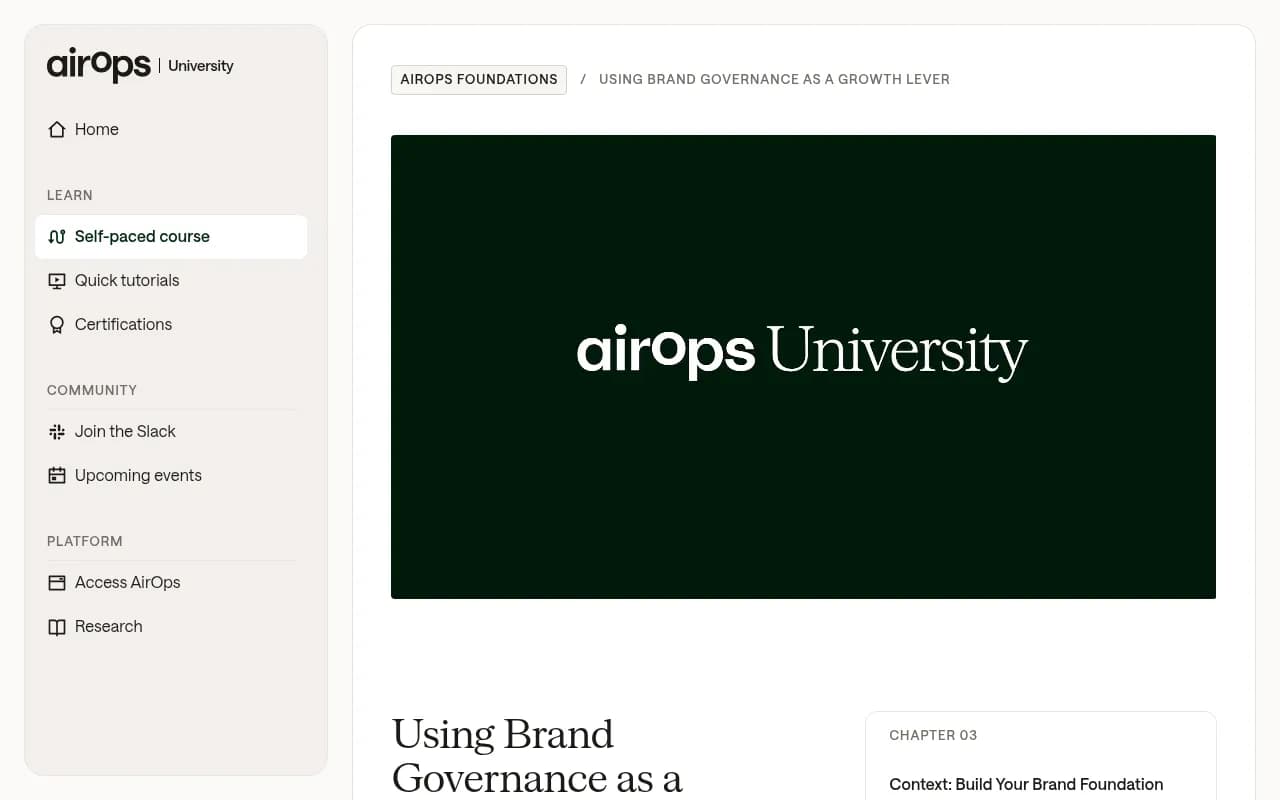
When the vendor's own training material says quality is the bottleneck, believe it.
What Google actually says
Google's spam policy defines scaled content abuse as generating many pages "for the primary purpose of manipulating search rankings and not helping users." The policy was introduced in March 2024 and covers automation used to generate low-quality or unoriginal content at scale. The method of production is not the test. Purpose and value are.
That matters because it explains why "was this written by AI?" is the wrong audit question. The right one is: if this page vanished, would any searcher notice?
The March 2026 update
A third-party analysis from Digital Applied claims the March 2026 core update made scaled content abuse a primary target. Treat this as secondary reporting, since I could not verify the specifics against Google itself. Still, the patterns it lists will look familiar to anyone who has audited an AI-heavy site:
- Batch publishing, including niche sites with 500+ AI pages released in 2025
- AI translation spam, with 20 to 50 language variants of the same thin page
- Thin programmatic SEO pages
- Reviews with no first-hand testing
- Rewritten news with no original reporting
- Generic educational explainers
The reasons it gives for the hits are identical page structure, no author credentials and no original data. Survivors were AI-assisted pages with expert input and human review. Razor Rank's write-up lands on the same lesson: AI content works when it is one input into a process that includes an SEO professional, an editor and an author who can be held accountable for what the page says.
Seven ways AI content platforms hurt rankings
1. Output outruns review
If your platform can generate 200 drafts a month and your editor can properly review 20, the other 180 are unreviewed. Razor Rank puts it bluntly: if your output outruns your editorial capacity, you have built a scaled content abuse problem on a schedule.
2. Every page has the same skeleton
Templated workflows are the whole point of these platforms. They are also a footprint. When hundreds of URLs share one structure, one intro pattern and one set of H2s, Google evaluates them as a group, not as individual pages. Razor Rank notes the same thing: audit by page group, because that is how Google looks at them.
3. Fact recycling instead of information gain
AirOps University makes a sharp point here. Traditional SEO rewarded restating existing information, such as top-10 lists and keyword-targeted rewrites. Now every team can generate that instantly, so it produces noise rather than differentiation. The brands earning AI citations add what the course calls citable chunks: unique data, first-party insights and expert perspectives models can't find elsewhere.
The course names three signals models use to decide what to cite: authority, freshness and information gain. A pipeline that rewrites the top five results fails the third one by construction.
4. Duplication and cannibalization
An Optidge podcast on the risks of AI content at scale makes the point that duplicating content, especially with AI, dilutes SEO value and confuses Google about which page to rank. If your platform produces ten near-identical articles on one topic, you compete with yourself.
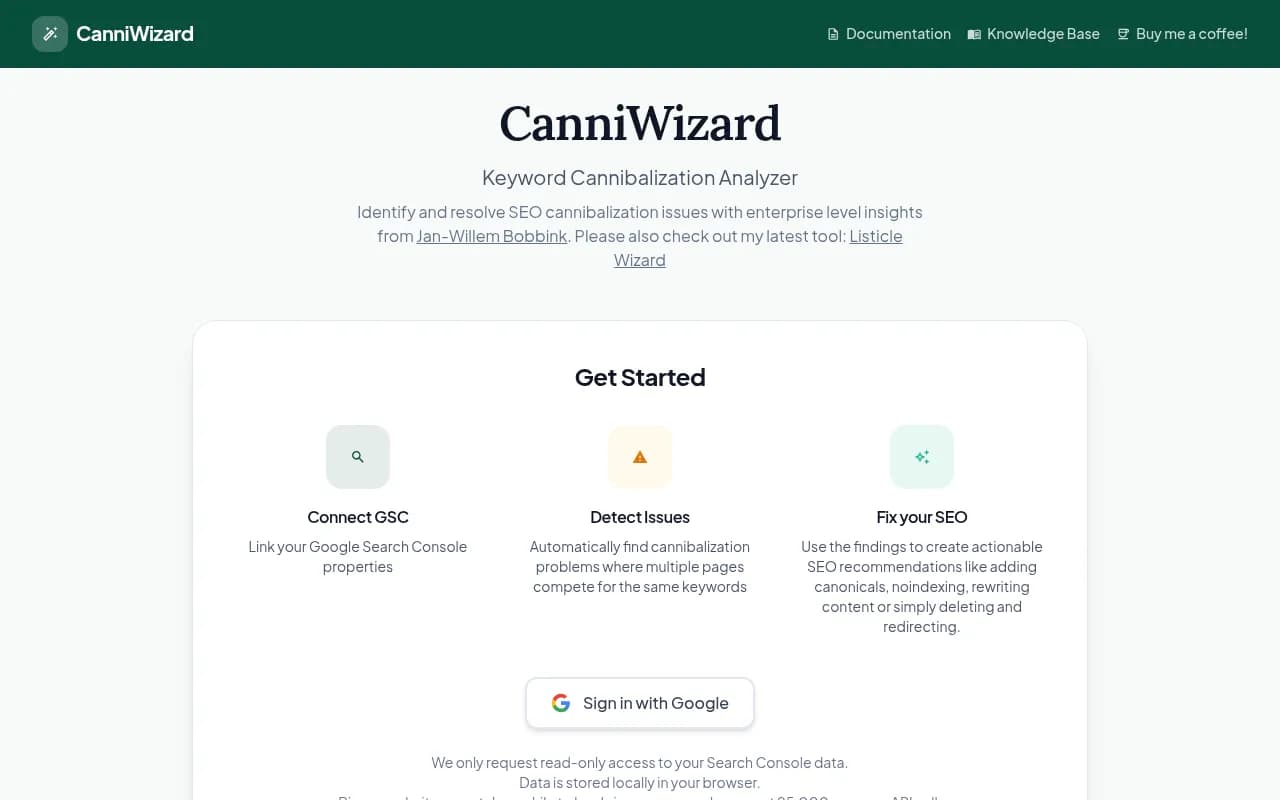
A tool like CannyWizard or Search Console data helps you find overlap.
5. No author, no accountability
Anonymous pages with no bio and no credentials are a weak E-E-A-T signal. Razor Rank's advice is to put a real name on every page, link a genuine author bio, and make sure that person could defend what is written.
6. Nothing the model couldn't know
Razor Rank has a test I like: strip out the AI-generated portion, and if nothing of value remains, the page shouldn't exist. An SME quote, a case outcome, your own data, a firsthand observation. Any one of those changes the page.
7. Your worst pages speak for your best
This one is about AI search, not Google. AirOps University notes that LLMs don't separate your best content from your worst. They read everything you've published and synthesize an impression of your brand from all of it. Outdated posts and off-brand pages feed into how ChatGPT describes you. Bulk low-quality content is not neutral clutter. It is input.
What the citation data says
If your goal includes being cited in ChatGPT, content type matters. Promptwatch Data on ChatGPT citations by content type (Sep 28 to Oct 4, 2026) found that product pages are the most cited type at 22.4%, with landing pages at 16.8%. Listicles get 13.6%, how-to guides 8.7%, general articles 6.1%, comparisons 5.9% and news 5.7%.
That is roughly 39% of citations going to pages that describe what a company sells, and about 43% going to editorial formats. A content engine that only produces generic articles is competing for the smaller, more crowded slice.
Durability matters too. In Promptwatch's content half-life study, which tracked pages cited on July 6, 2026 for 90 days, ChatGPT still cited 78% of landing pages and 76% of docs after 30 days. After 60 days it still cited 69% and 67%. Comparisons held 72% at 30 days and 63% at 60. News was the weakest: half of news pages were gone after 36 days, and almost a quarter were never cited again.
| Content type | Still cited after 30 days | Still cited after 60 days |
|---|---|---|
| Landing pages | 78% | 69% |
| Docs | 76% | 67% |
| Comparisons | 72% | 63% |
| Product pages, reviews, how-tos | n/a | about 55% |
| Listicles | n/a | 60% |
| News | n/a | 41% |
The takeaway: bulk-produced generic or news-style pages decay fastest. Durable assets keep their citations. A pipeline tuned for volume tends to produce exactly the fast-decaying kind.
A workflow that doesn't hurt rankings
Here is the version of AI-assisted publishing I would run. It pulls from Razor Rank's guidance and from AirOps' own framing.
Set the rules before the volume
- Write a brand book: tone, positioning, facts you can state, claims you can't. AirOps calls this a context system. Without it, more content just means more off-brand content.
- Decide the publishing cap by editor hours, not by what the platform can generate.
- Define what counts as original on every page: a quote, a data point, a screenshot, a result.
Gate every page
- A human reads the draft end to end. Razor Rank says this single rule prevents most of what got penalized in March 2026.
- A named author with a real bio signs off.
- Someone adds the part the model couldn't know.
- Facts and numbers get checked against a source.
- Internal links and the target query are confirmed, so you aren't cannibalizing an existing page.
Neil Patel's team reported something consistent in a test of AI content at scale: a roughly 20-minute human editing step was what made the difference. That is one anecdote, not proof, but it matches the logic. AI gives efficiency. Human insight gives the page a reason to rank.
Audit by group, not sample
Pull every URL from one template or workflow and look at them side by side. If you would be embarrassed by five of them in a row, Google will notice too. Screaming Frog helps you export and compare page sets, and Google Search Console shows which groups are losing impressions.
Refresh and prune
Because old pages feed AI's picture of your brand, retire or update outdated ones. Noindexing or consolidating a thin cluster is often a better move than writing another 50 pages.
Tools for the review layer
A content platform handles generation. You still need tools for quality, optimization and measurement.
| Job | Tool options | Notes |
|---|---|---|
| Content workflows | AirOps, Jasper, Writer | Generation and brand governance |
| On-page optimization | Clearscope, Surfer SEO, MarketMuse | Coverage and topic depth checks |
| Editing | Grammarly, Hemingway Editor | Readability, not originality |
| Crawl and audit | Screaming Frog, Sitebulb | Page-group audits |
| Search performance | Google Search Console | Impressions by URL group |
| AI visibility | Promptwatch, Profound, Otterly.AI | Do AI models cite what you publish? |


Note that optimization tools score topical coverage. They can't tell you whether your page contains a fact nobody else has. That judgment stays with a person.
Measure whether it is working
Rankings are only half the picture now. AirOps' webinar series argues that AI search is becoming bigger than SEO, with buyers discovering brands through ChatGPT, Claude, Perplexity and Google AI Overviews. That makes it worth checking whether your scaled content earns citations or sits unread.
Tools like Promptwatch can show which of your pages AI models actually cite, and its crawler logs reveal whether AI bots are even reading the pages you published.

For a broader list of options, the GEO software directory at bestgeosoftware.com compares trackers side by side.
A practical check: after a batch of AI-assisted pages goes live, look at three things after 60 days. Are they indexed? Do they earn impressions in Search Console? Are any cited in AI answers? If a whole template fails all three, stop publishing it and fix the template.
What to do if you have already over-published
- Export every URL generated by AI workflows and group them by template.
- Pull 90 days of impressions and clicks per group.
- For groups with near-zero traffic, decide: improve with original input, consolidate into a stronger page, or remove.
- Add real author bios and byline the pages you keep.
- Slow the publishing cadence to what your editors can review.
- Re-measure after the next crawl cycle.
Don't expect instant recovery. Cleaning up a footprint takes crawl cycles, and a third-party analysis of the March 2026 update suggests the hardest-hit sites were those with hundreds of undifferentiated pages.
The honest summary
AI content platforms hurt rankings when they are used as a replacement for editorial judgment. They help when they remove drudgery from a process that still has an editor, an author and a point of view. AirOps says it exists to scale quality without sacrificing the voice your audience trusts. That is the right goal. The platform can't deliver it alone, and no platform setting replaces someone reading the page before it goes live.
If you are deciding how much to publish next month, start with this number: how many pages can a human genuinely review? Publish that many.