Hypotenuse AI Review 2026
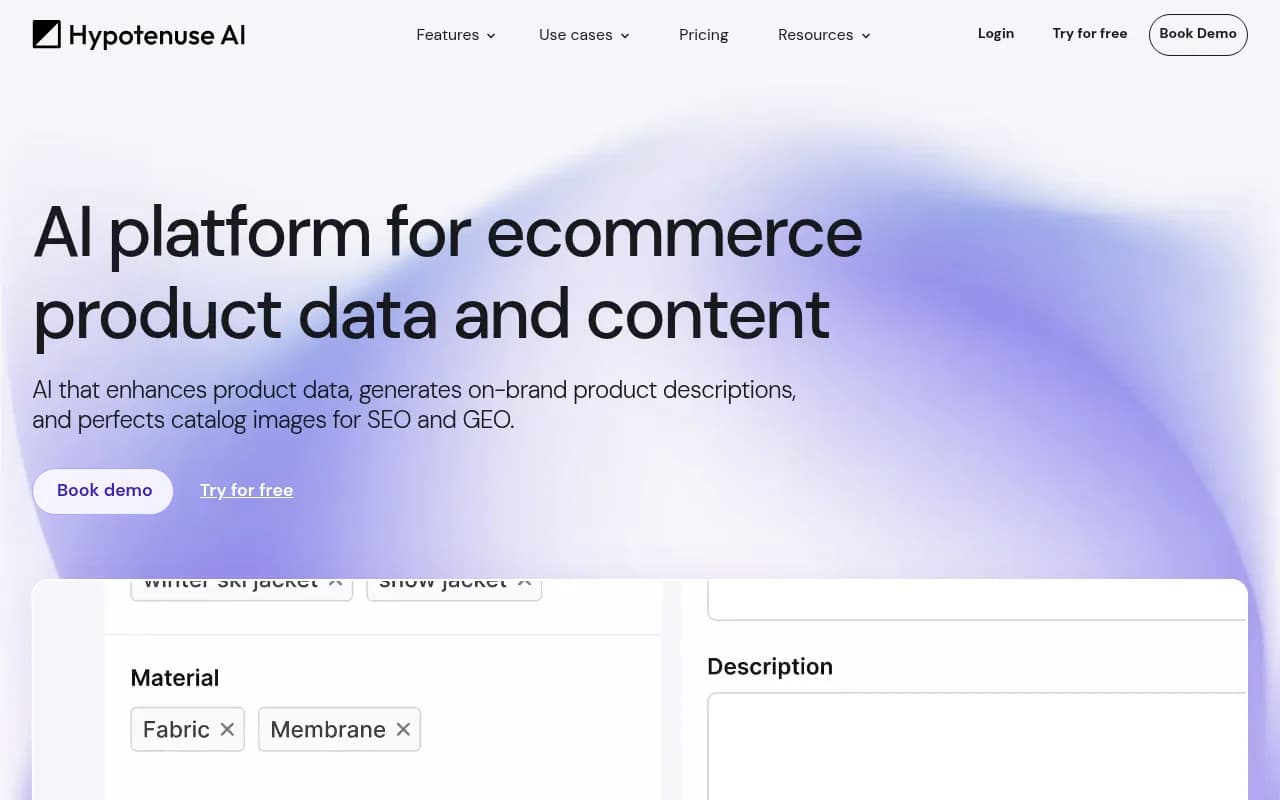
Hypotenuse AI is an AI platform for ecommerce brands that automates product data enrichment, generates on-brand product descriptions at scale, enhances catalog images, and publishes directly to major commerce platforms and marketplaces.
Key takeaways
- Hypotenuse AI is purpose-built for ecommerce product content -- product descriptions, data enrichment, and image editing -- not a general-purpose writing tool
- Strongest for mid-market to enterprise ecommerce teams managing large catalogs (thousands of SKUs) across multiple channels and marketplaces
- The brand voice training and bulk generation capabilities are genuinely impressive; the output quality is hard to distinguish from human-written copy
- Integrations cover the major commerce platforms (Shopify, Amazon, Walmart, WooCommerce, BigCommerce) and PIM systems (Akeneo, Salsify, Stibo, Plytix, PIMcore)
- Pricing is enterprise-oriented and not publicly listed in a clear tier structure, which makes it harder to evaluate for smaller teams
- Not a tool for AI search visibility or brand monitoring in LLMs -- for tracking how your products appear in ChatGPT or Perplexity responses, you'd need a dedicated GEO platform
Hypotenuse AI is a Singapore-based AI platform focused almost entirely on one problem: helping ecommerce brands produce and manage product content at scale. Founded around 2021, it started as a general AI writing tool and has since narrowed its focus sharply toward ecommerce -- product descriptions, catalog data enrichment, image editing, and digital shelf optimization. That focus shows in the product. This isn't a Swiss Army knife trying to do everything; it's a specialized tool that has clearly been shaped by feedback from real ecommerce teams.
The company's customer list includes Billabong, Yamaha, Quiksilver, Volcom, Living Spaces, Fujitsu, and MediaMarkt -- a mix of apparel, electronics, and home goods brands that all share the same core problem: large catalogs, inconsistent product data, and content teams that can't keep up with SKU volume. Hypotenuse AI's pitch is that it can handle the content production layer of that problem without sacrificing brand consistency.
The target audience is squarely enterprise and mid-market ecommerce. If you're running a Shopify store with 200 products, this is probably more tool than you need. If you're managing 50,000 SKUs across Amazon, Walmart, and your own storefront -- and your content team is drowning -- this is exactly the kind of platform worth evaluating.
Key features
Bulk product description generation
This is the core feature and the one Hypotenuse AI has invested the most in. You can upload a product catalog (CSV, or via direct integration with your PIM or ecommerce platform), configure your brand voice settings, and generate thousands of product titles, descriptions, and bullet points in a single batch run. The output isn't generic filler -- the system uses your existing high-performing descriptions as training examples to calibrate tone, vocabulary, and structure. Living Spaces' digital content team noted they can produce hundreds of descriptions at once while maintaining brand voice consistency, which is the real test.
The brand voice system lets you define style rules (formal vs. casual, sentence length preferences, words to avoid, product-specific terminology) and the model applies them consistently across the entire batch. This is meaningfully different from just prompting a general LLM -- the consistency holds at scale in a way that manual prompting doesn't.
Product data enrichment
Incomplete product data is one of the most common and expensive problems in ecommerce operations. Missing attributes mean products don't surface in filtered search results, and inconsistent data creates downstream problems in feeds and marketplaces. Hypotenuse AI's enrichment feature can:
- Extract attributes directly from product images (color, material, dimensions, style)
- Pull data from existing product information and fill gaps automatically
- Normalize and standardize attributes across a catalog (e.g., ensuring "cotton" and "100% cotton" are treated consistently)
- Tag and categorize products using your taxonomy or a standard one
This works as a centralized repository -- a single place where product data is enriched, validated, and then pushed downstream to wherever it needs to go.
AI image editing and enhancement
The image editing suite handles the visual side of product content. Key capabilities include:
- Background removal and replacement with AI-generated lifestyle scenes
- Resolution upscaling for images that don't meet marketplace requirements
- Precision cropping and framing to standardize product presentation
- Batch processing so you're not editing images one at a time
The lifestyle scene generation is particularly useful for brands that can't afford full product photography for every SKU. You can place a product image into a contextually appropriate scene (a piece of furniture in a living room, a jacket on a mountain trail) without a photo shoot. The quality isn't always perfect -- complex products with unusual shapes can produce artifacts -- but for standard catalog items it's genuinely usable.
Digital shelf optimization and performance monitoring
Beyond content creation, Hypotenuse AI includes a monitoring layer that tracks how your products perform on marketplaces and search. This covers:
- Keyword ranking tracking across platforms
- Keyword suggestions based on search volume and relevance
- Marketplace guideline compliance checking (so your listings don't get flagged or suppressed)
- Ongoing optimization recommendations
This is the feature that positions Hypotenuse AI as more than a content generator -- it's trying to close the loop between content creation and performance. The depth here is more limited than dedicated SEO tools, but for teams that want everything in one place, it's a useful addition.
Brand voice customization
The brand voice system deserves its own mention because it's more sophisticated than most AI writing tools offer. You can train the system on your existing content, define explicit style rules, and create different voice profiles for different product categories or markets. A brand selling both professional workwear and casual streetwear can maintain separate voice profiles and apply them to the right products automatically. This is the feature that makes the output feel like your brand wrote it rather than a generic AI.
Localization and multi-language support
For brands selling internationally, Hypotenuse AI can generate product content in multiple languages while maintaining brand voice consistency. This isn't just translation -- it's localization, meaning the content is adapted for cultural context and local search behavior. The platform supports major European languages, Asian languages, and others, which matters for brands like MediaMarkt operating across multiple European markets.
Marketing content generation
Beyond product pages, the platform generates blog articles, ad creatives, Instagram captions, and email campaigns. This is more of a secondary capability than a core one -- the product description and data enrichment features are clearly where the engineering investment has gone -- but it means content teams can use the same tool for broader marketing needs without switching platforms.
Direct publishing and integrations
Content can be published directly from Hypotenuse AI to connected platforms without manual copy-paste. The integration list is substantial: Shopify, WooCommerce, BigCommerce, Amazon, Walmart, Target, Webflow, WordPress, Wix, and PIM systems including Akeneo, Salsify, Stibo, Plytix, and PIMcore. For enterprise teams, the PIM integrations are particularly important -- they mean Hypotenuse AI can slot into existing data workflows rather than requiring a separate content management process.
Who is it for
The clearest use case is a mid-market or enterprise ecommerce brand with a large catalog and a content team that's perpetually behind. Think a fashion retailer with 10,000+ SKUs launching new collections every season, or a home goods brand selling across their own site, Amazon, and Walmart simultaneously. The pain point is always the same: there's more product to describe than the team can handle, and the quality is inconsistent because different writers handle different categories.
Ecommerce agencies managing content production for multiple retail clients are another strong fit. The ability to create separate brand voice profiles for each client, run bulk generation, and publish directly to client platforms makes the workflow significantly more efficient than manual production. Agencies that handle catalog migrations -- moving a brand from one platform to another and needing to rewrite or reformat thousands of descriptions -- will find the bulk processing particularly useful.
The platform is also well-suited for brands expanding into new markets who need localized content at scale. Translating and localizing 50,000 product descriptions manually is prohibitively expensive; doing it with Hypotenuse AI while maintaining brand consistency is a much more tractable problem.
Who should probably look elsewhere: small Shopify stores with a few hundred products, general content marketers who need blog and social content but not product-specific features, and anyone primarily focused on AI search visibility or brand monitoring in LLMs. Hypotenuse AI's GEO angle (appearing in ChatGPT, Perplexity, Gemini) is mentioned on the site but it's not the platform's core competency -- it's more of a content quality argument than a dedicated tracking or optimization capability.
Integrations and ecosystem
The integration story is one of Hypotenuse AI's stronger points. The platform connects directly with:
- Ecommerce platforms: Shopify, WooCommerce, BigCommerce, Webflow, WordPress, Wix
- Marketplaces: Amazon, Walmart, Target
- PIM systems: Akeneo, Salsify, Stibo Systems, Plytix, PIMcore
- Custom platforms: API access for teams with proprietary systems
The PIM integrations are particularly notable because they mean Hypotenuse AI can function as a content enrichment layer within an existing enterprise data stack rather than requiring teams to change their workflows. Data flows in from the PIM, gets enriched and described, and flows back out -- no manual export/import cycle.
An API is available for custom integrations, which matters for enterprise teams with proprietary catalog systems or unusual workflow requirements. The site mentions "no coding involved" for standard integrations, which is accurate for the pre-built connectors, though the API obviously requires development work.
There's no mention of a browser extension or mobile app, which makes sense given the platform is designed for bulk operations rather than individual content creation.
Pricing and value
Hypotenuse AI's pricing isn't publicly listed in a clear, current tier structure on their website -- they push toward a demo booking for enterprise conversations. Third-party sources suggest historical pricing around $29/month for individual creators and $87/month for small teams, with higher tiers for larger catalogs. One source mentions $150/month for a basic plan and $500/month for a pro plan with bulk generation. The enterprise pricing is custom and negotiated based on catalog size, usage volume, and required integrations.
This pricing opacity is a genuine friction point for teams trying to evaluate the tool without committing to a sales conversation. It's a common enterprise software pattern, but it does make comparison shopping harder. A free trial is available via the website signup, which at least lets teams test the output quality before engaging with sales.
For context, the main alternatives in this space -- tools like Jasper, Copy.ai, or Writesonic -- are generally cheaper but lack the ecommerce-specific features (PIM integrations, marketplace publishing, data enrichment) that justify Hypotenuse AI's pricing for enterprise teams. If you're comparing purely on per-word cost, there are cheaper options. If you're comparing on total workflow value for a large ecommerce operation, the math changes.
Strengths and limitations
What it does well:
- The brand voice consistency at scale is genuinely impressive. Running 10,000 descriptions through the system and having them all sound like the same brand is hard to achieve, and Hypotenuse AI handles it better than most alternatives.
- The PIM and marketplace integrations are deep and practical. This isn't just a Shopify plugin -- it connects to the enterprise data infrastructure that large ecommerce teams actually use.
- The combination of text generation, data enrichment, and image editing in one platform reduces the number of tools a content team needs to manage.
- SOC 2 compliance and granular access controls make it viable for enterprise security requirements.
- The data enrichment from images -- extracting attributes automatically from product photos -- is a genuinely useful capability that saves significant manual effort.
Honest limitations:
- Pricing transparency is poor. Teams can't self-serve evaluate whether the cost makes sense without going through a sales process, which adds friction.
- The GEO/AI visibility angle on the site is more marketing than substance. Hypotenuse AI can help your product content be more complete and accurate, which may help it surface in AI search results, but it doesn't track or measure AI visibility, monitor how your products appear in ChatGPT or Perplexity responses, or provide any of the citation analysis or prompt intelligence that dedicated platforms offer. For brands that want to actively manage their presence in AI search, this is a meaningful gap.
- The image editing quality, while useful, isn't at the level of dedicated AI image tools. Complex products or unusual compositions can produce results that need manual cleanup.
- The marketing content features (blog posts, social captions, email) feel like additions rather than core capabilities. Teams with serious content marketing needs will likely still want a dedicated tool.
Bottom line
Hypotenuse AI is a well-built, focused platform for ecommerce teams that need to produce and manage product content at scale. If your catalog has thousands of SKUs, you're selling across multiple marketplaces, and your content team is the bottleneck, this is worth a serious evaluation. The brand voice consistency, PIM integrations, and data enrichment capabilities are genuinely strong.
Best for: Enterprise and mid-market ecommerce brands managing large catalogs across multiple channels who need consistent, on-brand product content without proportionally scaling their content team.
Tags:
Frequently asked questions
What is Hypotenuse AI?
Who is Hypotenuse AI best suited for?
How much does Hypotenuse AI cost?
What integrations does Hypotenuse AI support?
Can Hypotenuse AI help with AI search visibility (GEO)?
Does Hypotenuse AI support multiple languages?
Similar and alternative tools to Hypotenuse AI