Key takeaways
- Perplexity uses real-time web retrieval (RAG architecture), so recent content can surface within hours — making it more responsive to optimization than ChatGPT
- Track three separate things: mentions (brand named in the answer), citations (your domain in the references), and links (clickable URLs users can follow)
- Manual tracking works fine to start — pick 20-30 prompts, run them weekly, log results in a spreadsheet
- Automated tools remove the manual work and add competitive benchmarking, sentiment tracking, and trend data over time
- The goal isn't just to know where you appear — it's to find the gaps and create content that gets you cited
Perplexity has quietly become one of the more important places a buyer might first encounter your brand. Not because it has the most users, but because of who uses it. The platform skews toward researchers, technical professionals, and informed B2B buyers — people who are actively comparing options before making a decision. If your brand doesn't show up when they ask Perplexity about your category, you're invisible at exactly the moment it matters.
This guide walks through how to set up brand mention tracking in Perplexity, from a free manual method you can start today to automated platforms that scale the process across multiple AI engines.
Why Perplexity is different from other AI search engines
Before getting into the setup, it's worth understanding what makes Perplexity distinct — because it changes how you approach tracking.
Unlike ChatGPT, which generates answers primarily from training data (with optional web plugins), Perplexity crawls the live web for every query using a RAG (Retrieval-Augmented Generation) architecture. Every response includes numbered citations, and those citations are visible to users. That transparency is actually useful for brand monitoring: you can see exactly which sources Perplexity trusted for a given answer.
The practical implication: content you publish today can influence Perplexity responses within days, not months. That's a faster feedback loop than traditional SEO, and it means tracking your visibility over time is genuinely actionable.
| Feature | Perplexity | ChatGPT | Google AI Overviews |
|---|---|---|---|
| Data source | Real-time web crawl | Training data + plugins | Google index + real-time |
| Citation transparency | Always visible | Rarely shown | Partial |
| Response to new content | Hours to days | Weeks to months | Days to weeks |
| User intent | Research, comparison | Broad/conversational | Informational |
| Trackable citation opportunities | High | Low | Medium |
What to actually measure
Most people start by asking "does Perplexity mention my brand?" That's a fine starting point, but it conflates three different things that require different responses.
Mentions are when your brand name appears in the answer text itself. This is the most visible outcome — users see your name even if they don't click anything.
Citations are when your domain appears in the reference list Perplexity attaches to its answer. This signals that Perplexity trusts your content as a source, which is a different kind of authority than a mention.
Links are clickable URLs that users can follow directly to your site. These drive actual referral traffic.
Track all three separately. A brand that gets mentioned but never cited has an entity recognition problem. A brand that gets cited but not mentioned has a content positioning problem. Mixing the metrics together makes it impossible to know which one to fix.
Add a fourth metric if you want to go deeper: share of voice, which measures how often you appear relative to competitors across the same set of prompts.
Step 1: Build your prompt list
The foundation of any Perplexity monitoring setup is a list of prompts that represent how your target customers actually search. These aren't keywords — they're full questions.
Think about:
- Category-level questions ("what's the best [product type] for [use case]?")
- Comparison queries ("[your brand] vs [competitor]")
- Problem-first questions ("how do I solve [problem your product addresses]?")
- Recommendation requests ("what tools do [your target persona] use for [task]?")
Start with 20-30 prompts. You want enough coverage to see patterns, but not so many that manual tracking becomes unmanageable before you've validated the process.
A few things to keep in mind when writing prompts:
Perplexity outputs vary based on model selection (it lets users choose between different underlying models), location, and how the question is phrased. Run each prompt in the same way each time — same model, same phrasing — so your results are comparable across weeks.
Step 2: Manual tracking setup (free method)
You don't need a paid tool to start. Here's a simple manual workflow:
Create a tracking spreadsheet with columns for: date, prompt, brand mentioned (yes/no), citation present (yes/no), link present (yes/no), competitor mentions, source URLs Perplexity cited, and any notes on sentiment or context.
Run each prompt weekly in Perplexity. Copy the response and the citation list. Fill in your spreadsheet.
Look for patterns after 4-6 weeks. Which prompts consistently include your brand? Which ones always cite a competitor instead? Which source URLs does Perplexity keep pulling from in your category?
The source URL column is particularly valuable. If Perplexity keeps citing a specific competitor blog post or a third-party review site, that tells you where to focus your content efforts — either by creating something better on your own site, or by getting mentioned on that third-party source.
The limitation of manual tracking is obvious: it doesn't scale, it's inconsistent across team members, and you can't easily trend data over time without significant spreadsheet management. For a quick audit or a small brand, it works. For ongoing monitoring across multiple competitors and prompts, you'll want automation.
Step 3: Choose an automated monitoring tool
Several tools now offer Perplexity-specific tracking. They differ significantly in what they actually do with the data they collect.
Promptwatch sits at the more capable end of the spectrum. Beyond tracking whether your brand appears, it identifies which prompts competitors rank for that you don't (Answer Gap Analysis), generates content designed to get cited, and tracks crawler activity from Perplexity's bot directly in your server logs. It monitors 10 AI engines including Perplexity, ChatGPT, Claude, Gemini, and Google AI Overviews.

For teams that want focused Perplexity tracking without the broader optimization layer, a few other tools are worth considering:
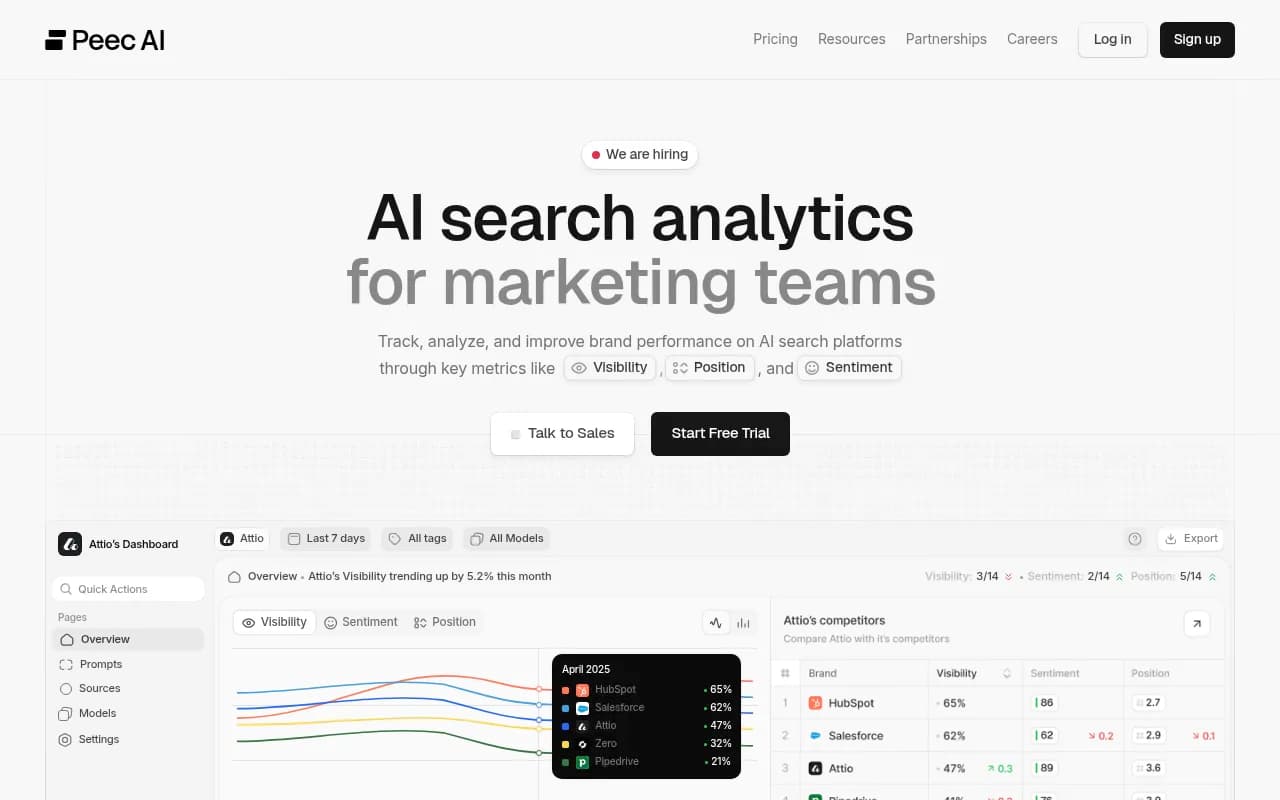
Peec AI tracks brand visibility across ChatGPT, Perplexity, and Claude with a clean monitoring dashboard.
Otterly.AI covers brand mention tracking across ChatGPT, Perplexity, and Google AI Overviews with competitive benchmarking.
Otterly.AI

Profound is an enterprise-grade option with strong multi-model coverage and detailed reporting.
Profound

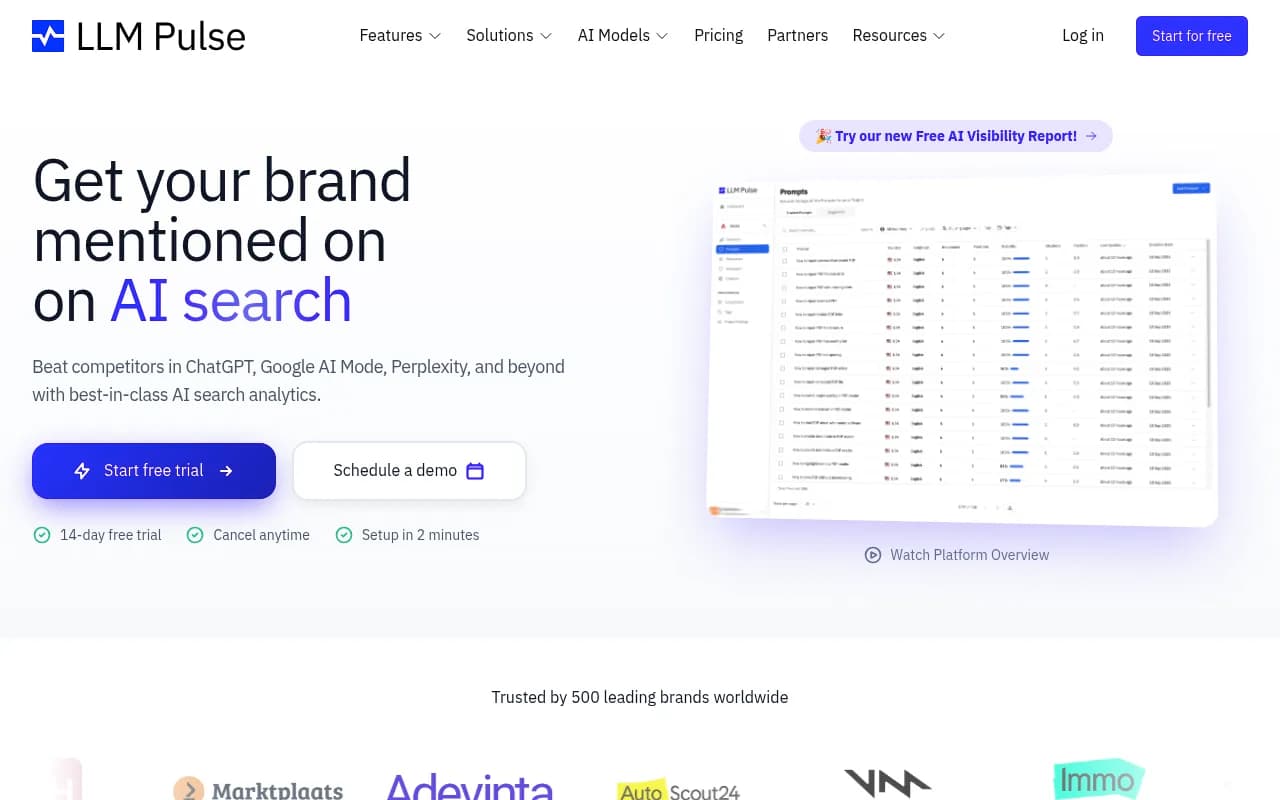
LLM Pulse offers straightforward AI search visibility tracking across ChatGPT, Perplexity, and other engines.
Here's how the main options compare on the features that matter most for Perplexity monitoring:
| Tool | Perplexity tracking | Competitor benchmarking | Content gap analysis | Crawler log access | Content generation |
|---|---|---|---|---|---|
| Promptwatch | Yes | Yes | Yes | Yes | Yes |
| Peec AI | Yes | Basic | No | No | No |
| Otterly.AI | Yes | Yes | No | No | No |
| Profound | Yes | Yes | Limited | No | No |
| LLM Pulse | Yes | Basic | No | No | No |
The monitoring-only tools (Peec AI, Otterly.AI) are fine if you just want to know where you stand. If you want to actually improve your visibility, you need something that tells you what content to create and why.
Step 4: Configure your monitoring setup
Whether you're using a manual spreadsheet or an automated tool, the configuration decisions are the same.
Prompt selection: Use the list you built in Step 1. In automated tools, you'll enter these as tracked prompts. Most tools let you group prompts by topic or funnel stage, which helps when analyzing results.
Competitor tracking: Add your top 3-5 competitors to track alongside your brand. The most useful insight isn't your absolute visibility score — it's your visibility relative to competitors on the same prompts.
Frequency: Weekly tracking is the right cadence for most brands. Daily is overkill unless you're in a fast-moving category or running an active content campaign. Monthly is too slow to catch meaningful changes.
Persona and location settings: Perplexity responses can vary by geography. If you serve specific markets, configure your tracking to run from those locations. Some tools also let you set user personas (e.g., "B2B marketing manager" vs "small business owner") to see how responses differ by audience.
Baseline snapshot: Before you start optimizing anything, run your full prompt list and save the results. This is your baseline. Every future measurement is compared against it.
Step 5: Interpret what you're seeing
Raw data from Perplexity tracking is only useful if you know what questions to ask about it.
High competitor visibility, low yours: This is a content gap. Perplexity is finding your competitor's content more useful or authoritative for these prompts. Look at which URLs they're citing for your competitor — that tells you the content format and depth Perplexity is rewarding.
Brand mentioned but not cited: Perplexity knows your brand exists (probably from training data or third-party mentions) but isn't pulling your own content as a source. This usually means your site isn't being crawled effectively, or your content doesn't directly answer the question being asked.
Cited but not mentioned: Your content is being used as a source, but Perplexity isn't naming your brand in the answer. This can happen when your content is informational but not positioned around your brand. Adding more explicit brand context to your content can help.
Inconsistent results across runs: Perplexity's outputs genuinely vary. If you're tracking manually, run each prompt 2-3 times and note the range. Automated tools handle this by averaging across multiple runs.
Step 6: Act on the data
Tracking without action is just logging. The point of monitoring your Perplexity visibility is to improve it.
The most direct lever is content. Perplexity cites pages that directly and comprehensively answer the question being asked. If you're not being cited for "best [category] tools for [use case]," the answer is usually to create a page that answers that exact question better than what's currently being cited.
A few content types that tend to perform well in Perplexity citations:
- Comparison pages ("X vs Y: which is better for [specific use case]")
- Listicles with specific criteria and reasoning
- FAQ pages that match question-format prompts directly
- Original data, research, or statistics that Perplexity can cite as a primary source
Beyond your own site, look at where Perplexity is pulling citations from in your category. If it consistently cites a particular industry publication, getting your brand mentioned there is worth pursuing. If Reddit threads keep appearing in citations, participating in relevant subreddits becomes a legitimate visibility strategy.
Tools like Promptwatch track which third-party sources (including Reddit and YouTube) AI engines cite in your category, which removes the guesswork from this kind of off-site strategy.
Step 7: Track the impact
Once you've made content changes, you need to close the loop. Did the new content actually improve your Perplexity visibility?
Run your full prompt list again 2-4 weeks after publishing new content. Compare against your baseline. Look for:
- New citations to the pages you created
- Increased brand mention rate on the prompts you targeted
- Shifts in competitor share of voice
For traffic attribution, check your analytics for referrals from perplexity.ai. Perplexity does pass referral traffic when users click citations. If you're seeing citation growth but no corresponding traffic, it may mean users are reading the answer without clicking through — which is still valuable for brand awareness, just not for direct conversion.
Some teams also use server log analysis to track when Perplexity's crawler (PerplexityBot) visits their site, which gives a leading indicator of citation potential before it shows up in tracked responses.
Common mistakes to avoid
Tracking too few prompts: Ten prompts gives you a narrow picture. You need enough coverage to see where you're strong, where you're weak, and where competitors are winning.
Changing prompts between tracking periods: If you rephrase a prompt, you can't compare results to previous weeks. Lock your prompt list and only add to it, don't modify existing prompts.
Ignoring the citation sources: The URLs Perplexity cites are as important as whether your brand appears. They tell you exactly what content is winning and why.
Optimizing for one AI engine in isolation: Content that gets cited by Perplexity tends to also perform well in ChatGPT, Claude, and Google AI Overviews. Build for the pattern, not just the platform.
Treating this as a one-time audit: Perplexity's outputs change as it crawls new content. Visibility you have today can disappear next month if a competitor publishes something better. Ongoing monitoring is the only way to stay ahead.
Putting it together
Setting up Perplexity brand mention tracking doesn't require a big budget or a dedicated team. Start with a spreadsheet, 20 prompts, and a weekly cadence. Once you've validated that the data is useful and you're seeing patterns worth acting on, move to an automated tool that can scale the process and add competitive context.
The brands that will win in AI search aren't necessarily the ones with the biggest marketing budgets. They're the ones that understand what questions their buyers are asking, create content that directly answers those questions, and track whether that content is actually being cited. That loop — monitor, create, measure — is the whole game.