Key takeaways
- AI models read the text of reviews, not just star ratings — shallow "great service!" reviews do almost nothing for your AI citations
- Trustpilot's domain authority (93) and scale (330M+ reviews) make it one of the most-cited review platforms in AI-generated answers
- Review recency matters: AI systems prioritize fresh signals, so a stale review profile hurts you even if your average rating is high
- 34.5% of AI Overviews cite at least one review platform — meaning review site presence is a direct citation channel, not just a trust signal
- Tracking which AI models actually cite your review profiles (and which don't) is the only way to know if your efforts are working
Why reviews suddenly matter for AI search
For years, reviews were a local SEO play. You collected stars, watched your Google Business Profile ranking, and moved on. The text inside the reviews? Largely irrelevant to algorithms that treated reviews as numerical proxies.
That's over.
Large language models don't scan star ratings. They read reviews the same way a person would — parsing sentiment, extracting specific claims, and using that information to build a picture of your brand. When someone asks ChatGPT "what's the best project management tool for remote teams?" the model isn't looking up your aggregate rating. It's drawing on everything it has ingested about your brand: what customers said, how specific they were, whether the language was consistent across sources.
The HOTH put it clearly in their February 2026 analysis: LLMs use reviews as "layered trust signals" that influence whether your brand earns AI citations at all. A brief, repetitive review like "they're great" carries almost no weight. A detailed review describing a specific use case, naming features, and explaining outcomes? That's the kind of signal AI models can actually use.
This shift has real consequences. Brands with high review volumes but thin, generic content are losing ground to competitors with fewer but more substantive reviews. The game has changed, and most marketing teams haven't caught up.
How AI models use review site data
Before getting into tactics, it helps to understand the mechanics. AI models use review site data in a few distinct ways:
As entity signals. When an AI model builds a picture of your brand, it pulls from every authoritative source it can find. Trustpilot, G2, Capterra, Google Reviews, Yelp — these are all high-authority domains that AI models treat as credible third-party validators. Consistent positive signals across multiple review platforms strengthen your "entity authority," which is the model's confidence that your brand is what you say it is.
As citation sources. This is the direct channel. According to data from the r/seogrowth community, 34.5% of AI Overviews cite at least one review platform. That means your Trustpilot page, your G2 profile, your Capterra listing — these can appear directly in AI-generated answers as sources. If your profile is thin or outdated, it won't get cited even if it technically exists.
As sentiment data. AI models synthesize patterns across many reviews to form a qualitative assessment of your brand. If 40% of your reviews mention slow customer support, that pattern will show up in AI-generated summaries whether you like it or not. Trustpilot's business blog made this point directly: "AI systems summarize patterns quickly — including negative ones."
As recency signals. Fresh reviews signal that your brand is active and relevant. AI systems weight recent data more heavily, so a profile with 500 reviews from 2022 and nothing since is a weaker signal than a profile with 50 reviews from the last 90 days.
The Trustpilot advantage (and its limits)
Trustpilot has a domain authority of 93 and over 330 million reviews. For AI models deciding which sources to trust, that combination is hard to beat. A citation from Trustpilot carries more weight than a citation from a niche review site with thin content.
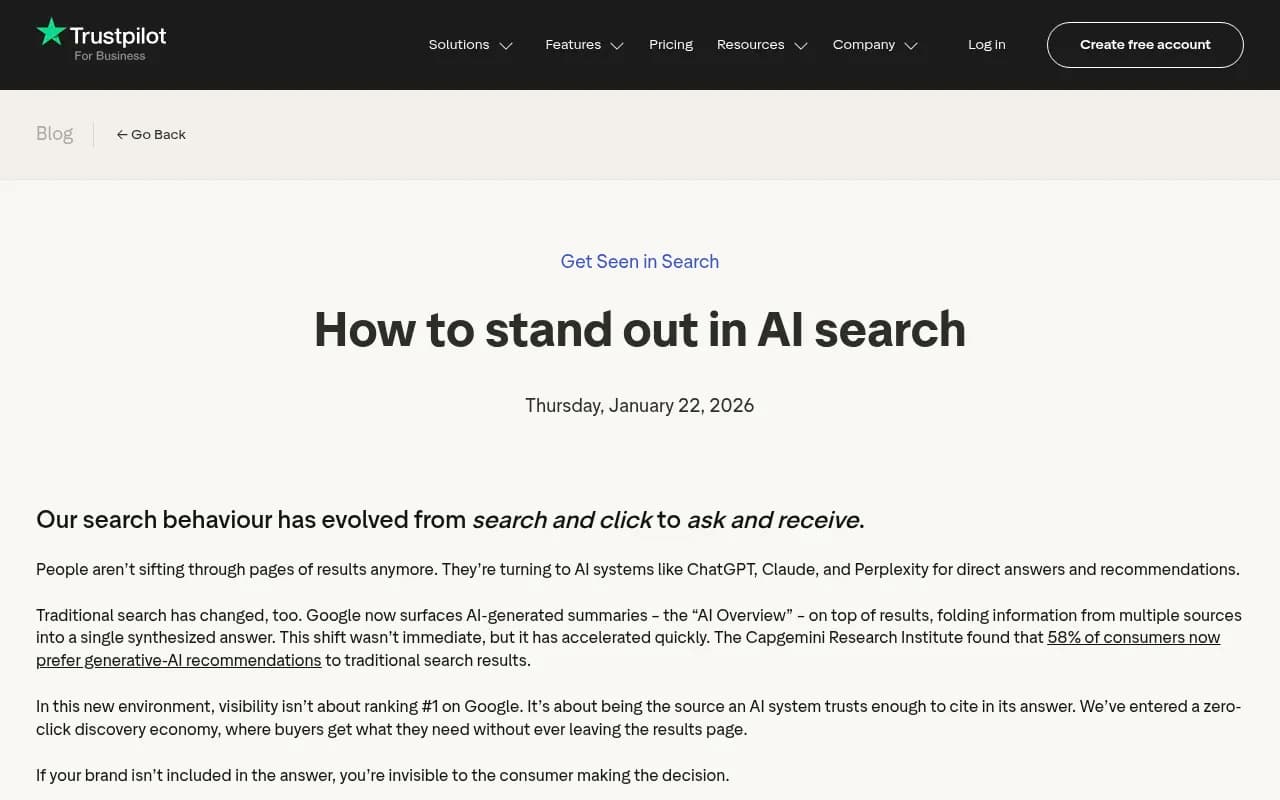
Trustpilot frames their approach around three factors they call the "3Rs":
- Relevance: High-authority sentiment gives AI the context it needs to match your business to user intent
- Ranking: Consistent quality signals on high-domain sites establish the credibility needed to be the top-cited answer
- Recency: AI systems prioritize real-time data to ensure answers are current
These aren't marketing claims — they map directly to how LLMs actually evaluate sources. The problem is that most businesses treat Trustpilot as a passive asset. They set up a profile, collect some reviews, and forget about it. That approach worked fine for traditional SEO. For AI citations, it's not enough.
Trustpilot is worth treating as an active channel, not a set-and-forget listing.
What "optimizing" your review profile actually means
"Optimize your Trustpilot profile" is advice you'll see everywhere, but it's rarely specific. Here's what it actually means in practice for AI citations:
Make your profile description answer real questions
AI models look for content that directly answers user queries. Your Trustpilot business description should include the specific problems you solve, the types of customers you serve, and the outcomes you deliver. Write it the way you'd write a FAQ answer, not a tagline.
If you sell project management software for construction teams, say that explicitly. Don't write "we help teams work better." The more specific your profile description, the more likely it is to surface when someone asks an AI a specific question about your category.
Respond to reviews with substance
Review responses are indexed content. When you respond to a review, you're adding more text to a page that AI models may cite. Generic responses ("Thanks for the feedback!") add nothing. Responses that acknowledge specific points, clarify features, or provide useful context add real signal.
This is especially true for negative reviews. A thoughtful, specific response to a complaint demonstrates accountability and adds nuance to the overall picture AI models form of your brand.
Encourage detailed reviews, not just ratings
Most businesses ask customers to "leave a review." A better ask is to prompt customers to describe a specific outcome. "Tell us how [product] helped you with [specific use case]" produces a more useful review than "let us know what you think."
You can do this through post-purchase emails, in-app prompts, or customer success follow-ups. The goal is reviews that contain specific language about your product's capabilities, the problems it solves, and the results customers achieved. That's the kind of content AI models can actually use when answering category questions.
Maintain review velocity
A burst of reviews followed by months of silence looks suspicious to both humans and AI models. Consistent review velocity — even if it's just a handful per month — signals that your business is active and that customer feedback is ongoing.
Set up automated review request sequences that trigger after key customer milestones. Keep the volume steady rather than trying to generate spikes.
Beyond Trustpilot: the review platform ecosystem
Trustpilot is the highest-authority general review platform, but it's not the only one that matters for AI citations. Different AI models draw on different sources, and your visibility across the review ecosystem affects your overall citation rate.
| Platform | Best for | Domain authority | AI citation relevance |
|---|---|---|---|
| Trustpilot | B2C and B2B, general | 93 | Very high |
| G2 | B2B software | ~90 | High for software queries |
| Capterra | SMB software | ~88 | High for software queries |
| Google Reviews | Local and service businesses | N/A (Google property) | Very high for local AI queries |
| Yelp | Local services, restaurants | ~93 | High for local queries |
| TrustRadius | Enterprise software | ~75 | Moderate |
| Any category | ~91 | Increasingly high |
Reddit deserves special mention. It's not a traditional review platform, but AI models — especially Perplexity and ChatGPT — cite Reddit threads heavily when answering product and service questions. A strong presence in relevant subreddit discussions, with customers organically recommending your product, is one of the most underrated AI citation signals in 2026.
For local businesses, BrightLocal can help you manage review presence across Google, Yelp, and other local platforms systematically.
For reputation management at scale across multiple locations, Reputation and Birdeye both offer tools to monitor and respond to reviews across platforms.

Connecting review data to AI visibility tracking
Here's where most guides stop: they tell you to get more reviews and optimize your profiles, but they don't tell you how to know if it's working. That's a real gap, because the connection between review activity and AI citation rates isn't always obvious or immediate.
The only way to close that loop is to actually track your AI search visibility — which prompts you appear in, which sources AI models cite when they mention you, and how that changes over time as you improve your review profiles.
Promptwatch is built specifically for this. It tracks your brand's visibility across 10 AI models (ChatGPT, Perplexity, Claude, Gemini, Google AI Overviews, and more), shows you which pages and sources are being cited, and identifies the gaps between what competitors are being cited for and what you're missing. If your Trustpilot profile starts getting cited more frequently after you've improved it, you'll see that directly in the citation data.

For a lighter-weight option, Otterly.AI and Peec AI both offer basic AI visibility monitoring that can help you see whether review platforms are showing up in your citation mix.

The content gap between reviews and AI citations
Reviews alone won't get you cited for every relevant query. AI models need to find answers to specific questions on your website and in your owned content — reviews are a trust signal and a citation source, but they're not a substitute for content that directly answers the questions your customers ask.
The practical implication: use your review data as a content brief. What specific problems do customers mention most often? What outcomes do they describe? What comparisons do they make? These are the topics your website content should address directly.
If your reviews consistently mention that your onboarding is faster than competitors, write a page that explains your onboarding process in detail. If customers frequently mention a specific integration, create content around that use case. You're essentially taking the language customers use to describe your product and turning it into structured content that AI models can cite.
This is the kind of content gap analysis that tools like Promptwatch are built to surface — showing you exactly which prompts competitors appear in that you don't, so you can create content that fills those gaps.
A practical workflow for 2026
Putting this all together, here's a repeatable process:
-
Audit your current review profiles. Check Trustpilot, G2, Capterra, and Google Reviews. Are your descriptions specific and current? Are you responding to reviews? What's your review velocity over the last 90 days?
-
Analyze your review content. Read through your last 50-100 reviews and identify the most specific, substantive ones. What language do customers use? What outcomes do they describe? What comparisons do they make?
-
Set up a review request sequence. Automate review requests that prompt customers to describe specific outcomes rather than just rate their experience. Aim for consistent velocity rather than volume spikes.
-
Respond to reviews with substance. Treat every response as indexed content. Be specific, add context, and address the actual points raised.
-
Use review language to brief content. Take the specific problems, outcomes, and comparisons from your reviews and turn them into website content that directly answers those questions.
-
Track your AI citation rate. Use a tool like Promptwatch to monitor which prompts you appear in, which sources AI models cite, and how your visibility changes over time. This is the only way to know if your review optimization is actually translating into citations.
-
Monitor Reddit and other discussion platforms. Set up alerts for brand mentions in relevant subreddits. Participate authentically in discussions where your product is relevant. AI models cite these threads, and organic positive mentions in high-traffic discussions carry real weight.
For monitoring brand mentions across the broader web and social platforms, Brand24 is a solid option for catching conversations you might otherwise miss.
The trust signal that actually moves AI models
There's a useful framing from Visa's CMO Frank Cooper III that Trustpilot cited in their 2026 AI search guide: "AI will amplify both credibility and risk... making trust the most critical differentiator in a B-to-AI world."
That's not hyperbole. AI models are essentially making trust judgments on behalf of users. When ChatGPT recommends a product or Perplexity cites a source, it's staking its own credibility on that recommendation. Models are conservative about this — they prefer sources with consistent, substantive, multi-platform signals of trustworthiness.
Review sites are one of the clearest trust signals available to AI models because they're third-party, hard to fake at scale, and rich with specific language about real customer experiences. A brand with 500 detailed, recent reviews across Trustpilot, G2, and Google Reviews is a brand that AI models feel safe citing.
The work of getting there isn't glamorous — it's review request sequences, response templates, and content briefs built from customer language. But it's also one of the most durable AI visibility strategies available, because it's grounded in genuine customer experience rather than technical optimization tricks that can be patched out in the next model update.
Start with your Trustpilot profile. Make it specific, keep it fresh, and respond to every review with something worth reading. Then track whether it's working.