Key takeaways
- Bluefish launched as a monitoring tool but has added Collections (campaign ROI), AI Accuracy (fact-checking), Brand Vault (source-of-truth ingestion for LLMs), and Agentic Campaigns (automated optimization) between February and June 2026 — that's a genuine platform shift, not a rebrand.
- The company raised a $43M Series B in April 2026 (total $68M) and claims 10%+ of the Fortune 500 as customers, but pricing is still quote-only with no public tiers.
- Model coverage claims are inconsistent across Bluefish's own materials: the homepage says "10+ LLMs," the funding press release names five (ChatGPT, Google AI, Claude, Perplexity, Amazon Rufus), and independent reviewers as recently as late 2025 found no Claude, Copilot, AI Mode, or DeepSeek support.
- SOC 2 certification was still "in progress" as of May 2026, which matters if you're evaluating Bluefish for regulated industries.
- Bluefish's real differentiator is agentic commerce tracking (Amazon Rufus / Alexa for Shopping) — a niche almost nobody else covers — but it lacks URL-level citation data, prompt-volume figures, and a content publishing pipeline that competitors like Profound and Promptwatch already ship.
What Bluefish used to be, and what it's calling itself now
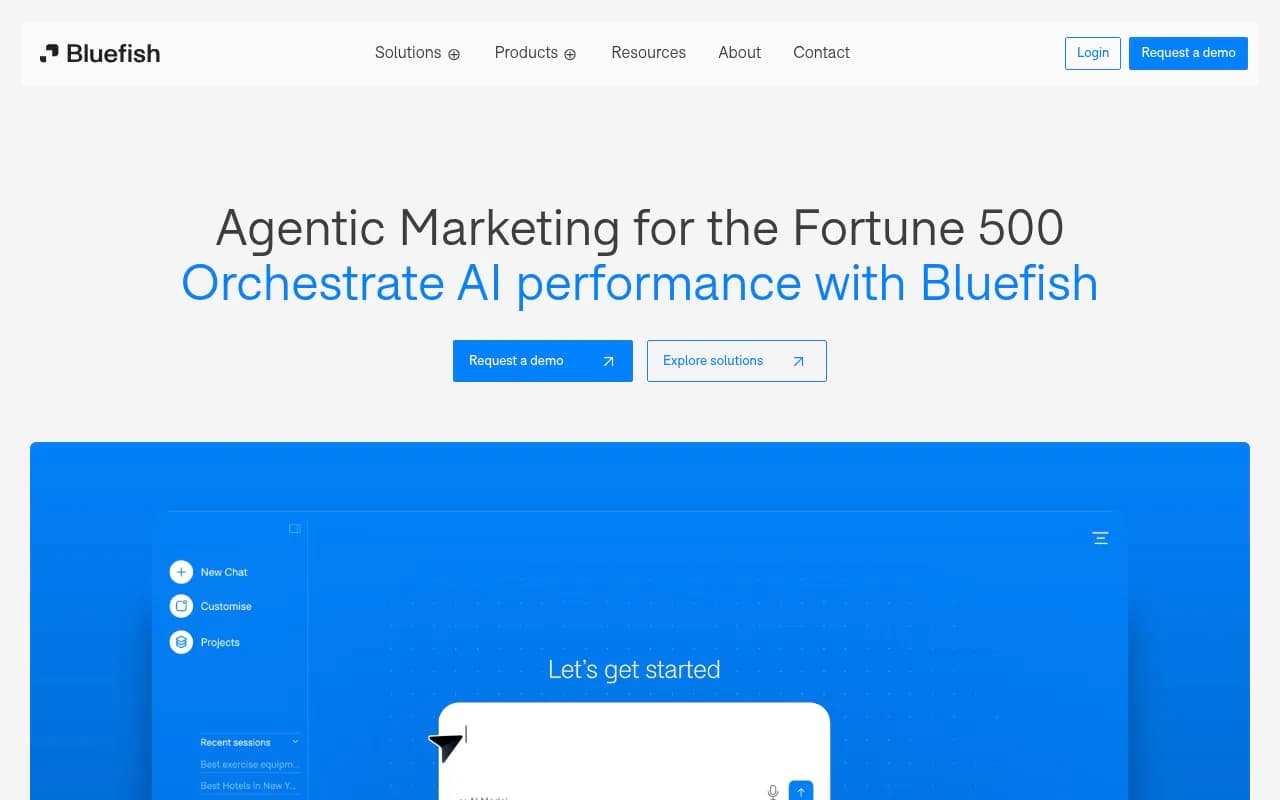
Bluefish launched in 2024 as an AI visibility tracker aimed squarely at large brands: does ChatGPT mention us, is the sentiment good, is the content safe. Simple enough. Eighteen months in, the company describes itself as "the Agentic Marketing Platform (AMP) for Fortune 500 brands," and it's chasing what it calls a $500 billion "Agentic Marketing" opportunity — its own number, not an independently verified market size, so treat it as a pitch-deck figure rather than fact.
The label change isn't just marketing copy. Look at what actually shipped between February and September 2026 and you can watch the product widen in real time.
The expansion timeline
- February 2026 — Collections. Groups related product pages, earned media, and reviews into one measurement unit so marketers can see campaign-level ROI in AI answers, benchmarked against Impact, Frequency, and Influence Rank scores. This is the first sign Bluefish wanted to move past "are we visible" toward "did this specific campaign work."
- May 2026 — AI Accuracy and Brand Vault. This is the one that actually surprised me. Brand Vault ingests a brand's first-party content and turns it into a continuously updated source of truth that gets shared with LLMs as training material, while AI Accuracy checks every factual claim an AI makes about the brand against that vault and flags mismatches by severity. Bluefish leans on a March 2026 Rithum survey here: 58% of shoppers say their trust drops when AI gets product info wrong, and 16% abandon the purchase outright. That's a real problem. Whether feeding an LLM your own "verified" content actually changes what it says later is a separate, unproven question.
- June 9, 2026 — "State of Enterprise Brands in AI" report. A benchmark of 194 Fortune-500-scale companies. The most useful finding, in my opinion: topic authority correlates more strongly with favorable AI descriptions than raw visibility does. Being mentioned a lot means less than being described well when you are mentioned.
- June 18, 2026 — Agentic Campaigns. Marketers set a target metric, Bluefish's agents diagnose what's dragging performance and generate tactics to hit the goal, then track the KPI impact of each change. This is the clearest evidence that Bluefish is trying to become an execution layer, not just a dashboard. It's also the module that most directly competes with the "agents that plan, write, and publish" category rather than the "tell me my score" category.
- September 24, 2026 — Forrester TEI study. Bluefish commissioned a Forrester Consulting Total Economic Impact study modeling a composite $35B enterprise with 20 brands. The projected numbers: ROI of 220% to 446%, NPV of $6.4M to $12.9M, against total costs of $2.9M over three years. Worth noting, productivity savings from less manual analysis made up only about 2% of the modeled benefit — almost all the projected value comes from revenue lift, not efficiency. Vendor-commissioned TEI studies are a well-worn genre; the methodology (six interviews at companies with $7.1B-$51B revenue) is thin for the size of the numbers being projected, so read the percentages as a sales aid, not an audited outcome.
Put those four releases together and the pattern is obvious. Bluefish isn't adding features randomly. It's building a straight line from "measure" to "diagnose" to "fix," which is the same arc every category in this space is chasing right now.
So is it still an AI visibility tool?
Yes, in the sense that visibility monitoring is still the foundation everything else sits on. No, in the sense that a buyer evaluating Bluefish purely as a monitoring dashboard is going to be surprised by a sales call that's really pitching an agentic marketing suite with a five-figure-and-up annual contract attached to it.
This matters for how you should read Bluefish's visibility scores in the first place. Promptwatch's own data on citation inventory gives useful context here: ChatGPT cites roughly five sources per web-search-triggered response, while Google AI Overviews and Perplexity cite closer to ten (https://promptwatch.com/data/average-sources-per-response). That's a small, contested pool of slots for every brand fighting for a mention, and it shifts month to month by content type — Promptwatch's August 2026 breakdown shows ChatGPT's citation mix moving from roughly 30% product pages down to 25% within the same month, while how-to content more than doubled its share (https://promptwatch.com/data/chatgpt-citation-types-over-time-august-2026). Any vendor's "visibility score," Bluefish included, is measuring against a target that moves under your feet. That's not a knock on Bluefish specifically, it's a reason to be skeptical of any single visibility number presented without context.
Where the story gets murky: coverage claims don't match
This is the part of the audit that gave me pause. Bluefish's own materials contradict each other on which AI platforms it actually tracks.
- The current homepage claims "10+ LLMs tracked daily including Alexa for Shopping and Amazon Rufus, plus 15+ provider integrations."
- The April 2026 Series B press release, the only place Bluefish names specific engines, says the platform covers "ChatGPT, Google AI, Claude, Perplexity, and Amazon Rufus." Five, not ten-plus.
- Independent reviewers, including Evertune's own comparison page from November 2025 and a separate roundup of AI visibility tools, both found that Bluefish did not support Claude, Copilot, Google AI Mode, or DeepSeek as of late 2025. Bluefish's claim to cover Claude only shows up in its own materials starting in April-May 2026.
- One reviewer (EchoWi) pointed out that Bluefish's actual product pages describe coverage in vague terms like "AI search" and "AI native experiences" and route straight to a demo request, rather than naming specific assistants anywhere except the funding press release.
None of this means Bluefish is lying. It probably means the product expanded its coverage between late 2025 and mid-2026 and the marketing hasn't caught up to a consistent story yet. But if coverage of a specific engine (say, Claude or Copilot) is a dealbreaker for your evaluation, don't take the homepage's word for it. Ask sales for a screen share of a live report showing that specific engine, dated to the current month.
Feature comparison: where Bluefish actually stands
| Capability | Bluefish AI | Profound | Evertune | Promptwatch |
|---|---|---|---|---|
| Prompt configuration | Managed by Bluefish's team, no self-serve | Full self-serve, exposes query fanout | Managed, dual base-model + search-layer view | Self-serve, 50-350+ prompts by plan, query fan-outs shown |
| Citation granularity | Domain-level only (Impact Score, Influence Rank) | Individual URL-level, with GA4/GSC tie-in | Source classified as Strength/Opportunity/Owned | Individual page-level, 22 content types, 20 source types |
| Crawler / log analytics | None disclosed | Agent Analytics via CDN integrations | Not a focus | AI Crawler Logs across 400+ bots, CDN integrations, citation rate per page |
| Content generation/publishing | Content Briefs only, no publishing | Full brief-to-publish pipeline | Not a focus | Content Agents with CMS publishing (Webflow, Framer, WordPress), content gap analysis |
| Agentic commerce (Rufus/Alexa) | Yes, named differentiator | No | No | Not a core focus |
| Prompt volume/difficulty data | Not disclosed | Real-conversation dataset | Not disclosed | Monthly search volumes and difficulty scores per prompt |
| Compliance | SOC 2 in progress as of May 2026 | SOC 2 Type II, HIPAA compliant | Not specified in research | Not specified here, check current status directly |
| Pricing | Quote-only, no public tiers | $99 (ChatGPT-only) to $399+ multi-engine | Quote-only | $95-$579/mo published tiers, plus agency and enterprise plans |
A few things jump out from that table. Bluefish's Impact Score and Influence Rank are domain-level, meaning you can see which sites shape an AI answer about you, but not which specific page on that site is doing the work. Profound's own comparison of the two (a competitor-authored comparison, so treat the framing with some skepticism, but the specific gaps it names check out against Bluefish's public materials) makes the same point: no URL-level breakdown, no GA4 or GSC integration, and no content generation or publishing pipeline. Bluefish gives you a ranked list of recommendations and a Content Brief, but somebody on your team still has to write, approve, and publish everything by hand.
Evertune's comparison adds a related gap: Bluefish's scoring can tell you which sources shape an AI's answer but, according to Evertune, can't classify those sources as an opportunity you should chase versus a strength you already own. That's a meaningful difference if you're trying to prioritize a content roadmap instead of just watching a number move.
The one thing Bluefish does that almost nobody else does
Credit where it's due: agentic commerce tracking is a real and mostly-unclaimed niche. Bluefish monitors whether AI shopping agents like Amazon Rufus actually recommend or select a brand's product correctly, not just whether a chatbot mentions the brand in a text answer. One independent review counted exactly two funded vendors doing this seriously, Bluefish and Brandlight, and noted that at least one competitor (Goodie) sells Rufus tracking as a defined line item on a priced plan, while Bluefish names the capability in a press release with no plan or price attached to it at all.
There's a timing risk worth flagging, though. Amazon is actively folding Rufus into a broader "Alexa for Shopping" experience through 2026, combining product comparison and order history with Alexa+ and a new agentic checkout feature. Rufus had more than 300 million users in 2025 per Amazon's own numbers. If you're buying into Bluefish specifically for Rufus tracking, confirm during the demo that its measurement has already adapted to the Alexa-for-Shopping rename and restructuring, not the old standalone Rufus interface.
It's also worth being honest about how much any of this optimization actually works yet. A July 2026 review of 45 GEO studies found no technique with a demonstrated, stable, causal effect on AI visibility across platforms, and the evidence gets even thinner for agentic-commerce optimization specifically. That's a useful gut-check against anyone, Bluefish included, selling certainty about controlling what an AI shopping agent decides to recommend.
Who Bluefish actually fits
A hands-on 30-day review from a competitor (tryanalyze.ai, so read for specifics rather than the overall verdict) landed on a pretty narrow ideal customer: Fortune 500 brands with 50+ marketing headcount, dedicated brand and PR teams, and six-figure annual tooling budgets. Third-party pricing estimates (not published by Bluefish itself) put a basic tier around $99-$299/month, a growth tier around $299-$799/month, and enterprise deals at five-to-six figures annually, but none of this is confirmed on Bluefish's own site, which routes everything to a demo request.
That combination, opaque pricing plus enterprise-sized minimum commitment, rules Bluefish out for most mid-market teams and basically all SMBs before you even get to a feature comparison.
Where this leaves buyers evaluating the category
If your priority is brand-safety and reputation monitoring specifically, with PR-suite integrations like Cision and a team that can absorb a managed, non-self-serve setup, Bluefish's own pitch still holds up reasonably well, with the caveats above about SOC 2 and inconsistent coverage claims. If you need self-serve prompt control, URL-level citation data, actual content publishing, and a transparent price you can see before you talk to sales, tools like Promptwatch cover more of that ground at a published price point, and its crawler-log and content-agent features fill the gaps Bluefish's own competitors keep pointing out.

For anyone still mapping the wider category before committing budget, the directory of GEO software at bestgeosoftware.com is a reasonable place to line up more options side by side, since Bluefish is one of dozens of vendors chasing the same problem from different angles right now, with wildly different levels of transparency about what they actually measure.
The bottom line
Bluefish has genuinely moved past being a plain AI visibility tracker. The Collections, AI Accuracy, Brand Vault, and Agentic Campaigns launches over 2026 are real product, not a coat of new paint on the same dashboard. But the company's own marketing is inconsistent about which AI engines it tracks, its pricing is entirely hidden behind a demo request, and its SOC 2 audit was still unfinished as of its most recent product announcement. If you're an enterprise brand that specifically needs agentic-commerce tracking and brand-safety alerting and you have the budget and patience for an opaque sales process, it's worth a demo. If you need transparency on price, engine coverage, and URL-level data before you'll even take a sales call, you'll get there faster with a competitor that publishes its numbers.