Key takeaways
- ISO 27001 produces a certificate for an information security management system (ISMS). SOC 2 produces an auditor's report on controls that can include exceptions. They answer different questions.
- For most AI visibility vendors, the strongest position is both: SOC 2 Type II for US enterprise buyers and ISO 27001:2022 for European and global procurement.
- Check the version and scope. ISO 27001:2013 certificates stopped being valid on October 31, 2025, and a SOC 2 report only covers the systems and period it names.
- Neither framework tells you how a vendor handles AI-specific risks like prompt injection or agent permissions. Ask about those separately.
- A public trust center, a recent report, and a clear data-handling answer matter more than a logo in the footer.
Why this question lands on procurement's desk
AI visibility platforms are an odd category to vet. They sit between marketing and IT. Marketing wants to know what ChatGPT says about the brand. Security wants to know what the vendor does with your analytics data, your CMS credentials, your Search Console connection, and your server logs.
That last part is where it gets serious. Many GEO platforms ask to connect to Google Search Console, a CDN, or a CMS so they can read crawler logs or publish content. Once a vendor touches those, it is a real third party in your supply chain, and the questionnaire that used to be a formality becomes a gate.
Two acronyms show up in nearly every response: ISO 27001 and SOC 2. They are related, not interchangeable, and treating them as the same thing is the most common mistake I see in vendor reviews.
What each one actually is
ISO 27001
ISO 27001 is the international standard for running an information security management system. It was developed by ISO and the IEC, and it takes a risk-based approach built on a Plan-Do-Check-Act cycle. The point is that security is a managed system with owners, risk treatment, reviews, and continual improvement, not a one-time checklist.
Certification is issued by an accredited certification body after two audit stages. Stage 1 checks documentation and scope. Stage 2 tests whether controls work in practice. After that come annual surveillance audits and a full recertification every three years.
The current edition is ISO/IEC 27001:2022, published October 25, 2022. Its Annex A has 93 controls in four themes: organizational (37), people (8), physical (14), and technological (34).
SOC 2
SOC 2 comes from the AICPA. An independent CPA firm examines a service organization's controls against the Trust Services Criteria: security, availability, processing integrity, confidentiality, and privacy. The result is a detailed report, not a certificate, and the auditor can note exceptions.
There are two flavors. Type I looks at whether controls are designed properly at a single point in time. Type II tests whether they operated effectively over a review period, which is why buyers generally want Type II.
Side by side
| ISO 27001:2022 | SOC 2 Type II | |
|---|---|---|
| Issued by | Accredited certification body | Independent CPA firm |
| Output | Certificate (pass/fail) | Detailed attestation report |
| Scope | Whole ISMS, defined by the vendor | Specific systems or services |
| Controls | 93 in Annex A, selected by risk | Mapped to Trust Services Criteria |
| Can show exceptions | No, it is binary | Yes |
| Cycle | 3 years, annual surveillance audits | Annual, over a review period |
| Strongest recognition | Europe, APAC, regulated global markets | US enterprise buyers |
Which one matters more for your team
It depends on who you are and where you buy.
If you are a US enterprise buyer, SOC 2 Type II is what your security team already knows how to read. They will want the report itself, not a summary. The exceptions section is useful precisely because it is not a clean certificate.
If you are in Europe, or you operate across several regulated markets, ISO 27001 tends to carry more weight. It also fits procurement processes that want a certificate on file and a named certification body. Mimecast makes the same point: ISO 27001 is globally recognized, while SOC 2 is requested mostly by US-based customers and partners.
If you want a shortcut: ISO 27001 proves a security program exists and keeps improving. SOC 2 proves that specific controls were examined by an outsider and how they performed. One says the system is managed. The other shows the evidence.
There is a reasonable argument that ISO 27001 is the better starting point for a young vendor, since SOC 2 tests controls the company defines itself while ISO makes it demonstrate risk management. That is a practitioner opinion from a Reddit thread, not a rule, but it explains why you see vendors holding one and working toward the other.
What AI-adjacent vendors actually show
Vendors present this differently, and the differences are informative. A few public examples:
| Vendor | What it states | Where |
|---|---|---|
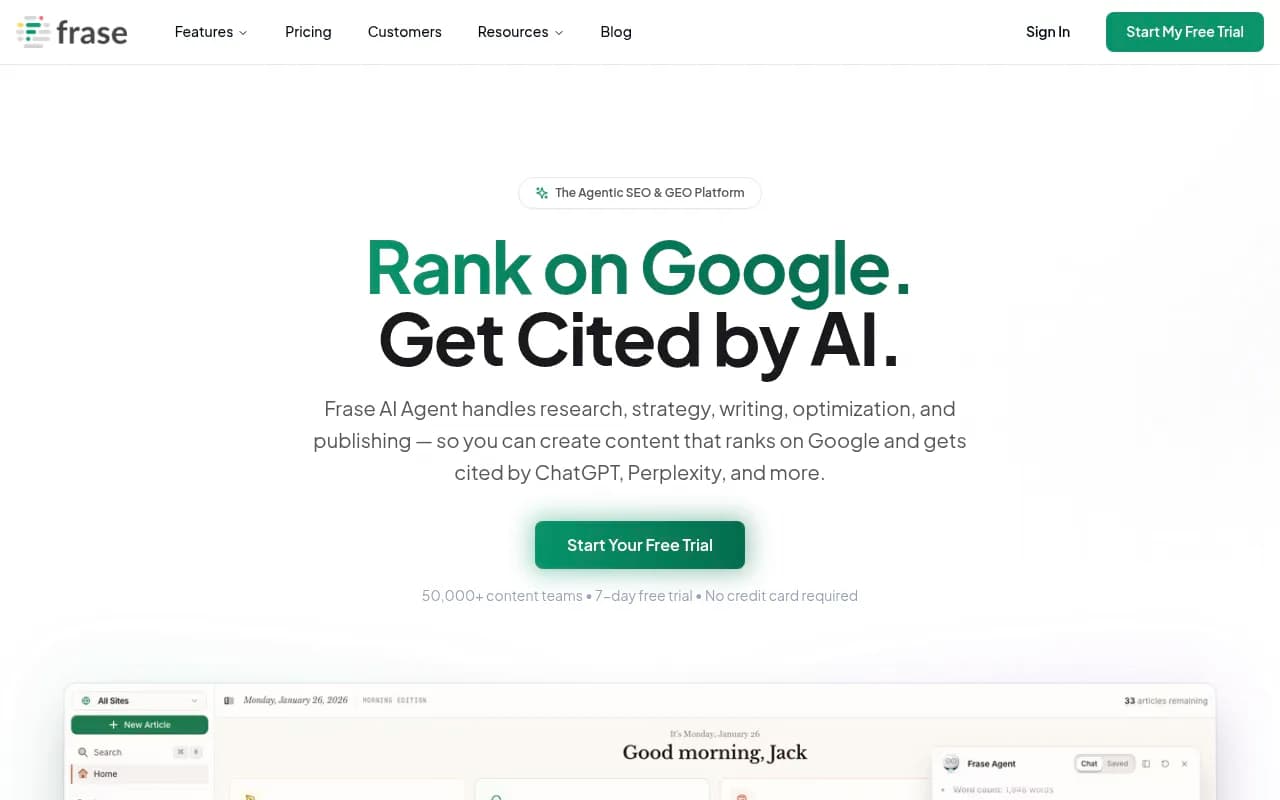
| Frase | SOC 2 Type II attested, GDPR compliant. ISO 27001 not listed. | Security page |
| Leadbeam | ISO/IEC 27001:2022, SOC 2 Type II audited, GDPR compliant | Trust center |
| Harvey | Another SOC 2 Type II audit completed, ISO 27001 renewed | SafeBase trust center |
| Level Access | ISO 27001 certified, SOC 2 Type II for platform and UserWay suite | Trust center |
The pattern is clear. The common stance among software vendors selling to enterprises is SOC 2 Type II plus ISO 27001, published on a trust center, often a SafeBase one. A vendor with only SOC 2 is not disqualified, especially if it sells mostly in the US, but you should know why ISO is missing and whether it is on the roadmap.
Frase is in our catalog if you want to look at a content-focused example:
Where AI visibility vendors differ from ordinary SaaS
The scoping question is more interesting here than in most categories. An AI visibility platform may handle several very different kinds of data:
- Prompt and response data collected from AI engines, which is mostly public-facing output.
- Your first-party analytics: visitor events, conversions, referrers.
- Server and CDN logs used for AI crawler analysis.
- Search Console and Bing Webmaster connections.
- CMS credentials or tokens, if the platform publishes content for you.
- Brand documents and knowledge base content you upload.
The prompt data is the least sensitive. The CMS tokens and server logs are the most. A certificate that covers "the corporate ISMS" may be broad, but a SOC 2 report that covers only the monitoring dashboard would say nothing about the publishing pipeline. Ask which system boundary each report covers and whether the features you plan to use are inside it.
A useful reference point: one platform I would call out is Promptwatch, which states ISO/IEC 27001 certification and GDPR compliance, with data handled by an EU-based company. That is the kind of explicit statement you want to see, and you should still ask for the certificate itself and the scope statement.

As with any vendor, confirm current status directly rather than relying on a marketing page.
What neither framework tells you
This is the part many procurement checklists miss. ISO 27001 and SOC 2 are about information security management and controls. Neither one specifically verifies how an AI product behaves under adversarial conditions. A vendor can hold both and still have weak answers on:
- Prompt injection and unsafe tool use by agents
- How much write access an agent has to your CMS, and whether actions need approval
- Whether your data is used to train models
- Logging of what an agent changed, and who approved it
- Dependence on external model providers and their own certifications
If the platform includes agents that write and publish content, ask whether changes are logged and whether you can review before anything goes live. Features like an organization audit log, scoped API keys, and role-based access are practical evidence here. They are not a substitute for a certification, but they show the vendor thought about control.
ISO 42001, the AI management system standard, is the newer framework that addresses governance of AI itself. Most AI visibility vendors do not hold it yet, and I would not make it a hard requirement. Asking whether it is planned is fair.
Seven checks that catch weak answers
- Check the ISO version. The certificate should cite ISO/IEC 27001:2022. The transition period ended October 31, 2025, so a 2013 certificate is no longer valid.
- Check the certification body. It should be accredited, and the certificate should have a number and an expiry date.
- Read the scope statement. Does it cover the product, the hosting, and the team that will handle your data?
- Ask for Type II, not Type I. Type I is a snapshot. Type II covers a review period, usually several months to a year.
- Look at the report period. If it ended 14 months ago, ask for a bridge letter and what changed since. A bridge letter is only the vendor's statement, not an audit, so treat it as a stopgap.
- Read the exceptions and the auditor's opinion. An unqualified opinion with a few minor exceptions is normal. A qualified opinion on a control that touches your data is not.
- Check complementary user entity controls. SOC 2 reports list what you are responsible for. Make sure you can actually do those things.
I could not find reliable public pricing for either audit, so I will not guess at what a vendor spent. What matters to you is the evidence, not the invoice.
A simple decision matrix
| Your situation | Minimum to ask for | Nice to have |
|---|---|---|
| US enterprise, standard SaaS review | SOC 2 Type II | ISO 27001:2022 |
| EU or multinational buyer | ISO 27001:2022 plus GDPR terms | SOC 2 Type II |
| Regulated industry (finance, health, legal) | Both, plus a data processing agreement | Pen-test summary, ISO 42001 roadmap |
| Vendor will publish to your CMS | Both, plus access controls and audit log | Scoped keys, approval workflow |
| Small team, low-risk read-only tool | Whichever one the vendor has, plus a trust center | The other, on a roadmap |
Use the trust center, and test what AI says about it
A public trust center saves everyone time. It lets security review happen before a sales call, with documents under NDA behind a request button. Harvey, Leadbeam and Level Access all publish one, and it is quickly becoming the norm.
There is a second angle worth knowing about. One vendor blog, MaxAEO, suggests maintaining a "Trust Fact Matrix" listing each certification, its status (certified, in progress, not certified), where the evidence lives, and who owns it. It also suggests asking AI engines questions like "Does [Brand] have ISO 27001?" and checking whether the answer states the certification and its scope correctly. That is a vendor's opinion, but the idea holds up: buyers increasingly ask AI assistants about vendor security before they ever email you. If you are the vendor, you can monitor these answers with AI visibility tools such as Promptwatch's Brand Narrative and Fact Check features, which flag claims AI makes about you that are inaccurate. If you are the buyer, remember that an AI answer about a certification is a lead, not evidence. Verify it on the trust center.
It also bears on how an AI visibility vendor handles its own data. One fair question is how it verifies the data it reports. For example, Promptwatch Data's AI crawler traffic report counts only requests whose source IP matches the operator's published ranges, which excludes spoofed user agents. Ask any vendor that sells crawler analytics the same thing: how do you know the traffic is real, and where is that log data stored?
Questions to put in your security questionnaire
Copy these straight into your review:
- Which ISO 27001 edition is your certificate issued under, and who is the certification body?
- Does the ISMS scope include the product, hosting, and support staff?
- Do you have a SOC 2 Type II report, and what is the period covered?
- Were there any exceptions, and which controls did they affect?
- Where is customer data stored, and who are your sub-processors?
- Is customer data used to train any models?
- What access do agents or automations have to our CMS, CDN, or analytics, and can it be scoped and logged?
- How do you handle prompt injection and unsafe agent actions?
- Do you publish a trust center, and how often is it updated?
- Are you working toward ISO 42001 or another AI-specific standard?
If a vendor gets defensive on any of these, that is information too.
Shortlisting AI visibility vendors with this lens
Once you know what to ask, you can narrow the field quickly. The category is crowded, and compliance posture varies a lot between large platforms and early-stage tools. A few that buyers commonly evaluate:
Profound

Otterly.AI

For a wider view, the GEO software directory at bestgeosoftware.com lists options by category, and Promptwatch's 2026 platform comparison covers features side by side. I would not pick on certifications alone. A vendor with both frameworks and nothing you can actually use is still the wrong choice. But a vendor that cannot answer the questions above should not get connected to your CDN or CMS.
Bottom line
If you have to pick one, match it to your buyers: SOC 2 Type II for US enterprise procurement, ISO 27001:2022 for European and global. For anything that connects to your logs, analytics, or CMS, ask for both, read the scope, and check the dates. Then ask the AI-specific questions that neither framework answers, and put the answers in writing before the contract is signed.