Key takeaways
- Jasper, Rytr, and Copy.ai are content generation tools -- they write words, but they don't track whether AI search engines like ChatGPT or Perplexity are actually citing those words.
- Rytr is the budget pick for solo writers who need quick drafts; Copy.ai suits marketing teams running high-volume campaigns; Jasper targets enterprise teams that want an opinionated workflow with brand controls.
- None of the three help you understand or improve your visibility in AI search engines -- that's a fundamentally different problem requiring a different category of tool.
- If AI search visibility matters to your business (and in 2026, it should), Promptwatch is the platform that closes the loop: find the gaps, generate content designed to be cited, and track the results.
- The honest answer for most teams: use a writing tool for drafts, use a GEO platform to decide what to write and measure whether it's working.
There's a version of this comparison that writes itself: Jasper has more templates, Rytr is cheaper, Copy.ai has better workflows, and so on. That comparison was useful in 2023. In 2026, it misses the bigger question.
AI search engines -- ChatGPT, Perplexity, Google AI Overviews, Gemini, Claude -- now answer a meaningful share of the queries that used to send people to your website. When someone asks "what's the best project management tool for remote teams," they often get an answer directly, with citations to specific pages. If your site isn't cited, you don't exist in that answer. No amount of well-written copy fixes that if you're writing about the wrong topics.
So this guide covers two things: how Jasper, Rytr, and Copy.ai actually compare as writing tools, and where the category ends -- and a GEO platform begins.
What these tools actually do (and what they don't)
Before getting into specifics, it's worth being clear about what AI writing tools are built for.
Jasper, Rytr, and Copy.ai are content generation tools. You give them a topic, a template, or a brief, and they produce text. They're good at reducing the time it takes to go from blank page to first draft. They can help with brand voice consistency, SEO metadata, and scaling content production.
What they don't do: track how AI search engines respond to your content, identify which prompts your competitors are being cited for but you aren't, show you which pages ChatGPT or Perplexity are pulling from, or measure whether your content is actually appearing in AI-generated answers.
That's not a knock on these tools -- it's just a different problem. A word processor doesn't tell you whether your article ranks on Google, and an AI writer doesn't tell you whether your content gets cited by AI engines. The tools in this guide operate in different layers.
Jasper AI: the enterprise content platform
Jasper started as a template-based AI writer and has evolved into something closer to a marketing workflow platform. In 2026, it positions itself around "AI agents" that can run multi-step content pipelines -- brief to draft to SEO optimization to brand review.
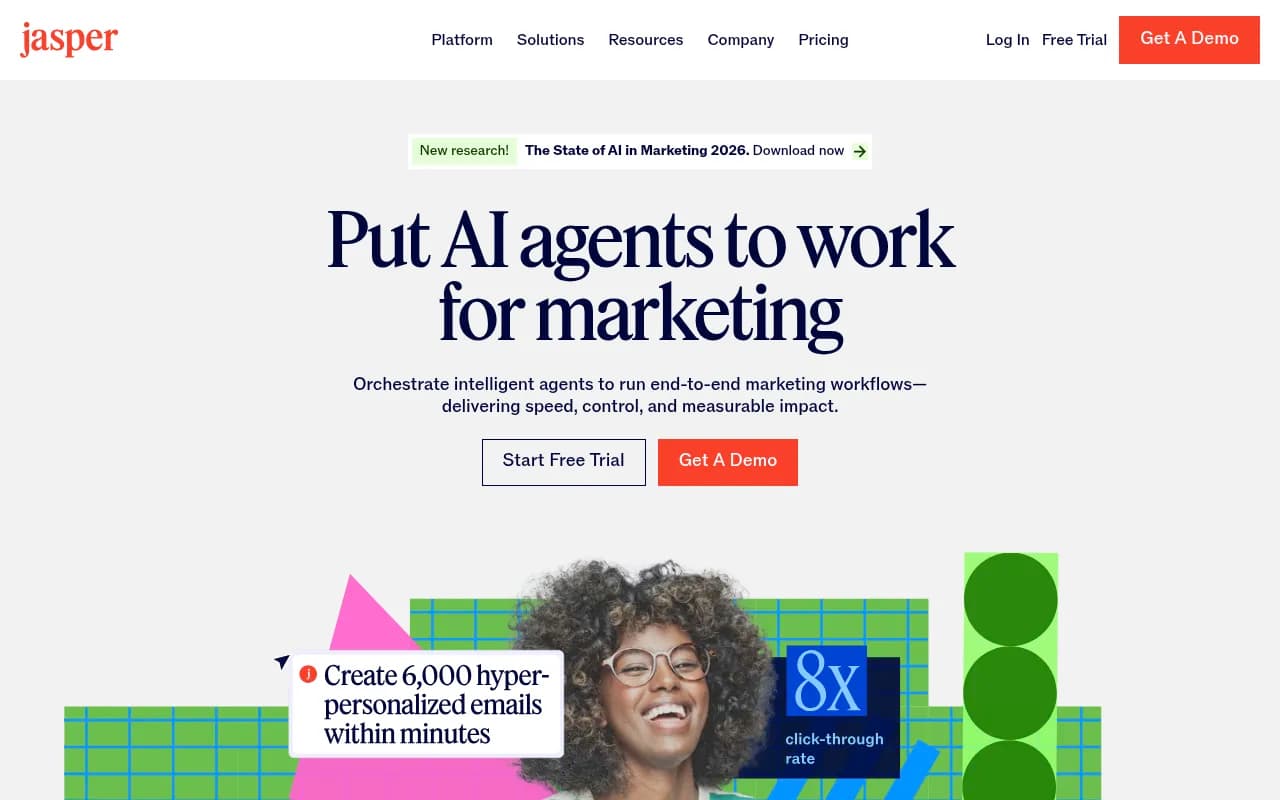
The core value proposition: if you're a mid-to-large marketing team that wants brand voice controls, approval workflows, and integrations with your existing stack (HubSpot, Salesforce, etc.), Jasper has more infrastructure than its competitors.
Pricing starts around $49/month for individuals and scales significantly for teams and enterprise. The enterprise tier adds brand voice training, custom workflows, and SSO.
Where Jasper works well:
- Marketing teams that need consistent brand voice across many writers
- High-volume content production with approval workflows
- Teams already invested in the HubSpot ecosystem
Where it falls short:
- The underlying model quality (GPT-4 class) is the same as what you'd get from ChatGPT directly -- you're paying for the workflow layer
- No AI search visibility features -- it generates content but has no way to tell you whether that content is being cited by AI engines
- Expensive relative to what you actually get if you just need drafts
One honest observation from testing: most of what Jasper produces still needs editing. A 2026 analysis of AI-generated content found that generic tools required 60-80% editing to sound authentic. Jasper is better than average at following style guides, but it's not a replacement for a writer -- it's a faster starting point.
Rytr: the budget pick for solo creators
Rytr is the most straightforward tool in this comparison. It's a structured AI writing assistant with a clean interface, a library of use-case templates (blog posts, emails, product descriptions, social captions), and pricing that starts free and tops out around $29/month for unlimited usage.
There's no pretense of being an enterprise platform. Rytr is for individual writers, freelancers, and small teams who need to produce content faster without spending much money. The output quality is decent for short-form content -- ad copy, email subject lines, product descriptions -- and weaker for long-form articles that require nuance or research.
Where Rytr works well:
- Freelancers and solo creators on tight budgets
- Short-form copy: emails, social posts, product descriptions
- Quick first drafts that you plan to rewrite heavily
Where it falls short:
- Long-form content tends to be generic and requires significant editing
- No SEO integration, no AI visibility features, no workflow tools
- The template-driven approach can feel rigid for complex briefs
If you're a solo blogger or freelancer who needs a cheap way to get words on the page faster, Rytr is fine. If you're a marketing team trying to build a content strategy that performs in AI search, it's the wrong tool for the job.
Copy.ai: the workflow-first option for marketing teams
Copy.ai has made a deliberate pivot toward marketing workflow automation. Where Rytr is a writing assistant and Jasper is a content platform, Copy.ai in 2026 is positioning itself as a "GTM AI platform" -- connecting content generation to sales workflows, email sequences, and campaign management.

The writing quality is comparable to Jasper (both use similar underlying models). The differentiation is in the workflow layer: Copy.ai has pre-built workflows for things like competitor analysis, prospect research, and multi-step campaign creation. For marketing teams that want to automate repetitive content tasks, this is genuinely useful.
Pricing starts around $49/month for individuals and scales for teams.
Where Copy.ai works well:
- Marketing teams running high-volume outbound campaigns
- Teams that want to connect content generation to CRM and sales workflows
- Use cases where speed matters more than depth (ad copy, email sequences, landing page variants)
Where it falls short:
- Like Jasper and Rytr, no AI search visibility -- it generates content but can't tell you what to write based on what AI engines are looking for
- The GTM pivot means the core writing experience has gotten more complex without necessarily getting better
- Output still requires editing for anything that needs to sound genuinely human
Head-to-head comparison
| Jasper | Rytr | Copy.ai | Promptwatch | |
|---|---|---|---|---|
| Primary use case | Enterprise content platform | Budget AI writer | Marketing workflow automation | AI search visibility + GEO |
| Starting price | ~$49/mo | Free / $9/mo | ~$49/mo | $99/mo |
| Content generation | Yes | Yes | Yes | Yes (AI Content Agents) |
| Brand voice controls | Yes | Basic | Basic | Yes (brand guidance) |
| SEO optimization | Basic | No | No | AI-search focused |
| AI search visibility tracking | No | No | No | Yes (10 AI engines) |
| Prompt/citation monitoring | No | No | No | Yes |
| Answer gap analysis | No | No | No | Yes |
| AI crawler logs | No | No | No | Yes |
| Reddit/YouTube insights | No | No | No | Yes |
| ChatGPT Shopping tracking | No | No | No | Yes |
| Traffic attribution from AI | No | No | No | Yes |
| Best for | Large marketing teams | Solo creators | Campaign automation | Brands tracking AI visibility |
Where the writing tool category ends
Here's the thing: Jasper, Rytr, and Copy.ai are all answering the question "how do I produce content faster?" That's a real problem, and they solve it reasonably well.
But in 2026, there's a second question that matters just as much: "Is my content being found and cited by AI search engines?" These tools have no answer for that. They can't tell you:
- Which prompts your competitors appear in that you don't
- Which pages on your site ChatGPT or Perplexity are actually pulling from
- Whether a piece of content you published last month has been crawled and cited by AI engines
- What topics AI models are looking for answers to that your site doesn't cover
This is where GEO (Generative Engine Optimization) platforms come in. And this is where the comparison gets more interesting.
Promptwatch: when you need more than a writer
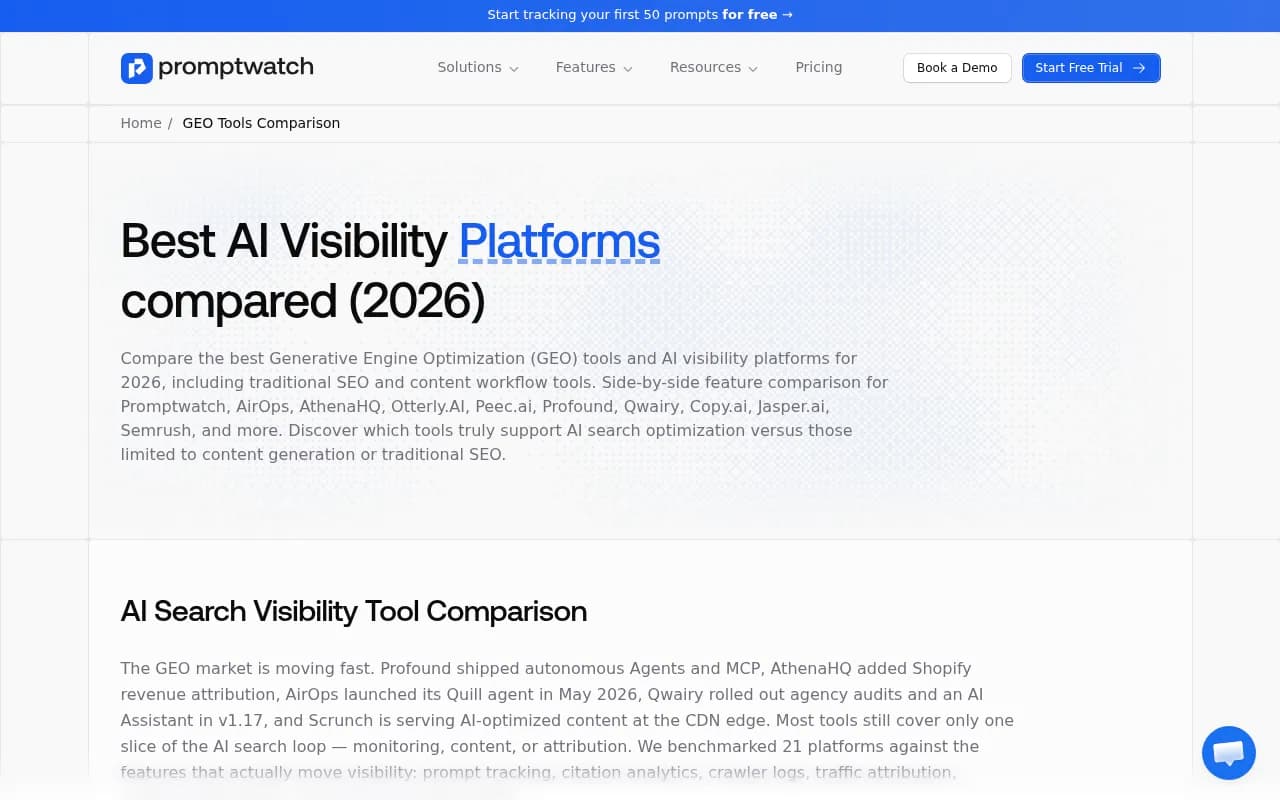
Promptwatch is a different category of tool. It's not primarily a writing assistant -- it's an AI search visibility platform that also generates content. The distinction matters.

The core workflow Promptwatch is built around:
-
Find the gaps: Answer Gap Analysis shows which prompts competitors are visible for in AI search engines (ChatGPT, Perplexity, Gemini, Google AI Overviews, Claude, and seven others) that you aren't. You see the specific topics and questions AI models are answering without citing your site.
-
Create content that addresses those gaps: Content Agents generate articles, listicles, and comparisons grounded in real prompt data, citation patterns, and competitor analysis. This isn't generic AI writing -- it's content built around what AI engines are actually looking for.
-
Track whether it works: Page-level tracking shows which pages are being cited, by which AI engines, and how often. AI Crawler Logs show when ChatGPT or Perplexity crawl your site, which pages they read, and when those pages move from crawled to cited.
The difference from Jasper or Copy.ai isn't just features -- it's the underlying logic. Writing tools start with "what do you want to write?" Promptwatch starts with "what are AI engines citing, and what are they missing from your site?"
For brands that care about appearing in AI-generated answers -- which, in 2026, is increasingly every brand -- that's a more useful starting point.
Pricing: $99/month (Essential, 1 site, 50 prompts), $249/month (Professional, 2 sites, 150 prompts, crawler logs), $579/month (Business, 5 sites, 350 prompts). Free trial available.
Which tier is actually right for you?
The honest answer depends on what problem you're trying to solve.
Use Rytr if: You're a solo creator or freelancer who needs to produce drafts faster and doesn't have budget for anything more sophisticated. It's the cheapest way to get AI-assisted writing. Don't expect it to improve your search visibility -- in AI search or traditional search.
Use Copy.ai if: You're a marketing or sales team running high-volume campaigns and you want to automate repetitive content tasks. The workflow automation is genuinely useful for outbound sequences and campaign copy. Accept that you'll still need to edit the output.
Use Jasper if: You're a larger marketing team that needs brand voice controls, approval workflows, and integration with enterprise tools. The workflow layer is worth paying for if you have multiple writers who need to stay on-brand. Still not a solution for AI search visibility.
Use Promptwatch if: You care about appearing in AI-generated answers -- in ChatGPT, Perplexity, Google AI Overviews, or any of the other major AI engines. If you want to know which prompts your competitors are winning that you aren't, which pages AI engines are citing, and whether your content strategy is actually working in AI search, this is the tool built for that problem.
The combination that makes sense for most teams: A writing tool (Jasper or Copy.ai) for execution speed, plus Promptwatch to decide what to write and measure whether it's working. The writing tool handles production; the GEO platform handles strategy and measurement.
A note on the broader GEO landscape
If you're evaluating Promptwatch against other AI visibility platforms, the market in 2026 has a clear split. Most tools -- Otterly.AI, Peec.ai, AthenaHQ -- are monitoring dashboards. They show you data about where you appear in AI search, but they don't help you fix it.
Promptwatch is one of the few platforms that closes the full loop: monitoring, gap analysis, content generation, and traffic attribution in one place. A 2026 comparison of 12 GEO platforms rated it as the only "Leader" across all categories, specifically because most competitors stop at monitoring while Promptwatch extends into optimization and content creation.
That said, if you're purely looking for an AI writing tool and AI search visibility isn't a priority yet, Jasper, Rytr, and Copy.ai are all legitimate options within their respective price tiers. The question is whether you're building for the search landscape of 2022 or 2026.
In 2026, AI engines are answering questions your customers used to Google. The brands that appear in those answers are the ones that understood this shift early and built content strategies around it -- not just content production pipelines.