Key takeaways
- Most AI visibility tools look the same in a demo: a prompt list, a score, a competitor chart. The differences show up in where the data comes from, how often it refreshes, and what you can do with it.
- Ask every vendor whether responses come from real user interfaces or from API calls. The answers can differ.
- AI engines change behavior abruptly, so a tool without frequent refreshes or model-change context will mislead you.
- Monitoring alone is the thin part. Look for crawler logs, traffic attribution, and a way to act on gaps.
- Run a two-week trial with your own prompts and a written scorecard before you pay annually.
Why so many GEO tools look alike
Open five GEO tool websites and you will see roughly the same thing. A hero line about being visible in ChatGPT, Perplexity and Gemini. A dashboard screenshot with a score, a line chart, and a competitor table. A pricing page with tiers based on prompt counts.
That sameness is not an accident. The cheapest version of this product is easy to build: take a list of prompts, send them to model APIs on a schedule, check whether your brand name appears in the text, and draw a chart. A weekend project can do it. Some of the tools in our catalog are honest about this. Directory descriptions for a few of them say things like "basic monitoring but missing key features" or "monitor AI search visibility, but not much else."
There is nothing wrong with a simple tracker if that is what you need. The problem is paying for a thin tool while believing you bought a full platform. This guide gives you the questions that separate the two.
The thin-product test in one table
| Question | Thin product | Real product |
|---|---|---|
| Where does data come from? | API calls only, or vague answer | Real UI monitoring of ChatGPT, AI Overviews, Perplexity and others, with API models shown separately |
| How often does it refresh? | Weekly, or unstated | Daily at minimum, faster on higher tiers |
| Does it show fan-outs? | No, only your static prompts | Shows the sub-queries models actually run |
| Does it explain why? | A score and a chart | Citations, source pages, crawler logs, content gaps |
| Does it measure traffic? | No | AI-referred visits and conversions |
| Can you act in the tool? | Export a CSV | Prioritized actions, content creation, publishing |
| Is there any change context? | No | Annotations or data showing model updates |
If a tool fails most of the left column, you are looking at a dashboard, not a platform. The rest of this guide explains each row.
Check where the data comes from
This is the question vendors dodge most. There are two ways to collect AI answers. One is to call a model API. The other is to monitor the actual interface a person uses, such as the ChatGPT web app with search turned on, or the AI Overview that appears in a Google result.
They are not the same. An API response may skip the web search step, cite different sources, or recommend different products than the user-facing answer. If a tool reports "you appear in 40% of ChatGPT answers" using API output, that number may describe something real users never see.
Promptwatch monitors the real interfaces of ChatGPT, Gemini, Perplexity, Claude, Google AI Overviews and others, and Promptwatch Data is built on that collection method. API models are tracked next to them to show what a model believes from training data, which is a different question. A good vendor can tell you exactly which is which. For more detail, the how Promptwatch collects data Academy page is a useful template for what a transparent answer looks like.

What to ask: "For ChatGPT, is each response collected from the web interface with search on, or from the API? What about AI Overviews?" If the answer is a pivot to how many models they support, that is your answer.
Check how fast the tool refreshes
AI citation behavior is not stable, and the data proves it. A few examples from Promptwatch's research:
- ChatGPT started using the site: operator at scale on August 8, 2026. It went from about 0.4% to about 17% of fan-out queries overnight, and searches per response nearly doubled (report).
- reddit.com's share of ChatGPT citations fell from about 4% to 0.5% on August 14, 2026 (report).
- Average citations per ChatGPT response dropped across GPT-5.3, GPT-5.4 and GPT-5-Mini around the GPT-5.3 rollout on March 4, 2026 (report).
- Microsoft Copilot's average source count swung from under 2 to nearly 17 within a few weeks, then settled low. The report's advice is to judge Copilot on monthly trends, not weekly snapshots (report).
Now imagine a tool that refreshes weekly and shows one visibility number. You lose 10 points one Monday. Was it your content, a competitor, or ChatGPT changing how it searches? The tool cannot tell you, and you end up rewriting pages that were fine.
Contrast that with Perplexity, which cites almost exactly 10 sources per answer every day. The report calls it a stable test bench, since movement in your citations there reflects your own changes rather than engine noise. A good tool lets you use stable engines as a control and volatile ones as a trend.
What to ask: how often do prompts run, can I increase the frequency, and does the product show me when an underlying engine changed behavior? Promptwatch runs prompts daily on every plan, and on Business and Agency Scale a monitor can run every 12, 6, or 1 hours. Confirm current limits on the pricing page.
Check whether it understands fan-outs
When you ask ChatGPT something, it often does not search for your exact words. A single prompt can trigger several separate searches, called query fan-outs. In Promptwatch's ChatGPT query fan-out data, the measured average was 2.15 fan-outs per response in early December 2025, easing to about 1.84 by early March 2026. Average fan-out query length fell from about 117 characters to the high 80s, then about 53 characters in April.
So what ChatGPT actually searches for is short and keyword-like, while many trackers feed models long, conversational, static prompts. A tool whose prompt set was written once and never revisited may not match how the engine behaves today.
What to ask: does the tool show the sub-queries models run? Can I see them per model? Can I turn a fan-out into a tracked prompt? Our explainer on query fan-outs and the free ChatGPT Query Fan-Out Generator are a quick way to see what you should expect.
Check whether it explains why, not just what
A score tells you something happened. It does not tell you why. The gap between a thin tool and a real one is mostly here.
Three layers are worth testing:
- Citations. Which of your pages get cited, where they sit in the source list, and which third-party pages are cited instead of you.
- Crawler access. Can the AI bots read your site at all? IP-verified crawler logs separate an access problem from a content problem. Most trackers do not have this. Promptwatch's AI crawler logs cover bots like GPTBot, ClaudeBot and PerplexityBot, and the AI crawler traffic report shows what that data looks like. Meta-WebIndexer, for instance, went from about 2% to nearly 38% of tracked AI crawler requests between mid-July and August 9, 2026 (report). A tool with no crawler view would never have shown you that.
- Traffic. Do visits from ChatGPT, Perplexity and others show up with conversions? Without it, you cannot prove the channel matters. See attributing AI traffic for how it works.
If a vendor shows a "visibility score" and then a CSV export, you will do the explaining yourself.
Check the score itself
Two tools can report different numbers for the same brand and both be defensible, because the definitions differ. Ask for the formula in writing.
Specific things to pin down:
- Does a response that does not mention you count as zero, or is it dropped from the average?
- Is a mention in the first sentence weighted differently from a mention in a list of ten?
- Is sentiment folded into visibility, or measured separately?
- Does Share of Voice count one mention per response per brand, or every mention?
- How are brand aliases and common-word names handled? If your brand is also an ordinary word, naive string matching produces garbage.
Promptwatch publishes its metric definitions for Visibility Score and Share of Voice, and its citations vs mentions page explains why being named and being cited are different outcomes. Publishing definitions is a good sign in any vendor. Hiding them is not.
Check whether you can act inside the tool
This is where "look-alike" tools split furthest from the rest. A dashboard reports. A platform also helps you fix things. Here is a sensible ladder:
- Prioritized to-do list based on your own data
- Content gap analysis that maps your pages against the prompts AI answers
- Content creation grounded in what AI already cites
- Publishing to your CMS
- Measurement of whether the published page got crawled, cited and clicked
Many tools stop at step one or skip all five. Promptwatch covers the full loop with its Action Board, content gap analysis, Content Agent and CMS publishing to WordPress, Webflow and Framer, then tracks the live page. Note that the Content Agent starts on the Business plan, so confirm what your tier includes.
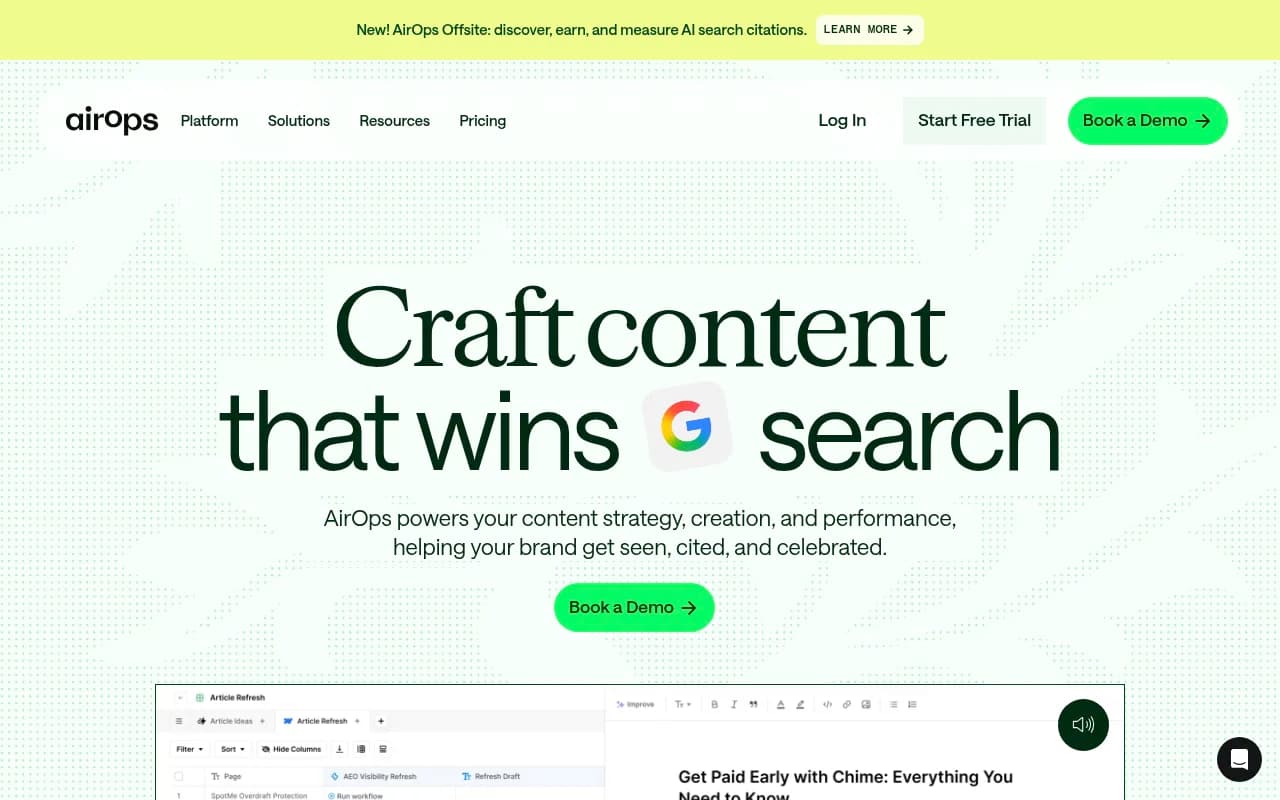
That said, not every team wants this. If you already have a content team and only need measurement, a lighter tool is fine. Just know which bucket you are buying. Content generation tools such as AirOps sit on the opposite end: they write, but they do not monitor visibility or crawler behavior.
Who is writing the comparison you are reading
Be suspicious of "best AI visibility tools" lists. The research behind this guide turned up several, and the pattern is consistent:
- Vendor-written guides, such as the one Scrunch publishes on how to choose a platform, are useful for frameworks but are not neutral about the conclusion.
- Independent-looking Medium listicles can still be commercially motivated. The comment thread under one July 2026 roundup includes a reader promoting their own tool, which tells you how crowded and promotional this space is.
- Vendor blogs ranking competitors often place themselves in the top five.
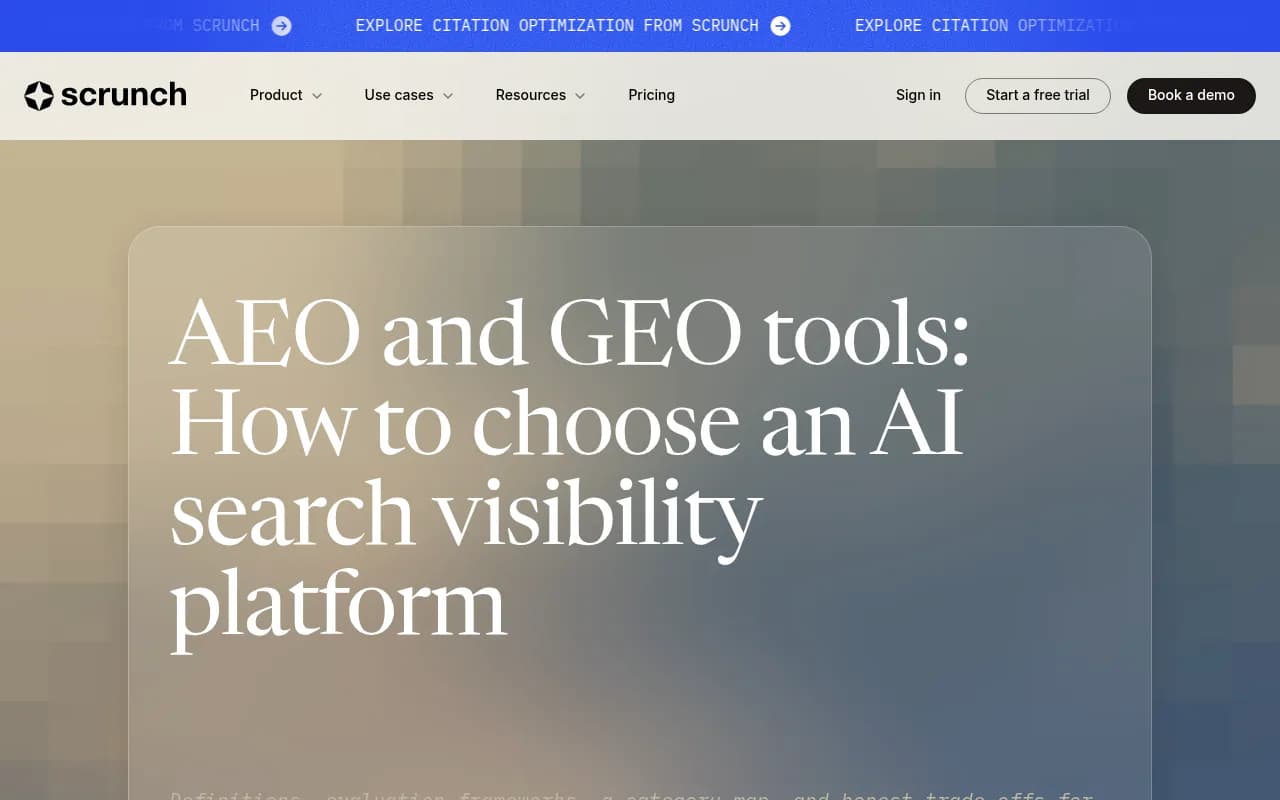
The Scrunch guide above is worth reading for its category map and evaluation questions, as long as you remember who wrote it. Our own position is also not neutral: this site is published by 1001 SEO Media, which uses Promptwatch as its AI visibility platform. Weigh that accordingly, and verify every claim here on the vendor's own pages.
The crowded middle: tools you will see in every shortlist
The categories below are broad on purpose. Features change fast, so confirm details directly.
| Category | Examples in our catalog | Typical strength | Typical gap to probe |
|---|---|---|---|
| Monitoring-first trackers | Otterly.AI, Peec AI, Rankshift, LLM Pulse | Simple setup, lower entry price | Crawler logs, traffic attribution, content creation |
| Enterprise monitoring | Profound, Scrunch, Evertune | Deep reporting, enterprise workflows | Price, execution features, social coverage |
| SEO suites with AI add-ons | Semrush, Ahrefs Brand Radar | Familiar interface, one login | Fixed prompt sets, shallow AI-specific data |
| Content generators | AirOps, Jasper, Copy.ai | Production speed | No visibility or citation grounding |
| Minimal or niche trackers | Promptmonitor, AI Peekaboo, Goodie AI | Cheap and quick | Often basic monitoring only |
Profound

Otterly.AI


For head-to-head details, see Promptwatch vs Profound, vs Scrunch, vs Semrush and the full 2026 GEO platform comparison. To browse more options on your own, the GEO software directory at bestgeosoftware.com lists many of these side by side.
Red flags in a demo
These are the tells I would watch for, roughly in order of how often they show up:
- The vendor cannot say whether data comes from the UI or an API.
- A single blended score across all models with no per-model view. ChatGPT and AI Overviews behave very differently, and the social citation gap is a good example: from Sep 28 to Oct 4, 2026, ChatGPT got 0.46% of citations from social platforms while Google AI Overviews got 12.2% (report). Averaging those hides the story.
- No country or language control. A monitor that mixes markets gives you mush.
- Pricing based on prompts alone with no mention of how many responses you actually get, or how often they run.
- Screenshots in the demo are all mock data, and trial accounts cannot load your own prompts.
- Nothing on crawler access, even though the first reason AI cannot cite you is often that it cannot read you.
- Claims like "rank #1 in ChatGPT" as if it were a fixed ranking. AI answers vary per run, so serious tools talk about sampled visibility.
- Lock-in: annual-only billing with no trial.
A two-week trial scorecard
Prompt-count tiers make it tempting to start small. Do not. A short, structured trial reveals more than any sales deck.
- Write down 30 to 50 real prompts across informational, commercial and branded intent. Include some that mirror real fan-outs, which are shorter than you think.
- Load the same prompts into each shortlisted tool where possible.
- Hand-check ten responses in the actual ChatGPT and Google interfaces. Compare to what the tool reports.
- Note the refresh time and whether any data gap appears.
- Look for the crawl and traffic views. Install tracking if offered. Free options help here: the Agentic Readiness Check and AI Crawler URL Inspector tell you whether bots can read your site before any paid tool does.
- Ask the tool to tell you the three most valuable things to do next. Judge the answer against what you already know.
- Export your data. If you cannot get it out cleanly, assume you cannot leave cleanly.
Promptwatch offers a 7-day free trial on monthly billing, and a free AI visibility report with no login gives you a baseline to compare other tools against. Always confirm current plan limits at promptwatch.com/pricing.
What a fair price looks like
Price alone does not predict quality, but check what the number buys. Compare cost per response, not just cost per prompt, and check whether country, state and city tracking, all AI models, API access and team seats are included or metered separately. As one reference point, Promptwatch lists Essential at $95 per month, Professional at $245 and Business at $579, with agency plans starting at $199. Use those as a yardstick for what "included" should look like, and verify on the pricing page.
If you are an agency, the questions change slightly: unlimited projects, client reporting and API access matter more than any one feature. The agency solutions page lays out what to expect.
Bottom line
A thin GEO tool is one that tells you a number and leaves you alone with it. A real one tells you where the data came from, refreshes often enough to survive engine changes, shows the sub-queries and citations behind the score, proves whether the traffic arrives, and gives you a way to fix the gaps. Run the scorecard on your own prompts before you commit, and keep the two-week trial result on file. It will be the most honest document in your buying process.
For more background on what the data says about how AI engines behave, the Promptwatch Data hub is the best starting point.