Key Takeaways
- Measurement is a platform job. AI answers are crowded and unstable, so you need many prompts, many models, and trend lines. That is hard to do by hand and cheap to do with software.
- Execution is where a managed service can earn its fee: third-party placements, comparison pages, and scheduled content refreshes.
- Published agency retainers range from roughly $1,500 to $50,000 a month. Self-serve platforms run from about $10 to $1,000+ a month, depending on whom you ask.
- For most teams with any in-house content capacity, buy the platform first and add outside help only for the gaps you cannot fill.
- Whichever you choose, content decays. Budget for ongoing work, not a one-off project.
The actual question you are answering
People frame this as agency versus software. That is a bit misleading. The real question is: which part of GEO work can your team not already do?
GEO (generative engine optimization) breaks into two jobs. The first is measuring how your brand shows up in answers from ChatGPT, Perplexity, Google AI Overviews, Gemini and others. The second is changing what those systems see: your pages, your technical setup, and what third parties say about you.
Software is built for the first job. People, whether yours or an agency's, do the second. Some platforms now automate chunks of the second job too, which blurs the line, but the framing still holds.
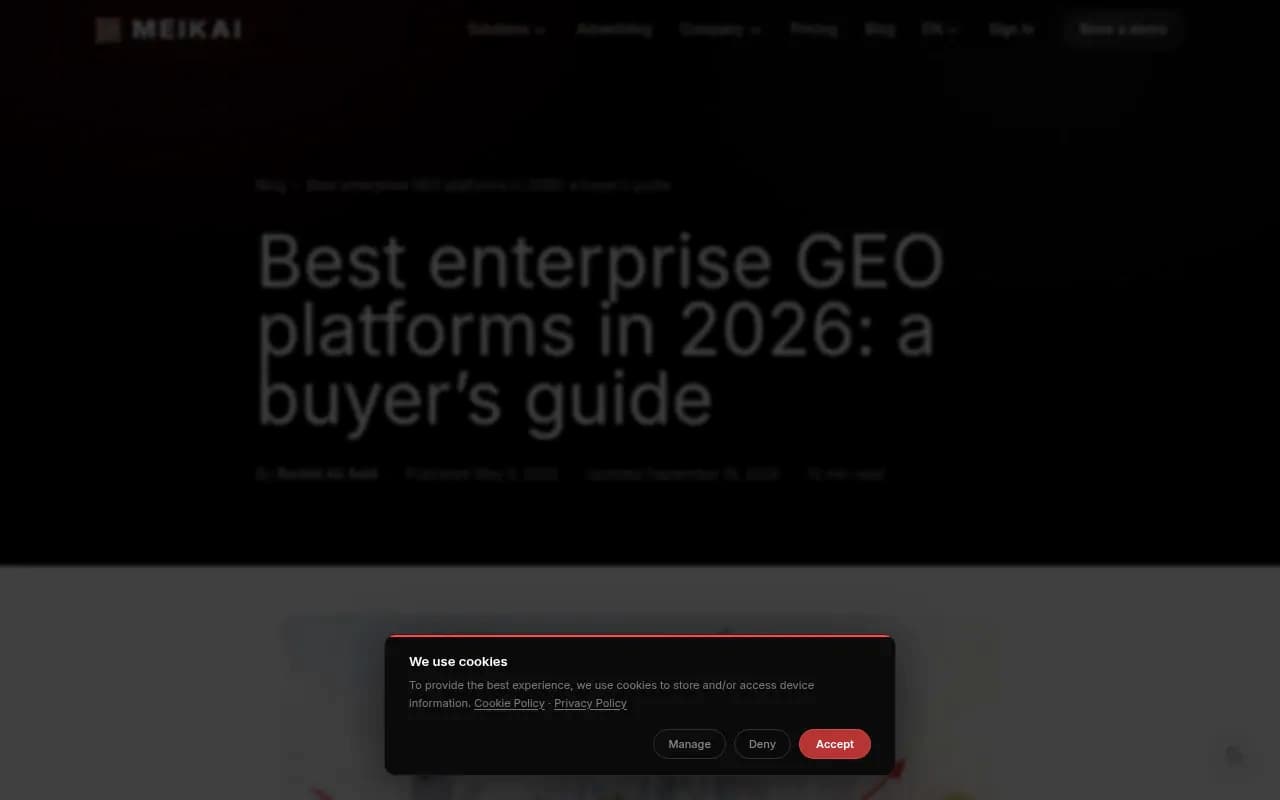
One caveat before we go further. Most of the comparison content on this topic is written by vendors. One enterprise buyer's guide I read says openly that it is "a vendor's point of view, not an independent benchmark," and a cost guide from a platform-tool seller concludes that platforms beat agencies. Both may be right. Both also have a horse in the race. Weigh accordingly, including this guide's mild preference for software-first buying.
What each option actually is
Software platforms
A platform tracks a set of prompts across AI models on a schedule and reports metrics such as mention rate, citation rate, share of voice, and how the model describes you. The better ones add crawler logs, site audits, content tools, and traffic attribution. The weaker ones stop at a dashboard.
Common categories:
- Monitoring-only trackers, for example Otterly.AI, Peec AI, and Rankshift
- Enterprise monitoring and benchmarking such as Profound and ScrunchAI
- Platforms that add execution: content generation, publishing, and prioritized to-do lists
- SEO suites with an AI add-on, such as Semrush and Ahrefs Brand Radar
Managed services
A managed GEO service is a team that does the work for you, usually with platform software behind it. You get an analyst or strategist, a roadmap, content production, and often off-site work like digital PR and citation building. Some vendors blur the categories, selling software plus a managed layer in one contract.
In our catalog, examples of the managed or agency side include Passionfruit Labs, First Page Sage, Grow and Convert, Stridec, and the done-for-you service Snezzi.
The hybrid
The third path is software that does execution itself. Agent-style platforms plan, write, and publish content against your visibility gaps, so you are renting automation rather than analyst hours. Promptwatch is one of these, and its Business tier includes an automated Content Agent that publishes to Webflow, Framer, or WordPress.

What it costs in 2026
Published figures disagree, which tells you something about the market. Here are two sources side by side.
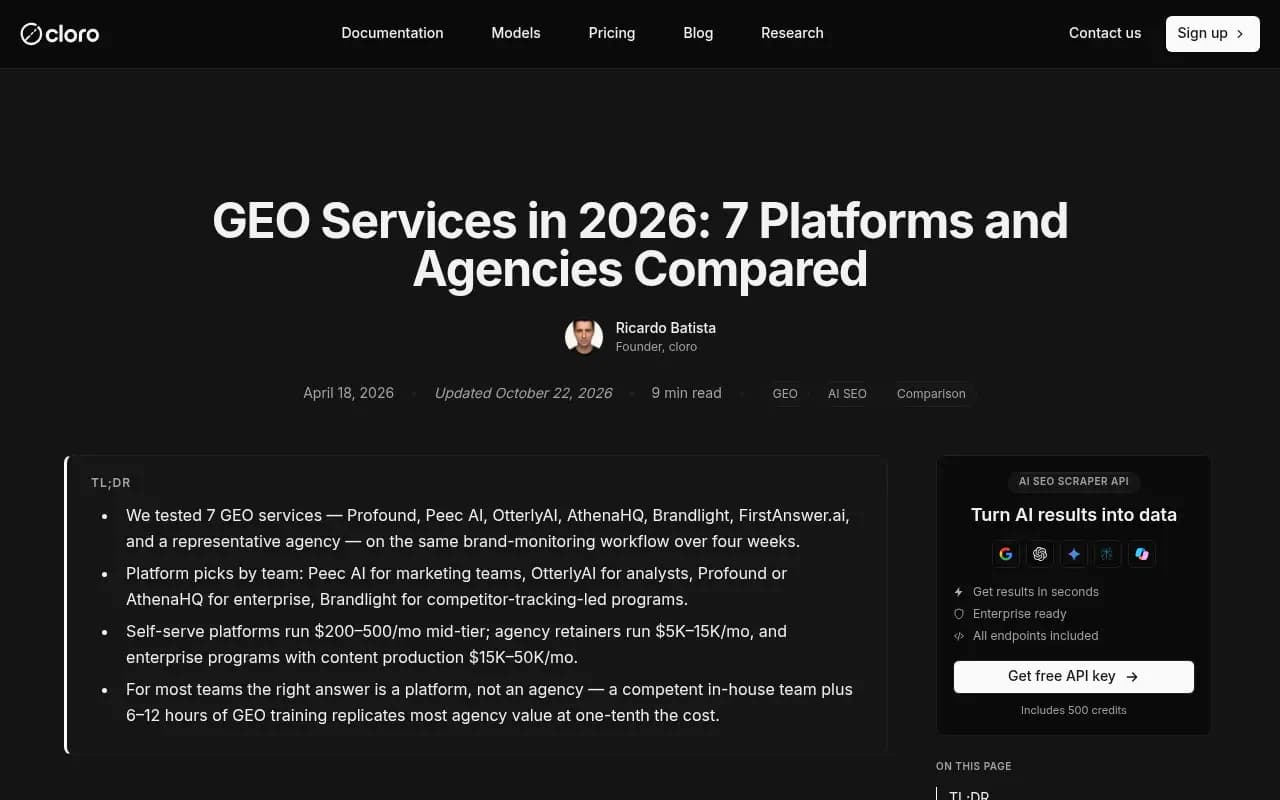
| Option | cloro (GEO services comparison) | TeamAI cost guide |
|---|---|---|
| Agency, mid-market | $5K-$15K/month | $1,500-$50,000/month (all tiers) |
| Agency, enterprise | $15K-$50K/month incl. content | Same range, upper end |
| Self-serve platform | $200-$500/month | $10-$250/month (DIY tools) |
| Monitoring software | n/a | $50-$1,000+/month |
| Hourly/project work | n/a | $50-$300/hour; $5K-$50K per project |
Treat these as ballparks. Neither source verified current vendor pricing line by line, and plans change often. Always confirm on the vendor's pricing page.
For reference, Promptwatch publishes its pricing: Essential at $95/month, Professional at $245/month, and Business at $579/month, with agency plans from $199/month. Confirm current numbers at promptwatch.com/pricing. At those prices, an agency retainer buys you the equivalent of roughly 10 to 50 months of a mid-tier platform each month. That gap is the core of the economic argument.
Why measurement belongs in software
Promptwatch Data gives a concrete reason you cannot eyeball this. In its report on unique domains per ChatGPT response (Sep 28 to Oct 4, 2026), 47.6% of cited responses cited 10 or more domains, and 66.1% cited at least 8. Only 6% cited three or fewer.
When answers are that crowded, one prompt tells you almost nothing. You need coverage across many prompts, plus position and framing, not just a yes/no on whether you were cited. An analyst manually checking 40 queries a month cannot produce that. Software can, daily.
Two more things software does better than people:
- Trend tracking. Promptwatch's content half-life report followed every page ChatGPT cited on July 6, 2026 for 90 days. News lost half its pages within 36 days. Landing pages kept 78% after 30 days. Visibility moves, and only continuous measurement catches it.
- Crawler and traffic data. Whether AI bots reach your pages, and whether citations turn into visits, is a log-and-analytics question. Few agencies have this data unless they license a platform that does.
Where a managed service can earn its fee
Execution is the harder, slower, more human part. A few areas where outside help makes sense:
- Third-party placements. Listicles, reviews and comparison pages on other sites are often the way into an answer. Getting listed takes outreach and relationships, which software does not do.
- Content volume. If you have no in-house content team, someone has to write.
- Content mix by intent. Promptwatch's citation data by content type (Sep 28 to Oct 4, 2026) shows product pages at 22.4% of ChatGPT citations and landing pages at 16.8%. For commercial prompts, product pages, landing pages, listicles and comparisons make up almost 70%. For branded prompts, reviews hit 5.6%, more than 3x their overall share. Each intent rewards a different content mix, and a good strategist maps content to that.
- Technical and CMS work. Structured data, rendering fixes, and crawl access often need developers. If you lack them, a service can bridge the gap.
There is a flip side. The cloro comparison notes that with an agency "you're paying for analyst time that may not be more sophisticated than your in-house team would be after a brief training investment." It also claims a competent team plus 6 to 12 hours of GEO training can replicate most of what an agency provides at one-tenth the cost. That is a vendor's claim and I would not bet a budget on the exact multiple, but the direction is plausible for teams that already run SEO well.
The decision table
| Your situation | Buy | Why |
|---|---|---|
| Small in-house SEO or content team, need to start measuring | Self-serve platform | Cheapest way to get baseline data; the team can act on it |
| No content team, no time, some budget | Platform with agent-based execution, or a managed service | Someone has to produce pages; automation is cheaper than retainers |
| Many brands, markets, languages | Enterprise platform, possibly plus managed layer | Access controls, SSO, and scale matter more than price |
| Heavy off-site needs (PR, listicles, reviews) | Agency for the off-site piece, platform for tracking | Relationships are not automatable |
| Strong SEO team, tight budget | Mid-tier platform, no agency | Use the money on content, not retainers |
| Brand with reputation issues in AI answers | Platform for monitoring, specialist for remediation | You need sentiment tracking and human judgment together |
Software tiers worth knowing
For monitoring on a budget, Otterly.AI and Peec AI are the usual starting points. Both are focused trackers: good for baselines, light on fixes.
Otterly.AI


For enterprise-scale benchmarking, Profound, AthenaHQ, and Bluefish AI are the names that come up. Profound is strongest on competitor and citation benchmarking, though one comparison describes it as monitoring-focused with no built-in execution layer.
Profound


If you already live in an SEO suite, Semrush adds AI visibility tracking to the stack you have, which is reasonable if you want one login.
For a broader view of the category, the directory at bestgeosoftware.com lists GEO platforms side by side.
Where I land on platforms that act: if you will not have bandwidth to turn dashboards into pages, pick one that closes the loop. Promptwatch's Action Board and Content Agent generate prioritized actions and draft content grounded in your own citation and crawler data, then track whether the published page gets crawled and cited. That is the piece many monitoring tools leave to you.
Questions to ask any vendor or agency
These work for both sides of the decision.
- Which real interfaces do you track? API outputs and consumer UI answers can differ. Ask whether data comes from the actual ChatGPT or AI Overviews interface.
- How many prompts, and how often? One-off snapshots are weak. Daily or weekly tracking over hundreds of prompts is better.
- How do you handle each content type and prompt intent? A vendor that has one template for everything is guessing.
- How often do you refresh pages? Citations decay. If the answer is "we publish and move on," walk.
- Can I see the underlying data? A "visibility score" with no explanation is a red flag. As one evaluation put it, platforms that offer only a score without what drives it or what to do next provide limited practical value.
- What is in the contract? Look for term length, minimums, and who owns the content and the data. Some agencies, including 1001 SEO Media, sell month-to-month with no long-term lock-in; ask every vendor the same.
- How do you prove it worked? Look for traffic and conversion attribution from AI sources, not just mentions.
A practical way to decide
Here is the sequence I would follow.
Step 1: Get a baseline with software
Sign up for a trial of one or two platforms. Most offer a free tier or trial. Track 30 to 50 prompts across your category, brand, and competitor comparisons. Take a week to see where you stand.
Step 2: Diagnose the bottleneck
Look at the data. Low share of voice across many prompts is a coverage problem: you need more content and more mentions. Mentions without citations to your own pages point to content or crawlability issues. Late position means prominence is the problem.
Step 3: Match the bottleneck to a resource
Coverage and content gaps: in-house writers, an agent-based platform, or an agency. Crawlability: your developers, or a technical specialist. Off-site mentions: PR or outreach help.
Step 4: Add outside help narrowly
If you hire an agency, scope it to the gap. Do not pay a full retainer for monitoring you already get from software. Keep the platform in-house so you own the data and can audit the agency's claims.
Step 5: Review at 90 days
Check whether tracked prompts moved, whether AI-referred traffic grew, and whether published pages are still cited. If not, change the plan, not just the budget.
When to choose a managed service anyway
Buy managed when you truly have no capacity. A two-person marketing team that cannot add a line to its workload will get more from a retainer than from a login it never opens. A platform nobody uses is the most expensive option of all.
Also consider it in regulated or high-stakes categories where someone needs to own accuracy and reputation in AI answers. And for enterprises running many brands and markets, a managed layer on top of platform software can make sense, as some enterprise vendors sell it that way.
The bottom line
For most teams in 2026, buy the platform first. It gives you measurement you cannot replicate by hand, at a small fraction of an agency retainer, and it keeps the data in your hands. Then spend the saved budget on what software cannot do: relationships, placements, and original content.
Choose a managed service when you lack the people to execute, and scope it tightly. Whichever route you take, plan for upkeep. The half-life data says pages need refreshing, and no vendor can make that go away.
To see how your brand looks in AI answers today, run a free scan or trial before you sign anything. Real numbers beat vendor claims, including this guide's.