Key takeaways
- Frase, Clearscope, and Surfer SEO are traditional content optimization tools built primarily for Google rankings — not AI citation visibility
- Peec.ai is an AI visibility monitoring tool, which puts it in a completely different category from the other three
- None of these four tools offer a complete answer to the question "why isn't AI citing my content?" — they each solve one piece of the puzzle
- If AI citation is your actual goal, you need a tool that combines visibility tracking, gap analysis, and content generation grounded in real citation data
- The comparison table below breaks down exactly where each tool fits and what it can't do
There's a question a lot of content teams are asking right now: "We're ranking on Google. Why isn't ChatGPT mentioning us?"
It's a fair question, and the honest answer is that ranking on Google and being cited in AI search are related but not the same thing. The signals that make AI models cite a source — topical authority, direct question-answering, citation patterns from other trusted sources — overlap with traditional SEO but don't map perfectly onto it.
So when you look at four tools like Peec.ai, Frase, Clearscope, and Surfer SEO, you're actually looking at tools built for different problems. Some were designed before AI search was a thing. Others were built specifically for it. Understanding what each one actually does — and what it doesn't — is the only way to figure out which one (or which combination) is worth your time.
What each tool actually does
Before comparing them, it helps to be clear about the category each tool belongs to.
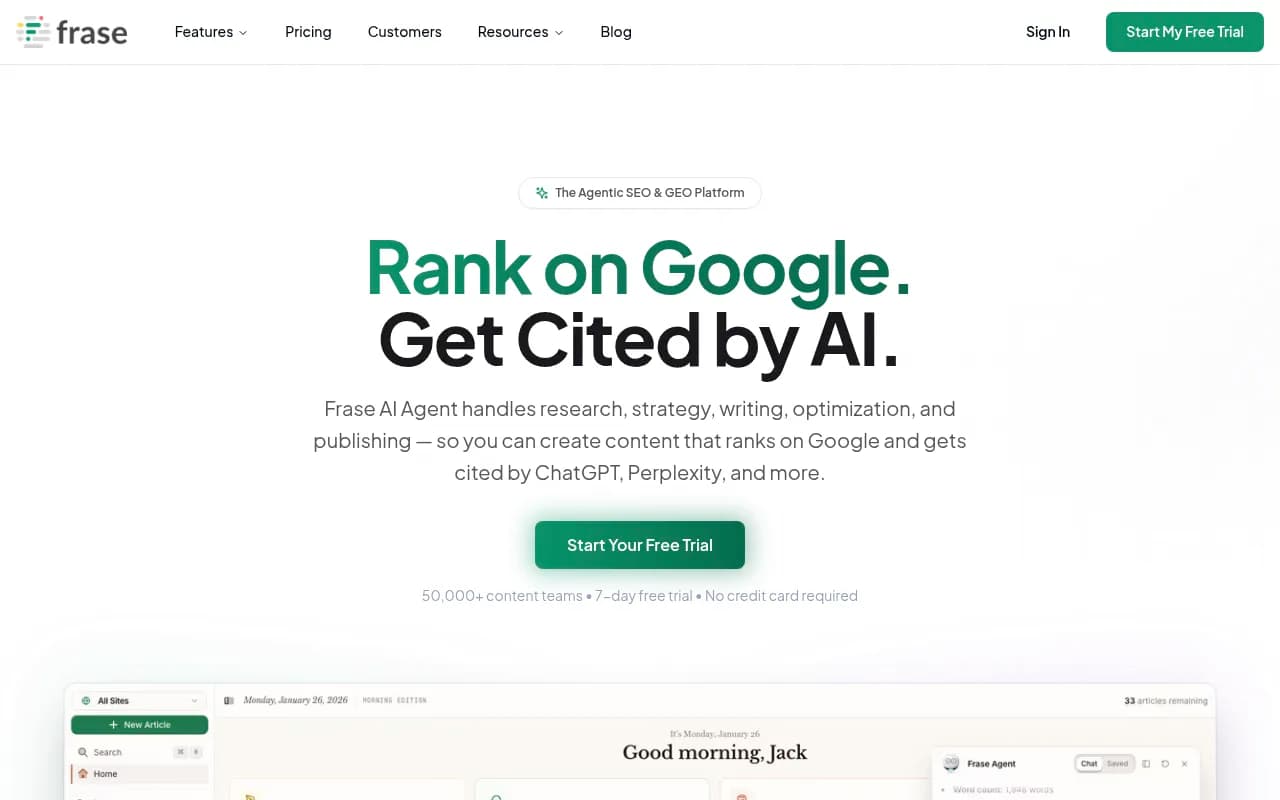
Frase is a content research and brief-generation tool. You give it a keyword, it scrapes the top-ranking pages, pulls out common headings and topics, and helps you build an outline. It has an AI writer built in. Its core job is helping you understand what Google's top results cover so you can write something competitive.
Clearscope is a content grading tool. You write (or paste) your content, and it scores it based on NLP-derived term frequency from top-ranking pages. It tells you which related terms you're missing and how your content compares to competitors. It's been the go-to for editorial teams at larger companies because the data is clean and the interface is simple.

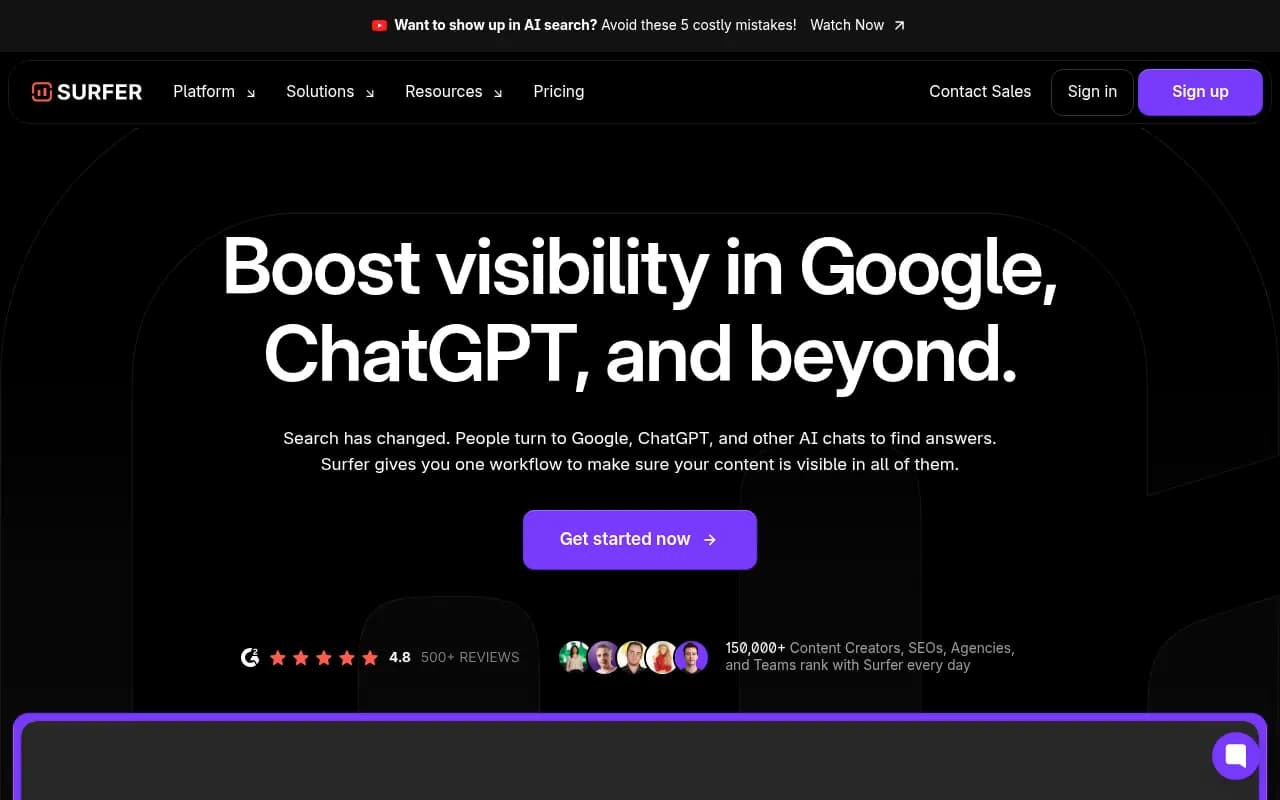
Surfer SEO does similar things to Clearscope but with more features: a content editor, keyword research, site audit, internal linking suggestions, and an AI writer. It's more of an all-in-one content optimization suite. The content score it generates is based on NLP analysis of top-ranking pages for a given query.
Peec.ai is different from all three. It's not a content optimization tool at all — it's an AI visibility monitoring platform. It tracks whether your brand appears in responses from ChatGPT, Perplexity, and other AI search engines when people ask relevant questions. It shows you your share of voice in AI-generated answers.

So right away, you can see the problem with putting these four in the same comparison: three of them help you write content for Google, and one tracks whether AI mentions you. They're not really competing with each other.
The core question: what does "getting cited in AI search" actually require?
To get cited by ChatGPT or Perplexity, a few things generally need to be true:
- AI crawlers need to be able to find and read your content
- Your content needs to directly answer the questions people are asking AI models
- Your content needs to be seen as authoritative enough to cite (which often means other trusted sources link to or reference it)
- The topics you cover need to match the actual prompt patterns users type into AI search
Traditional content optimization tools like Frase, Clearscope, and Surfer help with point 2 to some degree — they help you cover topics thoroughly. But they're optimizing based on what Google's top results look like, not based on what AI models actually cite.
That's a meaningful difference. The questions people type into ChatGPT are often more conversational, more specific, and more intent-driven than the queries they type into Google. A page that ranks well for "best project management software" might not be what Perplexity cites when someone asks "what's the best project management tool for a 10-person remote engineering team?"
Head-to-head comparison
| Feature | Peec.ai | Frase | Clearscope | Surfer SEO |
|---|---|---|---|---|
| Primary purpose | AI visibility monitoring | Content research & briefs | Content grading | Content optimization suite |
| Tracks AI citations | Yes | No | No | No |
| Content editor | No | Yes | Yes | Yes |
| AI writer | No | Yes | No | Yes |
| Brief generation | No | Yes | No | Yes |
| NLP term scoring | No | Basic | Strong | Strong |
| Keyword research | No | Limited | No | Yes |
| Site audit | No | No | No | Yes |
| Competitor AI visibility | Yes | No | No | No |
| Prompt/query tracking | Yes | No | No | No |
| Content gap analysis for AI | Limited | No | No | No |
| Price (entry level) | ~$49/mo | $45/mo | $189/mo | $89/mo |
Where Frase actually shines
Frase is genuinely useful for research-heavy content workflows. The brief generation is fast, the SERP analysis is solid, and the AI writer is good enough for first drafts. For teams producing a lot of content on a budget, it's hard to beat the price-to-feature ratio.
Where it falls short for AI citation purposes: Frase is entirely Google-centric. The "top results" it analyzes are Google's top results. There's no data on what AI models actually cite, no tracking of whether your content is appearing in AI answers, and no way to identify the specific questions your target audience is asking AI search engines.
Where Clearscope actually shines
Clearscope has a reputation for data quality, and it's earned. The NLP term recommendations are consistently accurate, the interface is clean, and it integrates well with Google Docs and WordPress. Enterprise editorial teams like it because it's simple enough that writers actually use it without complaining.
The limitation is similar to Frase: it's optimizing for Google rankings, not AI citation. The grading system tells you if your content covers the right terms relative to Google's top results. It doesn't tell you anything about whether AI models are citing your content or your competitors' content.
Where Surfer SEO actually shines
Surfer is the most feature-complete of the three traditional tools. The content editor, keyword research, and site audit in one platform makes it genuinely useful for teams that want to manage most of their on-page SEO workflow in one place. The content score is easy to understand and the AI writer has gotten noticeably better.
For AI citation, though, Surfer has the same blind spot as Clearscope and Frase. It's optimizing based on what ranks on Google. The assumption baked into the product is that if you rank well on Google, you'll do well in AI search too. That assumption is partially true but increasingly incomplete.
Where Peec.ai actually shines
Peec.ai is doing something the other three don't touch: it's watching AI models in real time and telling you whether your brand shows up. That's genuinely valuable data. If you're trying to understand your current AI visibility baseline, or track whether your efforts are moving the needle, Peec.ai gives you that.
The limitation is that Peec.ai is primarily a monitoring tool. It shows you where you stand. It doesn't tell you what content to create to improve your position, it doesn't generate content, and it doesn't have the depth of citation data or prompt intelligence that more advanced platforms offer. It's a good starting point, but it's not a full solution.
The gap none of these four tools fills
Here's the honest problem: none of these four tools gives you the full picture.
Frase, Clearscope, and Surfer help you write content that ranks on Google. Peec.ai tells you whether you're appearing in AI answers. But what's missing is the connection between the two — a tool that:
- Shows you exactly which prompts your competitors are being cited for that you're not
- Tells you what content to create based on real AI citation data (not just Google rankings)
- Generates that content in a way that's actually optimized for AI citation
- Tracks whether the new content starts getting cited after you publish it
That's a different category of tool entirely. Promptwatch is built around exactly this workflow — find the gaps, create content grounded in citation data, track the results. It's the difference between monitoring and actually doing something about it.

So which tool should you use?
It depends on what problem you're actually trying to solve.
If your goal is to write better content for Google rankings, Frase and Surfer are both solid choices. Frase is better for research-heavy brief generation. Surfer is better if you want an all-in-one suite with a site audit and keyword research built in. Clearscope is the right pick if you're at an enterprise with an editorial team that values data quality and simplicity over feature count.
If your goal is to understand your current AI visibility, Peec.ai gives you a starting point. You'll see where you stand relative to competitors in AI-generated answers.
If your goal is to actually improve your AI citation visibility — not just monitor it, but fix it — none of these four tools is built for that job end-to-end. You need something that combines citation intelligence with content creation and tracks the results.
The research from multiple 2026 tool roundups is consistent on this point: the tools that help you rank on Google and the tools that help you get cited in AI search are converging, but they haven't fully merged yet. Most content teams in 2026 are running at least two separate tools: one for traditional content optimization, one for AI visibility tracking.
The smarter move is finding a platform that handles both sides of that equation without requiring you to manually connect the dots between them.
Final take
Peec.ai, Frase, Clearscope, and Surfer SEO are all legitimate tools. None of them are bad. But they were built for different problems, and the question "which one helps me get cited in AI search?" doesn't have a clean answer within this group.
Frase, Clearscope, and Surfer are content optimization tools that assume Google rankings are the goal. Peec.ai is a monitoring tool that tells you where you stand in AI answers but doesn't help you change that position.
If AI citation is your actual goal in 2026, the most useful thing you can do is be honest about what each of these tools does and doesn't do — and fill the gaps accordingly.