Key takeaways
- Share of voice in AI search is now calculated differently from traditional SOV -- it measures how often your brand appears across a tracked set of prompts, not just keyword rankings
- Peec.ai, Omnia, Gauge, and BrandRank.AI each take a different approach to SOV tracking, with meaningful gaps in depth, coverage, and what you can actually do with the data
- Peec.ai is strongest for agencies needing multi-client setups; Omnia is clean and accessible for marketing teams; Gauge focuses on brand mention tracking; BrandRank.AI is the least documented of the four
- None of the four tools close the loop from visibility data to content creation -- if you need to act on gaps, not just see them, you'll want to look beyond this group
- For teams that need monitoring plus optimization in one platform, Promptwatch is worth evaluating as a more complete alternative
Why share of voice in AI search is a different problem
A year ago, most marketing teams were still debating whether AI search visibility was worth tracking at all. That debate is over. Brands appear in roughly 90% of AI Mode responses according to a 2026 study cited by SE Ranking -- compared to 43% in traditional AI Overviews. The question now isn't whether you show up, it's how often, in what context, and relative to your competitors.
That's where AI share of voice (SOV) comes in. The metric is conceptually simple: of all the prompts you're tracking, what percentage of AI responses mention your brand? LinkedIn's Sanjay Singh described the common formula as your brand mentions divided by total brand mentions across all tracked competitors. Simple enough. But the execution -- which prompts you track, which AI models you query, how you handle sentiment, and what you do when your SOV drops -- is where tools diverge sharply.
This guide compares four tools that have positioned themselves around this problem: Peec.ai, Omnia, Gauge, and BrandRank.AI. I'll cover what each actually does, where they're genuinely useful, and where they leave you stranded.
The four tools at a glance
| Tool | Best for | AI models covered | SOV tracking | Content gap analysis | Starting price |
|---|---|---|---|---|---|
| Peec.ai | Agencies, B2B SaaS | ChatGPT, Perplexity, Gemini, others | Yes | Limited | ~€89/mo |
| Omnia | Marketing teams | Multiple LLMs | Yes | No | Free tier available |
| Gauge | Brand mention tracking | ChatGPT, Perplexity | Basic | No | Not publicly listed |
| BrandRank.AI | Unknown | Unknown | Unclear | No | Not publicly listed |
| Promptwatch | Full-funnel GEO teams | 10+ AI models | Yes, with prompt volume data | Yes, with AI content generation | $99/mo |
Peec.ai

Peec.ai is one of the more established players in the AI visibility monitoring space. It treats prompts as the core tracking unit -- you define a set of questions your target audience might ask an AI, and Peec monitors how often your brand appears in the responses across multiple LLMs.
The platform's share of voice reporting is genuinely useful for competitive positioning. You can see branded vs. non-branded prompt sets separately, which matters a lot if you're trying to understand whether you're winning on category-level queries ("best CRM for startups") versus branded ones ("is [your brand] good?"). That distinction is something a lot of tools blur together.
Where Peec stands out is its agency setup. According to AI Advantage Agency's 2026 review, it includes unlimited users and free pitch workspaces on every paid plan -- which is a real differentiator if you're managing visibility tracking for multiple clients. Most tools charge per seat or per domain, so this is a meaningful cost advantage at scale.
The weakness is what happens after you see the data. Peec shows you your SOV, shows you where competitors are winning, and... that's largely it. There's no built-in mechanism to identify which content gaps are causing your low visibility, no content generation tools, and no crawler log analysis to understand how AI bots are actually interacting with your site. It's a solid monitoring dashboard, but it stops short of being an optimization platform.
Pricing starts around €89/month, which is competitive for what it offers.
Omnia
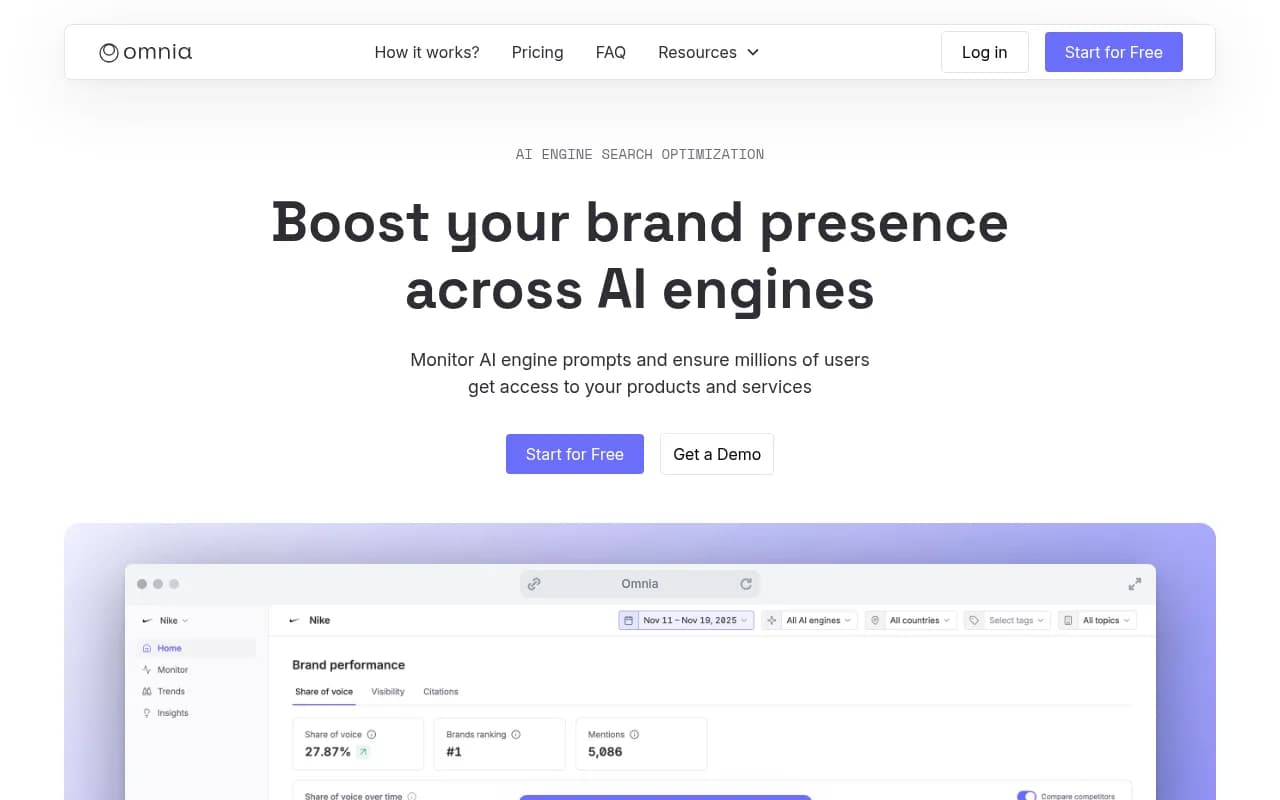
Omnia takes a cleaner, more accessible approach. The platform is designed for marketing teams who want a clear view of brand presence in AI-generated answers without being overwhelmed by data. Its own blog positions it as the top AI visibility platform in a comparison of 28 tools -- which, to be fair, is a comparison it wrote itself, so take that with appropriate skepticism.
That said, the product has real strengths. The SOV analysis is presented in a way that's easy to share with stakeholders who aren't deep in the GEO weeds. The citation extraction is solid -- you can see which sources AI models are pulling from when they mention (or don't mention) your brand. That's useful for understanding not just your visibility score but why it is what it is.
Omnia also has a free tier, which makes it accessible for teams that want to experiment before committing budget. For a marketing manager who needs to show leadership a competitive SOV comparison at the end of the quarter, Omnia's reporting structure works well.
The limitation is depth. Omnia doesn't offer prompt volume data (so you can't prioritize which prompts are actually worth winning), doesn't have crawler log analysis, and doesn't help you create content to close the gaps it surfaces. It's a good first tool for teams just getting started with AI visibility tracking, but teams that have been at this for a while will hit its ceiling.
Gauge
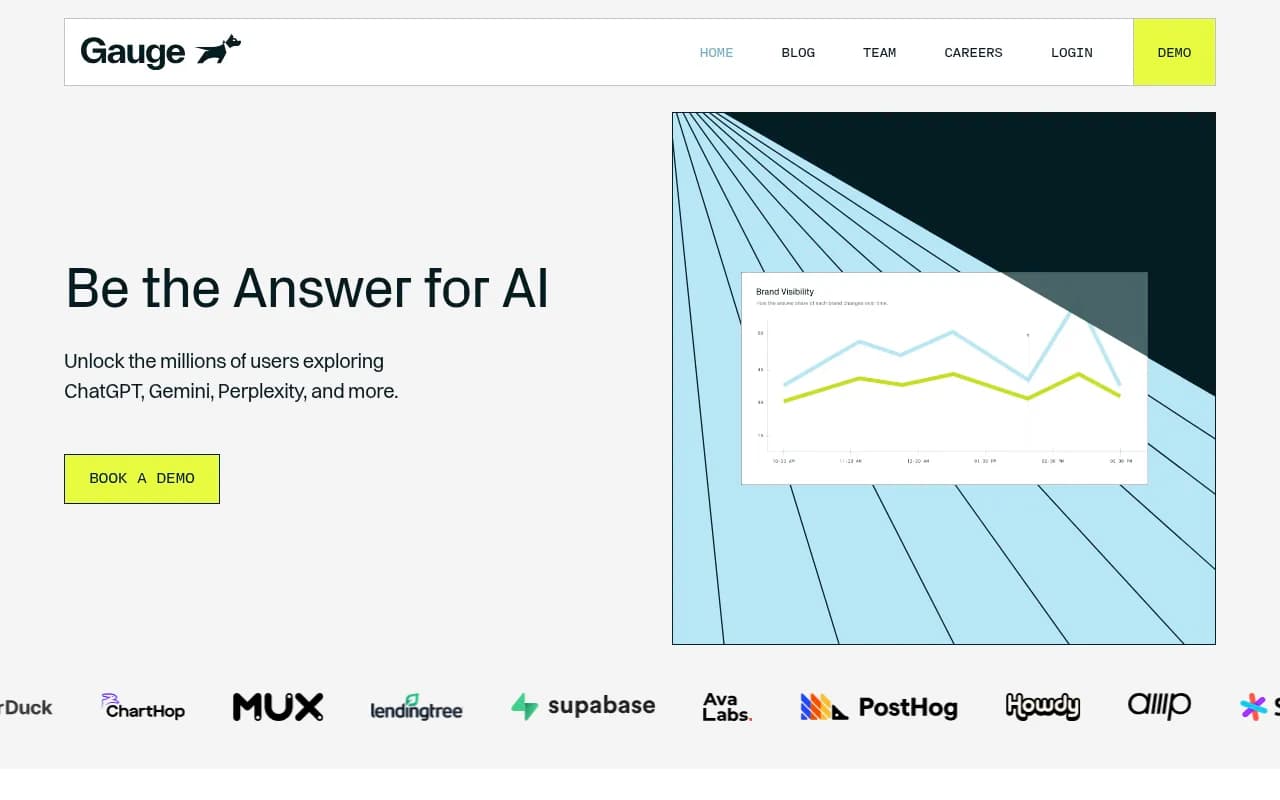
Gauge is the most focused of the four tools -- it's built specifically around tracking brand mentions across AI engines and helping you understand your visibility position. The product is cleaner in scope than Peec or Omnia, which can be a feature or a limitation depending on what you need.
For share of voice tracking specifically, Gauge does the job. You set up your brand and competitors, define your prompt set, and get a running view of how often each brand appears. The interface is straightforward.
What's harder to evaluate is Gauge's depth on the AI model side. Coverage appears to focus on ChatGPT and Perplexity, which are the two most commonly tracked models but leave out Gemini, Claude, Grok, DeepSeek, and others that are increasingly relevant depending on your audience. If your customers are heavy Claude or Gemini users, a tool that doesn't track those models is giving you an incomplete picture.
Pricing isn't publicly listed, which is always a mild frustration when evaluating tools. You'll need to book a demo to get numbers, which adds friction to the evaluation process.
Like Peec and Omnia, Gauge is a monitoring tool. It tells you where you stand but doesn't help you change it.
BrandRank.AI
BrandRank.AI is the hardest to evaluate in this group because public documentation is thin. The product exists and positions itself around AI brand visibility, but detailed feature breakdowns, pricing, and independent reviews are sparse as of mid-2026.
From what's available, BrandRank.AI appears to offer brand mention tracking and some form of competitive SOV comparison. Whether it covers multiple AI models, how it handles prompt customization, and what reporting looks like in practice are all unclear without a direct demo.
If you're considering BrandRank.AI, the honest advice is to run a trial alongside one of the better-documented tools in this comparison so you have a baseline for comparison. Committing to a platform with limited public information is a risk, especially in a category where the tooling is evolving fast and you want to know a product will be maintained and improved.
What none of these tools do well
Here's the honest gap across all four: they're monitoring tools, not optimization tools.
Knowing your AI share of voice is 12% while your main competitor sits at 34% is useful information. But it doesn't tell you which specific prompts you're losing, what content you'd need to create to win those prompts, or how AI crawlers are currently interacting with your site. The data is diagnostic, not prescriptive.
This is the core limitation of most AI visibility tools in 2026. They've solved the measurement problem reasonably well. The harder problem -- actually improving your AI visibility -- requires a different kind of platform.
For teams that need to close that loop, Promptwatch is worth a look. It's built around an action cycle: find the prompts you're missing (Answer Gap Analysis), generate content engineered to get cited by AI models (built-in AI writing agent trained on 880M+ citations), and track whether that content actually improves your visibility scores. It also includes AI crawler logs -- real-time data on which pages ChatGPT, Claude, and Perplexity are actually reading on your site -- which none of the four tools in this comparison offer.

How to choose between them
The right tool depends on what stage you're at and what you actually need from the data.
If you're an agency managing multiple clients and need a clean SOV dashboard with generous user limits, Peec.ai is the most practical choice. The unlimited users on paid plans is a genuine advantage, and the branded vs. non-branded prompt separation is useful for client reporting.
If you're a marketing team that's new to AI visibility tracking and needs something approachable with a free entry point, Omnia is a reasonable starting point. It won't overwhelm you, and the citation extraction gives you enough to understand the "why" behind your scores.
If you want a focused, simple brand mention tracker and your audience is primarily on ChatGPT and Perplexity, Gauge covers the basics. Just be aware of the model coverage gap.
If you're evaluating BrandRank.AI, do so alongside another tool so you have a comparison point. The limited public information makes it hard to recommend confidently without hands-on testing.
And if you've already been tracking AI visibility for a while and the monitoring data is no longer the bottleneck -- if the real problem is that you see the gaps but don't know how to close them -- then you've outgrown this tier of tools. The platforms that combine tracking with content gap analysis and AI-native content generation are a different category entirely.
A note on share of voice as a metric
One thing worth saying directly: AI SOV is a useful metric, but it's only as good as your prompt set. A tool that tracks 20 generic industry prompts will give you a very different (and much less useful) number than one that tracks 150 prompts mapped to your actual buyer journey.
Before you commit to any tool, ask how prompts are selected, whether you can customize them, and whether the tool gives you any signal on which prompts have the most volume or competitive difficulty. Prompt volume data -- which most monitoring-only tools don't offer -- is what separates a vanity metric from a prioritization tool.
The best AI visibility platforms in 2026 don't just tell you your SOV score. They tell you which prompts are worth fighting for, why you're losing them, and what to do about it. That's the standard worth holding any tool to.