Key takeaways
- Peec AI, Searchable, and Junia AI each cover a different slice of the AI visibility problem — monitoring, content generation, or SEO writing — but none covers the full loop on its own.
- AirOps is a serious content engineering platform but requires significant setup and is built more for teams with technical resources.
- Promptwatch is the only platform in this comparison that handles monitoring, gap analysis, and AI-optimized content generation in one place, with traffic attribution to close the loop.
- If your goal is to actually get cited by ChatGPT, Perplexity, or Google AI Overviews — not just track whether you are — the tool you pick matters more than the content you write.
There's a frustrating pattern in the GEO tool market right now. You sign up for an AI visibility platform, get a dashboard full of charts showing your brand's citation rate, and then... nothing. The tool has told you that you're invisible. It has not told you what to do about it.
This comparison looks at five tools that approach the problem from different angles: Peec AI (monitoring-first), Promptwatch (end-to-end optimization), AirOps (content engineering), Searchable (visibility plus content), and Junia AI (SEO content writing). The question isn't which one has the most features. It's which one actually moves the needle on getting your content cited.
What "getting cited" actually requires
Before comparing tools, it's worth being specific about what the problem is. When ChatGPT or Perplexity answers a question, it pulls from sources it has indexed and trusts. Getting cited isn't just about writing good content — it's about writing the right content, structured in a way AI models can parse, covering the specific questions those models are being asked.
That means the workflow has three distinct steps:
- Find out which prompts are driving AI responses in your category, and which ones your competitors are winning that you're not.
- Create content that directly addresses those prompts, structured for AI citation.
- Track whether that content is actually getting picked up, and by which models.
Most tools in this space handle step three reasonably well. Step one is where they start to diverge. Step two is where most of them fall apart entirely.
The five platforms
Peec AI

Peec AI is a monitoring platform. It tracks brand visibility across ChatGPT, Perplexity, and Google AI Overviews, shows citation frequency, source URLs, and competitive share of voice. The pricing starts at $100/month, which is transparent and reasonable for what it does.
The honest assessment: Peec AI is good at answering "are we visible?" It is not built to answer "what do we do about it?" There's no content gap analysis, no writing tools, no crawler log visibility. You get a dashboard. What you do with it is your problem.
For teams that just need a monitoring baseline and have separate content operations, that might be fine. But for most marketing teams, monitoring without a path to action is a frustrating dead end. Several users on Reddit's r/GEO_optimization have described exactly this — they know where they're not showing up, they just don't know what to write to fix it.
Best for: Teams that already have strong content operations and just need visibility data piped into their existing workflow.
Gaps: No content generation, no gap analysis, limited LLM coverage (three platforms vs. competitors covering 8-10+), no crawler logs.
Promptwatch

Promptwatch takes a different approach. It's built around a loop: find the gaps, create the content, track the results. The Answer Gap Analysis shows you exactly which prompts competitors are being cited for that you're not — not as a vague category observation, but as specific questions with prompt volume estimates and difficulty scores.
The built-in AI writing agent then generates articles, listicles, and comparisons grounded in citation data from 880M+ analyzed citations. This isn't generic SEO content — it's engineered around the specific prompts AI models are being asked, with competitor analysis and persona targeting baked in.
On the tracking side, Promptwatch monitors 10 AI models (ChatGPT, Perplexity, Claude, Gemini, Google AI Overviews, Google AI Mode, Grok, DeepSeek, Copilot, Mistral) and includes page-level citation tracking so you can see which specific pages are being cited, how often, and by which model. Traffic attribution closes the loop — you can connect AI visibility to actual revenue through a code snippet, GSC integration, or server log analysis.
The AI Crawler Logs feature is worth calling out separately. Most platforms have no visibility into how AI crawlers interact with your site. Promptwatch shows you real-time logs of GPTBot, ClaudeBot, PerplexityBot, and others — which pages they read, errors they hit, how often they return. That's genuinely useful for diagnosing why content isn't getting picked up.
Pricing: Essential at $99/month (1 site, 50 prompts, 5 articles), Professional at $249/month (2 sites, 150 prompts, 15 articles, crawler logs), Business at $579/month (5 sites, 350 prompts, 30 articles). Free trial available.
Best for: Marketing and SEO teams that want to move from "we're invisible" to "we're getting cited" without stitching together five different tools.
Gaps: Higher price point than pure monitoring tools, though the scope is also much broader.
AirOps
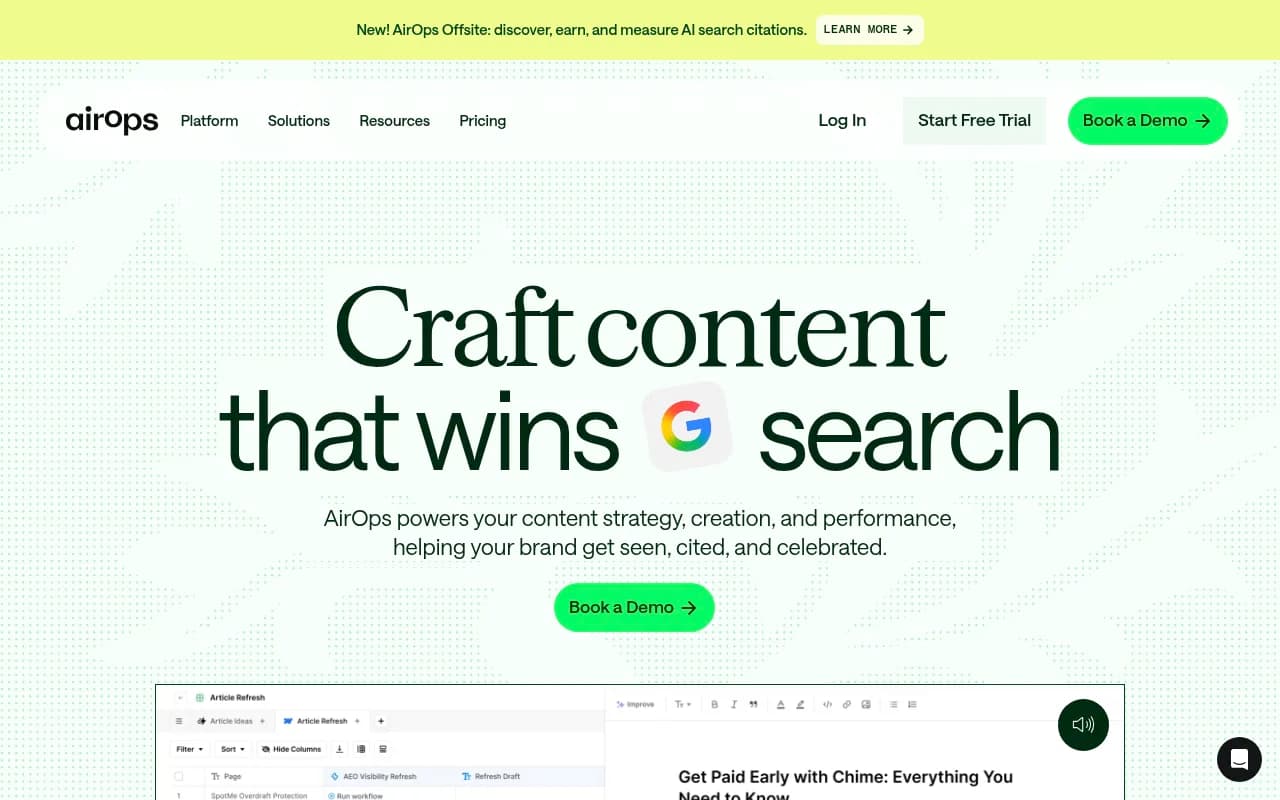
AirOps describes itself as a content engineering platform for AI search visibility. It's genuinely powerful — the platform lets you build content workflows that pull in competitive data, structure output for AI citation, and publish at scale. Teams that have invested in setting it up report strong results.
The catch is the setup investment. AirOps is built for teams with technical resources or dedicated content operations staff. It's not a plug-and-play tool. If you want to run a prompt gap analysis and generate a targeted article in the same session, you'll need to build that workflow yourself rather than having it pre-built.
It also doesn't include the monitoring layer — you'd need a separate tool to track whether your AirOps-generated content is actually being cited. That's a meaningful gap if you're trying to close the loop between content creation and visibility outcomes.
Best for: Larger teams or agencies with technical resources who want maximum control over content workflows and are willing to invest in setup.
Gaps: Steep learning curve, no built-in monitoring, requires workflow construction rather than out-of-the-box gap analysis.
Searchable
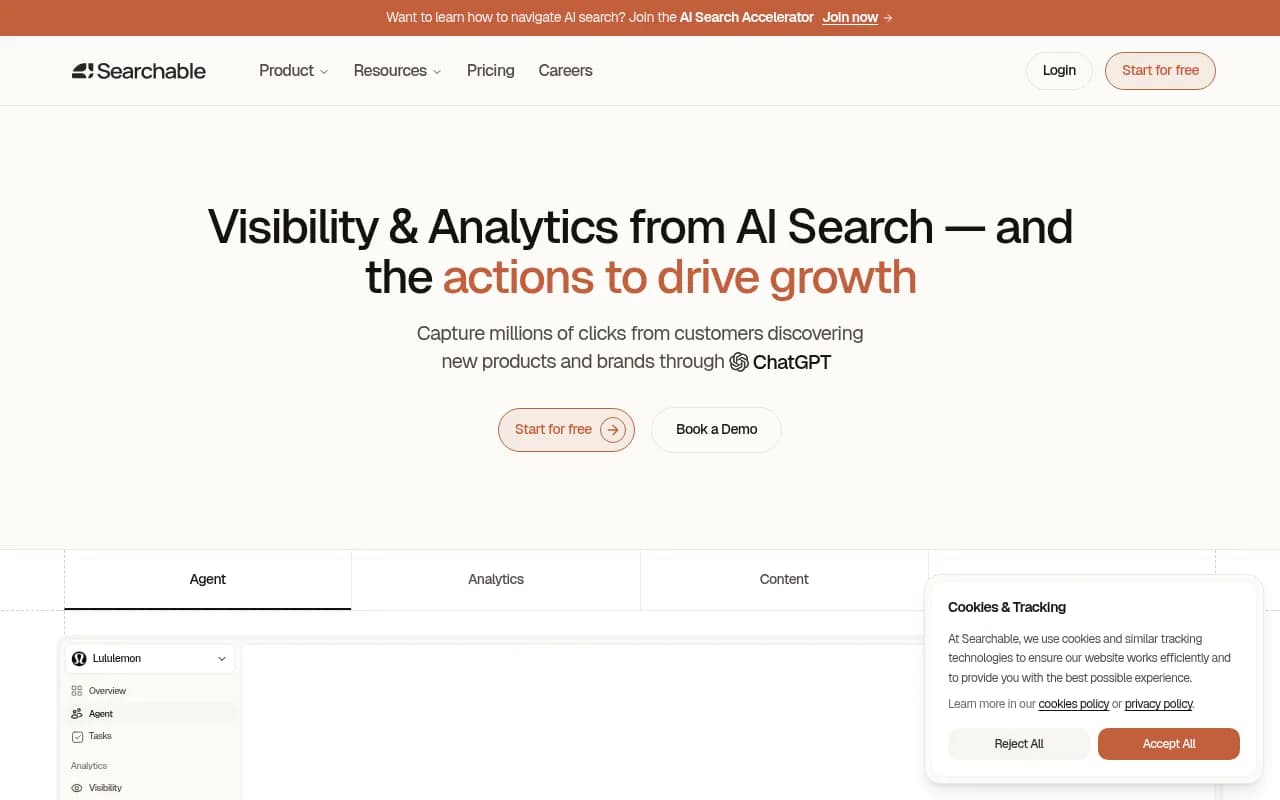
Searchable positions itself as an AI Search Visibility Platform with built-in content generation. It covers both the monitoring and content sides of the problem, which puts it in a similar category to Promptwatch.
Based on available information, Searchable's content generation is more template-driven than Promptwatch's citation-grounded approach. It generates content, but the connection between specific prompt gaps and the content output is less direct. The platform also has narrower LLM coverage and lacks some of the deeper features like crawler logs, Reddit/YouTube citation tracking, and query fan-outs.
For smaller teams or businesses earlier in their GEO journey, Searchable is a reasonable starting point. It's more accessible than AirOps and more action-oriented than Peec AI. But teams that need to compete seriously in AI search — particularly in competitive B2B categories — will likely hit its ceiling.
Best for: Small teams or businesses new to GEO who want a single tool that covers basics on both monitoring and content.
Gaps: Shallower prompt intelligence, less citation-grounded content generation, limited LLM coverage compared to Promptwatch.
Junia AI
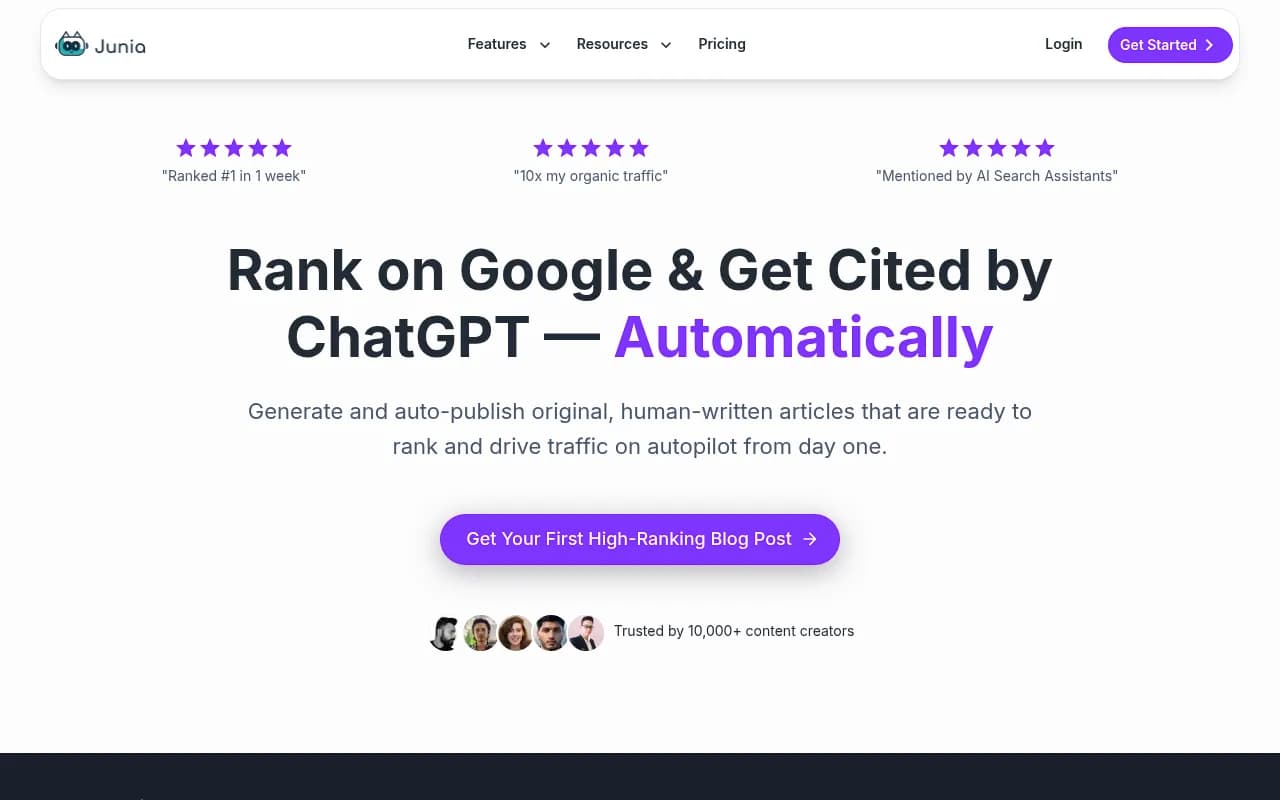
Junia AI is an AI-powered SEO content platform. It writes, optimizes, and publishes content — and it does that well. The writing quality is solid, the SEO optimization features are real, and it's a legitimate tool for teams that need to produce content at scale.
But Junia AI isn't a GEO platform. It doesn't track AI visibility, doesn't analyze which prompts competitors are winning, doesn't show you citation data from ChatGPT or Perplexity, and doesn't include any monitoring layer. It's an SEO content tool that can produce content that might get cited — but it has no way to tell you whether it is, or what gaps to fill to improve your chances.
Using Junia AI for AI search visibility is like writing blog posts without checking Google Search Console. You might be doing fine. You have no idea.
Best for: Teams that need high-volume SEO content and are comfortable managing AI visibility tracking separately.
Gaps: Not a GEO platform at all — no monitoring, no citation tracking, no prompt gap analysis, no AI crawler visibility.
Feature comparison
| Feature | Peec AI | Promptwatch | AirOps | Searchable | Junia AI |
|---|---|---|---|---|---|
| AI visibility monitoring | Yes | Yes (10 models) | No | Yes | No |
| Prompt gap analysis | No | Yes | Partial (DIY) | Limited | No |
| AI content generation | No | Yes | Yes | Yes | Yes (SEO-focused) |
| Citation-grounded writing | No | Yes (880M+ citations) | Partial | Limited | No |
| Crawler logs (GPTBot etc.) | No | Yes | No | No | No |
| Reddit/YouTube tracking | No | Yes | No | No | No |
| Traffic attribution | No | Yes | No | No | No |
| ChatGPT Shopping tracking | No | Yes | No | No | No |
| LLMs covered | 3 | 10 | N/A | Limited | N/A |
| Prompt volume/difficulty | No | Yes | No | No | No |
| Starting price | $100/mo | $99/mo | Custom | Varies | Varies |
| Free trial | Yes | Yes | Yes | Yes | Yes |
How to choose
The right tool depends on where you are in your GEO journey and what your team can actually execute.
If you're just starting out and need to understand your baseline visibility, Peec AI or Searchable will get you there without a big investment. You'll know where you stand. You won't have a clear path to improving.
If you have strong technical resources and want to build custom content workflows, AirOps is worth evaluating seriously. Budget time for setup and plan to pair it with a monitoring tool.
If you're producing SEO content at scale and AI visibility is a secondary concern, Junia AI is a solid content tool — just don't expect it to tell you anything about how AI models are actually responding to your brand.
If you want to actually move the needle on AI citations — find the gaps, generate content engineered to fill them, and track whether it's working — Promptwatch is the only platform in this comparison that handles all three steps without requiring you to stitch together multiple tools. The fact that it starts at $99/month (cheaper than Peec AI) while covering significantly more ground makes it the practical choice for most marketing teams.
The monitoring-only trap
One thing worth saying directly: the GEO tool market has a monitoring-only problem. There are now dozens of platforms that will show you a dashboard of your AI citation rate, your share of voice vs. competitors, which models mention you. Some of them are well-built. Most of them stop there.
The implicit promise is that if you can see the problem clearly enough, you'll figure out how to fix it. In practice, that's not how most marketing teams work. You need the gap analysis to know what content to create. You need the writing tools to create it efficiently. You need the tracking to know if it worked.
Peec AI is a good monitoring tool. But if you're evaluating it because you want to improve your AI search visibility — not just measure it — you should be honest with yourself about whether monitoring alone will get you there.
The platforms that close the full loop are fewer. Promptwatch is the clearest example in this comparison. AthenaHQ is another worth looking at if you're enterprise-focused.

The bottom line: pick a tool that matches the action you're actually able to take. A monitoring dashboard you can't act on is just a source of anxiety.