Key takeaways
- AI does not describe your brand once. The answer shifts with who is asking, how they phrase the question, and which intent (commercial, informational, branded) sits behind it.
- A single generic prompt set can make you look visible while you are invisible to the buyer who signs the contract.
- Different intents pull different sources. Promptwatch Data shows product pages, landing pages, listicles and reviews carry different weight depending on the prompt type.
- Perception is fixed upstream, at the pages AI cites, not on your homepage. Track it as a trend with a fixed prompt set, never as a one-off check.
- Pick tools that combine persona prompting, multi-model coverage and a way to act on what you find.
Why one brand description is a myth
Ask ChatGPT about your company and you get a confident paragraph. It reads like a fact. But that paragraph is one sample from a system that rewrites itself every time someone phrases the question differently.
Now add buyers. A VP of Finance asks for the most cost-effective option. A developer asks which tools have the best API. A procurement manager asks which vendors are SOC 2 compliant and integrate with SAP. Same buying committee, same decision, three different prompts, and quite possibly three different brand stories.
That is the gap persona-based perception tracking closes. Standard AI brand perception work asks: how do assistants describe us? The persona version asks: how do they describe us to each person who matters, and which of those descriptions are wrong, weak or missing?
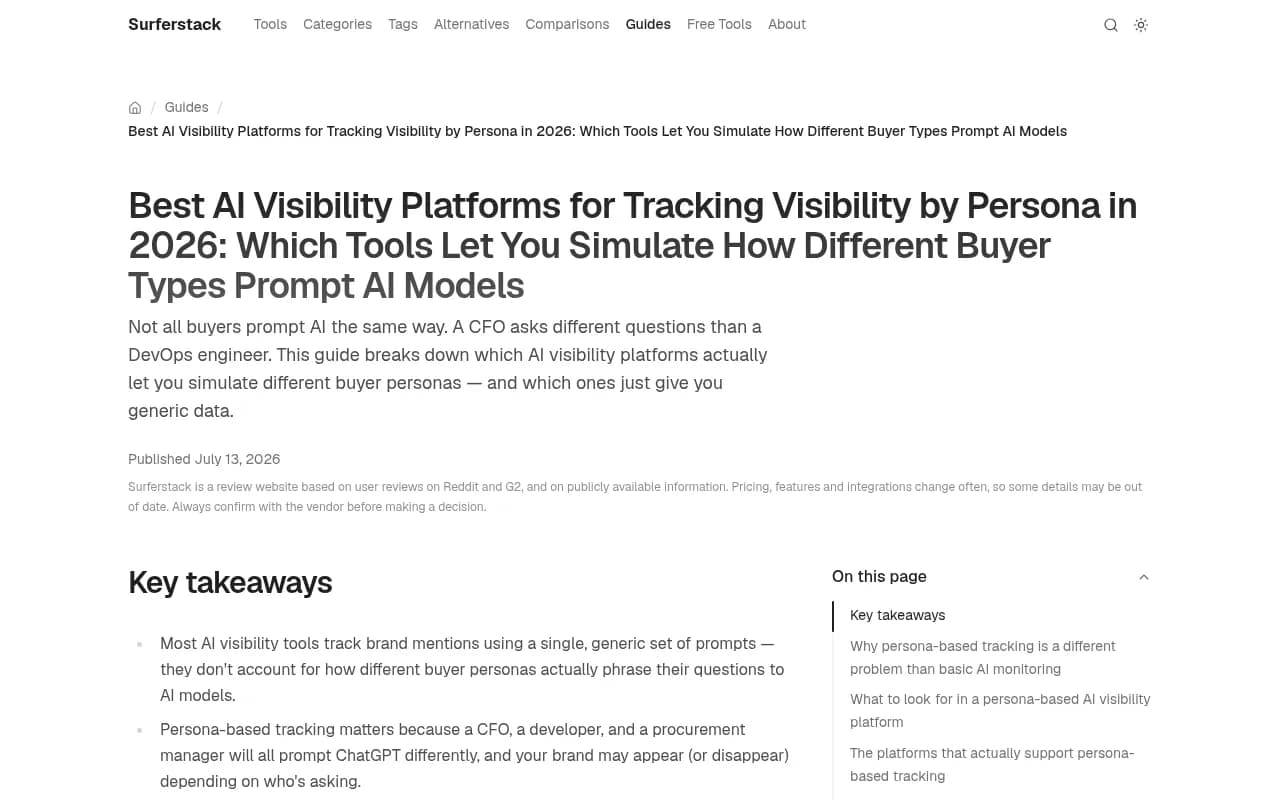
I think this is the most underrated part of AI visibility work right now. Teams run 50 prompts, see a decent score, and relax. Meanwhile the technical evaluator never sees them at all. Surferstack's guide to persona-based visibility platforms makes the same point: most tools use a single generic prompt set and ignore how personas actually phrase things.
What AI brand perception actually is
AI brand perception is the impression assistants convey about your brand when asked. It is not an opinion the model holds. It is what the model asserts, synthesized from training data and, for engines with live search, the pages it retrieves.
That has two consequences worth stating plainly:
- It is mediated by third-party sources. Reviews, listicles, forums, directories and docs shape the answer as much as your own site.
- It is fixable only upstream. You cannot edit what Perplexity says. You can fix the G2 listing it quotes, publish the factual page it lacks, and make sure crawlers can read your own pages.
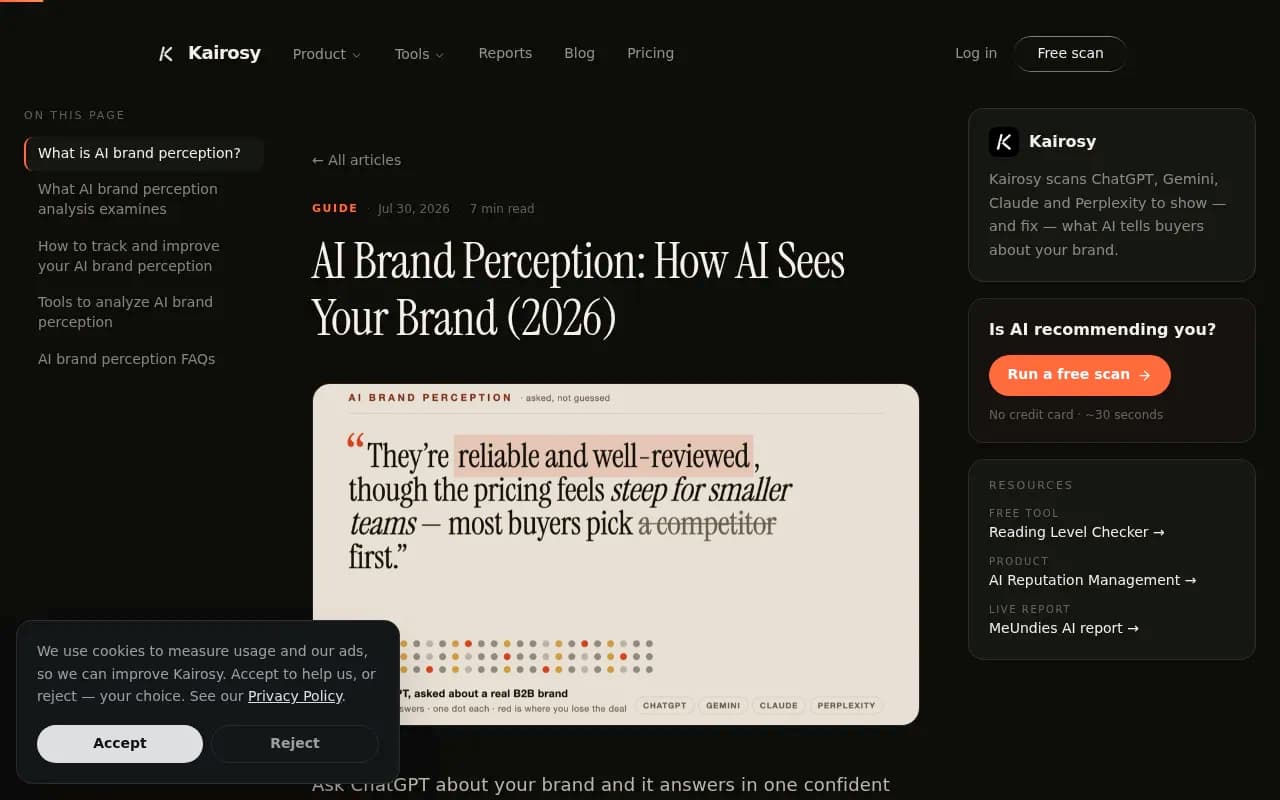
Kairosy's perception guide describes the same loop: scan fixed prompts, classify sentiment, trace wrong claims to sources, correct them, rescan. Persona tracking is that loop run once per buyer type.
Why the same brand reads differently per persona
Fan-outs split every prompt differently
When a search-enabled model answers, it often fires several web searches behind the scenes. Promptwatch Data's ChatGPT query fanouts report tracked an average of about 2.15 searches per response in early December 2025, easing to about 1.84 by early March 2026. Average fan-out query length also shrank, from roughly 117 characters to the high 80s.
The persona angle: a finance prompt gets split into pricing, ROI and alternatives queries. A developer prompt gets split into API docs, SDK and integration queries. Your content only has to match one of those generated queries, so a persona whose sub-queries hit your weak pages sees a weaker brand. The query fan-outs guide in the Promptwatch Academy explains how to read them.
Intent changes the source mix
Promptwatch Data's ChatGPT citation share by content type (Sep 28 to Oct 4, 2026) shows the sources shift by intent:
| Prompt intent | Top cited types | Notable detail |
|---|---|---|
| Commercial (comparing options) | Product pages 26.0%, landing pages 20.6%, listicles 15.0% | Comparisons add 7.9%; these four types are almost 70% of citations |
| Informational | Product pages 19.1%, landing pages 13.9%, listicles 13.6% | How-tos 10.7%, docs 8.5% |
| Branded ("is X good for startups") | Product pages 23.3%, landing pages 22.8% | Reviews 5.6%, over three times their share across all prompts |
So the economist persona researching alternatives reads your brand through listicles and comparison pages. The buyer who already knows your name reads it through reviews. Same company, different evidence base.
Platform differences matter too. In the October 2026 social citations data, ChatGPT got 0.46% of its citations from social platforms while Google AI Overviews got 12.2%. A persona that mostly uses AI Overviews hears a more forum-shaped version of your brand.
Building persona prompt sets
Start from real roles, not marketing archetypes
Pick three to five roles that actually touch the deal. For a B2B software company that might be:
- Economic buyer (CFO or VP Finance)
- Technical evaluator (developer or architect)
- Procurement or security reviewer
- End user or team lead
- Executive sponsor
Skip fictional names with hobbies. What you need is vocabulary and concerns.
Write 10 to 20 prompts per persona
Cover the funnel for each. A rough template:
| Stage | Finance persona | Developer persona |
|---|---|---|
| Awareness | "How do companies reduce contract review costs?" | "What are the main approaches to contract automation?" |
| Consideration | "Most cost-effective contract management software for mid-market" | "Which contract management tools have the best API and webhooks?" |
| Decision | "Contract management pricing and total cost of ownership" | "Is [Brand] easy to integrate with Salesforce?" |
Include branded prompts, competitor comparisons, and unbranded category prompts. The unbranded ones tell you whether you exist for that persona at all.
Keep the set fixed
AI answers vary run to run, so a single check is a snapshot, not a trend. Fix the prompt set, repeat it on a schedule, and compare periods. Change prompts rarely and log every change.
What to score per persona
For each prompt, record which brands appear, in what order, with what tone, and with what attributes. Then roll it up per persona and per engine. Useful dimensions:
- Visibility: do you appear at all, and how prominently?
- Position: where you land among brands in the answer.
- Sentiment: positive, neutral or negative, per engine.
- Claims: the specific statements made ("affordable for small teams", "limited API").
- Sources: which pages and domains the answer cites.
- Gap against the generalist: the persona where you diverge most from your overall score.
The claims layer is where this gets interesting. A developer persona might hear "strong API, steep learning curve" while the finance persona hears "expensive." Neither is in your messaging. Both came from somewhere you can trace.
Tools for persona-based perception tracking
Persona features range from real simulation to a renamed custom prompt field. Here is how the options in our catalog differ, based on vendor positioning. Verify details with each vendor before buying.
| Tool | Persona handling | Beyond monitoring | Best for |
|---|---|---|---|
| Promptwatch | Custom personas, persona stacking, radar chart vs general audience | Content gap analysis, Content Agent, crawler logs, visitor analytics | Teams that want to fix gaps, not just see them |
| Scrunch AI | Persona-oriented tracking | Monitoring focus | Enterprise monitoring |
| Profound | Persona customization | Monitoring focus, higher price tier | Large brands with budget |
| Otterly.AI | Basic prompt tracking | Limited | Light monitoring |
| Peec AI | Basic prompt tracking | Limited | Small teams starting out |
Promptwatch
Promptwatch lets you prompt like your actual buyers with custom personas and persona stacking. Persona insights show visibility, position and sentiment per persona on a radar chart against the general audience, and flag the persona with the biggest gap. Brand Narrative pulls the individual claims AI makes about you out of each response and groups them under themes like Pricing, Features and Support, so you can see which claim a persona keeps hearing. Fact Check (Business plan and up) then marks a claim as inaccurate and points to the page on your site that is teaching the model the wrong thing.

The part most trackers skip is what comes next. The Action Board prioritizes fixes, the Content Agent writes and publishes pages against the gaps, and crawler logs plus visitor analytics show whether the fix got crawled, cited and clicked. Plans start at $95 a month for Essential; check promptwatch.com/pricing for current numbers. There is a 7-day free trial and a free AI visibility report if you want a first read before committing. For a direct comparison, see Promptwatch vs Profound.
Scrunch AI and Profound
Both are strong on monitoring and offer meaningful persona customization, as the Surferstack roundup notes. Expect higher price points and less in the way of execution.
Profound

Otterly.AI and Peec AI
Fine for a quick baseline across engines. They are basic prompt trackers, so a persona workflow means manually organizing prompts and doing the analysis yourself.
Otterly.AI


Adjacent tools
Brand-health and social listening platforms like Brandwatch and Meltwater cover human perception, not AI answers. They are a useful cross-check, but they will not show you what ChatGPT says to a CFO. If you want to explore the wider category, the GEO software directory lists more options.
Running a persona perception audit
Step 1: Check that AI can read you
If crawlers cannot access your pages, the model builds its impression from third parties alone. Check robots.txt and server access first. The free Agentic Readiness Check shows which AI crawlers can read your site, and AI crawler logs show what they actually fetch.
Step 2: Run the fixed prompt set
Run each persona's prompts across the engines your buyers use: ChatGPT, Google AI Overviews, Perplexity, Gemini, Claude. Track in the real interfaces where possible. User-facing answers and citations can differ from API outputs.
Step 3: Build the persona scorecard
| Persona | Visibility | Position | Sentiment | Top claim | Top cited source |
|---|---|---|---|---|---|
| Finance | Fill in | Fill in | Fill in | e.g. "expensive" | e.g. listicle |
| Developer | Fill in | Fill in | Fill in | e.g. "good API" | e.g. docs |
| Procurement | Fill in | Fill in | Fill in | e.g. "no SOC 2 info" | e.g. none |
The empty cells are the useful ones. If procurement sees no brand and no source, you have a content problem, not a reputation problem.
Step 4: Diagnose by pattern
- Low share of voice: a coverage problem. You are not in the answer.
- Late position: a prominence problem.
- Mentions without citations to your domain: a content or crawlability problem.
- Weak sentiment: a reputation problem, usually traced to reviews or forums.
The Academy page on citations vs mentions covers the distinction well.
Step 5: Fix the sources
Match the fix to the evidence:
- Add pricing, specs and a "who it is for" section to product pages. Promptwatch's report recommends this for commercial prompts.
- Collect reviews on trusted sites, since branded prompts lean on them.
- Add a plain-language brand FAQ.
- Publish the page the persona's sub-queries are looking for, with keyword-style headings that put the entity and category first.
- Fix inaccurate claims at the page that states them.
Industry matters here. For software prompts, Promptwatch Data shows GitHub, Microsoft's docs and G2 leading ChatGPT citations, with documentation and help centers earning the largest share. A developer persona in software is mostly reading docs.
Step 6: Rescan and be patient
Changing a source does not change the answer instantly. The model has to recrawl, and training-based impressions can lag longer. Compare the same prompts after a few weeks and judge the trend, not one run.
Common mistakes
- Treating persona as a label on the same prompts. Real personas phrase things differently, so write distinct prompts.
- Tracking only your own brand. Buyers judge you by how AI defines the whole category, so include unbranded and competitor prompts.
- Averaging everything. An overall score of 60 can hide a persona at zero.
- Measuring without acting. Visibility reports do not change anything by themselves.
- Forgetting that mid-authority sources count. Promptwatch Data's domain rank report found DR 46-75 sites earned almost half of ChatGPT citations in August 2026, so you do not need a giant domain to be cited.
FAQ
How many personas should I track?
Three to five. More than that and the prompt sets get thin, which makes the trends noisy.
Do I need separate tracking per country?
Yes if you sell in several markets. Language and location shape both the prompts and the answers, so keep markets separate.
Can I fake personas by adding a role to the prompt?
Partly. Prefixing a role helps, but real buyers differ in vocabulary and concerns, not just job titles. Write prompts from interviews, sales calls and support tickets where you can.
What to do this week
Pick your three most important buyer roles. Write ten prompts for each, spanning awareness to decision. Run them across ChatGPT, AI Overviews and Perplexity and record claims and cited sources. The persona with the emptiest column is where your next piece of content goes. If you want help running this at scale or turning it into a content program, 1001 SEO Media works with Promptwatch on exactly this kind of AI visibility work.