Key takeaways
- A generic prompt shows one view of your brand. Personas let you see whether ChatGPT, Gemini or Perplexity treat a small business owner differently from an enterprise IT buyer.
- Persona effects are not guaranteed. Test them with a plain-versus-prefixed probe before you multiply your prompt list and your costs.
- Your biggest persona gap is the buyer segment where visibility, position or sentiment falls furthest below your overall average. Fix that one first.
- Synthetic personas are a cheap way to start, but ground them in closed deals, sales calls and support tickets.
- ChatGPT rewrites long prompts into short keyword-style searches, so pages need to answer the sub-questions each persona asks, not just carry persona wording.
Why personas matter in AI search tracking
Traditional rank tracking had a convenient fiction: one keyword, one position. AI search broke it. Two people can ask what looks like the same question and get different brand lists, because the model is working from different context. Role, company size, budget, location, and sometimes memory and custom instructions all leak into the answer.
That is why a prompt list built from keywords alone feels incomplete. You can see that your brand shows up in 40% of responses. You cannot see that it shows up for the CFO and vanishes for the practitioner who actually runs the trial.
Gumshoe frames this well on its personas approach page: without personas, "invisible to everyone" and "wins with some, loses with others" look identical in your dashboard. You know the score moved. You don't know for whom.
I would add a caveat. Personas are a useful lens, not a law of nature. More on testing that below.
What a persona is (and what it isn't)
A persona in AI tracking is a short audience profile added as context when a prompt runs. Think "small business owner" or "enterprise IT buyer." Profound describes it the same way: it runs the base prompt and the persona version separately so you can compare the two answers and see whether visibility holds for each buyer.
Two things get confused all the time:
- A persona is a role inside the buying group. It goes into the prompt as a voice.
- An ICP (ideal customer profile) describes the company. It goes into the prompt as slots like industry, size and region.
You need both, but they are different columns in your prompt sheet. A marketing director at a 50-person agency and a marketing director at a bank may share a persona and have nothing in common on ICP.
Step 1: build personas from evidence
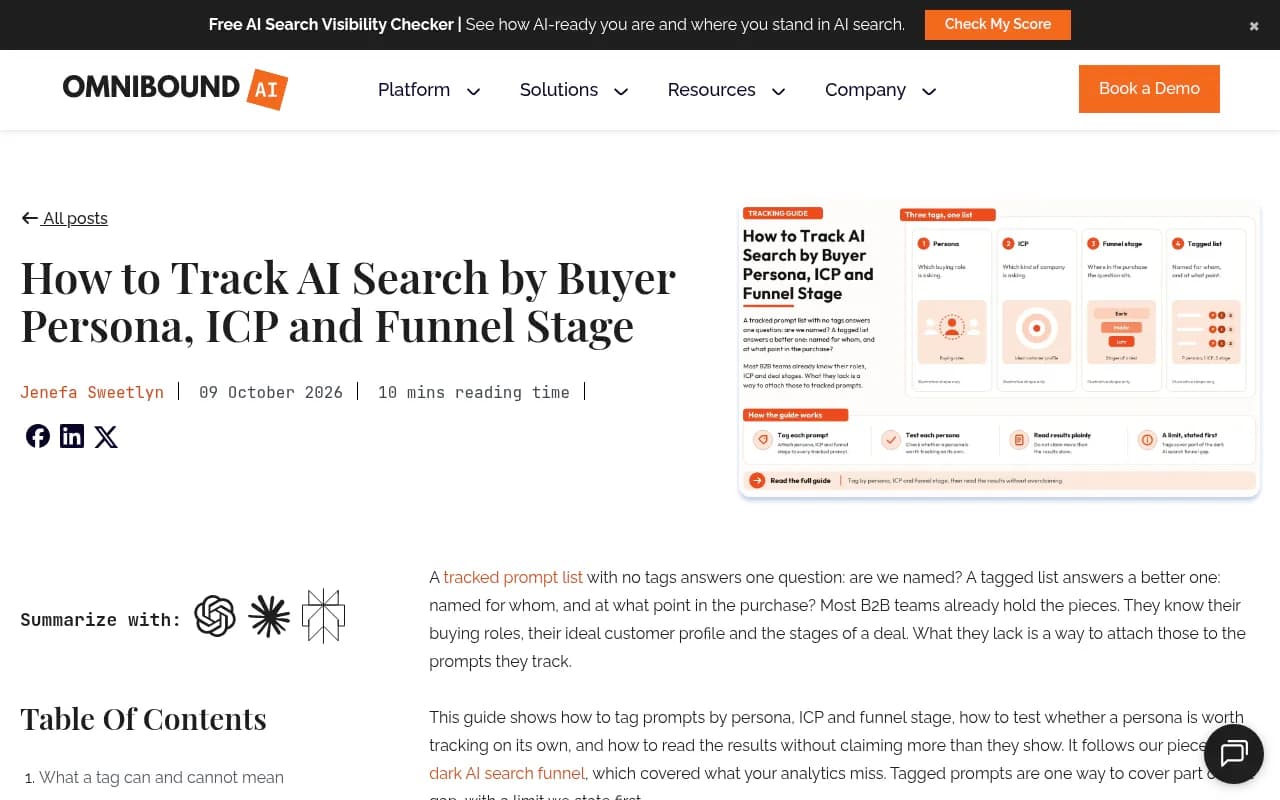
Do not start with a workshop and a whiteboard. Pull roles from your closed-won deals, then take the wording from sales calls, support tickets and CRM job titles. The Omnibound guide makes the same point: your own groups will differ from textbook ones.
For each persona, write down:
- Job title and company type
- The problem they are trying to solve this quarter
- What they worry about (budget, risk, integration effort, being blamed)
- How they evaluate vendors
- Where they are located, since location may matter more than you expect
Keep it to a few lines. A persona you cannot fit in a prompt prefix is a persona you will not use.
Using AI to draft a persona
Orbit Media's Andy Crestodina suggests teaching an LLM about your buyer so its responses are less generic. A starter prompt looks like this:
You are a B2B persona strategist and market researcher. Create a detailed
persona for a [job title] working in [industry/company size/geography] who
is responsible for [responsibilities]. They are struggling with [problem]
and are actively seeking [product/service].
- What are their hopes and goals?
- What are their fears about choosing the wrong solution?
- What emotional triggers push them to act?
- What decision criteria do they use to evaluate vendors?
Then use a prediction prompt: ask the persona to list 25 likely commercial-intent prompts it would type into an AI when researching providers in your category. Treat the output as a hypothesis list, not research. Check it against real sales conversations.
Letting the AI tell you who your buyers are
Another route is to ask the models directly. Gumshoe interviews LLMs about your category and turns the profiles they return into synthetic users. That is a useful sanity check on your own assumptions, though it shows what AI believes about your market, which is not always what is true.
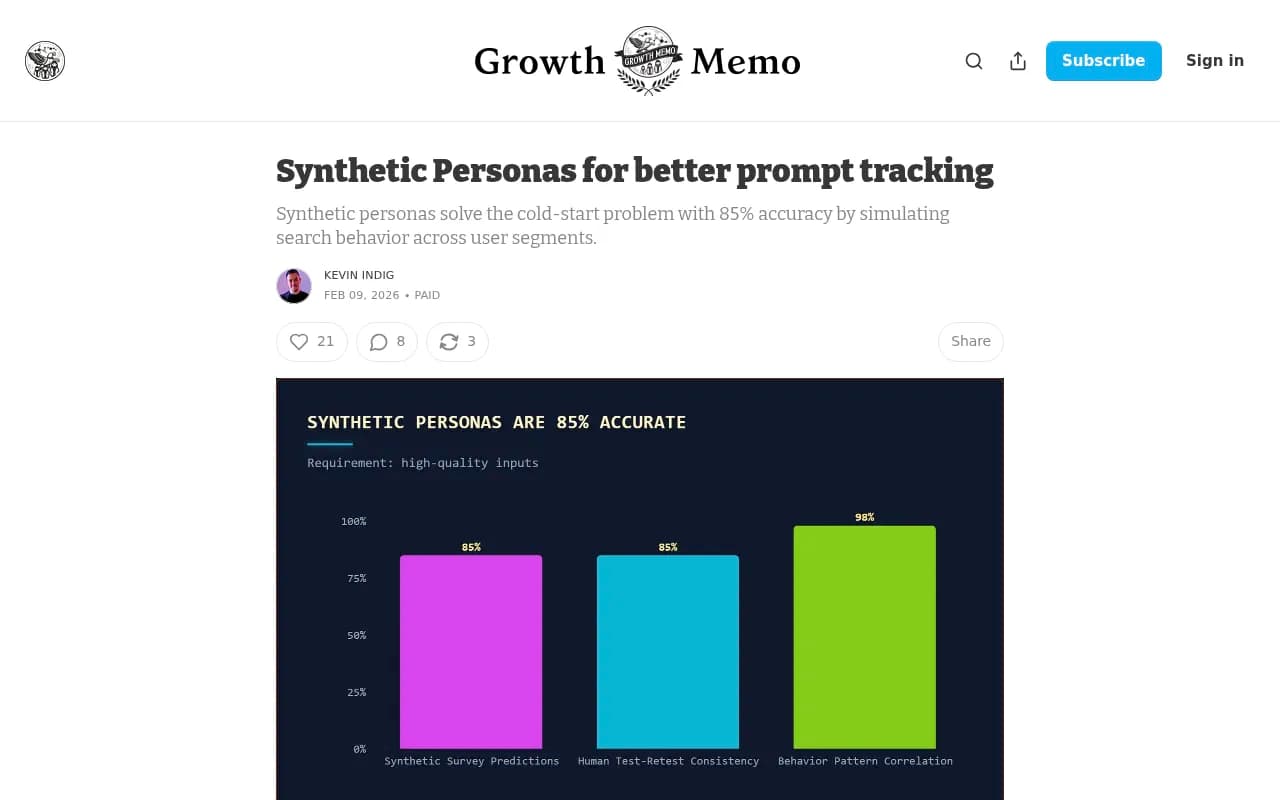
On the research-speed side, Kevin Indig's Growth Memo piece on synthetic personas for prompt tracking claims synthetic personas solve the cold-start problem with 85% accuracy by simulating search behavior across segments. The full memo is paywalled, so I can't tell you how that accuracy is measured. Treat it as a reason to try synthetic personas, not as a guarantee.
If you want to go further on synthetic audiences generally, tools such as Synthetic Users and Artificial Societies exist for market research, though they are not AI visibility trackers.
Step 2: write the persona into the prompt
The simplest pattern is a short prefix: "As a [role] at a [company type]", followed by the concern that role would actually state. Put the concern in the question, not only the title.
Plain: "What is the best project management software for agencies?"
Persona version: "As an operations lead at a 40-person digital agency who keeps missing client deadlines, what is the best project management software?"
The second prompt carries a situation. Omnibound points to a Northwestern preprint where situation-based prompts brought well-known brands into lists that category-only prompts missed. Situation detail may matter more than a job title.
Step 3: test whether personas change the answer
Here is the part most guides skip. Whether a persona prefix changes the answer is a question to test, not assume. The Omnibound article cites an academic study of scholar recommendations that ran 43 models over more than 900,000 queries. A stated role and language changed the lists very little, while the persona's location changed them more. That is a different domain from vendor recommendations, so it proves nothing about yours. It does show that persona effects are not guaranteed.
On the other side, a LinkedIn post by Buschner, "What 17,929 AI chats told us about personas," says adding any persona shrinks the set of brands the AI names to between 28.3% and 29.3%. I could only see the search snippet, and it doesn't say what that figure is measured against, so I would not quote it as a benchmark. It is a reason to run your own probe.
A simple probe
- Pick one question per funnel stage, with fixed wording.
- Run each question two ways, plain and with the role prefix, several times each, in the same engine and in a fresh session with no history.
- List the vendors named in each set. Decide what counts as "mostly the same" before you look.
- If the same vendors come back, keep one plain series for that persona and note the finding. If different vendors come back, keep a separate series. If the result is mixed, add more runs.
One rule matters a lot: a gap between plain and prefixed runs only counts if it is clearly larger than the gap between two plain batches. AI answers are noisy. Without that baseline you will chase randomness.
Step 4: account for how ChatGPT rewrites prompts
There is a wrinkle for persona work. Promptwatch Data's report on ChatGPT query fanouts shows that one prompt can trigger separate web searches, and that the average fanout query got short: about 117 characters in early December, high 80s through February and March, and about 53 characters from April, roughly 6 to 8 words.
My inference, not something the report states: the model rewrites your persona-flavored prompt into short keyword-style queries, so some persona wording may never reach the retrieval step. If that is right, the persona shapes which sub-questions get asked, and your pages win by answering those sub-questions directly.
Practically, that means writing headings that read like search queries, front-loading the entity and category, and building focused pages for each sub-question: comparisons, pricing, alternatives and how-tos. The Promptwatch query fan-outs guide explains how to read these.
Step 5: find your biggest persona gap
Once you have per-persona runs, the analysis is simple in principle. For each persona, compare three things against your all-persona average:
| Signal | What a low number means | Likely fix |
|---|---|---|
| Visibility | AI doesn't name you for this buyer | Coverage: content for their questions |
| Position | You appear, but late in the list | Prominence: stronger comparison and proof pages |
| Sentiment | You appear with weak claims attached | Reputation: reviews, case studies, corrected facts |
| Citations | AI names you but cites other sites | Crawlability or content gap on your own domain |
The biggest gap is the persona with the largest shortfall on the metric closest to revenue. GrowByData's gap analysis guidance is sensible here: sort gaps by how close the prompt is to a buying decision and what a win is worth. A persona gap on a bottom-of-funnel "X vs Y for [role]" prompt matters more than one on a top-of-funnel definition query.
A heatmap with personas on one axis and topics on the other is the fastest way to see it. Look for the red row.
Don't over-split
Profound notes that each persona adds a run for every prompt it's assigned to. Costs and noise multiply. Start with the two or three personas that matter most to revenue, and only add more if the probe shows the answers really differ.
Tools for persona-based tracking
Several AI visibility platforms now support personas in some form. Here is how the main ones differ at a high level.
| Tool | Persona approach | Notes |
|---|---|---|
| Promptwatch | Custom personas and persona stacking, radar chart vs general audience, flags the biggest gap | Also covers content gaps, crawler logs and content creation |
| Profound | Persona runs alongside base prompts | Each persona adds runs per prompt |
| Gumshoe AI | AI-inferred personas used as synthetic users | Persona-by-topic heatmap |
| Omnibound | Persona and stage tagging, per-prompt tracking | Plain twin and persona prompt each keep their record |
Promptwatch lets you prompt like your actual buyers with custom personas and persona stacking. Its persona insights show visibility, position and sentiment per persona on a radar chart against the general audience, and point out the persona with the biggest gap. It collects answers from the real interfaces of the AI engines, in the countries and languages you choose, which matters because location can shift answers more than role does. Plans start at $95/mo and there is a 7-day free trial, so confirm current details at promptwatch.com/pricing.

Profound runs the base prompt and persona version separately so you can compare.
Profound

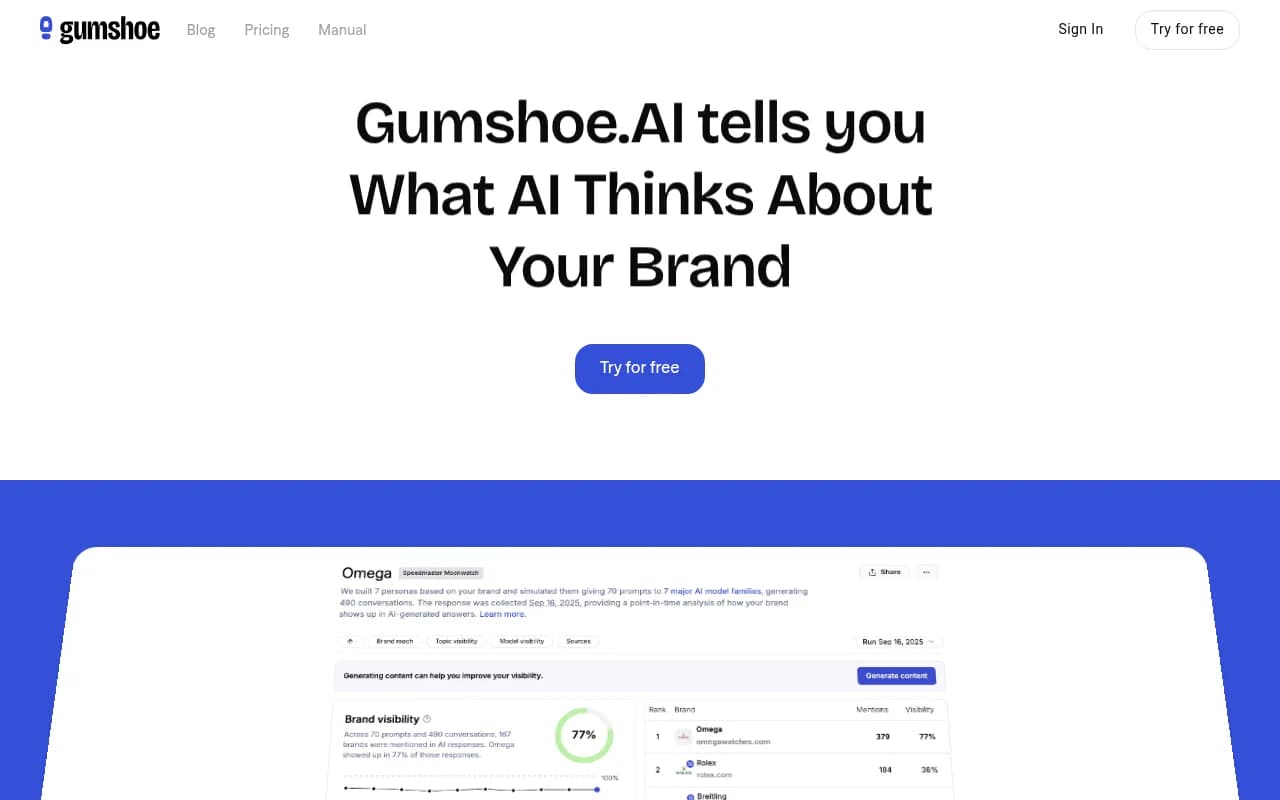
Gumshoe AI leans on AI-inferred personas and a persona-by-topic heatmap.
If you are comparing options, the GEO software directory at bestgeosoftware.com lists more of them.
Step 6: close the gap
Finding the persona gap is half the job. Fixing it means publishing the content AI cites for that buyer. A few patterns hold up:
- Check the citations for the weak persona's prompts. Which pages does AI pull from, and are any of them yours?
- Build pages for that persona's sub-questions: pricing, alternatives, integration, role-specific how-tos.
- Check whether AI crawlers can read those pages at all. A low-visibility persona is sometimes just an access problem.
- Look at the content type. Promptwatch Data found product pages were the most cited content type in ChatGPT at 22.4% of citations from Sep 28 to Oct 4, 2026, per its content type report. A persona-specific product or landing page is often a better bet than another blog post.
- Re-run the same persona prompts after publishing and compare to your baseline.
Promptwatch's content gap analysis and Content Agent are built for that last stretch, mapping your pages against the prompts AI answers and writing and publishing to your CMS. See the Content Agents page for the details.
A practical starting plan
- Choose two or three personas from closed deals.
- Draft 10 to 15 prompts across funnel stages.
- Run the plain-versus-prefixed probe on one question per stage.
- Keep separate persona series only where answers differ beyond normal noise.
- Review the persona by topic heatmap weekly.
- Pick the worst persona-and-topic cell tied to revenue and fix it.
- Re-run and compare.
If you want to see where you stand before building any of this, the free AI visibility report gives a no-login baseline.
Common mistakes
- Treating invented personas as truth. Synthetic personas are a starting hypothesis.
- Skipping the plain baseline, so you can't tell persona effect from randomness.
- Running too many personas and drowning in noise.
- Testing in a logged-in session with memory, then comparing to a fresh one.
- Ignoring location, which the scholar-recommendation study found moved lists more than role did.
The short version: personas help when they change what AI says, and the probe tells you whether they do. Start with a few, measure honestly, and spend your effort on the one persona where you are losing.