Key takeaways
- Semrush and Ahrefs remain strong for traditional SEO but their AI search features are add-ons, not core products -- expect gaps in crawler logs, content generation, and prompt intelligence.
- Profound is purpose-built for AEO with genuinely unique features (real-user prompt volumes, Amazon Rufus tracking), but pricing escalates sharply for multi-model coverage.
- Conductor adds AI citation tracking to its existing content intelligence platform, making it a reasonable choice if you're already in that ecosystem.
- Promptwatch is the only platform in this comparison that closes the full loop: find gaps, generate content, track results -- all in one place, across 10+ AI models.
- For enterprise teams that need to actually move visibility numbers (not just monitor them), the platform you pick matters more than the budget difference between them.
The AI search question used to be theoretical. Now it's showing up in quarterly reviews. Traffic from ChatGPT, Perplexity, and Google AI Mode is real and growing, and enterprise marketing teams are being asked to account for it.
The problem is that the tool landscape is genuinely confusing. You have legacy SEO platforms bolting on AI features, purpose-built AEO startups with narrow coverage, and a handful of platforms trying to do everything. Picking the wrong one means either paying for monitoring you can't act on, or missing coverage gaps that cost you citations.
This guide breaks down five platforms that enterprise teams are actually evaluating in 2026: Profound, Promptwatch, Conductor, Semrush, and Ahrefs. Not a feature checklist -- a real assessment of what each one does well, where it falls short, and which team it's actually built for.
The core question: monitoring vs. optimization
Before comparing platforms, it's worth being honest about what most of them actually do.
The majority of AI visibility tools -- including some expensive ones -- are monitoring dashboards. They show you where your brand appears in AI responses, how often you're cited, and how you compare to competitors. That's useful data. But it doesn't tell you what to do next, and it doesn't help you do it.
The more interesting question for enterprise teams is: after you see the gap, what happens? Can the platform help you close it? That's where these five tools diverge most sharply.
Profound
Profound

Profound was one of the first serious AEO platforms, and it still has some features that competitors haven't caught up to. The most notable: its prompt volume data comes from real user behavior rather than fabricated queries. That matters because visibility scores built on hypothetical prompts can be misleading -- you might be "winning" for questions nobody actually asks.
Profound also tracks Amazon Rufus (AI shopping recommendations) and has front-end response capture, meaning it records what users actually see in AI interfaces rather than just API outputs. These are real differentiators.
The friction point is pricing. The Starter plan ($99/mo) only covers ChatGPT. Adding Perplexity and Google AI Overviews pushes you to $399/mo. Full model coverage -- Claude, Gemini, Grok, and the rest -- requires enterprise pricing that isn't published. For a large brand that needs comprehensive coverage across 8-10 models, the cost can get uncomfortable fast.
Profound also launched autonomous Agents in 2026, which can execute content and optimization tasks. It's a step toward the full-loop vision, but the content generation side is still maturing compared to platforms that have been doing it longer.
Best for: Enterprise brands with budget flexibility that prioritize data quality and real-user prompt volumes, especially in e-commerce where Amazon Rufus tracking matters.
Promptwatch

Promptwatch is the platform that most directly competes with Profound on the full-stack vision -- and it's the one that's gone furthest in actually building it out.
The core difference from most competitors is what Promptwatch calls the action loop. It's not just about seeing where you're invisible; it's about fixing it. Answer Gap Analysis shows you exactly which prompts competitors are winning that you're not, with specific content gaps identified. Content Agents then generate articles, listicles, and briefs grounded in that prompt data -- not generic SEO content, but pages engineered to answer the specific questions AI models are already surfacing. Then page-level tracking shows you when those pages get crawled, when they start getting cited, and which models are citing them.
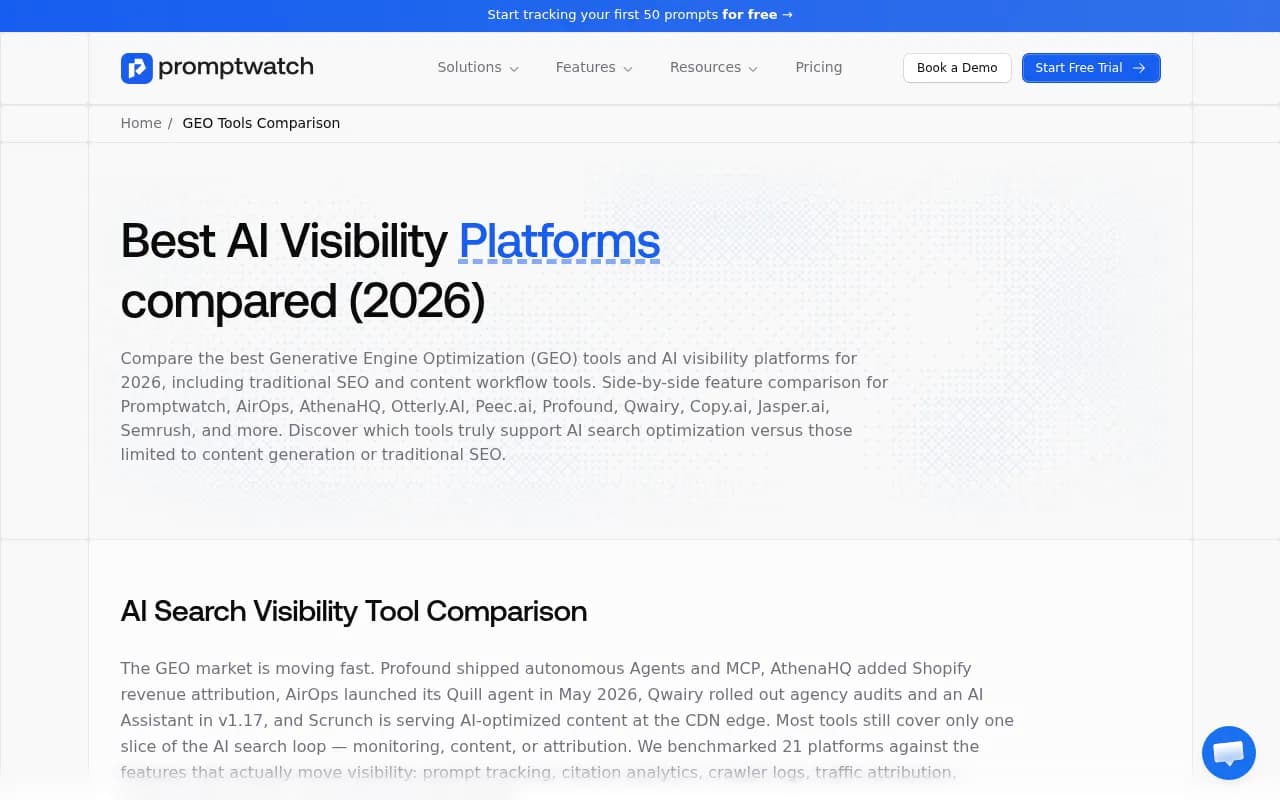
The crawler log feature is worth calling out specifically because most competitors don't have it. Promptwatch shows you real-time logs of AI crawlers hitting your site -- which pages ChatGPT's bot is reading, what errors it's encountering, how often it returns. That's the kind of technical visibility that lets you actually diagnose why you're not being cited, not just observe that you aren't.
Other capabilities that matter for enterprise teams: Reddit and YouTube insights (which discussions are influencing AI recommendations), ChatGPT Shopping tracking, offsite citation analysis, multi-language and multi-region support, and Looker Studio integration for custom reporting.
Pricing is more transparent than Profound: $99/mo (Essential, 1 site, 50 prompts), $249/mo (Professional, 2 sites, 150 prompts, crawler logs), $579/mo (Business, 5 sites, 350 prompts). Enterprise and agency pricing available. The platform covers 10 AI models: ChatGPT, Perplexity, Google AI Overviews, Google AI Mode, Claude, Gemini, Meta/Llama, DeepSeek, Grok, Mistral, and Copilot -- all included, not gated by tier.
Best for: Marketing and SEO teams that need to move from visibility data to actual content execution, without switching tools mid-workflow.
Conductor
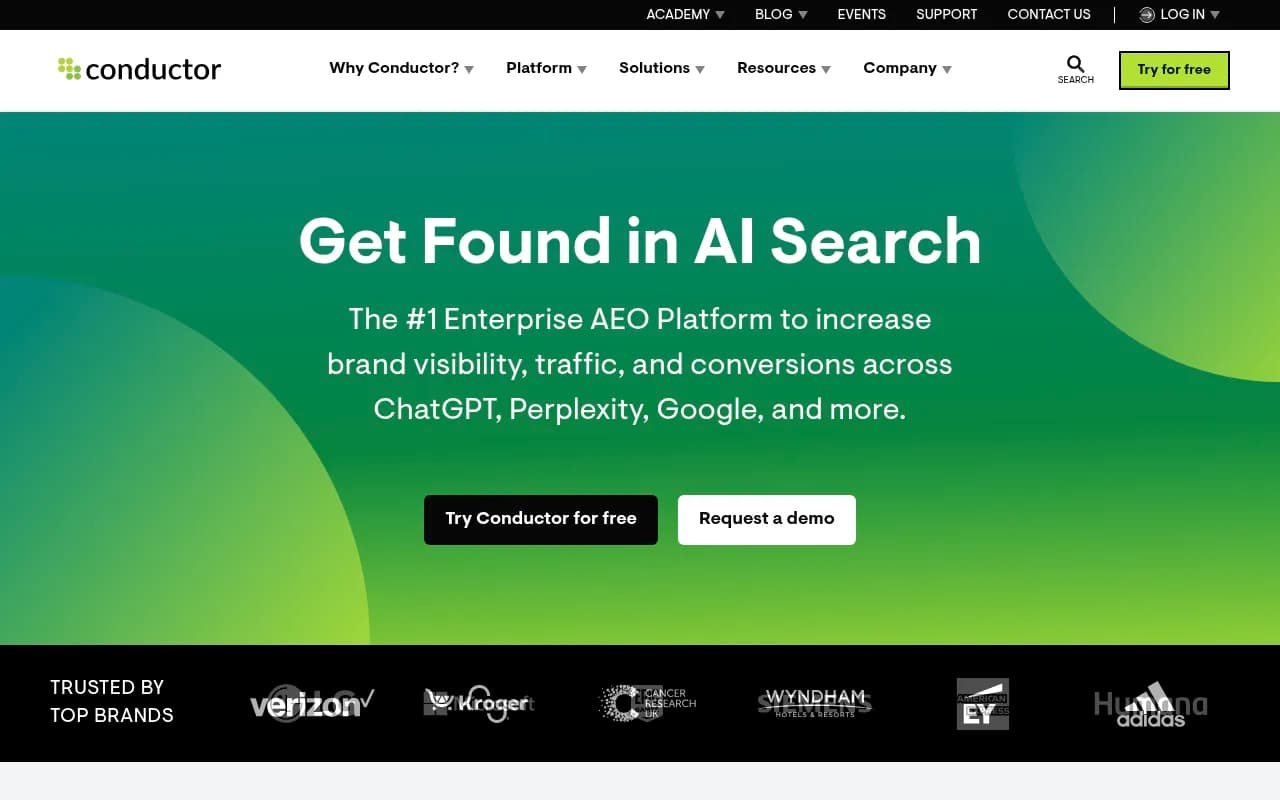
Conductor comes at this from a different angle. It's primarily a content intelligence and SEO platform that has added AI citation tracking as part of its broader offering. If your enterprise is already using Conductor for content strategy, the AI visibility layer integrates naturally into existing workflows.
What Conductor does well: it connects AI brand authority tracking to content performance data, so you can see how your existing content library is performing in AI responses alongside traditional search. The platform has a mature enterprise sales motion, strong integrations, and a reporting layer that's built for stakeholder communication.
What it doesn't do: Conductor isn't a purpose-built AEO platform. It doesn't have the depth of prompt intelligence, crawler logs, or content generation specifically designed for AI search that you'd get from Profound or Promptwatch. It's a content platform that added AI tracking, not an AI tracking platform that added content features.
Best for: Enterprise teams already embedded in the Conductor ecosystem that want AI visibility data without switching platforms.
Semrush
Semrush launched its AI Visibility Toolkit as an add-on to its core SEO suite. The honest framing: Semrush is a company built around traditional search, and AI visibility is a feature, not a product.
That's not a knock on the quality of what they've built -- Semrush has the resources to build good features. The issue is architectural. The AI Visibility Toolkit uses fixed prompts, which means you're tracking visibility for questions that Semrush chose, not questions your actual customers are asking. There's no AI traffic attribution, no crawler logs, and no content generation designed specifically for AI search.
Where Semrush still wins: keyword research, competitive analysis, backlink auditing, and the full traditional SEO stack. If your team needs to manage both traditional and AI search from one platform and you're willing to accept shallower AI coverage, Semrush is a defensible choice. But if AI search is a primary focus, you'll hit the ceiling quickly.
Best for: Teams that need a comprehensive traditional SEO platform and want basic AI visibility monitoring in the same tool, without deep AEO capabilities.
Ahrefs
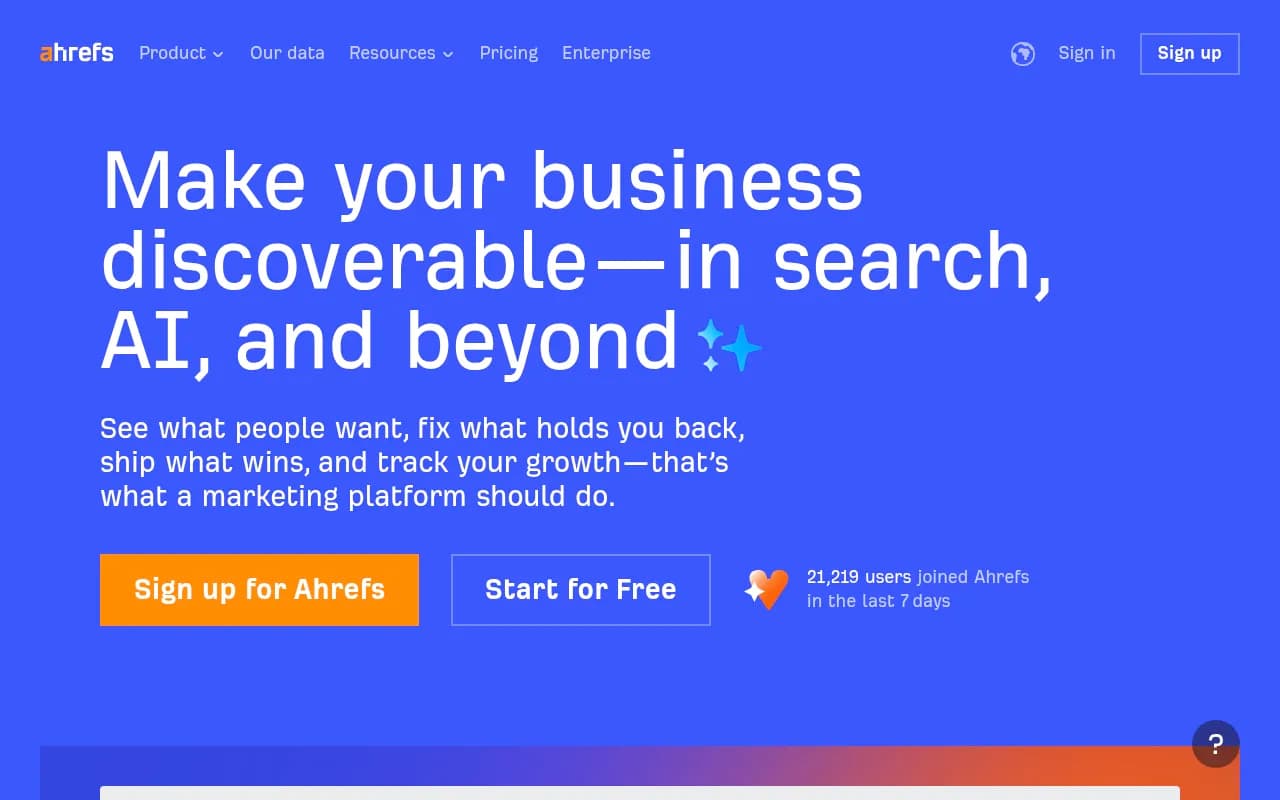
Ahrefs took a different approach with Brand Radar, and it's worth understanding why. Rather than building a separate AI visibility product, Ahrefs anchored its prompt data to real search behavior -- specifically "People Also Ask" questions with measurable search volume. The argument is that tracking AI visibility for prompts nobody actually uses produces misleading data.
That's a legitimate point, and Brand Radar's data quality is genuinely strong. The 243M+ prompts it tracks correspond to real queries, which means the visibility scores reflect something real.
The limitations: Brand Radar has fixed prompts (you can't define your own), no AI traffic attribution, and no content generation for AI search. It's a monitoring tool with high-quality data, not an optimization platform. Pricing is also modular in a way that can add up -- $699/mo for all 6 AI indexes plus custom prompt checks.
Like Semrush, Ahrefs is most valuable if you're already using it for traditional SEO and want AI visibility layered in, rather than as a standalone AEO solution.
Best for: Data-quality-focused teams that want AI visibility grounded in real search behavior and are already Ahrefs users.
Head-to-head comparison
| Feature | Promptwatch | Profound | Conductor | Semrush | Ahrefs Brand Radar |
|---|---|---|---|---|---|
| Purpose-built for AEO | Yes | Yes | Partial | No | Partial |
| AI models covered | 10+ | 9+ (tiered pricing) | Limited | Limited | 6 indexes |
| Custom prompt tracking | Yes | Yes | Limited | Fixed prompts | Fixed + custom (paid) |
| AI crawler logs | Yes | Yes | No | No | No |
| Content generation for AI search | Yes | Yes (Agents) | No | No | No |
| Answer gap analysis | Yes | Partial | No | No | No |
| Reddit/YouTube insights | Yes | No | No | No | No |
| ChatGPT Shopping tracking | Yes | Yes (Rufus) | No | No | No |
| AI traffic attribution | Yes | No | No | No | No |
| Real-user prompt data | Yes | Yes | No | No | Yes |
| Offsite citation analysis | Yes | Partial | No | No | No |
| Multi-language/region | Yes | Yes | Partial | Partial | Partial |
| Transparent pricing | Yes | Partial | No | Yes | Yes |
| Traditional SEO tools | No | No | Yes | Yes | Yes |
| Starting price | $99/mo | $99/mo (ChatGPT only) | Enterprise | $139/mo+ | $50/mo+ |
What enterprise teams actually need to decide
The comparison above makes the feature differences clear, but the real decision comes down to what your team is trying to accomplish.
If you need to report on AI visibility but aren't yet trying to actively improve it, any of these platforms will give you data to work with. Ahrefs Brand Radar or Semrush's AI toolkit might be enough if you're already paying for those platforms.
If you're trying to actively move your AI visibility -- close gaps, publish content that gets cited, track the results -- then you need a platform built for that workflow. Profound and Promptwatch are the two serious options here. Profound has stronger real-user data and Amazon Rufus tracking. Promptwatch has broader model coverage at transparent pricing, plus crawler logs, Reddit insights, ChatGPT Shopping, and a content generation layer that's further along.
If you're embedded in Conductor and don't want to switch platforms, the AI tracking layer is a reasonable starting point -- just go in knowing it's not a full AEO solution.
One thing worth being direct about: the platforms that only monitor are not going to help you improve. Visibility data without a path to action is just a more expensive way to watch your competitors win.
The data quality question
One thing that came up repeatedly in 2026 research on this category: where do the prompts come from?
Most AI visibility platforms construct their own queries. They guess what users might ask, run those prompts, and report results. The problem is that visibility scores built on fabricated prompts can be disconnected from actual user behavior.
Ahrefs Brand Radar anchors to "People Also Ask" data with real search volume. Profound uses real-user prompt volume data. Promptwatch tracks how AI search engines behave in real user interfaces, not just through APIs -- which matters because user-facing answers and citations can differ from what you'd see through an API call.
This isn't a reason to dismiss platforms that use constructed prompts -- the methodology can still produce useful directional data. But it's worth asking any vendor: where does your prompt data come from, and how do you validate that it reflects real user behavior?
Bottom line
For enterprise teams in 2026, the AI search visibility category has matured enough that "which platform should we use" is now a real strategic question, not just a tool evaluation.
Semrush and Ahrefs are the right answer if traditional SEO is your primary need and AI visibility is secondary. Conductor makes sense if you're already in that ecosystem. Profound is strong on data quality and has unique features for e-commerce, but pricing for full coverage is opaque.
Promptwatch is the platform that's built the most complete picture of the full optimization cycle -- from finding gaps to generating content to tracking results -- at pricing that scales predictably. For teams that need to show AI search as a channel that's actively managed and improving, that end-to-end capability is what separates it from the monitoring-only alternatives.
The market is moving fast. Whatever platform you pick, make sure it can tell you not just where you stand, but what to do next.