Key takeaways
- Scrunch AI's Core plan ($250/mo) limits you to 4 LLMs; Promptwatch's Professional plan ($249/mo) covers 10 AI models including Claude, Gemini, Meta AI, Grok, and DeepSeek
- Scrunch's most compelling feature -- its AXP (Agent Experience Platform) -- is locked behind Enterprise pricing; most marketing teams won't get access to it
- Promptwatch includes built-in content generation, Answer Gap Analysis, and AI crawler logs; Scrunch is primarily a monitoring and analytics platform
- Both tools have real enterprise customers and credible G2 reviews, so this isn't a clear "one is bad" situation -- it's a genuine trade-off between depth of analytics and breadth of action
- For marketing teams that need to close the loop from "we're invisible in AI search" to "we published content that fixed it," Promptwatch has a structural advantage
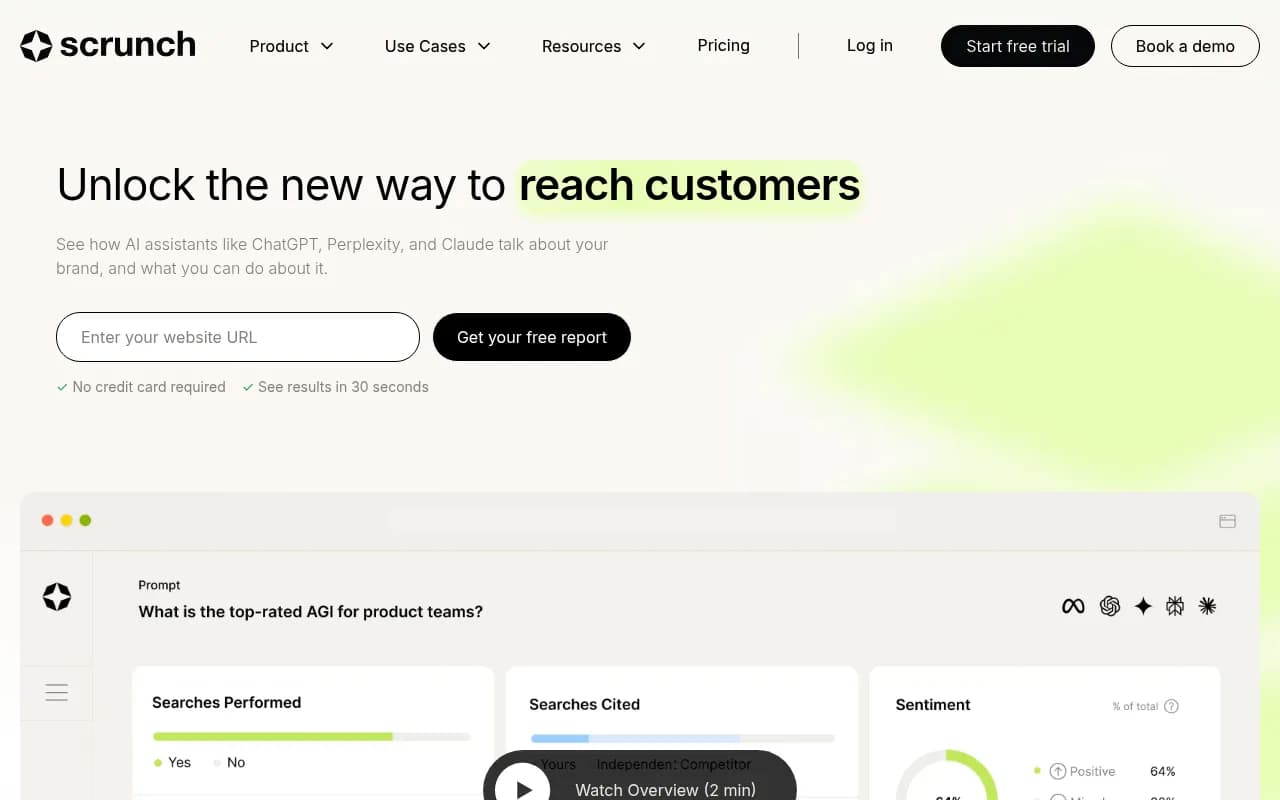
Scrunch AI raised over $15 million, landed customers like Lenovo and Crunchbase, and got written up in TechCrunch and Fast Company. That's not nothing. Its AXP technology -- which serves AI-optimized content directly to AI agents visiting your site, reportedly reducing page size by up to 98% -- is genuinely novel. There's nothing quite like it in the AEO category.
But here's the thing: most marketing teams evaluating Scrunch will never see AXP. It's Enterprise-only. And the Core plan at $250/month limits you to four LLMs -- ChatGPT, Perplexity, Google AI Overviews, and Copilot. Claude, Gemini, Meta AI, Grok, and AI Mode all require an Enterprise contract.
That's the tension at the center of this comparison. Scrunch has impressive technology, but a lot of it is gated. Promptwatch covers more ground at a comparable price point and includes tools to actually fix what you find.
Let's go feature by feature.

LLM coverage: how many AI engines do you actually monitor?
This is where the gap is most obvious.
Scrunch's Core plan covers ChatGPT, Perplexity, Google AI Overviews, and Copilot. That's four. Claude, Gemini, Meta AI/Llama, Grok, DeepSeek, and Google AI Mode are all Enterprise-tier. If you're a mid-market marketing team on a $250/month budget, you're monitoring less than half the AI search ecosystem.
Promptwatch's Professional plan ($249/month) covers all 10: OpenAI/ChatGPT, Perplexity, Google AI Overviews, Google AI Mode, Claude, Gemini, Meta/Llama, DeepSeek, Grok, and Copilot. You're not paying more to get the full picture -- you're paying roughly the same.
Why does this matter? Because your customers don't use just one AI engine. A buyer researching your product category might ask ChatGPT, then check Perplexity, then ask Claude. If you're only tracking four of those, you have a partial view of where you stand.
Pricing and what you actually get
Here's a direct comparison of what each platform offers at comparable price points:
| Feature | Scrunch Core ($250/mo) | Promptwatch Professional ($249/mo) |
|---|---|---|
| LLMs monitored | 4 | 10 |
| Prompts tracked | Not publicly disclosed | 150 |
| Content generation | No | Yes (15 articles/mo) |
| Answer Gap Analysis | No | Yes |
| AI crawler logs | No (Enterprise) | Yes |
| Reddit/YouTube tracking | No | Yes |
| ChatGPT Shopping tracking | No | No (Business tier) |
| Traffic attribution | No | Yes (GSC, code snippet, server logs) |
| Multi-region/language | Limited | Yes |
| AXP (AI agent content delivery) | No (Enterprise) | N/A |
| Advanced enterprise analytics | Yes | Partial |
Scrunch's Enterprise tier almost certainly includes more depth -- custom integrations, dedicated support, and the AXP feature. But for a marketing team on a defined budget, the Professional tier comparison above is what most people are actually choosing between.
Content generation and the "action gap"
This is the most important functional difference between the two platforms, and it's worth spending some time on.
Scrunch is fundamentally an analytics and monitoring platform. It shows you where your brand appears in AI responses, how often, and with what sentiment. G2 reviewers consistently praise the data quality. But the same reviewers flag that "optimization suggestions are minimal" and there's "limited guidance on implementation." You get the diagnosis without the prescription.
Promptwatch is built around what it calls the action loop: find the gaps, create content that fills them, track the results.
The Answer Gap Analysis shows you specific prompts where competitors are getting cited but you're not. The built-in AI writing agent then generates articles, listicles, and comparisons grounded in citation data from over 880 million analyzed citations. The content isn't generic -- it's engineered around the specific prompts and topics where AI models are looking for answers your site doesn't currently provide.
For a marketing team, this matters a lot. Most teams don't just want a dashboard that shows them they're invisible in AI search. They want to know what to do about it. Scrunch leaves that work to you. Promptwatch builds it into the product.
AI crawler logs: understanding how AI engines see your site
Promptwatch's Professional plan includes real-time logs of AI crawlers -- ChatGPT's GPTBot, Perplexity's crawler, Claude's crawler -- hitting your website. You can see which pages they're reading, how often they return, and what errors they encounter.
This is more useful than it sounds. AI models can only cite content they've actually crawled and indexed. If GPTBot is hitting your homepage but never reaching your product pages or blog posts, that's a fixable technical problem. Without crawler logs, you'd never know.
Scrunch doesn't offer this on any non-Enterprise tier. It's a meaningful gap for teams trying to understand why their content isn't getting cited despite being well-written.
Prompt intelligence and prioritization
One of the harder problems in AI visibility is knowing which prompts to care about. There are thousands of possible queries in any given category. Which ones have real volume? Which ones are winnable?
Promptwatch includes volume estimates and difficulty scores for each prompt, plus query fan-outs -- showing how a single prompt branches into related sub-queries. This helps teams prioritize high-value, realistic targets instead of spreading effort across everything.
Scrunch reviewers on G2 have noted that prompt credits deplete quickly when tracking multiple engines. The platform's prompt tracking model appears to work on a credit system, which can create friction when you're trying to monitor a broad set of queries across multiple LLMs.
Reddit and YouTube tracking
This one catches people off guard, but it's genuinely important.
AI models don't just cite brand websites. They cite Reddit threads, YouTube videos, forums, and third-party review sites. When someone asks ChatGPT "what's the best project management tool for remote teams," the answer might pull from a Reddit thread from 18 months ago, a YouTube comparison video, and a few blog posts.
Promptwatch surfaces Reddit discussions and YouTube content that directly influences AI recommendations. If a Reddit thread is shaping how AI engines describe your category -- and it's saying something unfavorable about your brand -- you want to know that.
Scrunch doesn't track Reddit or YouTube on any published tier. This is a channel most monitoring tools ignore entirely.
Traffic attribution: connecting AI visibility to revenue
Knowing you're getting cited in AI responses is useful. Knowing that those citations are driving actual traffic and revenue is what justifies the budget.
Promptwatch offers three attribution methods: a JavaScript code snippet, Google Search Console integration, and server log analysis. You can see which pages are being cited, how often, by which models, and whether those citations are translating into visits.
Scrunch's Core plan doesn't include traffic attribution. It's unclear whether Enterprise includes it. For marketing teams reporting to leadership, this is a real gap -- you need to show that AI visibility work is producing results, not just that your visibility score went up.
Where Scrunch genuinely wins
It would be dishonest to frame this as a one-sided comparison. Scrunch has real strengths.
Its AXP technology -- serving AI-optimized content directly to AI agents -- is genuinely differentiated. No other platform in this category does something similar. If you're an enterprise brand with the budget for an Enterprise contract, AXP could meaningfully improve how AI engines understand and represent your content.
Scrunch also has a stronger enterprise analytics story. Customers like Lenovo and Crunchbase aren't using it for basic monitoring -- they're getting deeper competitive intelligence and more sophisticated reporting. The G2 score of 4.6/5 across 50+ reviews reflects real user satisfaction, not just marketing.
For large organizations where the Enterprise tier is accessible, Scrunch's depth of analytics may outweigh Promptwatch's breadth of action tools. That's a legitimate trade-off.
Who each tool is actually built for
Scrunch AI makes most sense if:
- You're an enterprise brand with budget for the Enterprise tier (and want AXP)
- Your primary need is deep analytics and competitive intelligence
- You have a content team that can act on monitoring data independently
- You're primarily focused on ChatGPT, Perplexity, and Google AI Overviews (the four Core LLMs)
Promptwatch makes most sense if:
- You're a marketing team that needs to both identify and fix AI visibility gaps
- You want coverage across all 10 major AI models without paying Enterprise prices
- You need to show leadership that AI visibility work is driving traffic (attribution)
- You want to understand how AI crawlers are actually accessing your site
- Reddit and YouTube influence on AI recommendations matters to your category
A note on the broader market
The AI visibility category is moving fast. A comparison of 12 GEO platforms in 2026 -- including Search Party, Otterly.AI, Peec.ai, Profound, AthenaHQ, and others -- found that most tools are monitoring-only dashboards. They show you data but stop there.
Otterly.AI


Profound

The distinction that matters for marketing teams isn't which tool has the prettiest dashboard or the most impressive enterprise logos. It's whether the tool helps you close the loop: find where you're invisible, create content that fixes it, and verify that the fix worked.
Scrunch is strong on the first part. Promptwatch is stronger on all three.
Feature comparison summary
| Capability | Scrunch AI (Core) | Promptwatch (Professional) |
|---|---|---|
| AI models covered | 4 | 10 |
| Monthly price | $250 | $249 |
| Prompts tracked | Credit-based | 150 |
| Content generation | No | 15 articles/mo |
| Answer Gap Analysis | No | Yes |
| AI crawler logs | Enterprise only | Yes |
| Traffic attribution | No | Yes |
| Reddit/YouTube tracking | No | Yes |
| ChatGPT Shopping | No | No (Business) |
| AXP (agent content delivery) | Enterprise only | N/A |
| Multi-language/region | Limited | Yes |
| Looker Studio / API | Unknown | Yes |
The bottom line
If you're a marketing team trying to improve your visibility in AI search engines -- and you need tools that help you act on what you find, not just observe it -- Promptwatch covers more ground at the same price point. Ten LLMs instead of four, built-in content generation, crawler logs, Reddit tracking, and traffic attribution all come with the Professional plan.
Scrunch's most compelling technology is locked behind Enterprise pricing. For teams that can access it, it's genuinely interesting. For everyone else, the Core plan is a solid monitoring tool that leaves the optimization work to you.
That's the honest answer. The right choice depends on your budget tier and whether you need a monitoring platform or an optimization platform.