Key takeaways
- ChatGPT doesn't rank pages — it cites sources. That means traditional rank tracking is largely useless for AI search, and you need a different set of metrics entirely.
- The 6 metrics that matter most are: brand mention rate, citation share, sentiment score, prompt coverage, source authority, and AI traffic attribution.
- Most monitoring tools only show you the first two. The ones worth paying for go further — tracking which content gets cited, why competitors outperform you, and how to close the gap.
- Tools like Promptwatch go beyond monitoring to help you actually fix visibility gaps with content gap analysis and AI-native content generation.
Why your old metrics don't work here
If you've been trying to apply traditional SEO thinking to ChatGPT visibility, you've probably noticed it doesn't quite fit. There are no positions 1 through 10. There's no SERP to screenshot. A user asks a question, ChatGPT synthesizes an answer from multiple sources, and either your brand is part of that answer or it isn't.
That binary reality is what makes this space confusing for teams used to watching keyword rankings tick up and down. The question isn't "where do I rank?" — it's "am I even in the conversation?"
And the follow-up questions matter just as much: Am I cited favorably? For which topics? Compared to whom? Is any of this actually driving traffic?
These are the six things worth measuring. Everything else is noise.
Metric 1: Brand mention rate
This is the most basic metric, and it's where most teams start. Brand mention rate measures how often your brand name appears in ChatGPT's responses when users ask relevant questions.
The way to measure it: take a set of prompts relevant to your category (say, 50 to 100 queries your customers might realistically type), run them through ChatGPT, and count how often your brand shows up in the generated answers. Divide by total prompts to get a percentage.
A 20% mention rate means ChatGPT references your brand in roughly 1 in 5 relevant conversations. Whether that's good or bad depends entirely on your category and competitors.
The limitation of this metric alone: it tells you nothing about context. Being mentioned as "a brand some people complain about" is not the same as being cited as the recommended solution. That's where sentiment comes in.
Tools like Otterly.AI and Peec AI track brand mention rates across multiple AI engines.
Otterly.AI


Metric 2: Citation share (share of voice in AI)
Citation share is the competitive version of mention rate. Instead of just asking "how often am I mentioned?", you ask "what percentage of all AI citations in my category go to me versus my competitors?"
This is the metric that actually tells you where you stand. If you have a 15% mention rate but your top competitor has 60%, you're losing badly even if your absolute number looks okay.
Calculating citation share requires running the same prompt set for all competitors simultaneously, then comparing results. Most teams don't do this manually — it's tedious and the results go stale quickly as AI models update.
The better approach is a tool that automates this comparison. Promptwatch tracks citation share across 10 AI models and shows competitor heatmaps so you can see who's winning for each prompt category and why.

Profound also does this well at the enterprise level, with conversation volume tracking that gives you a sense of how many real user queries your citation share applies to.
Profound

Metric 3: Sentiment score
Not all mentions are equal. ChatGPT might reference your brand to say it's expensive, or that users have reported issues, or that it's "one option among many." Those are mentions, but they're not doing you any favors.
Sentiment scoring analyzes the context around your brand mentions — positive, neutral, or negative — and tracks how that changes over time. A drop in sentiment score can signal that new negative content is being ingested by AI models, or that a competitor has published content that positions you unfavorably.
The nuance here: AI sentiment isn't the same as social media sentiment. ChatGPT draws from web content, Reddit discussions, review sites, and its training data. A single widely-cited negative review piece can shift how ChatGPT describes your brand across thousands of user queries.
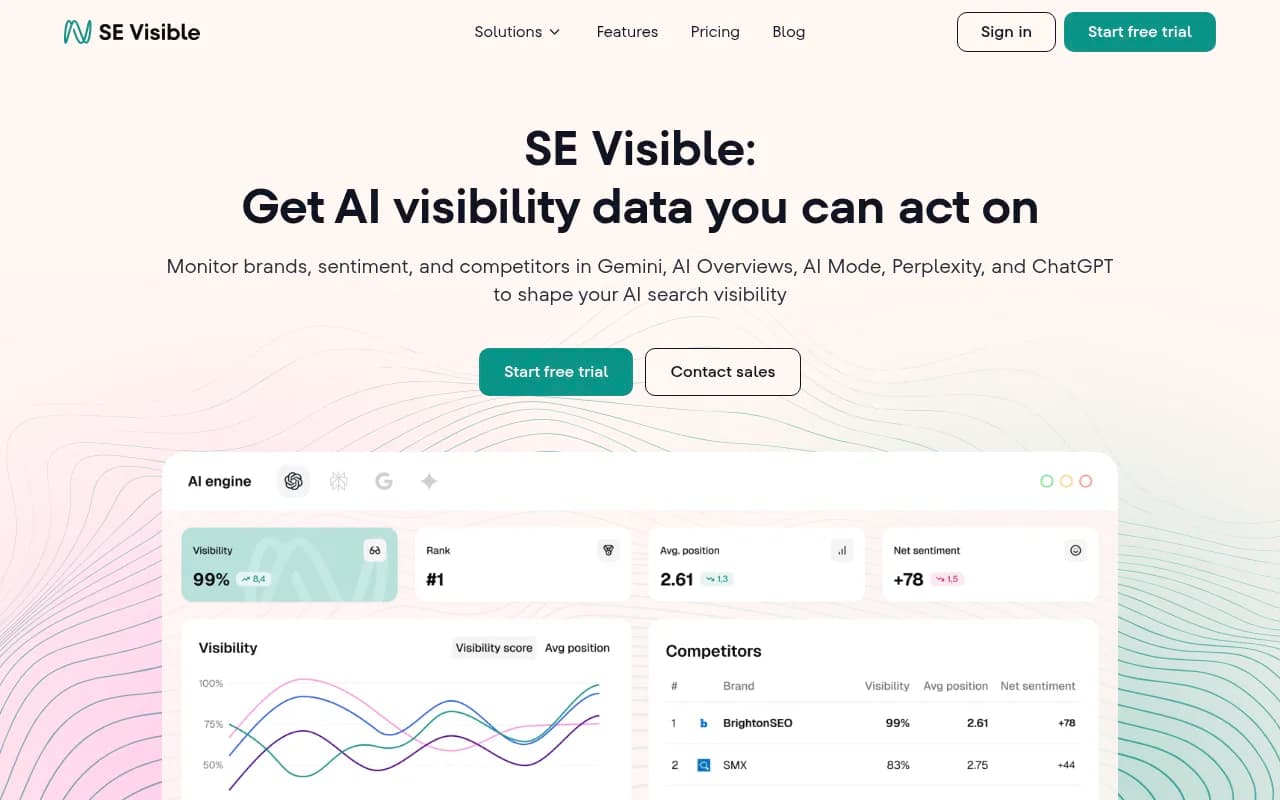
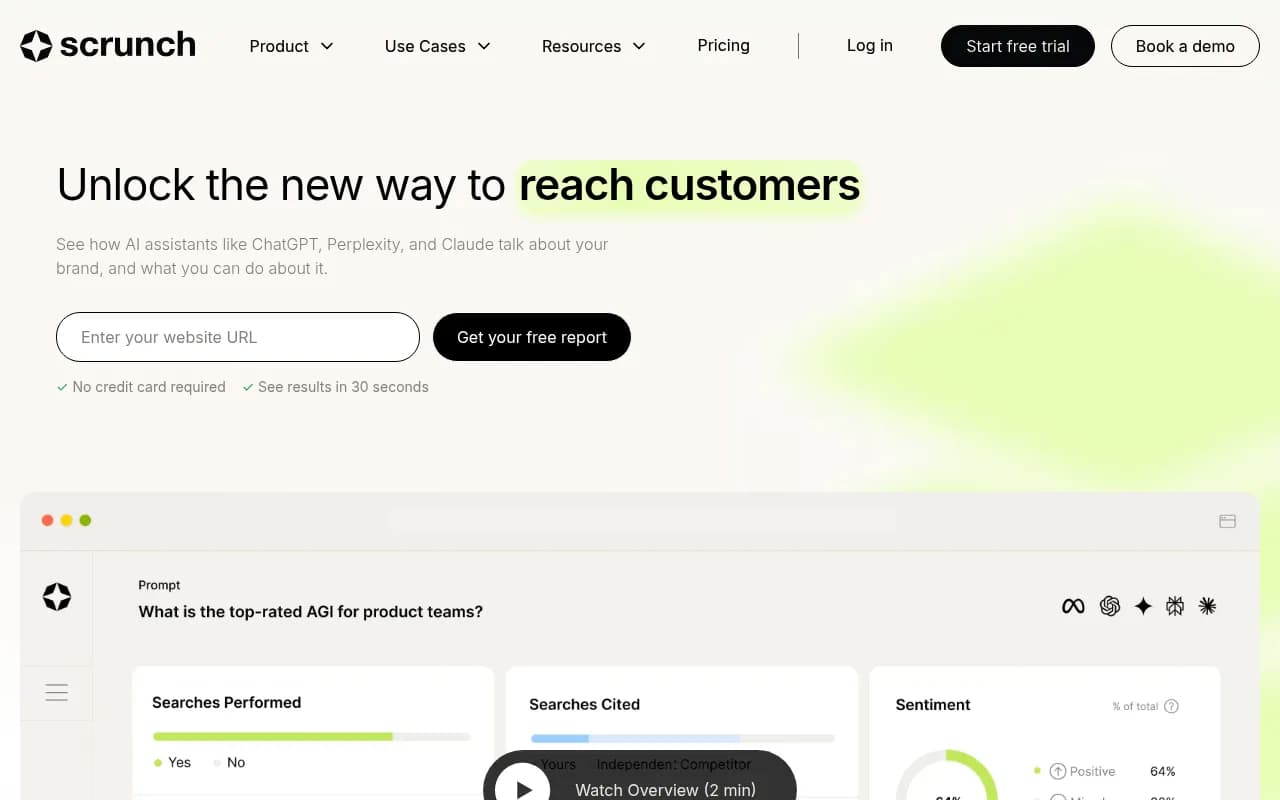
SE Visible (SE Ranking's AI visibility product) includes a Net Sentiment Score that tracks this over time. Scrunch AI also surfaces sentiment trends alongside mention data.
Metric 4: Prompt coverage
This one is underrated and most teams ignore it until they realize how much they're missing.
Prompt coverage measures what percentage of relevant queries in your category your brand appears in. The key word is "relevant" — not just branded queries, but the full range of questions your potential customers ask.
Think about the buyer journey. Someone researching your category might ask:
- "What's the best [product type] for [use case]?"
- "How does [your brand] compare to [competitor]?"
- "What are the pros and cons of [your solution]?"
- "Is [your brand] worth it for small businesses?"
Each of these is a separate prompt. Your brand might appear in the direct comparison query but be completely absent from the "best for small businesses" query — even though that's where a lot of your actual customers come from.
Prompt coverage analysis maps your visibility across the full prompt landscape. The gap between where you appear and where you should appear is your opportunity.
Promptwatch's Answer Gap Analysis does exactly this — it shows which prompts competitors are visible for that you're not, and identifies the specific content your site is missing. That's the kind of actionable output that makes the difference between a monitoring tool and an optimization tool.
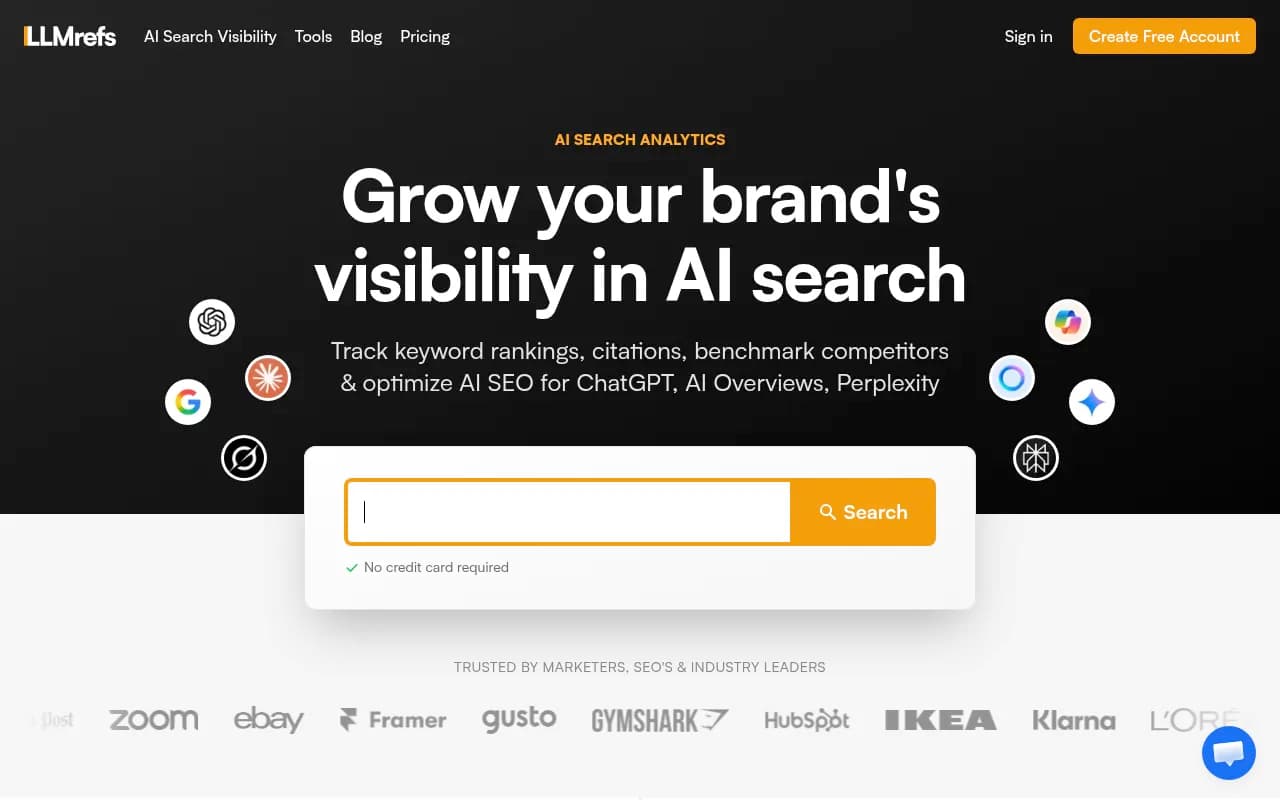
AthenaHQ and LLMrefs also track prompt coverage, though they stop at showing you the gap rather than helping you close it.

LLMrefs
Metric 5: Source authority and citation quality
Here's something most visibility dashboards don't show you: which specific pages on your site ChatGPT is actually citing.
This matters because AI models don't cite your brand — they cite specific URLs. A well-structured comparison page might get cited constantly while your homepage is ignored entirely. A blog post from 2022 might be pulling more AI citations than your current product pages.
Source authority tracking answers:
- Which of your pages are being cited, and how often?
- Which competitor pages are being cited instead of yours?
- What types of content (listicles, how-tos, comparisons, case studies) get cited most in your category?
- Are there Reddit threads or YouTube videos being cited that you could be creating content to compete with?
This last point is genuinely surprising to most teams. AI models frequently cite Reddit discussions and YouTube content alongside or instead of brand websites. If you're not monitoring those channels, you're missing a significant part of the picture.
Promptwatch tracks page-level citations and includes Reddit and YouTube insights — which sources are influencing AI recommendations in your category. Most competitors don't touch this at all.
ZipTie does solid page-level citation analysis too, with an "AI success score" that helps prioritize which pages to optimize first.
Metric 6: AI traffic attribution
This is the metric that connects everything to actual business results, and it's the hardest to measure well.
The problem: when someone visits your site after seeing your brand mentioned in a ChatGPT response, that traffic often shows up as "direct" in Google Analytics. The referral chain gets broken. You end up with a growing direct traffic number and no idea how much of it came from AI search.
AI traffic attribution tries to solve this. The approaches vary:
- UTM parameters on links ChatGPT cites (limited, since ChatGPT often doesn't include links)
- Server log analysis to identify AI crawler activity and correlate it with traffic patterns
- GSC integration to catch traffic from AI-adjacent search behavior
- JavaScript snippet tracking that captures referral data before it gets lost
None of these is perfect. But having some attribution is dramatically better than having none, because it's the only way to answer the question your CMO will eventually ask: "Is any of this AI visibility work actually driving revenue?"
Promptwatch offers all three attribution methods — code snippet, GSC integration, and server log analysis — which is more comprehensive than most tools in this space. It also includes AI crawler logs that show in real time which AI bots (ChatGPT, Claude, Perplexity) are crawling your site, which pages they're reading, and whether they're hitting errors.
Analyze AI focuses specifically on tying AI search visibility to real traffic, which makes it worth looking at if attribution is your primary concern.
How the metrics connect
These six metrics aren't independent — they form a chain.
Prompt coverage tells you where you should be visible. Brand mention rate tells you where you actually are. Citation share tells you how that compares to competitors. Sentiment score tells you whether those mentions are helping or hurting. Source authority tells you which content is driving your visibility. And AI traffic attribution tells you whether any of it is translating to real business outcomes.
Most teams start at metric 1 and never get to metric 6. That's partly because the tools that cover the full chain are newer, and partly because attribution is genuinely hard.
But the teams that will win in AI search over the next 12-18 months are the ones building measurement infrastructure now, before it becomes table stakes.
Tool comparison: who tracks what
| Tool | Mention rate | Citation share | Sentiment | Prompt coverage | Source/page level | AI traffic attribution |
|---|---|---|---|---|---|---|
| Promptwatch | Yes | Yes | Yes | Yes (+ gap analysis) | Yes (+ Reddit/YouTube) | Yes (3 methods) |
| Profound | Yes | Yes | Yes | Partial | Partial | No |
| Otterly.AI | Yes | Yes | Yes | Limited | No | No |
| Peec AI | Yes | Yes | Partial | Limited | No | No |
| AthenaHQ | Yes | Yes | Yes | Yes | Partial | No |
| ZipTie | Yes | Yes | No | Partial | Yes | No |
| Analyze AI | Yes | Partial | No | No | Partial | Yes |
| SE Visible | Yes | Yes | Yes | Partial | No | No |
The pattern is clear: most tools handle the first two or three metrics reasonably well. The later metrics — especially source-level tracking and traffic attribution — are where the field thins out quickly.
Where to start if you're new to this
If you haven't measured any of these metrics yet, here's a practical starting point:
First, define your prompt set. Write out 30-50 questions your customers actually ask when researching your category. Include comparison queries, use-case queries, and problem-based queries. This is your baseline measurement universe.
Second, run those prompts through ChatGPT manually and note where your brand appears, where competitors appear, and what the context is around each mention. This gives you a rough baseline even before you invest in tooling.
Third, pick a tool that matches your current priority. If you just need to understand where you stand, Otterly.AI or Peec AI are affordable starting points. If you want to actually improve your visibility and track the results, Promptwatch covers the full loop from gap identification to content creation to traffic attribution.
The brands that are investing in this infrastructure now will have a significant head start. AI search isn't replacing traditional search overnight, but it's already eating into it — Forbes reported in 2025 that 60% of organic traffic was being absorbed by AI responses. That number isn't going down.
Knowing your six metrics is how you make sure your brand is on the right side of that shift.