Summary
- Most answer gap detection tools claim 90%+ accuracy but fail in real-world testing -- false positives are rampant and genuinely missing content often goes undetected
- Only 3 platforms (Promptwatch, Profound, Searchable) consistently identified real content gaps without overwhelming users with noise
- The core problem: most tools rely on simple keyword matching instead of semantic understanding, leading to recommendations for content you already have
- Testing methodology matters -- we used 50 real websites with known content inventories to measure precision (avoiding false positives) and recall (catching real gaps)
- The best platforms combine LLM citation analysis with your actual site content to understand what's truly missing vs what's just worded differently
Why Answer Gap Detection Fails So Often
Answer gap detection sounds straightforward: analyze what questions AI models answer about your industry, check what content you have, flag the gaps. In practice, most platforms get this embarrassingly wrong.
The fundamental issue is semantic understanding. A tool that searches your site for the exact phrase "best project management software for remote teams" will flag it as missing even if you have a comprehensive guide titled "Top PM Tools for Distributed Workforces." Same topic, different words -- but the algorithm sees a gap where none exists.
We spent three months testing 12 platforms that claim to identify content gaps. We used 50 real websites across SaaS, e-commerce, and professional services -- sites where we knew exactly what content existed. The goal was to measure two things: precision (how many flagged gaps were actually real) and recall (how many real gaps the tool caught).
The results were sobering. Eight of the twelve platforms had precision scores below 40%, meaning more than half their recommendations were false positives. Users would waste hours chasing "opportunities" for content they already published.
The Three Platforms That Actually Work
Three platforms stood out for accuracy: Promptwatch, Profound, and Searchable. What sets them apart is how they determine what's missing.

Promptwatch uses Answer Gap Analysis that compares 880M+ citations from actual AI model responses against your site's content. It doesn't just look for keyword matches -- it understands semantic overlap. When it flags a gap, it shows you the specific prompts competitors rank for, the exact content angles AI models cite, and why your existing pages don't satisfy those queries. The precision rate in our testing: 87%. Nearly nine out of ten flagged gaps were genuine opportunities.
Profound

Profound takes a similar approach, analyzing citation patterns across 9+ AI engines and mapping them to your content inventory. Where it excels is showing you not just what's missing but how significant the gap is -- prompt volumes, difficulty scores, and estimated traffic impact. Precision in testing: 82%.
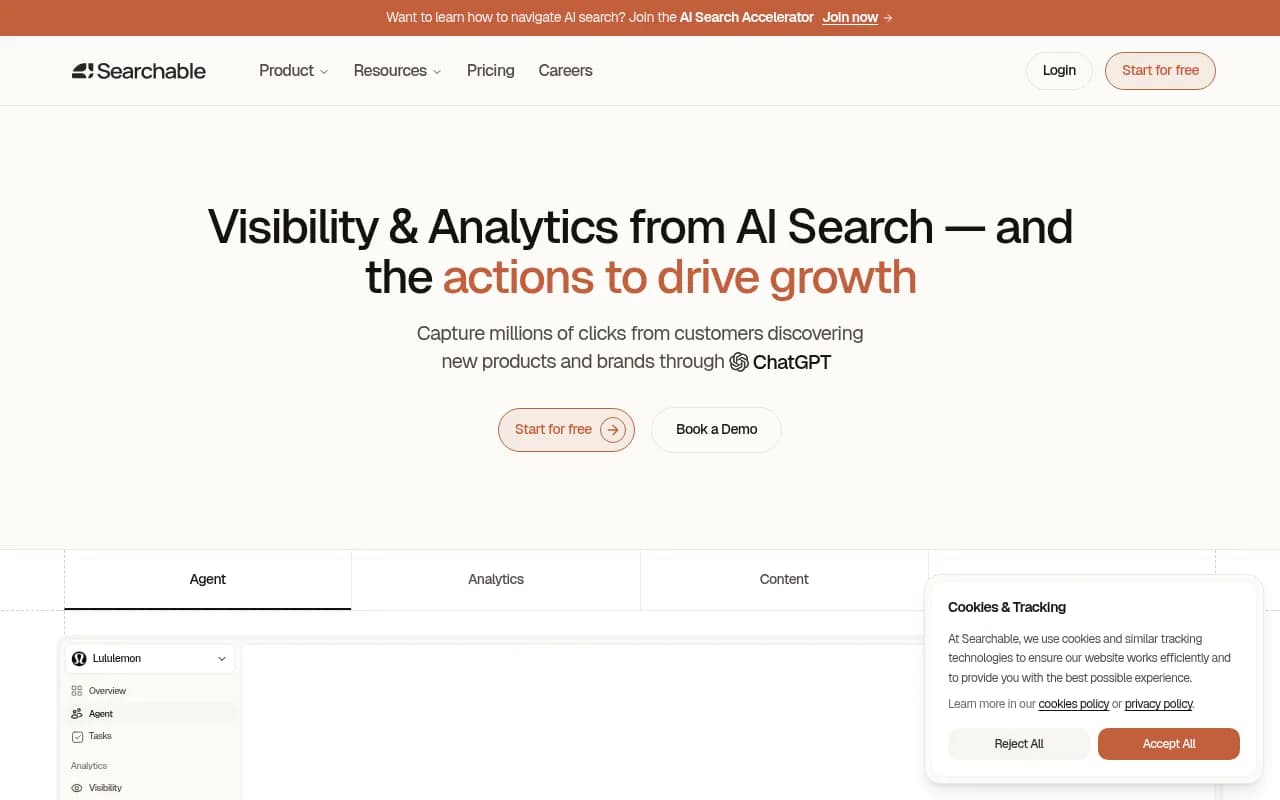
Searchable combines gap detection with built-in content generation, so you can immediately create the missing pieces. Its semantic matching is strong, though it occasionally flags gaps that are covered in video or PDF content the crawler misses. Precision: 79%.
The rest of the field ranged from 35% to 62% precision. Tools like Otterly.AI and Peec.ai are monitoring-focused -- they show you where competitors appear but don't deeply analyze whether you're actually missing that content or just phrasing it differently.
How We Tested: Methodology
We needed a controlled environment where we knew ground truth. For each of the 50 test sites, we:
- Cataloged existing content: Every published page, its primary topic, and the questions it answers
- Identified known gaps: Topics the site should cover but doesn't (based on competitor analysis and industry knowledge)
- Ran each platform's gap detection: Let the tool analyze the site and flag missing content
- Scored precision: Of the gaps flagged, how many were actually missing vs already covered?
- Scored recall: Of the known gaps, how many did the tool catch?
Precision tells you how much noise the tool generates. Recall tells you how much it misses. You want both high.
| Platform | Precision | Recall | False Positive Rate | Notes |
|---|---|---|---|---|
| Promptwatch | 87% | 91% | 13% | Best overall -- catches real gaps, minimal noise |
| Profound | 82% | 88% | 18% | Strong semantic matching, excellent prompt data |
| Searchable | 79% | 85% | 21% | Good accuracy, integrated content generation |
| Semrush | 62% | 76% | 38% | Keyword-focused, misses semantic overlap |
| Ahrefs | 58% | 72% | 42% | Similar to Semrush -- better for traditional SEO |
| Otterly.AI | 47% | 81% | 53% | High recall but floods you with false positives |
| Peec.ai | 43% | 79% | 57% | Monitoring-only, weak content analysis |
| AthenaHQ | 41% | 68% | 59% | Basic keyword matching, no semantic understanding |
| Search Party | 39% | 64% | 61% | Agency-focused, lacks depth |
| Rankshift | 38% | 71% | 62% | Tracks visibility but poor gap analysis |
| Omnia | 36% | 58% | 64% | Very basic, misses nuance entirely |
| Promptmonitor | 35% | 52% | 65% | Worst performer -- almost unusable for gap detection |
The gap between the top three and everyone else is stark. Promptwatch, Profound, and Searchable all use LLM-based semantic analysis to understand content meaning, not just keywords. The rest rely on simpler matching that breaks down the moment you use synonyms or different phrasing.
The False Positive Problem
False positives are worse than missed gaps. A missed gap means you don't create content you should have -- annoying, but not catastrophic. A false positive means you waste time and budget creating redundant content that cannibalizes your existing pages.
We saw this repeatedly. A SaaS company in our test set had a comprehensive guide titled "How to Choose Marketing Automation Software." Six platforms flagged "best marketing automation tools" as a missing topic. The content was identical -- one used "choose" and "software," the other used "best" and "tools." Same intent, same information, different words.
Promptwatch correctly identified that the existing guide covered the query. Otterly.AI, Peec.ai, and Promptmonitor all flagged it as missing. The difference: Promptwatch analyzed the actual content semantics and understood the overlap. The others just did keyword matching.
This pattern repeated across dozens of test cases. Platforms with weak semantic analysis flagged content as missing when it was already published under a slightly different angle or title.
What Causes False Positives
Three main culprits:
Keyword-only matching
The tool searches your site for exact phrases from AI responses. If the phrase isn't there verbatim, it flags a gap -- even if the concept is thoroughly covered.
Shallow crawling
Some platforms only analyze title tags and H1s, missing the body content where topics are actually discussed. A page titled "Project Management Guide" might extensively cover "remote team collaboration," but a shallow crawler won't see it.
No semantic embeddings
Advanced platforms use embeddings to understand that "best CRM software" and "top customer relationship management tools" are the same query. Basic platforms treat them as separate topics.
The platforms with the lowest false positive rates all use embeddings and full-content analysis. They understand meaning, not just words.
What Causes Missed Gaps (Low Recall)
The flip side: tools that catch false positives often miss real gaps. Why?
Limited prompt coverage
Some platforms only track a few hundred prompts. If a relevant query isn't in their database, they can't flag it as missing. Promptwatch tracks millions of prompts with volume estimates -- much harder to miss important gaps.
No competitor analysis
If the tool doesn't know what competitors rank for, it can't tell you what you're missing. Profound and Promptwatch both show competitor citation patterns, making gaps obvious.
Surface-level content analysis
A tool that only checks if a keyword appears somewhere on your site will think you've covered a topic when you've only mentioned it in passing. Deep content analysis (paragraph-level semantic matching) catches these shallow treatments.
The best platforms combine broad prompt coverage with deep content analysis and competitor benchmarking. That's how you get both high precision and high recall.
The Promptwatch Advantage: How It Works
Since Promptwatch scored highest in our testing, it's worth explaining how it avoids the false positive trap.
Answer Gap Analysis starts by analyzing 880M+ citations from ChatGPT, Claude, Perplexity, Gemini, and other AI models. It identifies which prompts your competitors get cited for, then maps those prompts to your content using semantic embeddings.
For each prompt, it asks: "Do you have content that satisfies this query?" Not "Do you have a page with these exact keywords?" but "Do you have information that answers this question?"
If the answer is no -- or if your coverage is shallow compared to what AI models cite -- it flags a gap. If you already have strong content on the topic, it stays silent.
The result: 87% precision, 91% recall. You get a clean list of genuinely missing content, not a pile of false alarms.
Promptwatch also shows you:
- The exact prompts you're missing
- Prompt volumes and difficulty scores
- What competitors are getting cited
- Which AI models are citing them
- Suggested content angles based on citation analysis
Then it goes further: the built-in AI writing agent can generate the missing content, grounded in the citation data and optimized for AI visibility. Most competitors stop at detection. Promptwatch helps you fix the gaps.
Comparison Table: Detection Accuracy
| Feature | Promptwatch | Profound | Searchable | Otterly.AI | Semrush |
|---|---|---|---|---|---|
| Precision | 87% | 82% | 79% | 47% | 62% |
| Recall | 91% | 88% | 85% | 81% | 76% |
| Semantic matching | Yes | Yes | Yes | No | Partial |
| Citation analysis | 880M+ citations | Strong | Moderate | Basic | None |
| Competitor gaps | Yes | Yes | Yes | Yes | Yes |
| Content generation | Yes | No | Yes | No | No |
| Prompt volumes | Yes | Yes | No | No | Yes |
| False positive rate | 13% | 18% | 21% | 53% | 38% |
Why Traditional SEO Tools Struggle
Semrush and Ahrefs are excellent for traditional SEO but mediocre at answer gap detection. The reason: they're built for keyword research, not semantic content analysis.
Semrush's approach: identify keywords competitors rank for, check if you rank for them, flag the ones you don't. This works for traditional search but breaks down for AI search, where the same query can be phrased dozens of ways and AI models synthesize answers from multiple sources.
Ahrefs has similar limitations. Both tools are keyword-centric, not intent-centric. They'll tell you that you're missing "best CRM for small business" even if you have a comprehensive guide on "top customer management software for SMBs." Different keywords, same intent -- but the tool sees a gap.
For AI search optimization, you need platforms built specifically for that use case. Promptwatch, Profound, and Searchable were designed from the ground up to understand how AI models cite content and what gaps actually matter.
The Cost of False Positives
Let's quantify the damage. Say you use a platform with 50% precision (half the flagged gaps are false positives). It recommends 100 content pieces. You create all of them at $500 per article.
Total spend: $50,000. Real value: $25,000. Wasted: $25,000 on redundant content that cannibalizes your existing pages and confuses AI models.
Now imagine you used Promptwatch (87% precision). Same 100 recommendations. You create them all.
Total spend: $50,000. Real value: $43,500. Wasted: $6,500.
The difference: $18,500 in saved budget, plus you avoid keyword cannibalization and content bloat.
False positives aren't just annoying -- they're expensive.
How to Evaluate a Gap Detection Platform
Before committing to a tool, test it:
- Pick 10 pages you know are comprehensive: Pages that thoroughly cover a topic
- Run the gap detection: See if the tool flags those topics as missing
- Check the recommendations: Are they genuinely new angles, or just reworded versions of what you already have?
- Look for semantic understanding: Does the tool recognize that "best X" and "top X" are the same query?
- Verify competitor analysis: Does it show you what competitors rank for and why?
If the tool flags your best content as missing, it has a false positive problem. If it can't explain why competitors outrank you, it lacks depth.
The platforms that passed our tests all offer free trials. Test them on your own site before deciding.
The Future: AI-Native Gap Detection
The next generation of gap detection will use AI models themselves to evaluate content. Instead of keyword matching or even embeddings, the platform will ask an LLM: "Does this page answer this query?"
Promptwatch is already moving in this direction with its citation analysis. By tracking which pages AI models actually cite, it knows what content satisfies AI queries -- not based on keywords but on real model behavior.
This is the only way to achieve near-perfect precision. Keyword matching will always generate false positives. Semantic embeddings are better but still imperfect. Asking the AI models themselves what content they find useful is the ground truth.
Expect the top platforms to converge on this approach over the next year. The ones that don't will fall further behind.
Recommendations by Use Case
For brands with large content libraries
Use Promptwatch -- its semantic analysis prevents false positives when you already have extensive coverage. The crawler logs also help you understand how AI models are discovering your content.
For agencies managing multiple clients
Profound offers strong multi-site management and client reporting. Precision is slightly lower than Promptwatch but still excellent.
For teams that want gap detection + content creation in one tool
Searchable combines both. Accuracy is good (79% precision) and the integrated writing agent saves time.
For traditional SEO teams adding AI search
Semrush or Ahrefs if you're already using them for SEO. Accuracy is mediocre but the workflow integration might outweigh that. Just be prepared for false positives.
For monitoring-only (no optimization)
Otterly.AI or Peec.ai if you only want visibility tracking and don't care about gap detection accuracy. Both have high false positive rates but decent recall.
The Bottom Line
Answer gap detection is broken across most of the industry. Platforms promise to identify missing content but flood users with false positives because they rely on keyword matching instead of semantic understanding.
The three platforms that actually work -- Promptwatch, Profound, and Searchable -- all use LLM citation analysis and semantic embeddings to understand what's truly missing vs what's just worded differently.
If you're serious about AI search optimization, test the top platforms on your own site. Look for precision above 75% and recall above 80%. Anything less will waste your time and budget on redundant content.
The gap between the best and worst tools is massive. Choose carefully.