Key takeaways
- AirOps is a no-code AI workflow and content operations platform used by brands like Webflow, Ramp, and Carta — but it's primarily built for content production at scale, not GEO/AEO strategy
- Pricing jumps sharply: the Solo plan is $200/month, while multi-engine AI visibility tracking requires the Pro plan at $2,000/month
- Real user reviews on G2 (4.6/5 from 118 reviews) are positive, but the most common complaints center on setup complexity and performance issues with large datasets
- For teams whose main goal is understanding and improving AI search visibility — not just producing content — AirOps has meaningful gaps, particularly around crawler logs, prompt intelligence, and traffic attribution
- Several alternatives do specific jobs better, especially if GEO optimization (not content ops) is your primary use case
What AirOps actually is
AirOps bills itself as a content engineering platform. The pitch is straightforward: connect your data sources, AI models, and CMS into automated pipelines, then run content production at scale without a massive team.
It's structured around three core ideas: Insights (visibility and competitive analysis), Actions (AI-powered workflow execution), and Context (brand voice, tone guidelines, internal knowledge). Together these are supposed to give you a system that doesn't just generate content but generates content that performs.
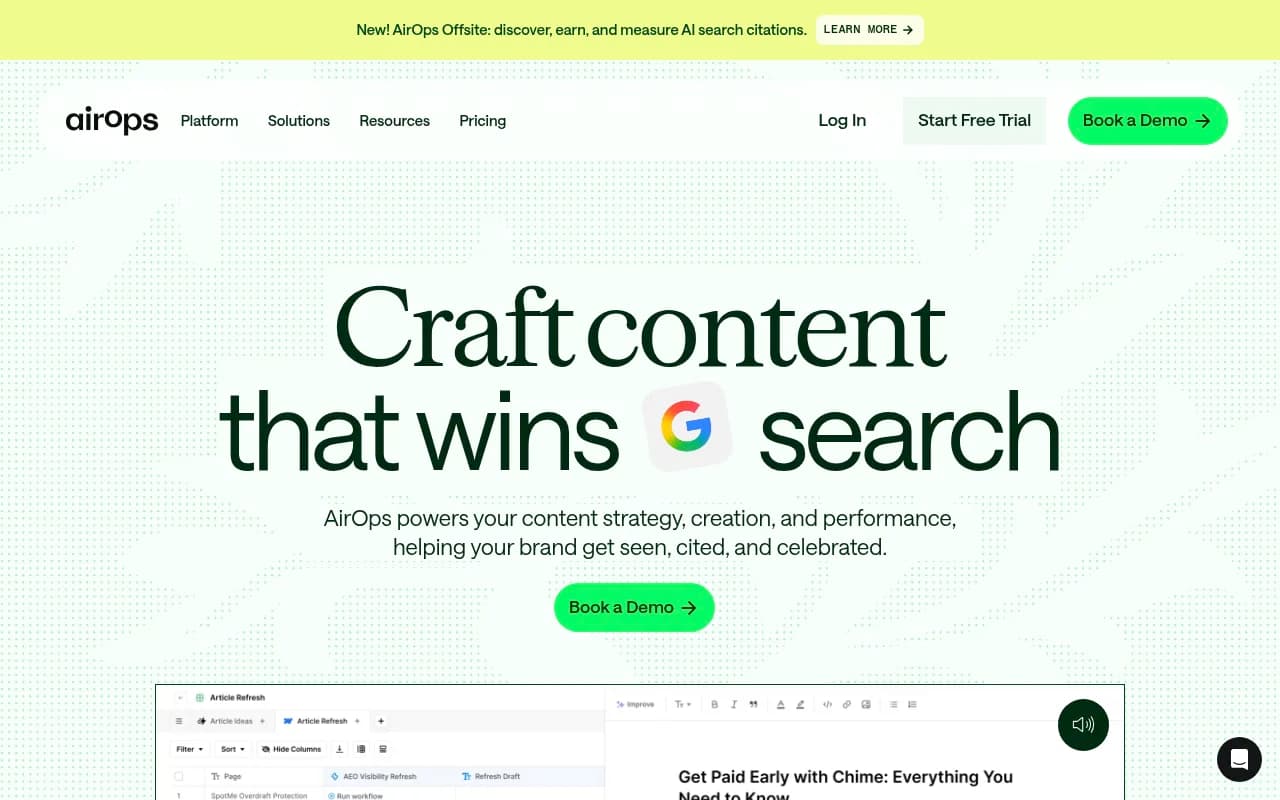
Companies like Webflow, Ramp, Carta, Chime, and Klaviyo use it. That's real adoption, not vaporware. G2 gives it 4.6/5 from 118 reviews, with 79% of reviewers giving it five stars. So the platform clearly works for a lot of people.
The question is whether it works for your team's specific situation — and that depends heavily on what you're actually trying to do.
Core features: what you get
Workflow builder
AirOps's workflow builder is a drag-and-drop interface for building AI automation pipelines. You can chain together steps — pulling data, running AI models, formatting outputs, publishing to a CMS — without writing code. It's genuinely powerful for teams that want to systematize content production.
The catch: it has a steep learning curve. Non-technical users often need a few weeks to get comfortable, and complex workflows can take significant setup time before they run reliably.
Grids
Grids are AirOps's spreadsheet-style content planner. You can plan content at scale, attach AI execution to rows, and run bulk operations. Think of it as a smarter content calendar with AI built in.
Performance degrades noticeably on large datasets. If you're running 100+ rows simultaneously, expect slowdowns.
Brand kits
Brand kits let you define tone guidelines, writing samples, and formatting rules so AI outputs stay on-brand. The Solo plan limits you to one brand kit, which is a real constraint for agencies managing multiple clients.
CMS publishing
Direct publishing to WordPress and Webflow is built in. That covers a lot of teams, but if you're on Shopify, a custom CMS, or anything outside those two, you're looking at workarounds.
AI search visibility
This is where things get interesting for GEO teams — and where the pricing gets uncomfortable. AirOps includes an Answer Engine diagnostic tool, but ChatGPT-only visibility tracking is locked to the Solo plan. Multi-engine tracking (covering Perplexity, Google AI Overviews, and others) requires the Pro plan at $2,000/month.
For a team that wants to understand how they appear across the full AI search landscape, that's a significant barrier.
Pricing: what it actually costs
| Plan | Price | Tasks | Key limitations |
|---|---|---|---|
| Solo | $200/month | 20,000 tasks | 1 brand kit, ChatGPT visibility only, limited team seats |
| Pro | $2,000/month | 75,000 tasks | Multi-engine AI visibility, unlimited team seats |
| Enterprise | Custom | Custom | Full feature access, dedicated support |
The jump from $200 to $2,000 is steep. There's no middle tier. If you need multi-engine AI visibility tracking but don't need 75,000 tasks per month, you're still paying $2,000.
G2 reports average time to implement at one month and time to ROI at eight months. That's not unusual for a platform of this complexity, but it's worth factoring into your decision — especially at Pro pricing.
Real user feedback
The G2 reviews paint a fairly consistent picture. Users love the workflow automation capabilities and the ability to scale content production without proportionally scaling headcount. The AI outputs are generally considered high quality when the workflows are properly configured.
The recurring criticisms:
- Setup complexity is real. Teams without a technical person often struggle to get workflows running correctly
- Performance on large datasets is a known issue
- The pricing jump between Solo and Pro feels disproportionate to many users
- The platform is better at producing content than at telling you whether that content is actually working in AI search
One agency founder quoted in reviews noted a 3x efficiency improvement — that's the kind of outcome AirOps is designed to deliver for content-heavy operations.
Where AirOps falls short for GEO teams
Here's the honest assessment: AirOps is a content operations platform that has added AI visibility features. It's not a GEO platform that happens to do content.
That distinction matters if your primary goal is winning in AI search.
What's missing or limited:
- No AI crawler logs. You can't see which AI engines are crawling your site, which pages they're reading, or what errors they're encountering. This is foundational for understanding how AI models discover your content.
- No prompt intelligence. There's no volume data or difficulty scoring for specific prompts, no query fan-out analysis showing how one prompt branches into sub-queries.
- No Reddit or YouTube tracking. These sources directly influence AI recommendations, and AirOps doesn't surface them.
- No traffic attribution. Connecting AI visibility improvements to actual revenue requires either a code snippet, GSC integration, or log analysis — AirOps doesn't offer this.
- Multi-engine visibility is Pro-only. At $2,000/month, you're paying for a full content ops platform when you might just need the visibility layer.
- No ChatGPT Shopping tracking. If your brand sells products and you want to know when you appear in ChatGPT's shopping recommendations, that's not covered.
For teams that primarily want to understand and improve their AI search visibility — and then create content specifically engineered to get cited — AirOps leaves meaningful gaps.
Who AirOps is actually right for
AirOps makes sense for teams that:
- Already have a content strategy and want to scale execution
- Publish to WordPress or Webflow
- Have at least one technical person who can configure workflows
- Need to produce high volumes of content consistently
- Have budget for the Pro plan if multi-engine visibility matters
It's less suited for:
- Teams whose primary goal is GEO/AEO optimization rather than content production volume
- Agencies managing many clients who need separate brand kits without paying Pro pricing
- Teams that need to understand the full AI crawler picture (which pages AI reads, errors, crawl frequency)
- Anyone who needs to connect AI visibility to revenue attribution
Better alternatives for GEO teams in 2026
If AI search visibility and GEO optimization are your primary goals, here are the tools worth evaluating:
For end-to-end GEO optimization
Promptwatch is built specifically around the optimization loop that GEO teams need: find gaps in AI visibility, create content engineered to get cited, track whether it works. The Answer Gap Analysis shows exactly which prompts competitors appear for that you don't. The built-in AI writing agent generates content grounded in 880M+ citations analyzed. And crawler logs show which AI engines are reading your pages and what they're finding.

Unlike AirOps, Promptwatch tracks 10 AI models (ChatGPT, Perplexity, Claude, Gemini, Grok, DeepSeek, Copilot, Meta AI, Google AI Overviews, and Google AI Mode), includes Reddit and YouTube source tracking, and connects visibility to actual traffic through attribution tools. Pricing starts at $99/month for the Essential plan.
For content-focused SEO and GEO
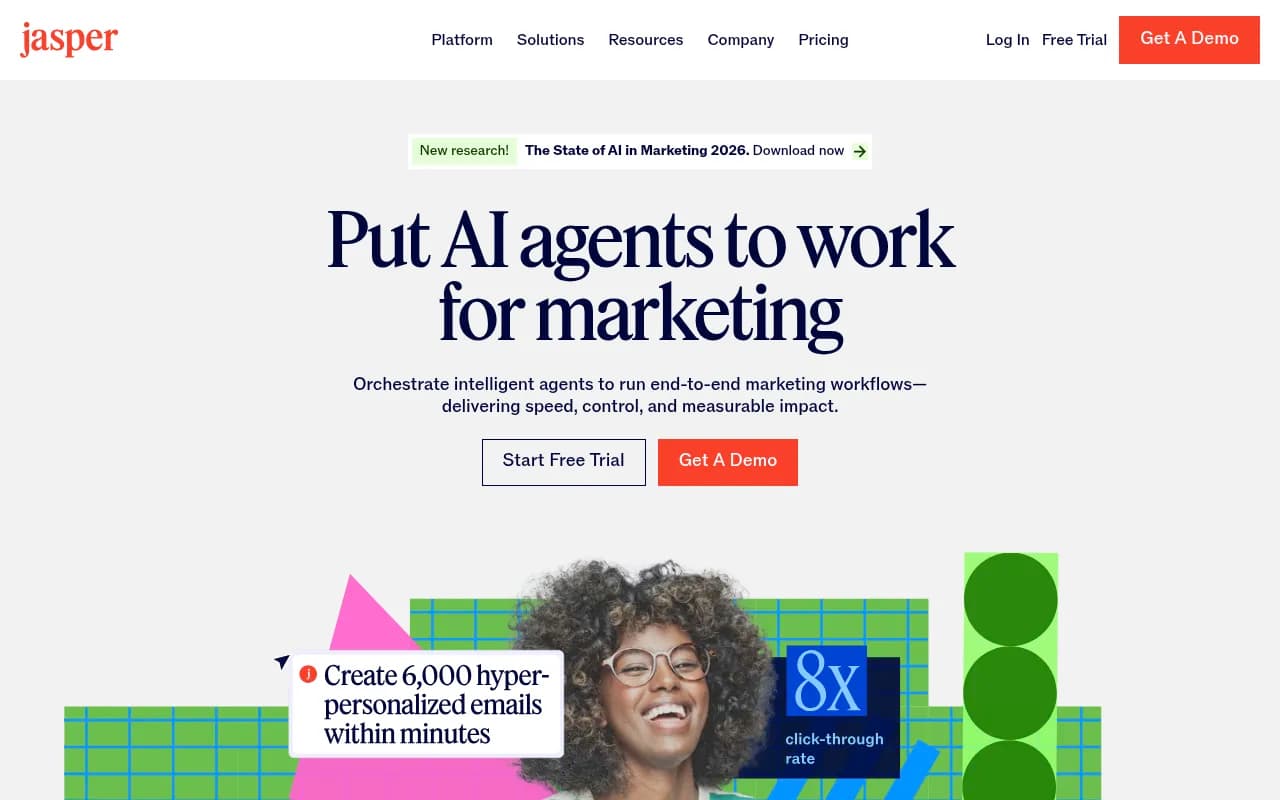
Jasper handles AI content generation with strong brand voice controls and marketing-specific templates. It's more accessible than AirOps for non-technical teams and pairs well with a separate GEO tracking tool.
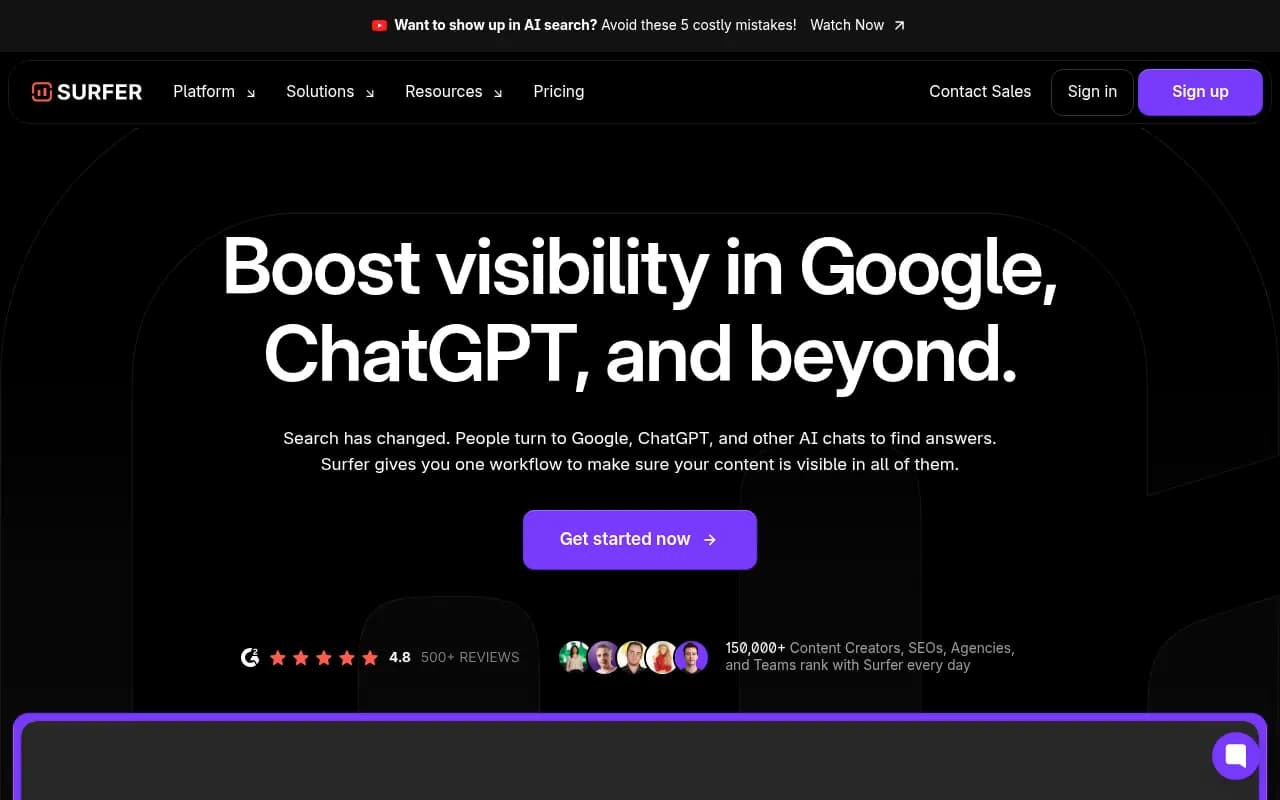
Surfer SEO is worth considering if you want content optimization grounded in real SERP data. It doesn't do AI visibility tracking, but for the content creation and optimization side of the workflow, it's well-established.
For AI visibility monitoring specifically
Profound

Profound covers enterprise-level AI visibility tracking across 9+ AI engines. Strong feature set, though pricing is higher and it doesn't include content generation.
Otterly.AI

Otterly.AI is a monitoring-focused option for teams that want to track brand mentions across ChatGPT, Perplexity, and Google AI Overviews. Simpler than AirOps, lower price point, but monitoring-only — no content gap analysis or generation.

AthenaHQ focuses on AI search visibility tracking and competitive analysis. Good for understanding where you stand, though like most monitoring tools it stops short of helping you fix the gaps it finds.
For workflow automation (non-GEO)
If what you actually need is AI content workflow automation without the GEO layer, Jasper AI's agent-based approach handles marketing workflows at scale. Worth comparing directly against AirOps on features and pricing for your specific use case.
Feature comparison: AirOps vs. top alternatives
| Feature | AirOps Solo ($200/mo) | AirOps Pro ($2,000/mo) | Promptwatch ($99-$579/mo) | Profound (Enterprise) | Otterly.AI |
|---|---|---|---|---|---|
| AI content generation | Yes | Yes | Yes (built-in agent) | No | No |
| Multi-engine AI visibility | ChatGPT only | Yes (multi-engine) | Yes (10 engines) | Yes (9+ engines) | Yes (3 engines) |
| AI crawler logs | No | No | Yes | No | No |
| Prompt volume/difficulty | No | No | Yes | Partial | No |
| Reddit/YouTube tracking | No | No | Yes | No | No |
| Traffic attribution | No | No | Yes | No | No |
| Answer gap analysis | Limited | Yes | Yes | Partial | No |
| ChatGPT Shopping | No | No | Yes | No | No |
| Starting price | $200/mo | $2,000/mo | $99/mo | Custom | Lower tier |
The bottom line
AirOps is a solid platform if content operations at scale is your core need. The workflow builder is genuinely powerful, the G2 reviews back up the efficiency gains, and the brand kit system works well for teams with consistent voice requirements.
But the pricing structure is aggressive. The jump from $200 to $2,000 with no middle option is a real problem for teams that need multi-engine visibility without the full content ops suite. And for GEO teams specifically, the missing pieces — crawler logs, prompt intelligence, traffic attribution, Reddit tracking — are not minor gaps.
If you're a content-heavy team that wants to scale production and can justify the Pro pricing, AirOps is worth a serious look. If your primary goal is understanding and improving how AI engines discover and cite your brand, you'll likely get more value from a platform built specifically for that problem.
The tools exist to do both jobs well. The key is being honest about which job you actually need done.