Key Takeaways
- White-label AI search reporting enables agencies to deliver branded GEO insights without building internal tracking infrastructure—essential as 67% of agencies now prioritize AI-era optimization capabilities when selecting partners
- The best platforms combine full branding control (custom domains, logo removal, embedded dashboards) with comprehensive AI model coverage across ChatGPT, Perplexity, Google AI Mode, Gemini, and Claude
- Successful implementation requires three core capabilities: multi-client management with permission controls, automated branded reporting, and actionable optimization workflows that go beyond monitoring
- Pricing models vary dramatically—from €49/month entry points to enterprise custom pricing—making it critical to match platform capabilities to your agency's client portfolio and service model
- The agencies winning in 2026 are those that position AI search visibility as a strategic service, not just another reporting dashboard, by connecting visibility metrics to content gaps, optimization actions, and revenue outcomes
Understanding White-Label AI Search Reporting in 2026
The search landscape has fundamentally transformed. Between ChatGPT's 200+ million weekly active users, Google AI Overviews dominating traditional SERPs, and Perplexity processing over 100 million queries monthly, discovery has shifted from blue links to conversational AI responses. For agencies, this evolution presents both immense opportunity and significant complexity.
White-label AI search reporting solves a critical problem: how do agencies deliver professional, branded insights into this new discovery landscape without investing months building internal tracking infrastructure? The answer lies in platforms that monitor how AI models mention brands, which sources they cite, and how visibility evolves across both traditional and AI-driven search surfaces.
What Makes AI Search Reporting Different
Traditional SEO reporting tracks rankings, backlinks, and organic traffic. AI search reporting operates in a fundamentally different paradigm:
Citation-based visibility: Instead of ranking positions, agencies track whether brands appear in AI-generated responses, how often they're cited, and in what context. A brand might rank #1 in Google but be completely invisible in ChatGPT responses—or vice versa.
Source attribution: AI models cite specific pages, Reddit threads, YouTube videos, and third-party domains when generating answers. Understanding which sources influence AI recommendations reveals entirely new optimization opportunities that traditional SEO tools miss.
Prompt-level tracking: Rather than tracking keywords, agencies monitor how brands appear across thousands of user prompts and queries. This includes tracking prompt volumes, difficulty scores, and query fan-outs that show how one prompt branches into sub-queries.
Multi-model coverage: Users don't just search on Google anymore. They ask ChatGPT for recommendations, use Perplexity for research, and rely on Google AI Mode for shopping. Comprehensive reporting requires tracking visibility across 10+ AI models simultaneously.
The White-Label Advantage for Agencies
White-label platforms enable agencies to deliver these insights under their own brand without building the underlying technology. This matters because:
Speed to market: Launch AI search services in days instead of months. While competitors scramble to understand GEO basics, agencies with white-label solutions are already delivering client results.
Professional presentation: Clients receive branded dashboards, automated reports, and embedded analytics that reinforce the agency's expertise—not a third-party tool's branding.
Scalability: Manage dozens or hundreds of client projects from a single platform with proper permission controls, multi-project dashboards, and automated reporting workflows.
Cost efficiency: Avoid the six-figure investment required to build internal AI search tracking infrastructure. White-label platforms distribute development costs across hundreds of agencies.
Evaluating White-Label AI Search Platforms
Not all white-label solutions are created equal. Based on analysis of the top 10 platforms operating in 2026, here are the critical evaluation criteria:
Branding Depth and Customization
The spectrum ranges from basic logo swaps to complete brand removal:
Surface-level branding: Some platforms only allow logo replacement on PDF reports. Clients still see the original platform's interface, domain, and branding throughout the dashboard experience.
Intermediate branding: Better platforms offer custom subdomains (reports.youragency.com), color scheme customization, and favicon replacement. The core interface is branded but still hosted on the platform's infrastructure.
Full white-label: The best solutions provide custom domain support, complete removal of all original branding, and the ability to embed dashboards directly into your agency's existing client portal or website.
AI Model Coverage
Comprehensive tracking requires monitoring visibility across multiple AI search engines:
Essential models: At minimum, platforms should track ChatGPT (OpenAI), Google AI Overviews, and Perplexity—the three highest-traffic AI search surfaces in 2026.
Extended coverage: Leading platforms add Google AI Mode, Claude (Anthropic), Gemini (Google), Meta AI, DeepSeek, Grok (X), Mistral, and Microsoft Copilot.
Specialized tracking: Advanced platforms include ChatGPT Shopping monitoring (for e-commerce brands), Reddit discussion tracking (since AI models heavily cite Reddit), and YouTube video citation analysis.
Platforms that only track one or two models leave massive blind spots in your clients' AI visibility strategy.
Client Management Infrastructure
Multi-project architecture: Agencies need clean separation between client accounts with the ability to manage dozens or hundreds of projects from a unified dashboard.
Permission controls: Granular access levels let you control what clients see, what team members can edit, and which stakeholders receive automated reports.
User management: Efficient onboarding and offboarding workflows, SSO support for enterprise clients, and audit logs for compliance requirements.
API access: For agencies building custom integrations or embedding AI search data into proprietary dashboards, robust API access is non-negotiable.
Reporting Automation
Manual reporting doesn't scale. Look for:
Scheduled reports: Automated delivery of branded PDF or email reports on weekly, monthly, or custom schedules.
Customizable templates: Ability to tailor report sections, metrics, and branding to match different client needs and service tiers.
AI-generated summaries: Natural language insights that explain visibility changes, highlight opportunities, and provide context—saving hours of manual analysis.
White-label export options: Reports that export with your agency's branding, not the platform's watermarks or attribution.
Top White-Label AI Search Platforms for Agencies
Based on comprehensive analysis of branding depth, AI model coverage, client management capabilities, and pricing transparency, here are the leading platforms for agencies in 2026:
Enterprise-Grade Solutions
Promptwatch stands out as the only platform rated as a "Leader" across all categories in 2026 competitive analysis. Unlike monitoring-only competitors, Promptwatch is built around an action loop: find content gaps through Answer Gap Analysis, generate AI-optimized content with the built-in writing agent, then track results with page-level citation monitoring.

Key differentiators include AI crawler logs (real-time tracking of ChatGPT, Claude, and Perplexity bots hitting your clients' websites), prompt intelligence with volume estimates and difficulty scoring, and Reddit/YouTube citation analysis that competitors lack entirely. The platform monitors 10 AI models and offers full white-label capabilities with custom domain support.
Pricing starts at $99/month for the Essential plan (1 site, 50 prompts, 5 AI-generated articles), with Professional at $249/month (2 sites, 150 prompts, crawler logs) and Business at $579/month (5 sites, 350 prompts). Agency and enterprise custom pricing available.
Profound targets enterprise clients with tracking across 9+ AI search engines and sophisticated competitor heatmaps. Strong feature set but higher price point than alternatives, and lacks Reddit tracking and ChatGPT Shopping monitoring that some agencies need.
Conductor offers brand authority tracking and citation monitoring with enterprise-level analytics. Well-suited for Fortune 500 clients but may be overkill for mid-market agency portfolios.
Mid-Market Agency Platforms
Otterly.AI provides solid monitoring across ChatGPT, Perplexity, and Google AI Overviews with clean reporting interfaces. However, it's monitoring-focused without content optimization or generation capabilities—agencies must handle the "what to do about it" question separately.
Otterly.AI

Peec.ai offers basic white-label capabilities and multi-model tracking but lacks crawler logs, visitor analytics, and content gap analysis. Best for agencies that only need visibility dashboards without optimization workflows.

AthenaHQ delivers monitoring-focused tracking with straightforward reporting but missing content optimization and generation tools that agencies increasingly need to deliver full-service GEO.

Budget-Conscious Options
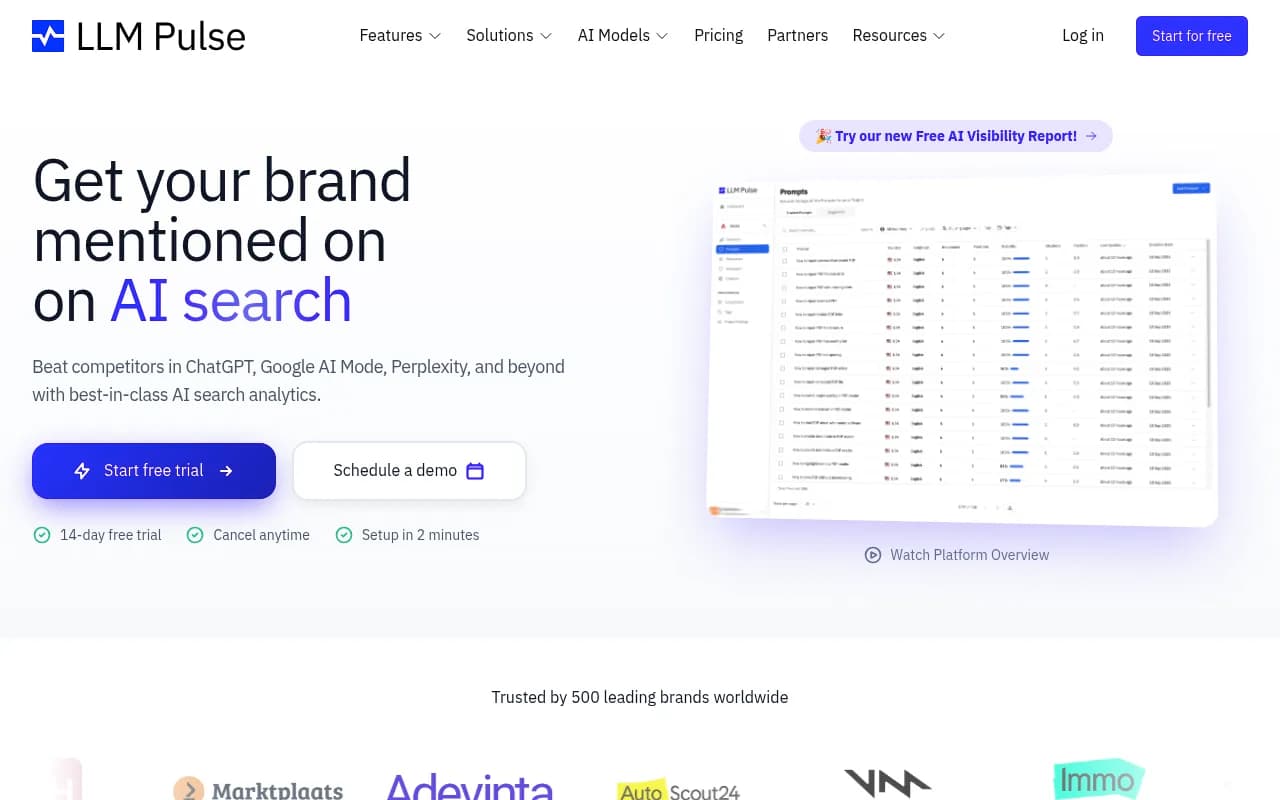
LLM Pulse provides full white-label capabilities including custom domain support and embeddable dashboards starting at €49/month plus white-label add-on. Tracks ChatGPT, Perplexity, AI Mode, Gemini, and AI Overviews. Good entry point for agencies testing AI search services.
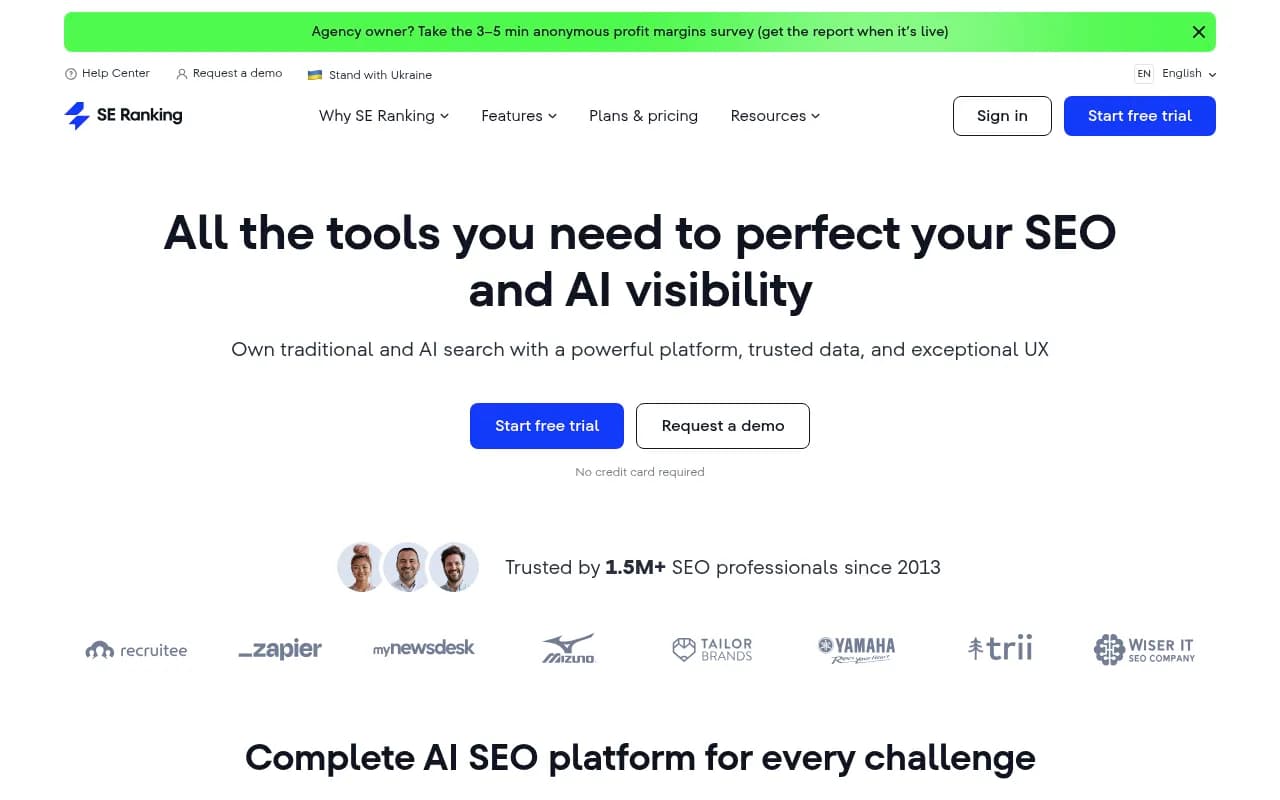
SE Ranking offers AI Overviews tracking as an add-on to their all-in-one SEO platform. The Agency Pack includes custom domain white-labeling. Starting price of $52/month makes it attractive for agencies already using SE Ranking for traditional SEO.
Semrush added AI Overviews tracking to their platform but uses fixed prompts rather than customizable queries. Ahrefs Brand Radar similarly offers fixed prompts without AI traffic attribution. Both are better suited for traditional SEO with basic AI visibility monitoring rather than comprehensive GEO services.
Specialized Solutions
Search Party focuses on agency-oriented workflows but has limited prompt metrics and lacks content gap analysis. Better for agencies that want simple monitoring with strong client presentation.
Scrunch AI and Brandlight.ai are niche players with specific strengths (Scrunch for Reddit tracking, Brandlight for recommendation optimization) but missing multiple core capabilities that full-service agencies need.
Implementation Strategy for Agencies
Successfully launching white-label AI search reporting requires more than just signing up for a platform. Here's the proven implementation framework:
Phase 1: Internal Setup (Week 1-2)
Platform selection and onboarding: Choose the platform that matches your agency's client portfolio, service model, and budget. Complete white-label configuration including custom domain setup, branding customization, and team member access.
Service packaging: Define your AI search service tiers. Most successful agencies offer:
- Monitoring tier: Basic visibility tracking with monthly reports
- Optimization tier: Monitoring plus content gap analysis and recommendations
- Full-service tier: End-to-end GEO including content creation, optimization, and ongoing tracking
Pricing strategy: Typical agency markups range from 2-5x the platform cost. A $249/month platform subscription might support a $999-$1,499/month client retainer when bundled with strategy and optimization services.
Team training: Ensure account managers understand GEO fundamentals, can interpret AI visibility metrics, and know how to explain citation-based visibility to clients unfamiliar with the concept.
Phase 2: Pilot Client Launch (Week 3-4)
Client selection: Choose 2-3 existing clients for pilot launch. Ideal candidates have:
- Active content marketing programs (so you have pages to optimize)
- Competitive markets where AI search visibility matters
- Openness to emerging channels and willingness to provide feedback
Baseline audit: Run initial AI visibility assessment showing current citation rates, competitor positioning, and content gaps. This becomes your "before" snapshot for demonstrating progress.
Goal setting: Establish clear KPIs. Common metrics include:
- Citation rate (percentage of tracked prompts where brand appears)
- Average citation position (first, second, third mention in AI responses)
- Share of voice vs. competitors
- Page-level citation growth
Reporting cadence: Start with bi-weekly check-ins during the pilot phase, then transition to monthly reporting once workflows stabilize.
Phase 3: Service Scaling (Month 2-3)
Workflow automation: Build repeatable processes for:
- New client onboarding and prompt list creation
- Monthly report generation and delivery
- Content gap identification and prioritization
- Optimization recommendations and implementation tracking
Content integration: Connect AI search insights to your agency's content production workflow. When Answer Gap Analysis reveals missing topics, feed those directly into your content calendar.
Client education: Develop educational materials explaining GEO fundamentals, why AI search visibility matters, and how your agency's approach drives results. This positions you as the expert and justifies premium pricing.
Upsell strategy: Use pilot results to demonstrate ROI and expand services across your client base. Typical conversion rates from pilot to full rollout range from 60-80% when results are clearly communicated.
Best Practices for Client Reporting
Effective AI search reporting goes beyond data dumps. Here's how leading agencies structure their client communications:
Report Structure and Content
Executive summary: Start every report with a 3-5 sentence overview highlighting the most important changes, wins, and opportunities. Busy clients should understand the story in 30 seconds.
Visibility scorecard: Present core metrics in a consistent format:
- Overall citation rate and month-over-month change
- Citations by AI model (ChatGPT, Perplexity, etc.)
- Competitive positioning and share of voice
- Top-performing pages and content
Opportunity analysis: Don't just report what happened—explain what to do next. Include:
- High-priority content gaps (prompts competitors rank for but you don't)
- Underperforming pages that need optimization
- New prompt opportunities based on volume and difficulty data
Action items: End with 3-5 specific, prioritized recommendations for the coming month. Make it clear what you'll handle vs. what requires client input or approval.
Visualization and Presentation
Trend charts: Show visibility changes over time, not just point-in-time snapshots. Clients need to see progress trajectories.
Competitive context: Always position your client's performance relative to competitors. A 15% citation rate means nothing without knowing competitors average 8% or 25%.
Source attribution: When AI models cite specific pages, show which content is driving visibility. This connects GEO efforts to tangible content assets clients recognize.
Screenshot examples: Include actual AI response screenshots showing your client's brand mentioned. This makes abstract metrics concrete and shareable with internal stakeholders.
Communication Cadence
Monthly reporting: Standard for most agency relationships. Provides enough time to see meaningful changes without overwhelming clients with noise.
Quarterly business reviews: Deeper strategic sessions examining long-term trends, competitive shifts, and service expansion opportunities.
Real-time alerts: For significant events (major visibility drops, new competitor threats, viral content opportunities), proactive communication builds trust and demonstrates you're actively monitoring.
Ad-hoc insights: When you spot interesting patterns or opportunities outside the regular reporting cycle, share them. This positions your agency as a strategic partner, not just a reporting vendor.
Common Implementation Challenges
Client Education and Expectation Setting
Challenge: Clients familiar with traditional SEO expect immediate ranking improvements. AI search visibility operates differently—it's about citation rates, not positions.
Solution: Set expectations upfront that GEO is a 3-6 month investment before seeing substantial results. Share case studies and benchmarks from similar industries. Position it as a strategic initiative, not a tactical quick win.
Prompt List Development
Challenge: Creating comprehensive prompt lists that accurately reflect how target audiences actually search requires deep industry knowledge and user research.
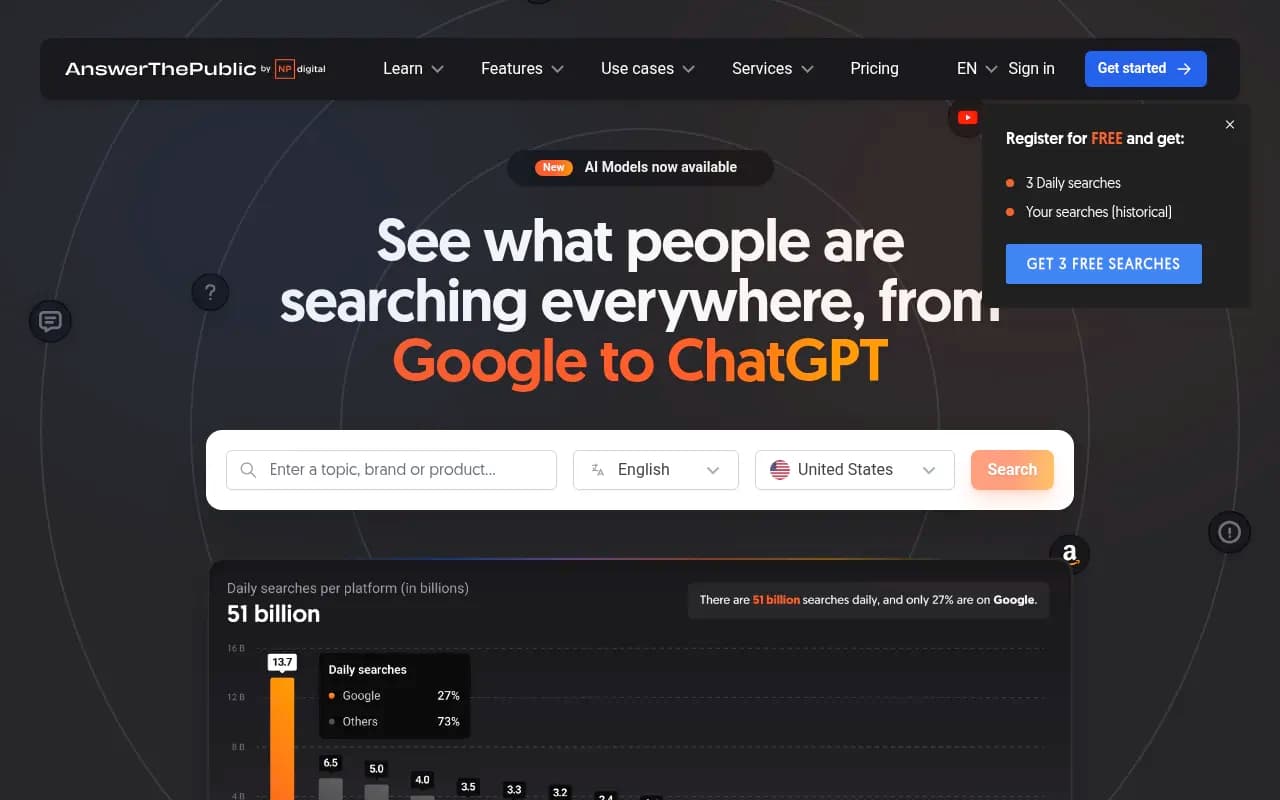
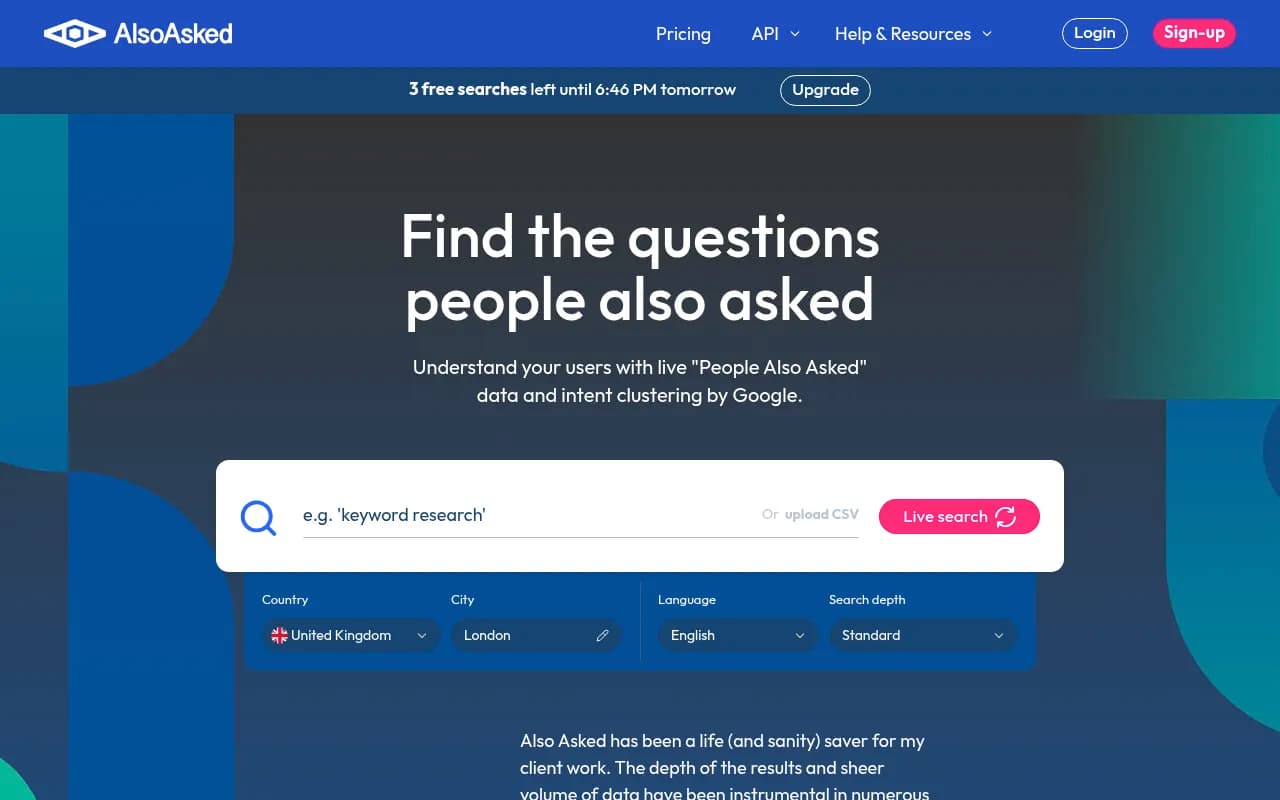
Solution: Start with competitor analysis—track prompts where competitors already have visibility. Use tools like AnswerThePublic and AlsoAsked to discover real questions people ask. Interview client sales and support teams to understand common customer questions.
Attribution and ROI Measurement
Challenge: Connecting AI search visibility to actual traffic and revenue is harder than traditional SEO because AI models don't pass referral data the same way search engines do.
Solution: Implement tracking through multiple methods:
- Code snippet tracking (similar to Google Analytics)
- Google Search Console integration for AI crawler activity
- Server log analysis to identify AI bot traffic
- UTM parameters on cited URLs when possible
Platforms like Promptwatch offer built-in traffic attribution capabilities that connect visibility metrics to actual visitor data.
Content Optimization Bandwidth
Challenge: AI search visibility requires creating and optimizing substantial content volumes—more than many agencies can handle with existing resources.
Solution: Leverage AI content generation tools built into platforms like Promptwatch, which creates articles grounded in real citation data and competitor analysis. This isn't generic SEO filler—it's content engineered to get cited by AI models. Alternatively, partner with white-label content providers who understand GEO requirements.
Future-Proofing Your Agency's AI Search Services
The AI search landscape continues evolving rapidly. Here's how forward-thinking agencies are positioning for 2026 and beyond:
Agentic AI and Autonomous Search
AI agents that autonomously research, compare, and make decisions on behalf of users are emerging as the next frontier. Agencies need to understand how brands appear not just in conversational responses but in agent-driven workflows and automated decision-making.
Platforms adding agentic tracking capabilities will have significant advantages as this trend accelerates.
Voice and Multimodal Search
Voice-based AI search through devices like smartphones, smart speakers, and wearables is growing. Visual search through AI models that analyze images is expanding. Agencies that can track and optimize for these modalities—not just text-based queries—will differentiate themselves.
Vertical AI Search Engines
Industry-specific AI search engines are emerging for healthcare, legal, finance, and other regulated verticals. Agencies serving these industries need platforms that can track visibility across both general-purpose models (ChatGPT, Perplexity) and specialized vertical engines.
Integration with Traditional SEO
The distinction between "SEO" and "GEO" is blurring. Google's AI Overviews now appear in traditional search results. ChatGPT is testing web search integration. Agencies need unified platforms that track both traditional rankings and AI visibility from a single dashboard.
Privacy and Compliance
As AI search grows, privacy regulations are adapting. Agencies need platforms with robust data handling, GDPR compliance, and clear terms around how client data is processed and stored. This becomes especially critical for agencies serving enterprise clients in regulated industries.
Conclusion: Positioning Your Agency for AI Search Success
White-label AI search reporting isn't just another service offering—it's a strategic differentiator that positions agencies as forward-thinking partners who understand where discovery is headed. The agencies thriving in 2026 are those that recognized this shift early and built the infrastructure, expertise, and client relationships to capitalize on it.
Success requires three elements:
The right platform: Choose white-label solutions that combine comprehensive AI model coverage with actionable optimization workflows, not just monitoring dashboards. Platforms like Promptwatch that close the loop from visibility tracking to content creation to results measurement provide the most value.
Clear positioning: Don't sell AI search reporting as a commodity add-on. Position it as a strategic service that protects clients from the zero-click future, captures demand in emerging channels, and future-proofs their digital presence.
Execution excellence: Deliver consistent value through automated reporting, proactive insights, and tangible optimization results. The agencies that treat GEO as a core competency—not an experimental side project—are the ones building sustainable competitive advantages.
The shift from traditional search to AI-powered discovery is the most significant change in digital marketing since the mobile revolution. Agencies that adapt quickly, choose the right partners, and execute with excellence will define the next decade of digital marketing success.