Key takeaways
- Peec AI is a solid AI visibility monitoring tool that tracks brand mentions, sentiment, and share of voice across ChatGPT, Perplexity, and Google AI Overviews.
- Starting at $89/month, it's one of the more affordable options in the GEO/AEO space -- but lower-tier plans have strict prompt and engine caps that push costs up quickly.
- The platform scores well on analytics and competitor benchmarking, but offers limited guidance on what to actually do with the data.
- Peec AI is best for teams that already have a content strategy and just need a monitoring layer on top of it.
- If you need a platform that goes beyond tracking -- finding content gaps, generating AI-optimized content, and attributing AI traffic to revenue -- you'll need something more capable.
Peec AI launched at an interesting moment. AI search was growing fast, most marketing teams had no idea whether they were showing up in ChatGPT or Perplexity, and the tools to find out were either enterprise-only or barely functional. Peec stepped in with a clean interface, transparent pricing, and a clear pitch: know where you stand in AI search.
That's a real problem worth solving. But in 2026, "knowing where you stand" is table stakes. The harder question is what you do about it. This review covers what Peec AI actually delivers, where it runs out of road, and which alternatives are worth considering if you need more than a dashboard.
What Peec AI does
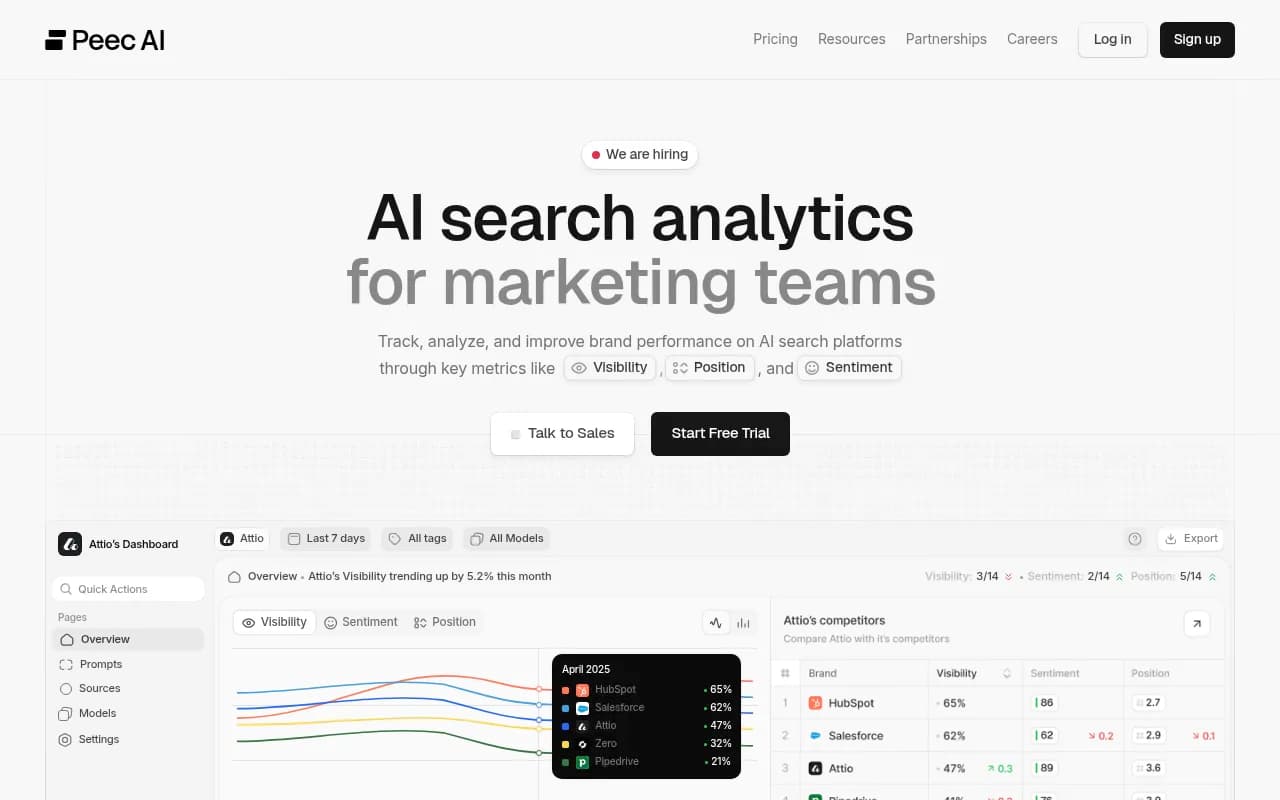
Peec AI is an AI search analytics platform. You give it a set of prompts -- questions your target buyers might ask an AI assistant -- and it runs those prompts across AI engines to see whether your brand appears in the responses.
The core metrics it tracks:
- Visibility rate: how often your brand appears in AI-generated answers
- Position: where in the answer your brand shows up
- Sentiment: whether the mention is positive, neutral, or negative
- Share of voice: how your visibility compares to named competitors
The platform covers ChatGPT, Perplexity, and Google AI Overviews on its standard plans. Higher tiers add more engines. Setup is relatively quick -- you configure your brand, add competitor names, and define your prompt set.
The interface is genuinely clean. Compared to some tools in this space that feel like they were designed by engineers for engineers, Peec is accessible. The charts are readable, the data is organized logically, and you can get to useful information without much onboarding.
Pricing breakdown
According to the 2025/2026 Peec pricing page, plans are structured roughly as follows:
- Starter: around $89/month -- covers a limited prompt set, ChatGPT, Perplexity, and Google AI Overviews
- Pro: higher tier with more prompts, more engines, and additional reporting
- Enterprise: custom pricing for larger teams
The starting price looks attractive. But the prompt limits on lower plans are real. If you're tracking a competitive category with dozens of relevant queries, you'll hit the ceiling fast. Adding more engines or prompts means upgrading, and the cost can climb quickly depending on your use case.
One consistent complaint from users: the pricing feels fair at entry level but becomes less competitive once you factor in what you're not getting -- no content generation, no crawler logs, no AI traffic attribution.
What Peec AI does well
Clean, usable interface
This is genuinely one of Peec's strengths. The dashboard doesn't overwhelm you. Visibility scores, competitor comparisons, and prompt-level breakdowns are all surfaced clearly. For teams new to AI visibility monitoring, the learning curve is low.
Prompt-level granularity
Peec tracks visibility at the individual prompt level, not just at a brand level. That means you can see exactly which questions your brand appears for and which ones it doesn't. That's more useful than a single aggregate score.
Competitor benchmarking
You can add competitors and see how your share of voice compares across the same prompt set. This is useful for executive reporting -- "we appear in 34% of relevant AI responses, Competitor X appears in 61%" is a concrete number that lands in a board meeting.
Sentiment tracking
Knowing you're mentioned is one thing. Knowing whether the mention is positive or negative is another. Peec's sentiment layer adds useful context, particularly for brand teams managing reputation.
Where Peec AI falls short
Monitoring without action
This is the central limitation. Peec tells you what's happening -- it doesn't help you change it. There's no content gap analysis that shows which topics you're missing. No built-in writing tools to create content that might get cited. No recommendations engine that says "here's what you should publish to improve your visibility for these prompts."
For teams that have a strong content operation and just need data to inform it, that's fine. For teams that need to actually move the needle, it's a significant gap.
Strict prompt limits on lower plans
The Starter plan's prompt cap is a real constraint. AI visibility monitoring only works if you're tracking the prompts that actually matter to your buyers. If you're in a competitive B2B category, 50 prompts might cover your most important queries -- but probably not all of them. Upgrading to track more is a recurring cost conversation.
No AI crawler logs
Some tools in this space let you see which AI crawlers (GPTBot, ClaudeBot, PerplexityBot) are visiting your site, which pages they're reading, and how often. Peec doesn't offer this. That means you can't diagnose why your content isn't being cited -- you just know that it isn't.
No traffic attribution
Peec shows you AI visibility. It doesn't connect that visibility to actual website traffic or revenue. You can't answer "how much of our organic traffic is coming from AI search?" or "which AI-cited pages are driving conversions?" That attribution layer is missing entirely.
Limited prescriptive guidance
Multiple independent reviews flag the same issue: Peec gives you data but doesn't tell you what to do with it. The platform scores well on analytics (9/10 in one detailed breakdown) but drops to 6/10 on actionable recommendations. You're left to interpret the data and build your own response strategy.
Who Peec AI is actually for
Peec works best for:
- Marketing or SEO teams that already have a content strategy and want to add AI visibility monitoring on top
- Teams that need to report AI share of voice to leadership without building a custom tracking solution
- Brands in less competitive categories where a smaller prompt set covers most of the relevant queries
- Agencies running AI visibility audits for clients who want a clean, presentable dashboard
It's less suited for:
- Teams that need to actively improve their AI visibility, not just measure it
- Brands in highly competitive categories where prompt limits become a real constraint
- Organizations that need to connect AI visibility to traffic and revenue
- Teams without an existing content operation that can act on the monitoring data
Peec AI vs. the alternatives
Here's how Peec compares to the main tools in this space:
| Tool | Starting price | AI engines tracked | Content generation | Crawler logs | Traffic attribution | Best for |
|---|---|---|---|---|---|---|
| Peec AI | ~$89/mo | 3 (Starter) | No | No | No | Monitoring-focused teams |
| Promptwatch | $99/mo | 10+ | Yes (built-in AI writer) | Yes | Yes (GSC + snippet) | Full optimization loop |
| Profound | Custom | 9+ | Limited | No | No | Enterprise monitoring |
| Otterly.AI | ~$49/mo | 3-5 | No | No | No | Budget monitoring |
| AthenaHQ | Custom | Multiple | No | No | No | Monitoring-focused |
| Semrush | $140/mo+ | Limited | Partial | No | Partial | Traditional SEO + AI add-on |

The table above makes the core trade-off clear. Peec sits in the monitoring-only category alongside Otterly.AI and AthenaHQ. It's priced reasonably for what it does, but what it does stops at measurement.
Promptwatch is the main alternative if you want to close the loop. It tracks visibility across 10+ AI engines (ChatGPT, Claude, Perplexity, Gemini, Grok, DeepSeek, Copilot, Meta AI, Google AI Overviews, and Google AI Mode), but it also includes an Answer Gap Analysis that shows exactly which prompts competitors rank for that you don't, a built-in AI writing agent that generates content engineered to get cited, AI crawler logs, and traffic attribution through GSC integration or server log analysis. It's the difference between knowing you have a problem and having tools to fix it.
Otterly.AI

Profound


A closer look at the monitoring-only problem
It's worth spending a moment on why "monitoring only" is a real limitation in 2026, not just a feature gap.
AI search visibility isn't static. The models that power ChatGPT, Perplexity, and Google AI Overviews are constantly updating their training data and retrieval sources. A brand that's invisible today can become visible next month if the right content exists and gets indexed. A brand that's visible today can disappear if a competitor publishes better-structured, more authoritative content on the same topics.
Monitoring tells you the score. But the score changes based on what you publish, how your site is structured, what sources cite you, and whether AI crawlers can actually read your pages. If your tool only shows you the score, you're watching a game you can't play.
The teams getting the most out of AI visibility tools in 2026 are using monitoring data to inform content decisions, then tracking whether those content decisions move the numbers. That requires a platform that connects both ends of the loop.
Peec AI ratings summary
Based on multiple independent reviews and hands-on testing:
| Category | Score |
|---|---|
| AI visibility and analytics | 9/10 |
| Prompt-level insights | 9/10 |
| Competitor benchmarking | 8/10 |
| Ease of use (experienced SEOs) | 8/10 |
| Reporting and exports | 8/10 |
| Beginner-friendliness | 6/10 |
| Actionable recommendations | 6/10 |
| Pricing fairness at scale | 6/10 |
| Enterprise readiness | 6/10 |
| Overall | 7.3/10 |
That 7.3 overall is fair. Peec is a good monitoring tool. It's not a complete AI visibility platform.
Other alternatives worth knowing
If Peec isn't the right fit, here are a few other tools depending on your specific needs:
For budget-conscious teams: Otterly.AI starts cheaper and covers the basics of brand mention tracking across a few AI engines. It's even more limited than Peec on features, but if you just need a simple visibility check, it works.
Otterly.AI
For enterprise teams: Profound has a stronger feature set and covers more AI engines, though it's priced at the enterprise end and still sits in the monitoring-heavy camp.
Profound
For teams that want traditional SEO + AI monitoring in one place: Semrush has added AI Overview tracking to its existing platform. It's not purpose-built for GEO, but if you're already a Semrush customer, it reduces the number of tools you're managing.
For the full optimization loop: Promptwatch is the only platform in the 2026 market rated as a leader across monitoring, content generation, crawler logs, and traffic attribution. It's built around the idea that visibility is something you earn through action, not just measure.
The bottom line
Peec AI is a legitimate tool. The interface is clean, the prompt-level tracking is genuinely useful, and the starting price is accessible. For a team that needs to answer "are we showing up in AI search?" and report that to leadership, Peec does the job.
The honest limitation is that it stops there. No content gap analysis, no writing tools, no crawler diagnostics, no traffic attribution. In a market where AI search is actively influencing buyer behavior -- 29% of B2B buyers now start research via ChatGPT rather than Google, according to G2's 2025 buyer behavior data -- knowing you're invisible isn't enough. You need a path to becoming visible.
If you're evaluating tools in 2026, the right question isn't "does this tool track AI visibility?" Almost all of them do. The right question is "does this tool help me improve it?" That's where the field narrows considerably.