Key takeaways
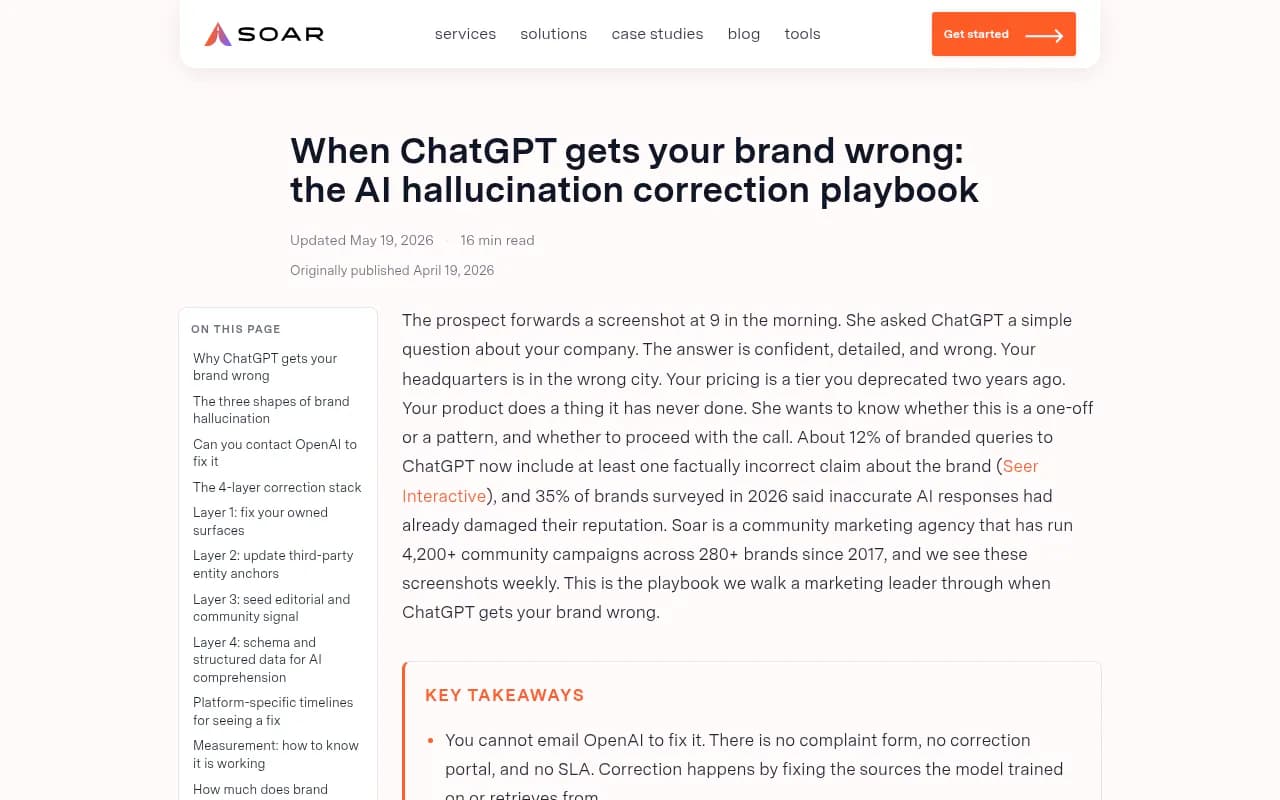
- About 12% of branded queries to ChatGPT include at least one factually incorrect claim about the brand (Seer Interactive, via Soar Agency), and 35% of brands surveyed in 2026 said inaccurate AI answers had already hurt their reputation.
- Wrong claims spread because models draw on overlapping sources: forums, old articles, directories, review sites. One bad page can produce the same false claim in several engines.
- You cannot edit a chatbot. You fix what it reads: your own pages, third-party mentions, and the sources it cites.
- Corrective landing pages, docs and comparison pages stay cited much longer than news coverage, so put your corrections there.
- Monitoring only helps if someone acts on it. Audit monthly, log every claim, and treat each error as a content task with an owner.
What a wrong claim actually looks like
Picture a prospect forwarding you a screenshot at 9 a.m. She asked ChatGPT about your company. The answer is confident, detailed, and wrong. Your headquarters is in the wrong city. The pricing tier it quotes was retired two years ago. It says your product does something it has never done.
Nobody replies to that. There is no comment thread, no review to dispute, no editor to email. The same answer can be generated across millions of separate conversations, worded slightly differently each time. That is what makes this different from a bad Google review. As 5WPR puts it, fixing it means changing what the model has access to, not replying to a post.
I find the quiet part the most unsettling. You never see most of these answers. The prospect who got the wrong pricing just doesn't book the call.
How big is the problem?
The numbers vary by study, so treat them as directional rather than precise:
- Seer Interactive, as cited by Soar Agency, found about 12% of branded ChatGPT queries include at least one incorrect claim about the brand.
- Soar also reports that 35% of brands surveyed in 2026 said inaccurate AI responses had already damaged their reputation.
- NewsGuard's one-year audit found leading chatbots repeated false claims on controversial news topics 35% of the time, up from 18% a year earlier. The reason was telling: the models stopped refusing and answered every prompt, wrong or not.
- A 2026 benchmark across 37 models, summarized by Geology, reported hallucination rates between 15% and 52%. Those benchmarks test general knowledge, not brand-specific facts, so your own rate could be better or worse.
I could not find a verified, primary-source dollar figure for the cost of a bad AI reputation. Anyone quoting you one is estimating. What you can measure yourself is narrower and more useful: how many tracked prompts return a wrong claim, which engines say it, and whether AI-referred visitors convert.
Why one wrong claim spreads across models
Shared sources
Most major assistants lean on a similar pool of web material. A forum thread, an outdated press article, a stale directory listing, a competitor's comparison page. If that page says something false, ChatGPT, Gemini and Perplexity can all pick it up, either from training data or from live retrieval. Reputation X describes this directly: one bad page can produce the same false claim in several engines at once.
Surferstack's earlier guide on how negative AI brand mentions spread across LLMs covers the same mechanism: the models often pull from the same underlying sources, so a negative mention does not stay in one place.
Three root causes
Soar's playbook groups brand errors into three mechanisms, and the fix differs for each:
- Stale training data. A renamed product, a moved headquarters, a retired pricing tier. The model learned the old version.
- Entity confusion. A competitor with a similar name, a founder with a common name, or an unrelated product merged with yours.
- Source weighting. A single well-upvoted forum thread with outdated or sarcastic information can outweigh your own website.
Soar also notes that reliable parametric knowledge for current models stops months before today, so anything you changed after that point is a hallucination candidate.
Why the source mix matters per engine
Not every engine leans on the same places. Promptwatch Data's social media citations report (Oct 11 to Nov 9, 2026) shows social platforms make up 13.16% of Google AI Overviews citations, 1.94% of Perplexity's and 0.64% of ChatGPT's. YouTube alone is 6.71% of AI Overviews citations. Reddit is 2.1% of AI Overviews, 0.82% of Perplexity and 0.4% of ChatGPT.
So a nasty video or forum thread is a bigger risk in AI Overviews than in ChatGPT. And it moves around: Promptwatch's Reddit citations report found Reddit's share of ChatGPT citations held at 3.83% until August 7, 2026, then fell under 1% on August 14. Promptwatch flags that drop as provisional, since a data-collection issue can't be ruled out, and Reddit recovered to 0.4% by the November report. The lesson: a source that does not hurt you today can start hurting you next quarter, and a source that hurt you can fade.
Hallucination or misinformation?
These need different responses.
| Problem | What it is | Typical fix |
|---|---|---|
| Hallucination | The model invents or garbles a fact with no real source | Publish clear, authoritative pages that state the correct fact so retrieval finds it |
| Misinformation | A real page says something false or outdated | Correct or remove the page, or publish stronger material that outranks it |
| Entity confusion | The model merges you with a similarly named entity | Add disambiguating facts, schema and consistent profiles |
| Stale knowledge | The model learned an old version of the truth | Update every page and listing, then wait for retrieval and retraining |
The real costs
You will not find a neat statistic, but the costs show up in predictable places:
- Lost deals. Buyers use AI to shortlist vendors. A wrong price or a missing feature gets you cut before you know you were considered.
- Sales friction. Reps spend calls correcting what the prospect read in a chat window.
- Support load. Customers arrive expecting features or policies you do not have.
- Trust damage. Once a false claim is repeated across several assistants, it starts to feel like consensus.
- Executive and professional risk. For founders, doctors and lawyers, a mixed-up bio can attach someone else's credentials or history to your name. Reputation Rhino's advice here is blunt: this is not about arguing with an AI, it is about fixing the source material that feeds it.
Step 1: run a misinformation audit
Start with a fixed prompt set so results are comparable month to month. Include:
- Branded prompts: "What is [brand]?", "Is [brand] legit?", "[brand] pricing"
- Comparison prompts: "[brand] vs [competitor]"
- Persona prompts: how a CFO, a developer or a first-time buyer would ask
- Fact prompts: headquarters, founding year, leadership, integrations, certifications
Run them across ChatGPT, Gemini, Perplexity, Claude, Copilot and Google AI Overviews. Capture answers verbatim, with the sources each one cites. Then score every claim.
| Platform | Total claims | Incorrect | Outdated | Fabricated | Misinformation rate |
|---|---|---|---|---|---|
| ChatGPT | |||||
| Gemini | |||||
| Perplexity | |||||
| AI Overviews | |||||
| Claude | |||||
| Copilot |
This table format comes from Geology's brand-correction guide. Fill it in by hand once to learn what you are looking at, then automate it.
Step 2: trace each error to a source
For every wrong claim, ask where it came from. Look at the citations in the answer. Search the exact phrasing. Check whether the same claim appears in multiple engines, because that usually points to one upstream page.
Then classify it using the table above. A hallucination with no source needs new content. A claim with a clear bad source needs that source dealt with.
Step 3: fix the source, not the chatbot
Your own site
Make the correct fact easy to find and impossible to misread. State it in plain text on a dedicated page, not buried in a PDF or an image. Update pricing, about, FAQ and integration pages together so they agree. Use consistent naming everywhere.
Also check that AI crawlers can actually read those pages. A blocked bot or a JavaScript-only page means your correction never gets seen. Promptwatch's free Agentic Readiness Check shows which AI crawlers can read your site.
Third-party pages
Contact the owners of outdated directory listings, review profiles and articles. Ask for corrections. Where you cannot get one, publish better material and earn newer mentions so the bad page stops being the best answer.
For forums and Reddit, do not astroturf. Show up with a transparent, accurate reply from a real account. It is slow, but it is the only approach that does not backfire.
Pick content types that last
Where you put the correction matters. Promptwatch Data's content half-life report tracked pages ChatGPT cited on July 6, 2026 for 90 days:
| Content type | Still cited after 30 days | Still cited after 60 days |
|---|---|---|
| Landing pages | 78% | 69% |
| Docs | 76% | 67% |
| Comparison pages | 72% | 63% |
| Listicles | n/a | 60% |
| Product pages, reviews, how-tos | n/a | about 55% |
| News | n/a | 41% |
News has a half-life of 36 days, while product pages, reviews and how-tos sit at 74 to 77 days. So a bad news story fades faster than a bad landing page, and your corrections should live in landing pages, docs and comparison pages rather than press releases.
Step 4: monitor, then verify the fix worked
A correction is a hypothesis until the answer changes. Re-run the same prompts after publishing and again at 30 and 60 days. Realistically, models that rely on live retrieval can change in weeks, while changes that depend on retraining take much longer, so do not promise stakeholders a date.
Promptwatch covers this loop in one product: it tracks prompts and responses from the real interfaces of ChatGPT, Gemini, Perplexity, Google AI Overviews and others, pulls out the individual claims AI makes in Brand Narrative, and lets Business plans mark a claim accurate or inaccurate in Fact Check to find which pages are teaching the model the wrong thing. Its Action Board and Content Agent then turn the gap into pages. See the Brand Narrative and Fact Check details on the pricing page before you pick a plan.

There is a crowded field of cheaper options if you only need alerts. Here is how a few relevant ones compare.
| Tool | Strength for reputation work | Limitation |
|---|---|---|
| Promptwatch | Claim-level tracking, Fact Check, content creation and crawler logs in one loop | Fact Check is on higher plans |
| LLMClicks | Hallucination detection | Narrower monitoring scope |
| Profound | Enterprise monitoring across many engines | Higher price point, monitoring-focused |
| Otterly.AI | Simple mention tracking | Basic, no content fixes |
| Peec AI | Easy visibility tracking | Monitoring only |
Profound

Otterly.AI


If you want to browse more options, the GEO software directory at bestgeosoftware.com lists dozens.
Step 5: make it a routine
One-off audits find the loudest problems. Routine catches drift.
- Run the prompt set monthly, weekly if you are in a regulated or high-trust category.
- Keep a claim log: the claim, engines affected, suspected source, owner, fix, date published, date verified.
- Set a trigger list. Product launches, rebrands, price changes, leadership changes and funding news should each prompt an immediate re-audit.
- Track sentiment as well as accuracy. A model can be factually right and still describe you as "expensive and limited."
- Watch AI-referred traffic. If wrong answers are costing you, conversions from AI sources will tell you before anything else does.
Some teams hire help for this. A GEO agency such as 1001 SEO Media, which publishes this network and covers AI search and digital PR, handles the audit and content work when an internal team cannot. It is worth considering if the errors trace back to third-party coverage you cannot easily change.
What not to do
- Do not argue with the chatbot in the chat window. It will not remember, and the correction does not persist.
- Do not mass-produce thin pages to "flood" the topic. Low-quality content gets ignored or makes things worse.
- Do not fake reviews or sock-puppet forum replies. If caught, you hand critics a better story than the original error.
- Do not assume one engine's fix carries to the others. Verify each one.
A quick checklist
- Build a fixed set of 30 to 50 branded, comparison and fact prompts.
- Run them across six engines and score every claim.
- Trace each error to a source and classify it.
- Fix your own pages first, then third-party listings.
- Put corrections in landing, docs and comparison pages.
- Re-test at 30 and 60 days and log the outcome.
- Re-audit after every launch, rebrand or pricing change.
The uncomfortable truth is that you do not control what AI says about you. You control what it can find. Start with the audit this week, because the first wrong claim you find will almost certainly be repeated somewhere else.