Key takeaways
- LinkedIn has become the most-cited professional domain in AI search engines, with Profound ranking it #1 for professional queries across major AI models.
- 95% of LinkedIn content cited by AI comes from original posts, not reshares. Engagement matters too: posts with 15-25 reactions hit a sweet spot for citation frequency.
- A LinkedIn citation audit involves checking whether your company's posts, articles, and employee content are actually appearing in AI-generated answers.
- Most companies are flying blind here. They have no systematic way to check which LinkedIn content AI models are reading, citing, or ignoring.
- Tools like Promptwatch can track which of your LinkedIn pages and posts are being cited by AI engines, and show you the gaps where competitors are getting cited but you're not.
Why LinkedIn citation auditing matters now
Something shifted in 2025 and it's still accelerating in 2026. AI search engines, the ones your buyers use to research vendors before ever visiting your website, started treating LinkedIn as a primary source of truth for professional topics.
Profound's research found LinkedIn is the most-cited domain for professional queries across major AI search engines. Semrush's analysis of 89,000 LinkedIn URLs cited in AI search confirmed the pattern. A Meltwater report found that 72% of AI-cited LinkedIn content is original (not reshared), and 48% was published within the last three months.
That last number is significant. AI models actively recrawl LinkedIn and reward fresh content. This isn't a static archive situation where old posts keep accumulating citations. The models want recent, original, educational content, and they're going back to LinkedIn regularly to find it.
The problem: most marketing and SEO teams have no idea whether their company's LinkedIn presence is part of this ecosystem or invisible to it.
What a LinkedIn citation audit actually checks
A citation audit for LinkedIn isn't the same as a social media audit. You're not looking at follower counts, engagement rates, or reach metrics. You're asking a different question: when AI models generate answers about topics relevant to your business, are they pulling from your LinkedIn content?
There are four things worth checking:
1. Whether your company page content appears in AI responses
When someone asks ChatGPT or Perplexity about a topic your company has published on, does your LinkedIn content show up as a source? This is the most direct measure of AI citation.
2. Whether your employees' LinkedIn posts are being cited
Individual employee posts, especially from executives and subject matter experts, are often cited more than company page content. The Meltwater report found that posts with 15-25 reactions hit a sweet spot for AI citation frequency. Not viral, just credibly engaged.
3. Which content formats AI models prefer
According to Semrush's analysis of 89K cited URLs, educational content and original analysis significantly outperform opinion pieces and personal updates in AI citation rates. If your LinkedIn strategy leans heavily on thought leadership opinions without data, you may be producing content that humans engage with but AI models skip.
4. Whether your competitors are getting cited where you're not
This is the gap that actually costs you. If a buyer asks an AI model "what's the best [your category] solution for [use case]" and your competitor's LinkedIn content is cited but yours isn't, that's a visibility problem with real commercial consequences.
How to run the audit: a step-by-step approach
Step 1: Define your target prompts
Before you check anything, you need a list of prompts that matter to your business. These are the questions your buyers actually ask AI models. Think about:
- Category-level queries ("best [your category] tools for [use case]")
- Problem-based queries ("how to solve [problem your product addresses]")
- Comparison queries ("[your brand] vs [competitor]")
- Educational queries about topics you've published on LinkedIn
Aim for 20-30 prompts to start. These become your test set.
Step 2: Run those prompts manually across AI models
Open ChatGPT, Perplexity, Claude, and Gemini. Run each prompt. Look at the sources cited in the responses. Are any of them LinkedIn URLs? Are any of them your LinkedIn URLs?
This is tedious but revealing. Most companies discover at this stage that their LinkedIn content doesn't appear in a single AI response, even for prompts directly related to their expertise.
Screenshot the responses. Note which competitors appear. Note which LinkedIn URLs get cited and what type of content they are (company posts, individual posts, articles, newsletters).
Step 3: Audit your existing LinkedIn content against citation patterns
Now compare what you found against what you've published. The research is clear about what AI models prefer:
- Original content, not reshares
- Educational and analytical posts, not opinion pieces
- Posts with some engagement (15-25 reactions is a meaningful signal)
- Fresh content published within the last 3 months
- Posts from credible authors with complete profiles
Go through your company page posts and your key employees' posts from the last 6 months. For each post, ask: does this match the citation-friendly profile? Does it contain original data, a clear educational point, or a specific claim that AI models could use as a source?
Most audits reveal a mismatch. Companies are producing content that performs well for human engagement (motivational posts, company news, hiring announcements) but has almost nothing for an AI model to cite.
Step 4: Check your LinkedIn profile completeness
AI models don't just look at post content. They look at author credibility signals. A post from someone with a complete profile, clear expertise indicators, and a history of relevant content is more likely to be cited than the same post from someone with a sparse profile.
Check the profiles of anyone publishing on behalf of your company:
- Is the headline specific about their expertise?
- Is the About section written in a way that establishes topical authority?
- Do they have relevant experience, skills, and endorsements listed?
- Are they consistently posting on a specific topic area, or all over the place?
Consistency matters. AI models appear to favor authors who show up repeatedly on the same topic, not generalists posting about everything.
Step 5: Use a tracking tool to systematize this
Manual checking across four AI models for 30 prompts is a one-time exercise. To track this over time, and to catch changes as AI models update their citation patterns, you need a tool.
Promptwatch tracks how your brand and content appear across 10 AI models including ChatGPT, Perplexity, Claude, Gemini, and Google AI Overviews. Crucially, it includes page-level tracking that shows which specific URLs (including LinkedIn pages) are being cited, how often, and by which models.

The Answer Gap Analysis feature is particularly useful for LinkedIn audits: it shows you which prompts competitors are visible for but you're not, so you can see exactly where your LinkedIn content strategy has holes.
For simpler tracking needs, tools like Semrush's AI visibility features or Profound also surface LinkedIn citation data.
Profound

What good LinkedIn content for AI citation looks like
After running the audit, most teams need to adjust their content strategy. Here's what the research says actually works:
Educational depth over surface-level takes
The Semrush study found that AI models strongly prefer content that teaches something specific. A post that explains a framework, breaks down a process, or shares original data is far more citable than a post that shares an opinion or reaction.
"5 things I learned from [experience]" is okay. "Here's the data we collected from [X customers] about [specific problem], and what it means for [specific role]" is much better.
Original data and firsthand experience
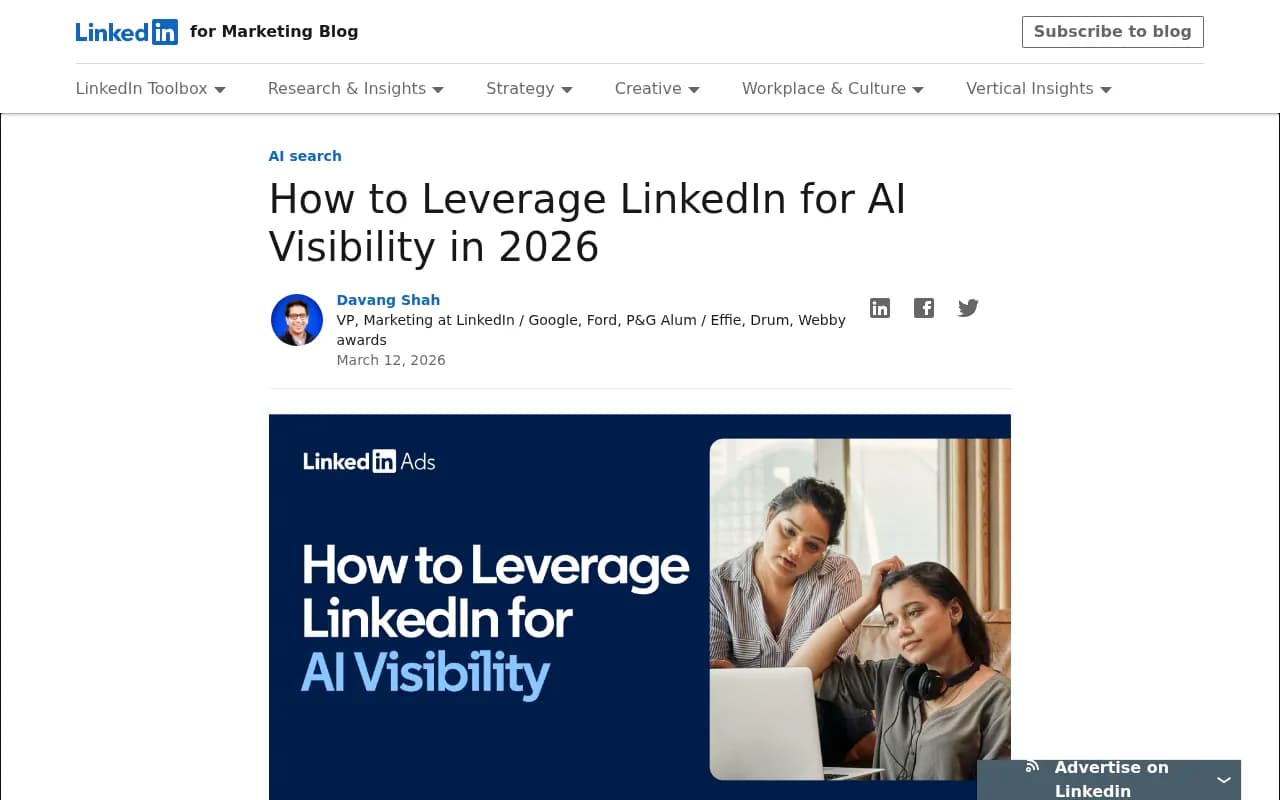
LinkedIn's own VP of Marketing, Davang Shah, wrote in March 2026 that "the secret sauce is to frequently craft and share high-quality, insightful content that showcases your expertise or firsthand experience through unique angles, data, and information about your industry."
The key phrase is "firsthand experience." AI models are trying to find sources that know something from direct experience, not sources that are summarizing what others have said. If your LinkedIn posts are mostly aggregating industry news or sharing articles with a brief comment, they're unlikely to become AI citations.
Specific claims with supporting evidence
AI models cite sources when they need to support a specific claim in their response. Your LinkedIn content should contain specific, citable claims: numbers, findings, frameworks, conclusions. Vague posts about "the importance of [topic]" give AI models nothing to work with.
Consistent posting on a defined topic area
The research consistently points to topic consistency as a citation signal. A company page or individual profile that posts regularly about a specific domain builds a kind of topical authority that AI models recognize. Spreading content across 10 different topics dilutes this.
Pick 2-3 topic areas that are genuinely relevant to your business and expertise. Post on those topics consistently. Over time, this creates a pattern that AI models can recognize and cite.
Common mistakes that kill LinkedIn AI citations
Posting only company news. Product launches, hiring announcements, and award wins are fine for brand awareness, but AI models have no reason to cite them when answering a buyer's research question.
Resharing without adding value. The 72% original content figure from Meltwater is stark. If most of your LinkedIn activity is resharing others' content with a brief comment, you're essentially invisible to AI citation.
Ignoring employee advocacy. Company pages often underperform individual profiles in AI citations. Your executives, product leaders, and subject matter experts posting in their own voice, with their own expertise, can generate more AI visibility than the company page alone.
Publishing in bursts then going quiet. The 48% "published within last 3 months" figure means recency matters. A burst of 20 posts followed by two months of silence won't maintain citation visibility.
No call to action or clear conclusion. Posts that meander without a clear takeaway are harder for AI models to cite usefully. End posts with a specific, quotable conclusion.
Tracking LinkedIn citations over time
The audit is a starting point. The real work is building a system that tells you when your LinkedIn content starts getting cited, when citations drop, and which content types are working.
A few approaches:
Manual spot-checking: Run your target prompts across AI models monthly. Takes 2-3 hours but gives you direct visibility into what's happening.
AI visibility platforms: Tools like Promptwatch, Profound, or Otterly.AI can automate this tracking and alert you when your brand or content appears (or disappears) in AI responses.
Otterly.AI

Google Search Console for indirect signals: While GSC doesn't show AI citations directly, unusual traffic patterns from LinkedIn URLs can sometimes indicate AI-driven discovery. It's an imperfect signal but worth monitoring.
Semrush's LinkedIn AI visibility study methodology: Semrush published their methodology for analyzing 89K LinkedIn URLs. You can adapt this approach to audit your own domain's LinkedIn presence against competitor LinkedIn presence.
Putting it together: a practical audit checklist
Here's a condensed version you can work through in a day:
- Define 20-30 target prompts relevant to your business
- Run each prompt across ChatGPT, Perplexity, Claude, and Gemini
- Record which LinkedIn URLs appear as sources
- Check whether any are yours; note which competitors appear
- Audit your last 6 months of LinkedIn posts against citation-friendly criteria (original, educational, specific claims, recent, engaged)
- Review key employee profiles for completeness and topical consistency
- Identify 2-3 topic areas where you have genuine expertise and could produce more citable content
- Set up ongoing tracking with a tool or a manual monthly check
The companies winning in AI search right now aren't necessarily the ones with the biggest LinkedIn followings. They're the ones producing content that AI models can actually use to answer a buyer's question. That's a different game, and the audit is how you figure out where you stand.
Most companies who run this audit for the first time find they're essentially invisible in AI search, even for topics they've been writing about for years. The good news is that the fix is straightforward: produce more original, educational, specific content consistently. The hard part is doing it systematically enough to see results.
That's where tracking tools earn their keep. Knowing which posts are getting cited, which prompts you're winning, and where competitors are beating you turns a guessing game into something you can actually manage.