Summary
- Each AI engine has its own source hierarchy: ChatGPT cites Wikipedia 12.1% of the time, Claude 0.1%, Perplexity 0%. LinkedIn appears in ChatGPT (4.1%) but never in Claude or Perplexity.
- Cross-platform consensus is extremely low: Only 11% domain overlap exists between platforms like ChatGPT and Perplexity for identical prompts. AI tools return the same brand list less than 1 in 100 times.
- Third-party sources dominate: 82.9% of brand citations come from external sources (review sites, news, blogs), not brand websites. Content type preferences vary wildly -- Claude favors blogs (43.8%), while ChatGPT and Perplexity prefer product pages (60%+).
- Sentiment gaps reach 79 points: The same brand can be rated up to 79 points apart on sentiment depending on which sources each engine cites.
- Real-time vs training data: Perplexity searches live and reflects current events reliably. ChatGPT and Claude rely on training data that might still think it's 2024 unless web browsing is enabled.
The divergence nobody talks about
You ask ChatGPT for CRM recommendations. Then you ask Claude. Then Perplexity. Same query, three completely different lists. Not just different rankings -- different brands entirely.
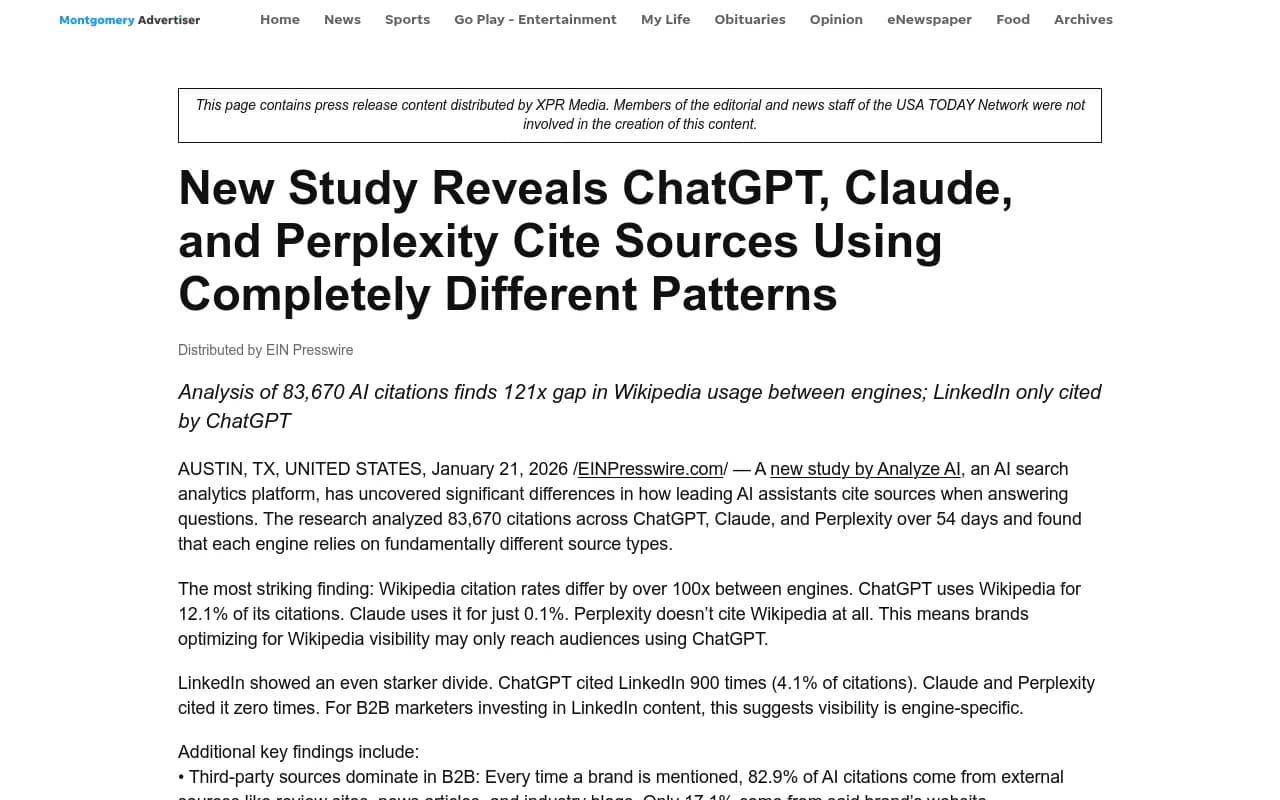
This isn't a bug. It's how AI search works in 2026. A recent study by Analyze AI analyzed 83,670 citations across ChatGPT, Claude, and Perplexity over 54 days. The findings: each engine relies on fundamentally different source types. Wikipedia citation rates differ by over 100x between engines. LinkedIn shows an even starker divide -- ChatGPT cited it 900 times (4.1% of citations), Claude and Perplexity zero times.
Cross-platform consensus sits at 11% domain overlap for identical prompts. AI tools almost never return the same list of brands twice -- we're talking well under 1 in 100. The multi-platform prompt divergence problem is real, measurable, and growing.
Why AI engines cite different sources for the same query
Training data vs real-time retrieval
ChatGPT and Claude work from training materials and uploaded files. They don't search the web by default. ChatGPT's knowledge cutoff means it operates within a defined snapshot unless web browsing is enabled. Claude's training data might still think it's 2024 for time-sensitive queries.
Perplexity is different. It's a real-time AI-powered answer engine that searches the web and cites sources. Every response includes citations linking directly to original sources. Because Perplexity retrieves information dynamically, its search results tend to reflect current events more reliably than ChatGPT's default mode.
This architectural difference alone explains part of the divergence. ChatGPT might recommend a tool based on 2023 training data. Perplexity sees a 2026 review published yesterday and surfaces that instead. Claude pulls from a different training corpus entirely.
Source hierarchy preferences
Each AI engine has built-in biases about which sources to trust. The Analyze AI study found:
- ChatGPT: Uses Wikipedia for 12.1% of citations. Cites LinkedIn 4.1% of the time. Prefers product pages (60.1% of citations).
- Claude: Uses Wikipedia for just 0.1% of citations. Never cites LinkedIn. Favors blog content (43.8% of citations).
- Perplexity: Doesn't cite Wikipedia at all. Never cites LinkedIn. Prefers product pages (54.3% of citations).
A Wikipedia strategy that works for ChatGPT will completely miss Claude and Perplexity users. B2B marketers investing in LinkedIn content get visibility only in ChatGPT. Platform-specific strategies aren't optional -- they're required.
Content type preferences
| Engine | Product pages | Blog posts | Wikipedia | |
|---|---|---|---|---|
| ChatGPT | 60.1% | Lower | 12.1% | 4.1% |
| Claude | Lower | 43.8% | 0.1% | 0% |
| Perplexity | 54.3% | Moderate | 0% | 0% |
Claude loves long-form blog content. ChatGPT and Perplexity lean toward product pages. If you're optimizing blog posts for AI visibility, you're playing to Claude's strengths but potentially missing ChatGPT and Perplexity audiences. If you're focused on product pages, the reverse is true.
Third-party dominance
Every time a brand is mentioned, 82.9% of AI citations come from external sources like review sites, news articles, and industry blogs. Only 17.1% come from the brand's own website. This means your visibility depends more on what others say about you than what you say about yourself.
Review sites, Reddit threads, YouTube videos, news coverage, and industry blogs drive the majority of AI citations. The platforms you don't control matter more than the ones you do. This is uncomfortable but measurable.
The sentiment gap: same brand, wildly different perceptions
AI engines can rate identical brands up to 79 points apart on sentiment, depending on which sources each engine cites. One engine pulls from a glowing review on a trusted site. Another pulls from a critical Reddit thread. A third cites a neutral Wikipedia entry.
The brand is the same. The sources are different. The sentiment diverges by 79 points.
This isn't theoretical. If ChatGPT cites your LinkedIn thought leadership and positive product reviews, you look great. If Claude cites a critical blog post from a competitor's site, you don't. If Perplexity pulls from a neutral industry report, you're somewhere in the middle. Same query, three different perceptions.
Winner-take-all dynamics and visibility concentration
The top 10 brands captured 30% of all AI mentions across 4,980 unique brands tracked in the Analyze AI study. Winner-take-all dynamics are real. If you're not in the top tier of citations for your category, you're invisible to most users.
This concentration effect means small differences in source coverage compound quickly. A brand cited by ChatGPT but not Claude loses half the market. A brand cited by all three engines but ranked lower loses visibility to competitors ranked higher. The gap between visible and invisible is narrow and brutal.
How to track and optimize for each engine separately
You can't fix what you don't measure. Tracking AI visibility across ChatGPT, Claude, and Perplexity requires platform-specific monitoring. Tools like Promptwatch help you see exactly where you're visible, which prompts trigger your brand, and which sources each engine cites.

What to track
- Prompt-level visibility: Which queries return your brand? Which don't? Track this separately for ChatGPT, Claude, and Perplexity.
- Source analysis: Which pages, Reddit threads, YouTube videos, and domains does each engine cite when mentioning your brand?
- Sentiment by engine: How does each engine perceive your brand based on the sources it cites?
- Competitor heatmaps: Compare your AI visibility vs competitors across all three engines. See who's winning for each prompt and why.
- Content gaps: Answer Gap Analysis shows exactly which prompts competitors are visible for but you're not. You see the specific content your website is missing.
Platform-specific optimization strategies
| Engine | Optimize for | Priority sources |
|---|---|---|
| ChatGPT | Wikipedia, LinkedIn, product pages | Wikipedia entries, LinkedIn posts, official product pages |
| Claude | Blog content, long-form articles | Industry blogs, thought leadership, detailed guides |
| Perplexity | Real-time news, product pages | Recent news coverage, updated product pages, current reviews |
For ChatGPT: Invest in Wikipedia presence. Publish LinkedIn thought leadership. Optimize product pages with clear, factual descriptions. ChatGPT favors structured, authoritative sources.
For Claude: Write long-form blog content. Publish detailed guides and case studies. Claude loves narrative depth and pulls heavily from blog posts.
For Perplexity: Keep product pages updated. Generate recent news coverage. Perplexity searches live and prioritizes current information. Stale content loses.

Otterly.AI

The content gap problem: what you're missing
Most brands don't know which prompts they're invisible for. You might rank well for "best CRM software" in ChatGPT but be completely absent for "CRM for small teams" in Claude. The content gap is the difference between what users ask and what your site answers.
Answer Gap Analysis (available in platforms like Promptwatch) shows exactly which prompts competitors are visible for but you're not. You see the specific topics, angles, and questions AI models want answers to but can't find on your site. This isn't guesswork -- it's data from real citation patterns.
Once you know the gaps, you can fill them. Generate articles, listicles, and comparisons grounded in real citation data, prompt volumes, persona targeting, and competitor analysis. Content engineered to get cited by ChatGPT, Claude, and Perplexity closes the visibility gap.
Real-time vs training data: the Perplexity advantage
Perplexity's real-time search gives it a structural advantage for current events and recent product launches. ChatGPT and Claude rely on training data that might be months or years old unless web browsing is enabled. For time-sensitive queries, Perplexity wins by default.
If you launched a product in 2026, Perplexity knows. ChatGPT might not unless it searches the web. Claude might not at all. This creates a visibility gap that compounds over time. Brands optimizing for Perplexity prioritize fresh content, recent news coverage, and updated product pages. Brands optimizing for ChatGPT and Claude focus on evergreen authority and structured data.
Multi-platform comparison tables
Citation source preferences
| Source type | ChatGPT | Claude | Perplexity |
|---|---|---|---|
| Wikipedia | 12.1% | 0.1% | 0% |
| 4.1% | 0% | 0% | |
| Product pages | 60.1% | Lower | 54.3% |
| Blog posts | Lower | 43.8% | Moderate |
| Third-party sources | 82.9% (all engines combined) | 82.9% | 82.9% |
Real-time vs training data
| Feature | ChatGPT | Claude | Perplexity |
|---|---|---|---|
| Default mode | Training data (cutoff date) | Training data | Real-time web search |
| Web browsing | Optional (Plus/Pro) | Limited | Always on |
| Current events | Weak (unless browsing enabled) | Weak | Strong |
| Citation freshness | Depends on mode | Depends on training | Always current |
Optimization priorities by engine
| Priority | ChatGPT | Claude | Perplexity |
|---|---|---|---|
| 1 | Wikipedia presence | Long-form blog content | Recent news coverage |
| 2 | LinkedIn thought leadership | Detailed guides | Updated product pages |
| 3 | Product page optimization | Case studies | Real-time reviews |
| 4 | Structured data | Narrative depth | Fresh content |
Tools for tracking multi-platform AI visibility
You need separate tracking for each engine. A single dashboard that aggregates ChatGPT, Claude, and Perplexity visibility helps you see where you're strong and where you're invisible.
Profound


These platforms track prompt-level visibility, source analysis, sentiment by engine, and competitor heatmaps. Some include content gap analysis and AI writing agents to help you generate content that ranks.
The action loop: find gaps, create content, track results
Most AI visibility tools stop at monitoring. They show you data but leave you stuck. The platforms that actually help you improve follow an action loop:
- Find the gaps: Answer Gap Analysis shows exactly which prompts competitors are visible for but you're not. You see the specific content your website is missing.
- Create content that ranks in AI: AI writing agents generate articles, listicles, and comparisons grounded in real citation data, prompt volumes, persona targeting, and competitor analysis. This isn't generic SEO filler -- it's content engineered to get cited by ChatGPT, Claude, and Perplexity.
- Track the results: See your visibility scores improve as AI models start citing your new content. Page-level tracking shows exactly which pages are being cited, how often, and by which models.
This cycle -- find gaps, generate content, track results -- is what separates optimization platforms from monitoring-only dashboards.
Why cross-platform consensus is so low
Only 11% domain overlap exists between platforms like ChatGPT and Perplexity for identical prompts. Why is consensus so low?
- Different training data: ChatGPT and Claude trained on different corpora at different times. They learned different associations.
- Different retrieval mechanisms: Perplexity searches live. ChatGPT and Claude pull from memory (unless browsing is enabled).
- Different source hierarchies: Each engine trusts different types of sources. Wikipedia works for ChatGPT but not Claude or Perplexity.
- Different ranking algorithms: Even when engines access the same sources, they rank them differently based on internal scoring.
The result: AI tools almost never return the same list of brands twice. Cross-platform divergence is the default, not the exception.
What this means for marketers in 2026
If you're optimizing for "AI search" as a monolith, you're doing it wrong. There is no single AI search. There's ChatGPT search, Claude search, Perplexity search, and they behave differently.
Your strategy needs to account for:
- Platform-specific source preferences: Wikipedia for ChatGPT, blogs for Claude, real-time news for Perplexity.
- Content type alignment: Product pages for ChatGPT and Perplexity, long-form blog posts for Claude.
- Third-party dominance: 82.9% of citations come from external sources. You need review coverage, news mentions, Reddit discussions, and YouTube videos.
- Sentiment divergence: The same brand can be perceived 79 points apart depending on which sources each engine cites. Monitor sentiment by engine, not just overall.
- Winner-take-all dynamics: The top 10 brands capture 30% of mentions. Small visibility gaps compound quickly.
A unified AI visibility strategy that treats all engines the same will fail. You need separate tactics for ChatGPT, Claude, and Perplexity. Track them separately. Optimize them separately. Measure results separately.
The future of multi-platform AI search
Divergence will likely increase, not decrease. As more AI engines launch (Grok, DeepSeek, Mistral, Meta AI, Gemini), each will have its own source preferences, training data, and ranking algorithms. Cross-platform consensus will drop further.
Brands that win in this environment will be the ones that:
- Track visibility across all major engines
- Identify content gaps for each engine separately
- Generate platform-specific content that aligns with each engine's preferences
- Monitor third-party sources (reviews, news, Reddit, YouTube) that drive 82.9% of citations
- Close the loop with traffic attribution to connect visibility to revenue
The multi-platform prompt divergence problem isn't going away. It's the new normal. Brands that adapt will dominate AI search. Brands that don't will be invisible.