Key takeaways
- A 30-day sprint is enough to build a baseline, fix your source pages, land a few placements, and record what changed. It is not enough to promise a citation lift, and you shouldn't.
- Earned news gives a short burst. In Promptwatch Data, half of the news pages ChatGPT cited on July 6, 2026 had dropped out within 36 days, while landing pages and docs held on much longer.
- Pair every placement with a durable asset (an anchor page, a comparison, a listicle inclusion) so the burst has somewhere to land.
- Measure before you spend: fixed buyer questions, cited domains logged weekly, AI referral traffic in analytics, and a check of your last 90 days of placements against the domains AI engines actually cite.
- PR teams are behind on this. Agility PR Solutions' 2026 survey found PR pros rate their brand's AI visibility at 5.5 out of 10, even though 46% call it a critical or high priority.
Why PR teams own a big piece of this
Most AI visibility advice is written for SEOs. But the sources AI engines lean on are mostly things PR teams already produce or influence: independent reporting, roundups, reviews, expert commentary.
Two third-party findings are worth knowing, with caveats. Ahrefs' study of 75,000 brands found that brand web mentions correlated with AI Overview brand visibility at 0.664 (Spearman), against 0.218 for backlinks (Ahrefs). That is correlation with brand visibility, not a measured citation rate. And Muck Rack's May 2026 study reported that 84% of links cited by ChatGPT, Claude, and Gemini came from earned media, with paid and advertorial content around 0.3% (Muck Rack).
Neither proves that buying a placement causes a citation. Google's own guidance on AI features says the foundation is the same as Search (accessible pages, useful text, internal links) and that there is no special AI schema and no guaranteed inclusion (Google). Treat all of this as a list of things to test, and set targets against your own starting point.
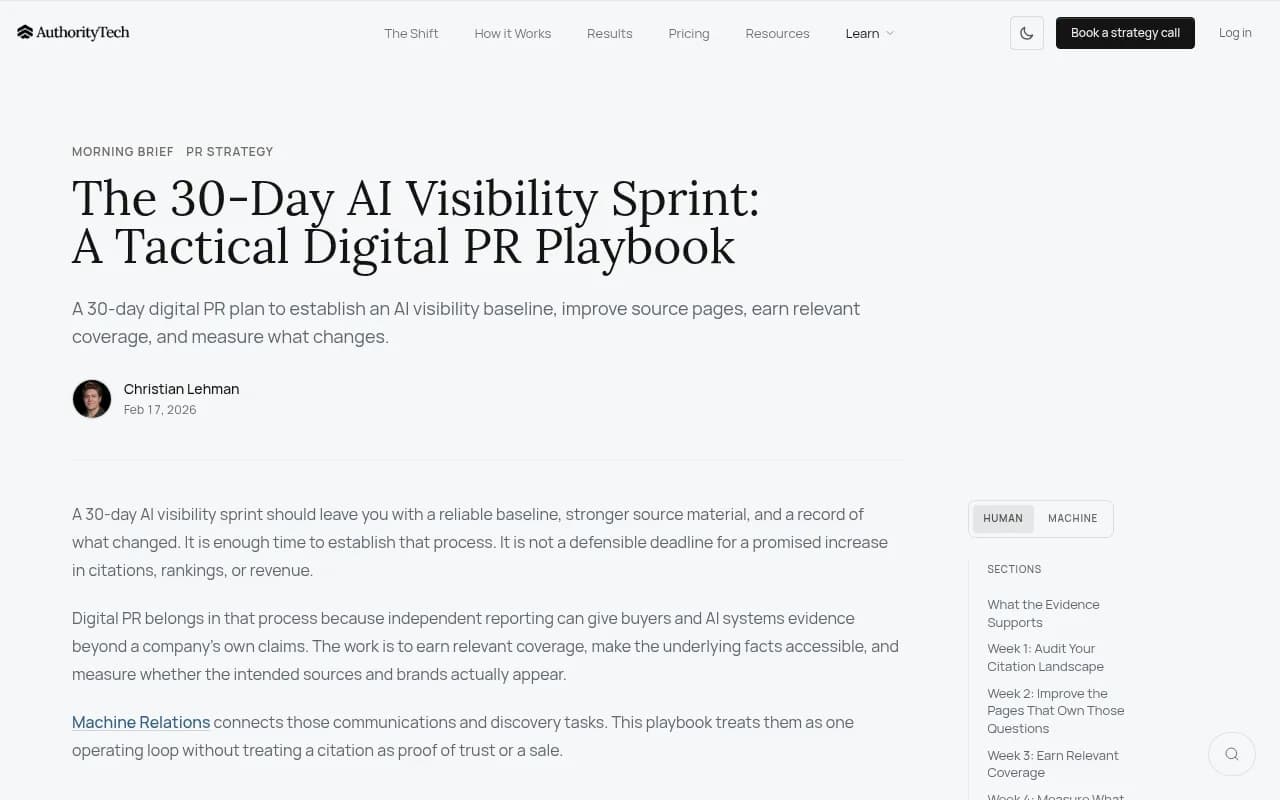
That framing matches the Authoritytech sprint playbook, which says 30 days is enough to establish a reliable baseline, stronger source material, and a record of what changed, but not a defensible deadline for a promised increase in citations or revenue.
What the citation data says about placements
Before planning pitches, it helps to know what kind of pages get cited. Promptwatch tracks ChatGPT's real interface across millions of responses, and its numbers change how you should weight the sprint.

From Promptwatch Data on ChatGPT citation share by content type (Sep 28 to Oct 4, 2026):
- Product pages are 22.4% of classified citations and landing pages 16.8%, so about 39% of citations go to pages describing what a company sells.
- Listicles are 13.6%, how-tos 8.7%, general articles 6.1%, comparisons 5.9%, and news 5.7%.
- For commercial prompts, product pages, landing pages, listicles, and comparisons add up to almost 70% of citations.
- For branded prompts, reviews are 5.6% (more than three times their share overall) and press releases 2.1%. Press releases earn more there than elsewhere, but the share is still small.
The lesson for PR: a news hit is rarely the thing being cited for a buyer's "best X for Y" question. A "best of" roundup that includes you, or a comparison page that describes you accurately, is more likely to be. Your placements are most valuable when they put you into those formats, or when they send authority to a page of your own that can be cited directly.
Then there is decay. In Promptwatch's content half-life report (pages cited on July 6, 2026, tracked for 90 days):
| Content type | Still cited after 30 days | Still cited after 60 days |
|---|---|---|
| Landing pages | 78% | 69% |
| Docs | 76% | 67% |
| Comparisons | 72% | 63% |
| Listicles | n/a | 60% |
| Product pages, reviews, how-tos | n/a | about 55% |
| News | half gone by day 36 | 41% |
A caveat from the report: lines drop faster in the final week because the tracking window ends. Still, the direction is clear. Treat press coverage as a short burst of roughly five weeks, and lean on durable formats for the long game.
One more adjustment. Don't count on social posts to carry the sprint into ChatGPT. Promptwatch's November 2026 social citations report (Oct 11 to Nov 9) found social platforms combined were 0.64% of ChatGPT citations, 1.94% on Perplexity, and 13.16% in Google AI Overviews, where YouTube alone was 6.71%. Social amplification still helps humans find your coverage. It just isn't a ChatGPT strategy.
Week 1: baseline and anchor article
Two jobs this week: find out where you stand, and build the page your pitches will point to.
Build the question set
Pick a fixed list of buyer questions. Ten to twenty is a manageable number, not a statistical threshold. Include category recommendations ("best [category] for [use case]"), comparisons, and questions about the problem you solve. Keep the wording stable, because changing it mid-sprint ruins your before and after comparison.
Run them across the AI products your buyers use, for example ChatGPT, Perplexity, and Gemini. For every run, record:
- The product, model if disclosed, date, locale, and whether web search was on.
- The full answer and whether your brand was mentioned.
- Every cited URL, separating a mention of your brand from a link to your own site.
- The claim attached to each citation, and whether the source actually supports it.
- Failed or empty responses, kept apart from valid answers with no brand mention.
Repeat across several days. A single screenshot records one answer, not a stable ranking.
Pick the tooling
Doing this by hand works for a first pass, but it gets painful at scale. Tools like Promptwatch can run the same prompts daily across ChatGPT, Gemini, Perplexity, Google AI Overviews and others, and log the cited sources automatically. Its prompt tracking covers real interfaces rather than only API outputs, which matters because user-facing answers and citations can differ. Smaller trackers exist too. The directories at ai-rank-tools.com and bestgeosoftware.com list dozens.
| Approach | Cost | Citation logging | Best for |
|---|---|---|---|
| Manual spreadsheet | Free, plus time | Manual | A first baseline of 10 to 20 questions |
| Lightweight trackers such as [tool:otterly-ai] or [tool:peec-ai] | Low | Mentions and sources | Teams that only need monitoring |
| Enterprise suites such as [tool:profound] | Higher | Mentions, sources, more engines | Large brands with budget |
| Promptwatch | From $95/mo (check promptwatch.com/pricing) | Citations, crawler logs, traffic, content gaps | Teams that want to track, fix, and measure in one place |
Otterly.AI


Profound

Write the anchor article
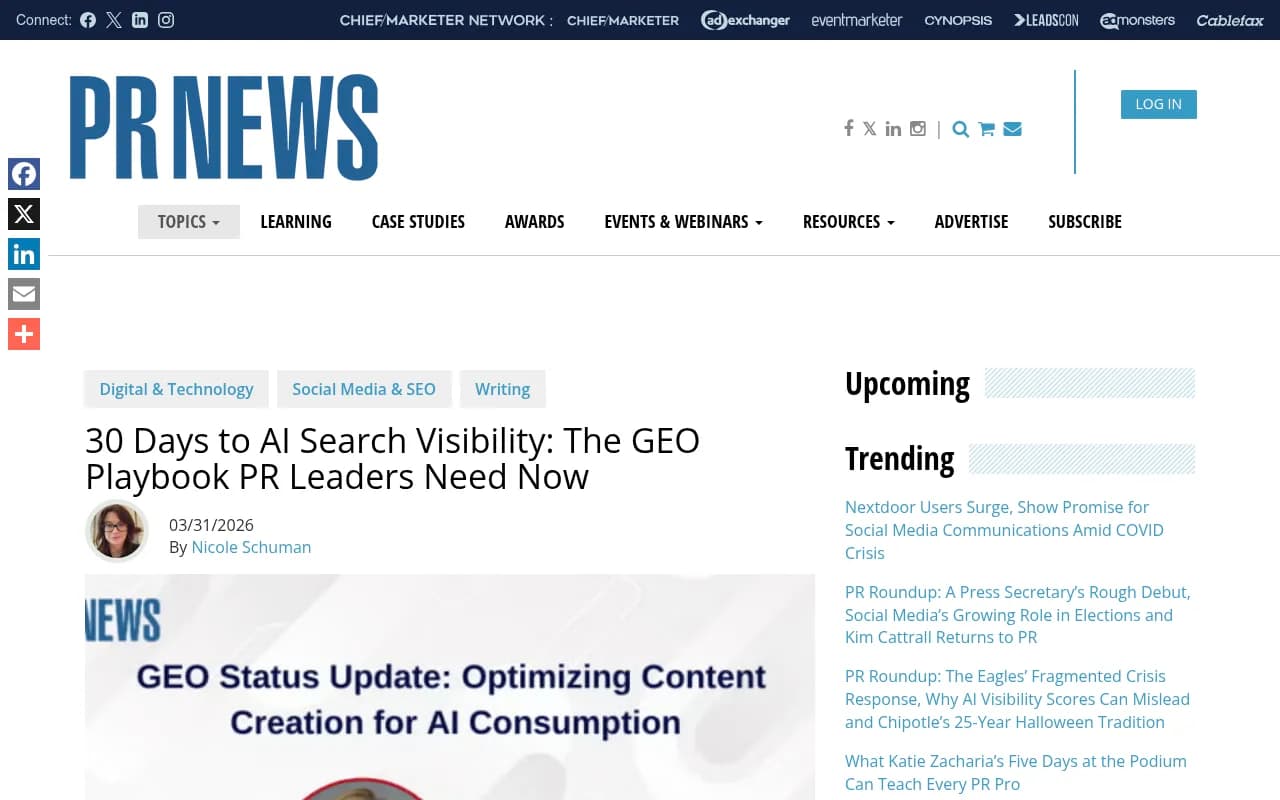
This comes from Sarah Evans, Partner and Head of PR at Zen Media, in a PRNEWS session on a 30-day GEO playbook. Week one: pick one topic your brand wants to be known for and draft a long-form anchor article, the kind of pillar page an SEO team would recognize. Pull together the authority points your brand has accumulated over the past few years, structure it cleanly with bullet points and schema where it fits the visible content, and publish it. Your pitched thought leadership will link back to it.
I'd add one thing. Write the page so a machine can lift a claim from it without context. Name the product, the number, the date. Because AI engines quote own-site pages directly, a vague or outdated fact on your anchor page is worse than no page.
Turn on measurement
By the end of week one, switch on AI referral tracking in your analytics. If you use GA4, set up the AI assistant channel grouping. One wrinkle: according to Promptwatch's notes, ChatGPT stopped sending a referrer on October 8, 2026, so tag your own links with utm_source=chatgpt.com wherever you control the URL. Google Analytics is enough to start. Promptwatch's attribution guide explains the options.
Week 2: pitch with the machine in mind
Pitching doesn't change much. The targeting does.
Choose outlets by citation, not just by reach
Before you build a media list, pull the domains your week-one baseline showed being cited for your questions. Those are your target outlets. A top-tier outlet that never shows up in the answers matters less for this sprint than a mid-sized trade site that appears constantly. Wiztrust's 2026 PR analysis also argues that outlets with formal licensing or content agreements with AI platforms carry extra weight because they are indexed with priority. That is a vendor's claim, so verify it against your own cited-domain list rather than taking it as given.
Promptwatch's data points the same direction on authority. In August 2026 ChatGPT citation data by domain rank, sites with domain rank 46 to 75 earned almost half of citations while DR 91 to 100 fell to about 3%. Mid-authority sites are worth pitching.
Pitch formats that survive in AI answers
- Thought leadership from a named expert, with the link to your anchor article.
- Original data. A proprietary number gives journalists and models something to cite that exists nowhere else.
- Roundup and listicle inclusion. For commercial prompts, "best of" lists are a large slice of what gets cited, so ask to be considered for the ones already appearing in your baseline.
- Reviews, for branded prompts where review pages punch above their weight.
A small target worked in the Zen Media example: a handful of topic-aligned placements, then re-run the prompts. Their story was seven placements and a fast proof point. Treat that as an anecdote, not a benchmark.
Tools for the outreach side
Media databases and monitoring help here. [tool:cisionone] and [tool:meltwater] cover media lists and coverage tracking, and [tool:buzzsumo] helps find what content is getting shared in your niche. None of them tell you what AI cites, so keep the cited-domain list from week one as the filter.
Week 3: land placements and fix the source pages
As coverage goes live, three things need to happen.
- Point every byline and expert quote at the anchor article, and make sure the coverage names your brand in the text rather than only in an image or sidebar.
- Audit the facts. Pull every claim an AI answer made about you in week one and check it. Wrong pricing, outdated features, and mixed-up product names often trace back to specific pages. Promptwatch's Brand Narrative and Fact Check are built for this: they pull individual claims out of responses and find the pages that state them.
- Check crawl access. If AI bots can't read your anchor page, the best placement in the world won't help. Promptwatch's AI crawler logs show whether GPTBot, ClaudeBot, and PerplexityBot actually reach a page, and the free Agentic Readiness Check gives a quick read on robots.txt and related standards. Tools like [tool:screaming-frog] help with the general technical crawl.
If you want the durable assets that outlast the news burst, this is also the week to plan them: a comparison page, an updated docs or FAQ page, a landing page for the topic. Promptwatch's content gap analysis maps your pages against the prompts AI is answering, and its Content Agent can draft and publish to WordPress, Webflow, or Framer, though that needs the Business plan. A writer and an editor can do the same job, just slower.
Week 4: remeasure and report
Re-run the exact same question set, in the same products, across several days. Compare against week one.
What to report
A three-part stack works well for leadership:
| Metric | What it answers | Source |
|---|---|---|
| Mention and citation rate across your fixed questions | Do AI answers include us, and with which sources? | Prompt tracking |
| Share of cited domains that match your placements | Is PR landing where AI looks? | Your last 90 days of placements vs. cited domains |
| AI-referred sessions and conversions | Does it send people? | GA4 channel or a visitor analytics tool |
The Authoritytech measurement playbook makes the same point: by day 30, check your last 90 days of placements against the domains AI engines actually cite. That comparison is often the most uncomfortable and the most useful slide in the deck.
Gauge shifts honestly. If something moved, say what changed in the same window (placements, page updates, model updates) and note that you can't prove cause. If nothing moved, report that too, along with what the data says to do next. Prismic's 30-day experiment report is a useful reminder that visibility can shift for reasons unrelated to your work, so look at daily data rather than a single before-and-after snapshot.
Watch for platform shifts
Models change behavior mid-sprint. Promptwatch Data recorded reddit.com's share of ChatGPT citations falling from roughly 4% to 0.5% on August 14, 2026 (report), and ChatGPT starting to use the site: operator at scale on August 8 (report). If your numbers jump or sag, check for an engine-side change before crediting or blaming your campaign.
A simple 30-day checklist
| Days | Task | Output |
|---|---|---|
| 1 to 3 | Fix question set, run across ChatGPT, Perplexity, Gemini | Baseline log |
| 4 to 7 | Draft and publish anchor article, turn on AI traffic tracking | Live page, analytics ready |
| 8 to 14 | Build outlet list from cited domains, pitch thought leadership and data | Pitches out |
| 15 to 21 | Land placements, link to anchor page, audit facts, check crawl access | Coverage plus clean source pages |
| 22 to 25 | Publish one durable asset (comparison, FAQ, docs update) | New citable page |
| 26 to 30 | Re-run prompts, compare cited domains to placements, report | Leadership readout |
Where an agency fits
Some teams don't have the people to run this alongside normal PR work. An agency that does technical SEO, digital PR, and generative engine optimization together can cover the baseline, pages, and placements as one program. 1001 SEO Media is one example, and it uses Promptwatch for AI visibility tracking. You can also scan the directories at surferstack.com if you are comparing options.
Mistakes to avoid
- Promising a number. Thirty days sets a baseline. Don't tell leadership a citation lift is guaranteed.
- Chasing one big-name hit and ignoring the formats AI cites for commercial questions.
- Changing your question set mid-sprint.
- Counting a mention as a citation, or a citation as trust or a sale.
- Forgetting that news decays. If your whole plan is press coverage, plan the next burst before the first one fades, and keep landing pages and comparisons fresh.
Next steps
Start with the free AI visibility report to see how ChatGPT, Gemini, and Perplexity talk about your brand today, then build the question set around the gaps. If you want to track daily and tie placements to crawls, citations, and traffic, Promptwatch has a 7-day free trial on monthly plans, and current pricing is at promptwatch.com/pricing. For the broader methodology, its 90-day GEO program picks up where this sprint ends.