Key takeaways
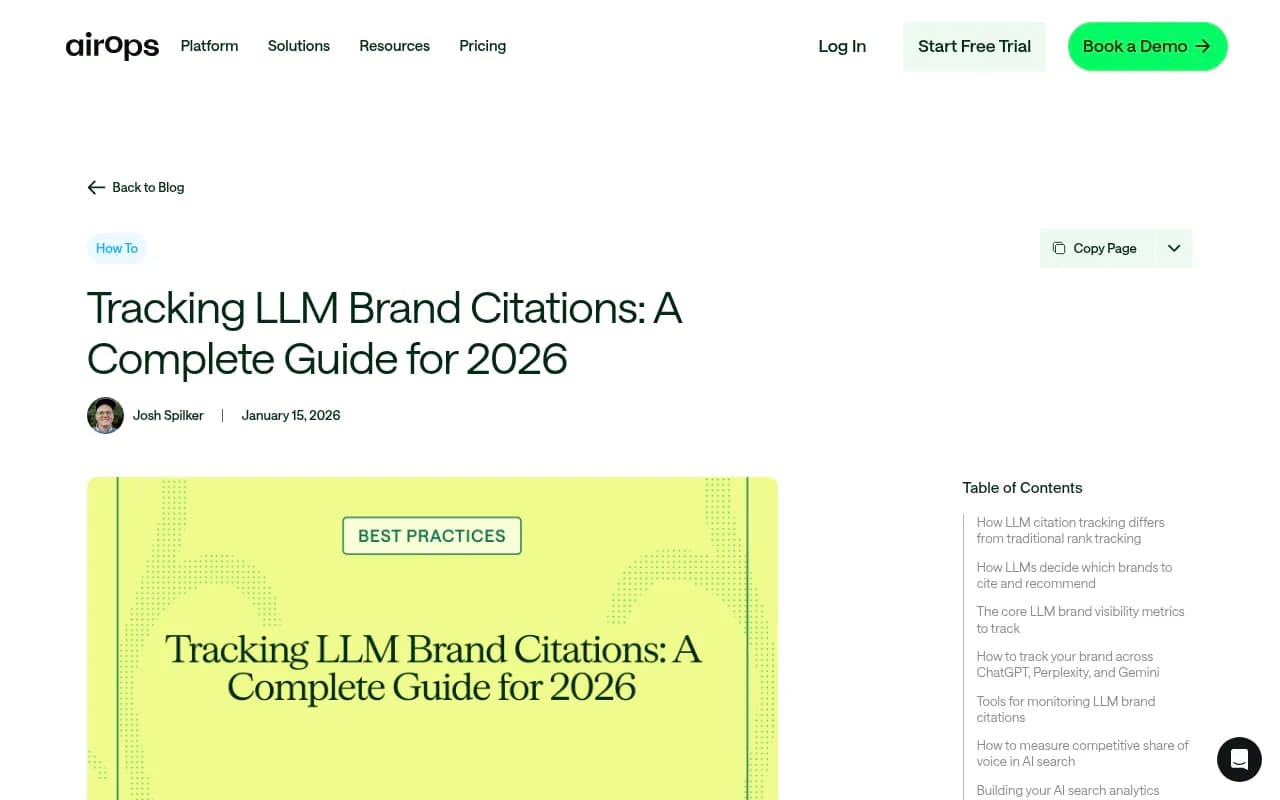
- Only 30% of brands maintain consistent visibility from one AI response to the next, according to AirOps research -- making one-off checks essentially useless
- AI brand monitoring in 2026 is no longer just about knowing you're mentioned; it's about understanding sentiment, citation accuracy, competitive share of voice, and which content is actually getting cited
- Most monitoring tools stop at showing you the data. A smaller number help you act on it -- generating content, fixing gaps, and tracking whether changes actually improved visibility
- The field is still early. We're roughly where SEO was before Moz and Ahrefs existed -- measurement is getting better, but there's no universal standard yet
- Brands that treat AI visibility as a separate discipline from SEO, with its own metrics and workflows, are pulling ahead
Why this matters more than most brands realize
Here's a scenario that's playing out thousands of times a day: a potential customer opens ChatGPT and types "what's the best project management tool for remote teams?" They get a confident, well-structured answer that names three or four products. Your brand isn't one of them.
You didn't lose a Google ranking. You weren't even in the race.
This is the core problem with AI-mediated search. Unlike Google, where you can see your position and track it over time, LLMs don't publish query volumes. Their responses vary by phrasing, by model, by the day. There's no "page two" to fall back on -- either you're in the answer or you're not.
The shift is happening faster than most marketing teams have adjusted for. Generative AI tools like ChatGPT, Perplexity, Gemini, and Amazon Rufus are increasingly the starting point for consumer research. People get direct, conversational answers instead of a list of links to click through. For brands, that means the discovery funnel now runs through AI responses before it ever reaches your website.
The question for 2026 isn't whether to monitor AI brand visibility. It's how to do it well.

What "AI brand monitoring" actually means in 2026
Brand monitoring used to mean Google Alerts and social listening. You'd track mentions on Twitter, news sites, review platforms. That's still useful, but it doesn't tell you anything about what AI models say about you.
AI brand monitoring is a different thing. It involves:
- Querying AI models with prompts your customers actually use
- Recording whether your brand appears, and in what context
- Tracking sentiment and accuracy -- not just presence
- Comparing your visibility against competitors for the same prompts
- Doing this repeatedly, across multiple models, to catch variance
That last point is critical. AirOps research found that only 30% of brands stayed visible from one AI response to the next, and just 20% maintained presence across five consecutive runs of the same prompt. This isn't a bug -- it's how LLMs work. They're probabilistic systems. The same question can produce meaningfully different answers.
This means a single manual check tells you almost nothing. You need structured, repeated testing to build a reliable baseline.
The metrics that actually matter
The industry has started converging on a few core metrics:
- AI Visibility Score: an aggregate measure of how often your brand appears across a defined set of prompts and models
- Share of voice: what percentage of AI responses mention your brand vs. competitors, for a given topic or category
- Citation accuracy: whether the AI's description of your brand is correct -- hallucinations are a real problem, especially for newer or less-documented brands
- Sentiment: is the mention positive, neutral, or negative?
- Source attribution: which pages on your site (or elsewhere) are being cited when your brand appears?
These metrics don't map neatly onto traditional SEO KPIs, which is part of why many teams are still figuring out how to report on them.
The data landscape: what we know so far
We're still early. As Search Engine Land noted, the LLM optimization space is roughly where SEO was before Semrush and Moz existed -- there's no standardized measurement, no universal benchmark, and a lot of noise.
But some patterns are emerging:
Visibility is highly volatile. The 30% consistency figure from AirOps isn't an outlier. Multiple practitioners have observed that AI responses shift based on prompt phrasing, recency of training data, and model updates. A brand that appears prominently in ChatGPT responses today might not tomorrow.
Source quality drives citation. LLMs tend to cite brands that appear in sources they already trust -- established publications, high-authority review sites, Reddit discussions, YouTube content. This means your own website isn't always the primary driver of AI visibility. Third-party coverage matters enormously.
Different models behave differently. ChatGPT, Perplexity, Claude, and Gemini don't produce identical responses for the same prompt. A brand might be well-represented in Perplexity (which relies heavily on real-time web search) but nearly invisible in Claude (which draws more from training data). Monitoring a single model gives you a partial picture.
Luxury and high-touch brands face a specific risk. Mandarin Oriental Group's Director of Technology Portfolio Management, Sjoerd Brouwer, has pointed out that if AI assistants don't "know" a brand in depth, they risk flattening brand voice or hallucinating details. For commodity products this is annoying; for premium brands it can actively damage perception.
How brands are approaching monitoring in practice
Most teams that are doing this seriously have settled into a weekly cadence of structured prompt testing. Here's what that looks like in practice:
Defining your prompt set
Start with the questions your customers actually ask. Not branded queries ("what is [your brand]?") but category-level research questions: "what's the best [category] tool for [use case]?" These are the prompts where you either win or lose consideration before the customer ever visits your site.
A reasonable starting set is 20-50 prompts covering your main use cases, competitor comparisons, and category-level questions. Run them across at least three or four models.
Tracking over time
One-off checks are misleading. You need a baseline and you need to track changes over time. When you publish new content or earn new coverage, does your visibility score improve? Which prompts moved? Which models responded?
This is where purpose-built tools become genuinely useful -- manually querying five AI models with 50 prompts, recording results, and calculating share of voice is tedious enough that most teams won't sustain it.
Competitive benchmarking
Share of voice is arguably more actionable than raw visibility. Knowing you appear in 40% of relevant AI responses is less useful than knowing your main competitor appears in 65% of the same responses. The gap tells you where to focus.
The tools landscape: monitoring vs. optimization
There are now dozens of tools in this space, ranging from simple trackers to full optimization platforms. The most important distinction is between tools that show you data and tools that help you act on it.
| Tool | Monitoring | Content generation | Crawler logs | Prompt intelligence | Best for |
|---|---|---|---|---|---|
| Promptwatch | 10 AI models | Yes (built-in AI writer) | Yes | Yes (volume + difficulty) | Full optimization cycle |
| Profound | Strong | No | No | Limited | Enterprise monitoring |
| Otterly.AI | Basic | No | No | No | Simple tracking |
| Peec.ai | Basic | No | No | No | Basic monitoring |
| AthenaHQ | Good | No | No | No | Monitoring-focused teams |
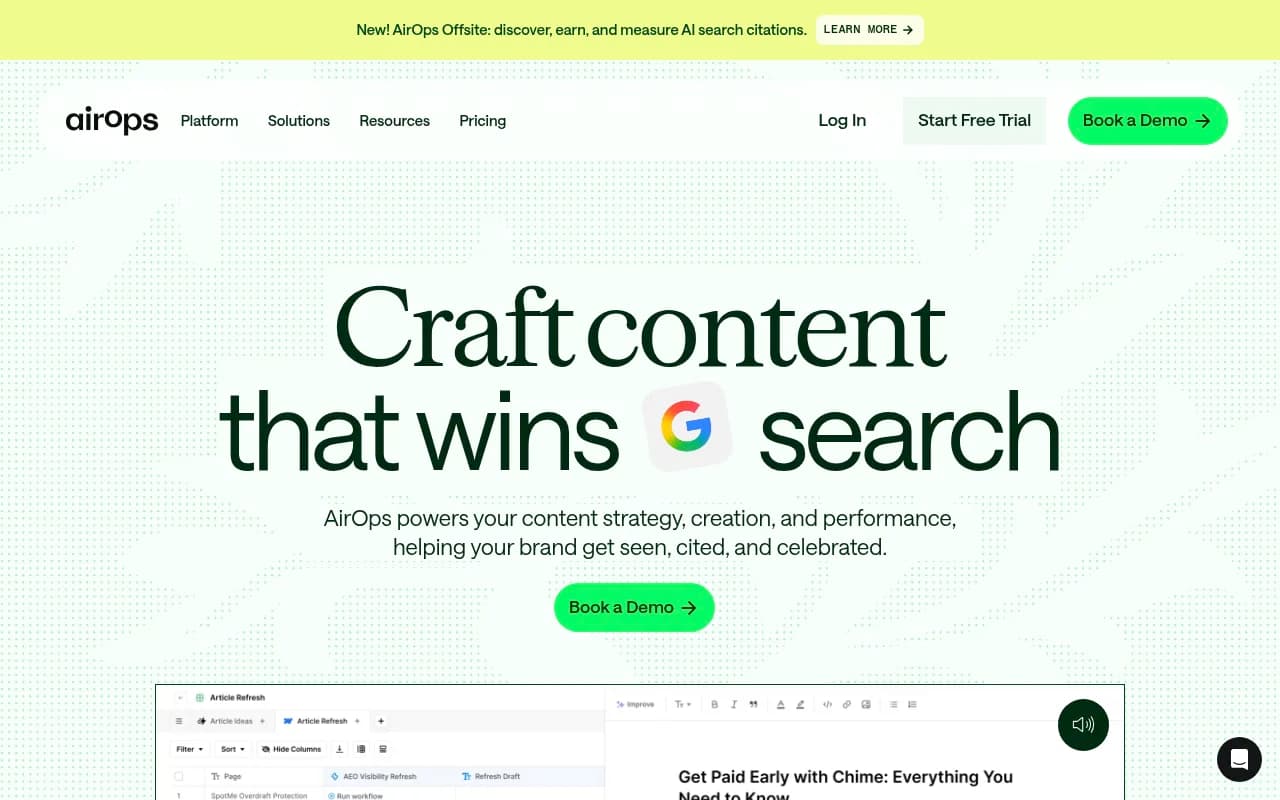
| AirOps | No | Yes | No | No | Content creation |
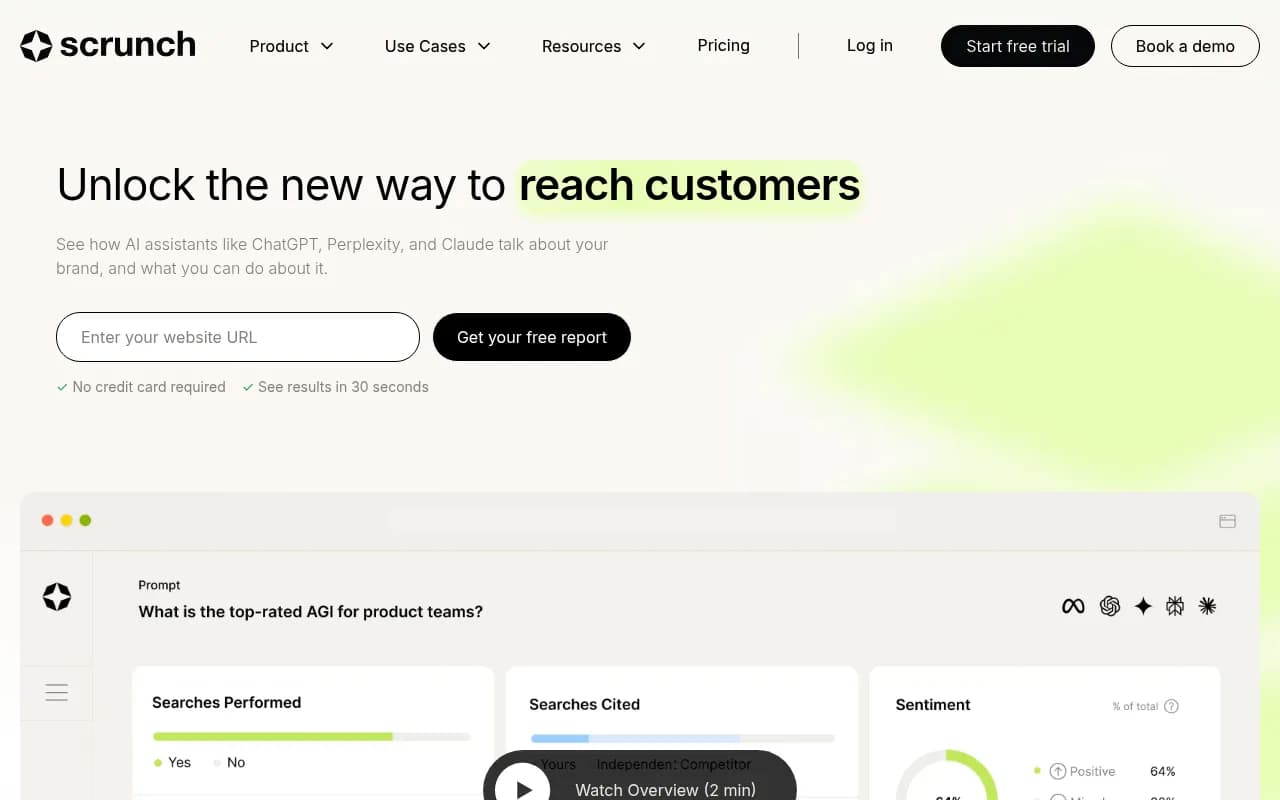
| Scrunch AI | Good | No | No | No | Mid-market monitoring |

The monitoring-only tools are useful for awareness. You'll know whether you're visible and roughly how you compare to competitors. What they can't tell you is what to do about it -- which content gaps are causing you to miss prompts, which pages AI crawlers are actually reading, or whether new content you published actually moved the needle.
Promptwatch takes a different approach. Rather than stopping at the dashboard, it's built around an action loop: find the gaps (Answer Gap Analysis shows exactly which prompts competitors rank for that you don't), create content to fill them (a built-in AI writing agent generates articles grounded in citation data), and track whether visibility improved. It also includes AI crawler logs -- real-time data on which pages ChatGPT, Claude, and Perplexity are actually reading on your site, and where they're hitting errors. Most competitors don't have this at all.
For teams that want to monitor across multiple models without the full optimization workflow, a few other tools are worth knowing about:
Otterly.AI


Profound


What good content looks like for AI citation
Understanding what gets cited is half the battle. LLMs don't cite pages randomly -- they pull from sources that answer questions clearly, directly, and with enough depth to be trustworthy.
A few patterns that consistently drive citation:
Direct answers to direct questions. Content structured around specific questions ("what is X?", "how does X compare to Y?") performs better than general brand pages. If someone asks ChatGPT to compare two products, it needs a source that actually makes that comparison.
Third-party authority. Your own website matters, but so does your presence on established review platforms, industry publications, Reddit, and YouTube. LLMs weight sources they already trust. Getting covered in those places is often more valuable than optimizing your own pages.
Factual accuracy and specificity. Vague marketing language ("we're the leading solution for...") doesn't give AI models anything to work with. Specific claims, numbers, and comparisons do.
Accessible structure. If your site relies heavily on JavaScript rendering, AI crawlers may not be reading it properly. Technical accessibility for crawlers matters just as much as it does for Google.
The Reddit and YouTube factor
This is underappreciated. A significant portion of AI citations come from Reddit threads and YouTube content -- not just traditional web pages. Perplexity in particular draws heavily from real-time web sources, and Reddit discussions frequently appear in its citations.
For brands, this means community presence and video content aren't just nice-to-haves for social engagement. They're part of the AI visibility stack.
Common mistakes brands are making
Checking once and assuming it's stable. Given the volatility in AI responses, a single check is close to meaningless. You need repeated testing to understand your actual baseline.
Monitoring only ChatGPT. ChatGPT gets the most attention, but Perplexity, Gemini, Claude, and Google AI Overviews each have significant user bases and behave differently. A brand that's visible in one model may be nearly absent in another.
Treating AI visibility as an SEO subset. There's overlap, but they're not the same discipline. High Google rankings don't guarantee AI citation. The content formats, source types, and optimization strategies differ enough that they need separate attention.
Ignoring hallucinations. AI models sometimes describe brands inaccurately -- wrong pricing, wrong features, wrong positioning. If you're not monitoring what AI models actually say about you, you won't catch these errors. And they're shaping buyer perceptions before anyone visits your site.
No baseline, no measurement. Many brands have started publishing "AI-optimized content" without establishing a before/after measurement framework. Without a baseline, you can't know whether anything you're doing is working.
Building a practical monitoring workflow
Here's a workflow that works for most marketing teams:
- Define 30-50 prompts covering your category, use cases, and key competitor comparisons
- Run them weekly across at least ChatGPT, Perplexity, Gemini, and Claude
- Record visibility (yes/no), sentiment, and which competitor appears when you don't
- Calculate share of voice per prompt category
- Identify your biggest gaps -- the high-volume prompts where competitors appear and you don't
- Create or update content specifically targeting those gaps
- Track whether visibility improves over the following 4-8 weeks
The gap identification step (step 5) is where most manual workflows break down. It's time-consuming to systematically map competitor visibility across dozens of prompts. This is where tools like Promptwatch's Answer Gap Analysis become genuinely useful -- it surfaces the specific prompts you're missing automatically, rather than requiring you to infer them from manual testing.
For teams tracking traffic attribution, connecting AI visibility to actual website visits requires either a code snippet, Google Search Console integration, or server log analysis. Without this, you can improve your AI visibility score without knowing whether it's actually driving business results.
What to expect in the next 12 months
A few things seem likely:
AI models will get better at real-time web access. Perplexity already operates this way; the others are moving in the same direction. This makes fresh, well-structured content more important and reduces the advantage of purely training-data-based optimization.
Measurement standards will improve. Right now every platform uses slightly different methodologies for calculating visibility scores. Expect more convergence, and more scrutiny of what these scores actually mean.
The gap between monitoring and optimization will widen. As the space matures, the tools that help brands act on data -- not just observe it -- will pull ahead. Knowing you're invisible is only useful if you can do something about it.
The brands that are building systematic workflows now, with real baselines and repeatable measurement, will have a meaningful head start. The ones waiting for the space to "mature" before investing are ceding ground to competitors who are already showing up in the answers.
Bottom line
AI brand monitoring in 2026 is no longer optional for brands that care about discovery. The question is whether you're doing it systematically or just checking occasionally and hoping for the best.
The core discipline is straightforward: define your prompts, track them consistently, measure share of voice against competitors, identify gaps, and create content that fills them. The hard part is sustaining that workflow at scale -- which is why purpose-built tools matter.
What separates the leaders from the laggards right now isn't access to data. It's the ability to act on it.