Key takeaways
- Searchable's published self-serve plans ($125/mo Pro, $400/mo Scale) aren't built for multi-client use — each plan is scoped to one project, so a 10-client agency needs either multiple accounts or a separate agency SKU
- Searchable's own agency page references a $400/month, 3-seat Growth plan, while a third-party review cites a $250/month, 5-workspace tier — the inconsistency alone should make you ask for a current quote in writing before you budget
- Run the math per client (not per seat) and Searchable can land anywhere from roughly $40 to $130+ per client per month once you account for prompt caps, add-on engines, and workspace limits
- Several competitors (Rankability, HubSpot AEO) price for unlimited clients on every tier, which changes the math completely for agencies past the 10-client mark
- Searchable also has no execution layer — content fixes get exported as task lists, not published — so the "seat cost" is only part of the real spend; someone still has to implement everything manually
Why seat-based AI visibility pricing breaks at agency scale
Most AI visibility tools were priced the way SaaS has priced everything since Salesforce: per seat, per workspace, sometimes per domain. That model works fine when you're a single brand tracking your own visibility across ChatGPT and Google AI Overviews. It gets weird fast when you're an agency juggling ten, twenty, or fifty client accounts, each with its own prompt set, its own competitors, and its own reporting cadence.
Gartner projects global software spending will hit $1.43 trillion in 2026, and seat-based pricing is still the dominant model across the industry even as usage-based and hybrid approaches gain ground. Flexera's research on this shift points out the core problem directly: seat-based pricing assumes predictable usage, and AI-driven workloads don't behave predictably. One client might need 500 tracked prompts across nine engines; another might only need 40 prompts on three. Paying a flat per-seat or per-project rate for both is either a waste or a shortfall, depending on which client you're looking at.
That tension is exactly what agencies run into with Searchable, an AI search visibility and AEO platform that tracks brand citations across ChatGPT, Google AI Overviews, Google AI Mode, Perplexity, Gemini, Copilot, Claude, Grok, and DeepSeek.
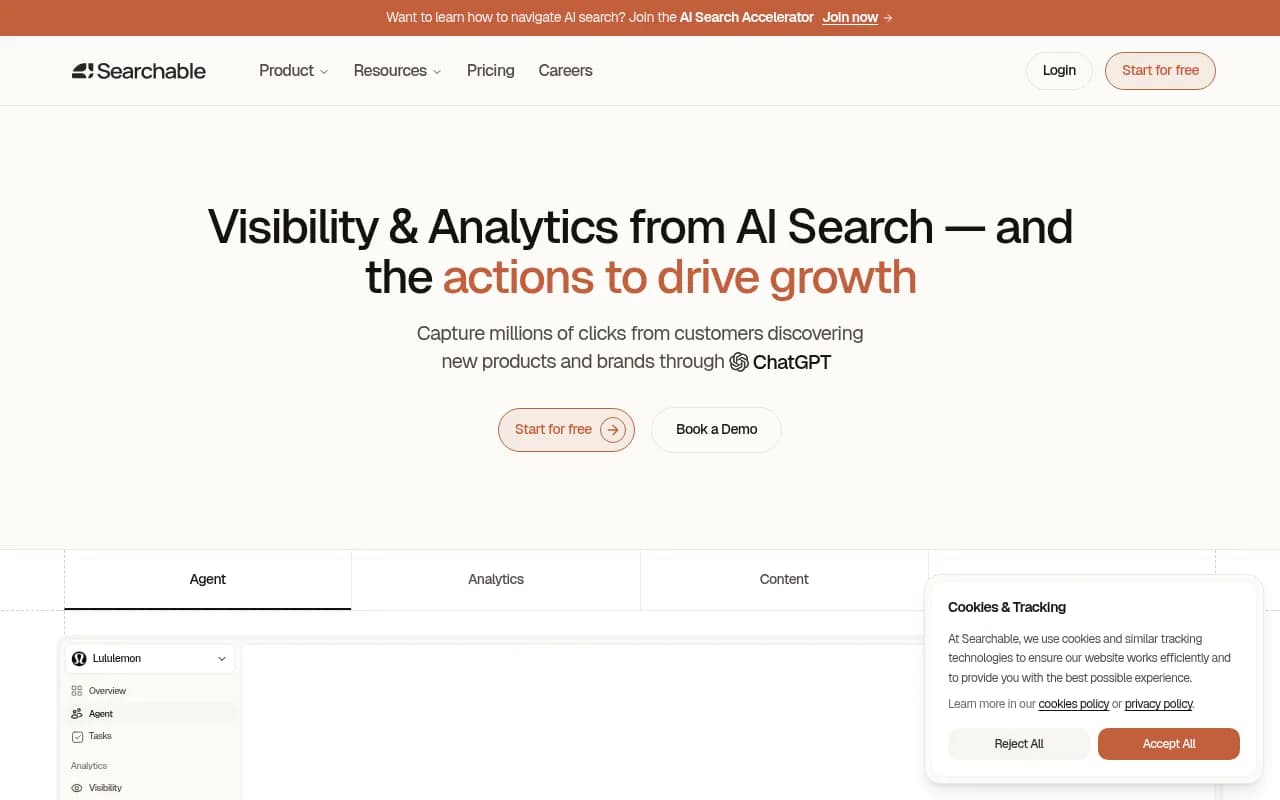
What Searchable actually charges, line by line
Searchable's public pricing has three tiers:
- Pro, $125/month: 100 tracked prompts, 9,000 AI answers per month, unlimited domains, 20 articles/month, 1 project
- Scale, $400/month: 500 tracked prompts, 45,000+ answers per month, 80 articles/month, white-label reports, dedicated account specialist
- Custom: 500+ prompts, custom engine add-ons, white-label reporting, API access, SLA
Annual billing knocks 20% off any of these. So far, that reads like a normal SaaS pricing table. The catch for agencies is the "1 project" line on Pro and the engine coverage. Only ChatGPT, AI Overviews, and Perplexity are included by default on the standard tiers — Claude, Copilot, Grok, and DeepSeek are paid add-ons until you reach Custom pricing. If your clients care about visibility in Copilot or Claude (and enterprise clients increasingly do), you're paying extra per engine, per account.
Then there's the agency-specific pricing, which is where things get genuinely confusing. Searchable's own "AI Search Accelerator" agency training page references Searchable Growth at $400/month for 3 seats. A separate third-party review from Profound, published in late July 2026, describes Searchable's agency tier as starting at $250/month for five projects under something called "Pitch Workspaces." Those are two different products, two different prices, and two different unit structures (seats vs. projects) being described as "the agency plan." Before you build a client-facing budget around either number, get a written quote with the current SKU name attached.
Searchable also runs a separate Agency Partner Programme with unlimited seats, unlimited sub-brands, and a white-label platform, but that's a reseller track with recurring commission structure, not the same as simply buying seats to run your own client work.
Running the real math: 10 clients, three scenarios
Here's where the "true cost" question actually gets answered. Let's say you run a 10-client agency and each client needs roughly 50 tracked prompts across the three default engines, with occasional reporting.
Scenario 1: One Scale account, split across 10 clients. At $400/month for 500 prompts, that's 50 prompts per client if you divide evenly — right at the edge of usable. But remember: Scale is scoped around a single project/workspace structure in most of Searchable's self-serve docs. If each client needs separate reporting, separate competitor sets, and separate white-label dashboards, one workspace stops working in practice, even if the prompt math pencils out on paper.
Scenario 2: Ten separate Pro accounts. $125 x 10 = $1,250/month. Each client gets their own 100-prompt allowance and isolated workspace, which solves the reporting problem but multiplies the base fee. That's $125/client/month before any engine add-ons.
Scenario 3: The agency SKU, assuming the $400/3-seat Growth figure holds. If "seats" here map loosely to client workspaces (unclear from public docs, which is itself a flag), three seats doesn't cover 10 clients. You'd need roughly 3.3x that spend, landing around $1,320/month — closer to the Scenario 2 math than the headline "$400 for agencies" framing suggests.
Add engine add-ons for clients who want Claude, Copilot, or Grok tracked, and per-client cost climbs further. The honest range for a 10-client agency, using Searchable's current public pricing and accounting for either multiple accounts or the ambiguous agency tier, lands between roughly $100 and $135 per client per month for bare prompt tracking, before any content generation credits or extra engines.
What the per-seat number doesn't capture
The subscription fee is only half the real cost. A third-party review from Profound (July 2026) flagged several functional gaps worth weighing against the price tag:
- No side-by-side engine comparison — you view ChatGPT, Perplexity, and AI Overviews data one at a time, which adds real hours when you're reporting across 10 clients weekly
- No persona segmentation, only location-based slicing
- The AI agent feature only runs while the browser tab stays open, and testers described it as slow and occasionally buggy
- No execution layer at all — schema fixes, content gaps, and internal linking recommendations export as a task list (even integrating with Linear), but nothing gets published automatically to a live site
That last point matters most for agencies, because it means the seat fee buys you monitoring, not work done. Every fix still needs a human to implement it manually, which is its own line item in your internal cost model, separate from the software bill.
How Searchable compares to agency-priced alternatives
| Tool | Starting price | Client/workspace structure | Content execution |
|---|---|---|---|
| Searchable | $125/mo (Pro), agency tier $250-400/mo | 1 project (Pro); unclear seat-to-client mapping on agency tier | Exports task lists only, no CMS publishing |
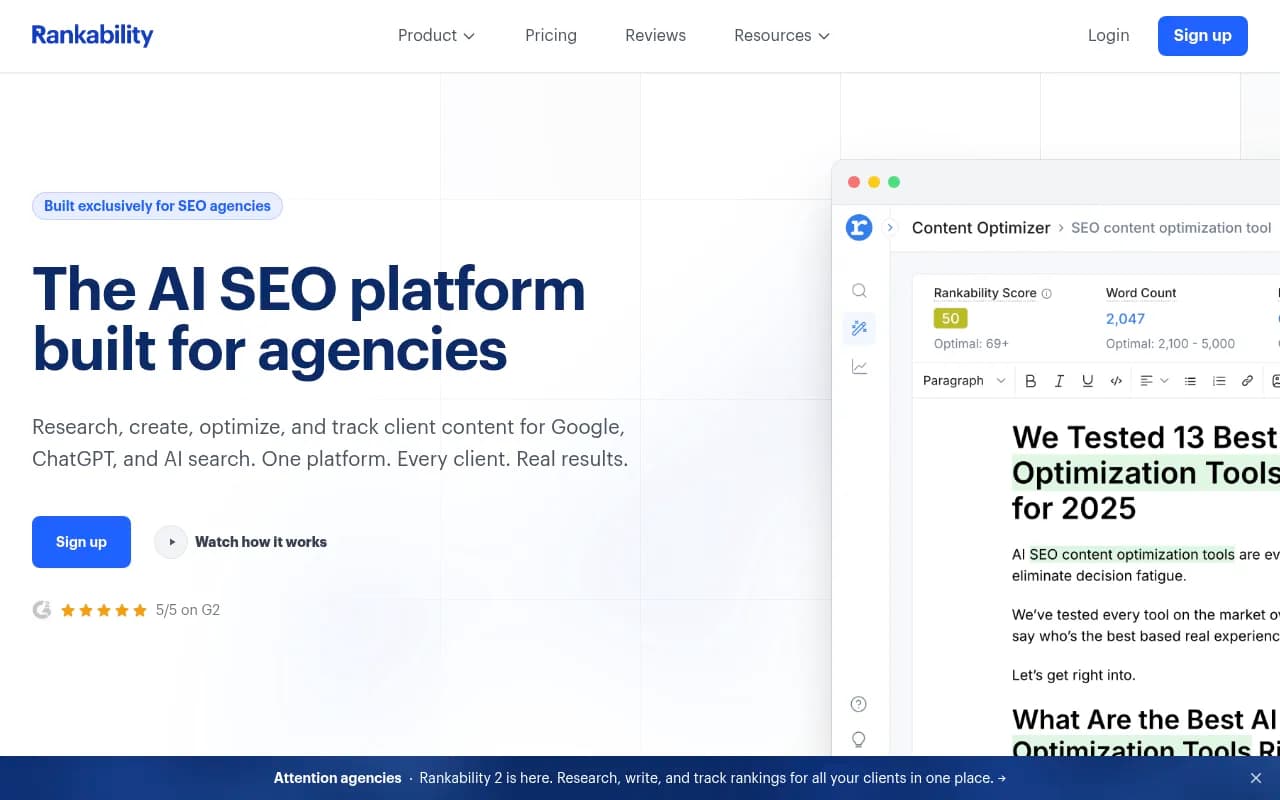
| Rankability | $99/mo | Unlimited clients and users on every plan | Unified AEO+SEO scoring, no native publishing |
| Profound | $99/mo (Growth $399/mo) | One workspace per account — 5 clients can mean 5 accounts | Monitoring only |
| Scrunch AI | ~$250/mo | 350 prompts, 3 users per plan | Monitoring only |
| HubSpot AEO | $50/mo | Tiered, bundled with Marketing Hub | Monitoring only |
| Peec AI | ~$95-245/mo | Project-based, extra engines $30-140/mo each | Monitoring only |
Rankability stands out here because it's one of the only platforms priced around unlimited clients rather than per-seat or per-project limits. If your agency's math problem is specifically "how do I avoid multiplying my software bill by my client count," that structural difference is worth more than a lower sticker price.
Where Promptwatch fits into the agency cost conversation
If the real pain point isn't just tracking fees but the fact that monitoring tools hand you a problem list and leave the fixing to you, it's worth looking at platforms built around closing that loop rather than just reporting on it. Promptwatch is one of the few AI visibility platforms with Content Agents that plan, write, and publish GEO-optimized content directly to a client's CMS (Webflow, Framer, or WordPress), plus Unified Actions that turn visibility and crawler data into a prioritized to-do list instead of a raw export.

For agencies specifically, the Agency tiers start at $199/month (Kickoff) with unlimited projects and prompts across 10 seats, scaling to $399/month (Growth, 25,000 responses) and $799/month (Scale, 65,000 responses). Because prompts and projects are unlimited rather than capped per client, the per-client math doesn't degrade the way it does with Searchable or Profound as your roster grows past 10. Crisp, an agency client on the platform, scaled to 5-10 published articles per day using the Content Agent and saw 2x higher conversion rates from AI traffic compared to traditional channels — a useful data point when you're trying to justify tool spend against actual retainer value, not just citation counts.
It also tracks crawler logs (ChatGPTBot, ClaudeBot, PerplexityBot, and 400+ others) hitting client sites, which Searchable doesn't offer at all, and covers Reddit and YouTube citation tracking, both channels Searchable's review flagged as gaps.
How to actually budget this for your agency
A few concrete steps before you sign anything:
- Get the exact per-client unit (seat, project, or workspace) in writing from any vendor, not just the headline monthly price. The Searchable Growth vs. Pitch Workspaces discrepancy shows why this matters.
- Calculate cost per client, not cost per plan. Divide the monthly fee by the number of clients you'll actually run through it, including any multi-account workarounds.
- Price in engine add-ons separately if your clients expect Claude, Copilot, or Grok coverage — these are rarely included in entry tiers across the category.
- Factor in implementation labor. If a platform only monitors and exports task lists, add your team's hourly rate for manual fixes to the real monthly cost.
- Compare against unlimited-client pricing models (Rankability, Promptwatch's agency tiers) if you're already past 10 clients or plan to grow past it within a year — the breakeven point usually arrives faster than agencies expect.
For a broader shortlist of platforms built specifically for multi-client AI visibility work, the GEO software directory at bestgeosoftware.com is a reasonable place to keep comparing options as pricing shifts through the rest of 2026.