Key takeaways
- A citation lifecycle has four points worth tracking: first cited date, rise, peak, and half-life. Review them weekly and you stop refreshing pages on a guess.
- Decay is not the same for every format. Promptwatch Data shows news losing half its cited pages in 36 days, while landing pages and docs are still mostly cited after 60 days. Judge each page against its own type.
- The routine below takes 20 minutes: 3 to cover data hygiene, 5 for new peaks, 7 for the decay queue, 3 for cross-checking with search data, and 2 to log decisions.
- Output matters more than dashboards. Every review should end with a short list of pages to refresh, with a named owner and a reason.
Why a weekly review beats a quarterly refresh calendar
Most content teams refresh on a schedule. Every page gets touched every six months, or the oldest ones get touched first. It feels orderly. It is also wasteful, because some pages are fine at 14 months and others go stale in five weeks.
AI search makes this worse. Profound's Citation Decay announcement (September 29, 2026) says half of the content answer engines cite is less than 13 weeks old. If that holds for your category, a quarterly cadence means you notice decay a full cycle late.
SEO teams already know content decay: a page slowly loses rankings and traffic. Writesonic put it neatly in a LinkedIn post in October 2026: AI search has its own version, where a page earns citations in ChatGPT or Perplexity and then shows up in fewer answers over the following weeks.

The fix is a short, boring, repeatable review. Not a deep audit. Twenty minutes, same day each week, same sheet or dashboard, same questions.
The four numbers that describe a citation lifecycle
Before the routine makes sense, you need shared vocabulary. Profound defines these terms in its Citation Decay view, and they are useful whatever tool you use.
- Citation share: the percentage of citations a page gets on a given day out of all citations across the models you track. Profound smooths this on a rolling two-week average because daily numbers are noisy.
- First cited date and rise: the first day an answer engine cited the page, and the number of days between that date and the peak. A short rise means the page caught on fast. A long rise means it built slowly.
- Peak: the highest point of smoothed citation share.
- Half-life: days from the peak until share falls to half the peak and stays there. In Profound's definition, it must hold for 14 straight days through to today before the page counts as decayed.
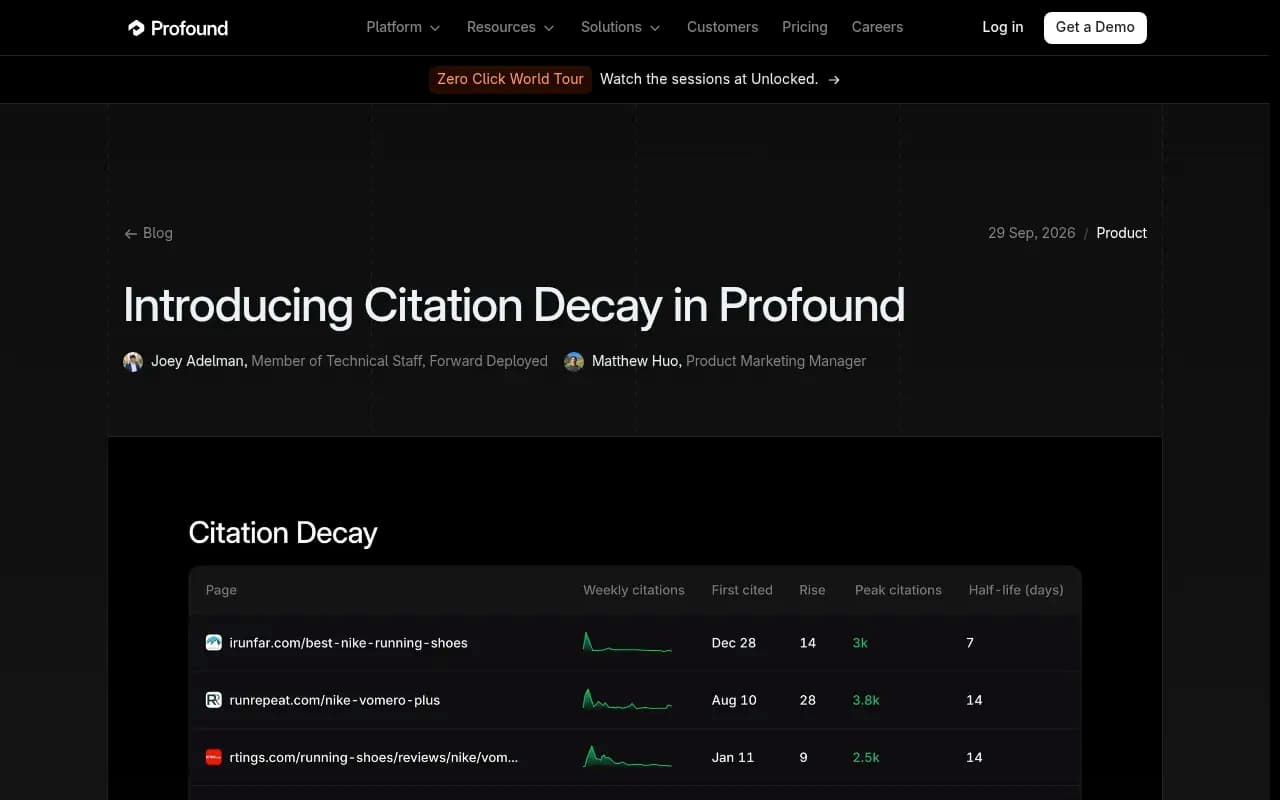
Profound also screens out pages that would distort the averages: the page must be live at least 28 days, have at least 5 citations in the window, reach a peak share above zero, and have at least 5 raw citations inside its peak 14-day window. Borrow that logic even if your tool does not enforce it. Do not review a page with three lifetime citations. There is no curve to read.
What decay looks like by content type
This is where most teams go wrong. They apply one threshold to everything and end up refreshing news posts that were always going to fade, or ignoring a pricing page that quietly lost half its citations.
Promptwatch Data tracked every classified page ChatGPT cited on July 6, 2026 through October 4, 2026 and measured how many were still being cited. The full method and charts are in the ChatGPT content half-life report. Here is what it found for the pages tracked:
| Content type | Still cited at 30 days | Still cited at 60 days | Half-life |
|---|---|---|---|
| Landing pages | 78% | 69% | Likely near or beyond 90 days |
| Docs | 76% | 67% | Likely near or beyond 90 days |
| Comparisons | 72% | 63% | Likely near or beyond 90 days |
| Listicles | Not stated | 60% | Likely near or beyond 90 days |
| Product pages | Not stated | 55% | About 74 to 77 days |
| Reviews | Not stated | 55% | About 74 to 77 days |
| How-to guides | Not stated | 55% | About 74 to 77 days |
| News | Not stated | 41% | About 36 days |
A caveat on the long-lived types: landing pages, docs, comparisons and listicles only crossed 50% in the final week because the tracking window ended. Their real half-life is probably longer than 90 days, but the data cannot say how much longer.
Two other details from the report are worth pinning to the wall. Almost a quarter of news pages were never cited again after day 0. And ChatGPT cited 93% of docs again after day 0, against 77% of news pages.
Note that this measures how many pages remain cited, not how a single page's citation share falls. It is a population benchmark, not the same thing as Profound's per-URL half-life. Still, it gives you a sane default for what normal looks like.
Turning the benchmark into review rules
Here is how I would translate it into thresholds for your sheet:
- News and time-bound posts: expect a half-life around five weeks. A drop to half at week five is normal. Do not spend refresh time here unless the topic is evergreen in disguise.
- Product pages, how-tos and reviews: expect roughly 11 weeks. A page still cited at week 11 is in line with the data. A page that halves at week 4 is an outlier worth checking.
- Landing pages, docs, pricing and comparisons: expect them to last. A page of one of these types that has lost half its citation share inside two months is an anomaly. Something changed: a competitor page, a crawl error, a rewrite, a price change.
One more thing about volume. In the Promptwatch Data content type report (Sep 28 to Oct 4, 2026), product pages made up 22.4% of ChatGPT citations and landing pages 16.8%, so together they are 39% of what gets cited. That is where your review time pays off most.
The 20-minute routine
Pick a fixed slot. Tuesday morning works because it leaves time to act before the week is gone. You need one view of per-URL citation share over time, and ideally the same page list joined with Search Console data.
Minutes 0 to 3: check the data before reading it
Quick hygiene so you do not chase noise.
- Confirm tracking ran all week with no gaps in prompts or models.
- Check that the date range covers at least the last 8 weeks.
- Confirm the page list is current. New launches should be in, retired URLs out.
- Look for model changes. If one engine changed behavior this week, a drop across all pages on that engine is not decay.
The last point matters. Promptwatch Data recorded a site-operator shift in ChatGPT on August 8, 2026, when site: queries went from about 0.4% to about 17% of fanout queries overnight, and a Reddit citation collapse on August 14, 2026, when reddit.com fell from roughly 4% to 0.5% of ChatGPT citations. Platform-wide shifts like these will move many pages at once. Rule them out first.
Minutes 3 to 8: new peaks and first citations
Scan for pages that hit a new peak or got cited for the first time this week.
- Which pages hit a new peak? Note the rise: how many days from first citation to peak?
- Which pages were cited for the first time? Write down format, topic, and publish date.
- Which content types are producing short rises? Those are the formats AI picks up quickly.
This part is the fun part, and it is easy to overspend time here. Cap it at five minutes. Peaks do not need action. They need a note, so you can answer later "what do our fast risers have in common?"
Minutes 8 to 15: the decay queue
This is the core of the review. Sort owned pages by how far their smoothed citation share has fallen from peak, and filter to pages that clear a minimum bar (at least 5 citations in the window, live at least 28 days).
For each page near or past half of its peak, ask four questions in order:
- Is this normal for its type? Compare to the table above. A five-week-old news post at 50% of peak is fine.
- Is it decaying everywhere or in one model? Filter by engine. If only one model dropped it, the cause is probably that engine's behavior, not your page.
- Is the page still worth ranking for? If the topic is dead, let it go.
- Is it past peak and falling fastest? Those go to the top of the queue.
Profound's own advice here is sound: the pages worth updating this week are the ones whose citation share is already falling toward half its peak, not the ones that happen to be oldest. Sort by decay, not age.
Move at most five pages into this week's refresh queue. More than that and nothing ships.
Minutes 15 to 18: cross-check with search data
A citation curve alone does not tell you why. Pull the same pages into Google Search Console and compare.
- Citations down, impressions flat: probably an AI-specific issue. Check freshness, structure, and whether a competitor page replaced yours.
- Citations down, impressions down: classic content decay. A refresh will help both channels.
- Citations flat, impressions down: AI is covering for a weaker organic position. Watch but do not panic.
The point of this step is to stop treating AI citations as a separate universe. One reason to refresh a page is far more convincing when two data sources agree.
Minutes 18 to 20: log the decisions
Write three lines per page in the queue:
- Page and type
- Evidence: how far from peak, how many days since peak, which model
- Action and owner: refresh, merge, redirect, leave, or investigate
That log is the real deliverable. After a few weeks it also answers the question your boss will ask: did the refreshes work? Compare citation share two to four weeks after each update.
Tools for each part of the routine
You can run the first version of this in a spreadsheet exported from any tracker. But some tools do more of the work.
Profound now has a Citation Decay view in Answer Engine Insights that plots a curve per URL with first cited date, peak, rise and half-life, filterable by owned domains and by model. It is the closest thing to the review described here as a single screen.
Profound

For teams that want the loop closed (track, find the gap, write the fix, publish, check whether it worked), Promptwatch covers more than monitoring. Its Citation Trends classify every citation into 22 content types and 20 source types, with first cited date, ramp-up, peak, and decay half-life per cited page. That content type split is what lets you apply the per-format thresholds above. Page Tracker watches specific URLs, Search Insights overlays Google Search Console and Bing data on AI crawls and citations, and the Content Agent plus Content Refresh handle the rewrite when a page lands in your queue. Its Action Board can turn weekly findings into assigned tasks.

For the Search Console half of the cross-check, Google Search Console is free and enough to start.
For the refresh itself, content optimizers like Clearscope and Surfer SEO help you compare a decaying page to what is currently cited.

| Job in the routine | What you need | Options |
|---|---|---|
| Per-URL citation curves and half-life | AI citation tracking by page | Promptwatch, Profound |
| Format-level decay comparison | Citations classified by content type | Promptwatch Citation Trends |
| Organic cross-check | Impressions and clicks per page | Google Search Console, Bing Webmaster Tools |
| Refresh drafting | Content brief and optimization | Promptwatch Content Refresh, Clearscope, Surfer SEO |
| Task tracking | Owner and status per page | Promptwatch Action Board, or your project tool |
If you are still choosing a tracker, the GEO software directory at bestgeosoftware.com lists the options side by side.
Common mistakes in a lifecycle review
Reviewing every page
You will not. Filter to pages that clear a minimum citation count, or the review turns into noise management. A page with two citations total has no lifecycle.
Treating all decay as a problem
News fades. That is its job. The Promptwatch Data report suggests using news for short bursts of visibility, and I agree. Do not burn refresh hours on content that had a natural five-week life.
Reacting to one week
Smoothing exists for a reason. Profound uses a two-week rolling average and requires 14 straight days below threshold before calling a page decayed. If your tool shows raw daily share, wait for a second week before acting unless the drop is dramatic.
Blaming the page for a platform change
Before you rewrite anything, check whether the same drop appears across unrelated pages in the same engine. If it does, it is the engine.
Never closing the loop
A refresh with no follow-up is a guess with extra steps. Put a recheck date in the log. Two to four weeks after publishing, look at whether the page's share recovered. If it did not, the cause was not what you assumed.
Using the data beyond the weekly queue
After six to eight weeks of logs, patterns start to show. Three worth looking for:
- Which formats you publish have long rises and long half-lives. Make more of them.
- Which formats fade in a couple of weeks. Publish them faster, or change the approach.
- Which pages decayed in one model only. That usually points to how that engine sources content, and the fix is different.
This is the same idea Profound describes when it suggests comparing half-lives across product pages, comparison pages, glossary entries, and launch posts. You do not need a big tool to do it. A sheet with page type, rise days, and half-life days gets you most of the way.
If you lack the team time to run this weekly, an agency can run it for you. 1001 SEO Media runs weekly AI citation reviews as part of its GEO work for clients.
A starting template
Copy this into a sheet and fill it every Tuesday:
| URL | Type | First cited | Peak date | Rise (days) | Days since peak | Share vs peak | Normal for type? | Action | Owner | Recheck date |
|---|---|---|---|---|---|---|---|---|---|---|
| /pricing | Landing | |||||||||
| /blog/example | How-to |
Keep the "Normal for type?" column. It is the single field that stops you from refreshing the wrong pages.
Bottom line
Twenty minutes a week is enough if the review ends in a short, owned list. Check the data, note new peaks, work the decay queue against per-format benchmarks, cross-check with search data, and log what you decided. Start this week, with whichever tracker you already have, and add the recheck column on day one.