Key takeaways
- A pitch project is a short-lived workspace where you track a prospect's brand and competitors across AI assistants before they become a client. It costs little and replaces the capabilities deck.
- Show the gap, not the score. "A competitor is named in this answer and you are not" survives noisy data. "You are at 23%" does not.
- Use at least two AI models and many prompts. Small pitch samples swing a lot, so treat them as a direction, not a verdict.
- Promise a diagnosis and a ranked plan in month one. Promise visibility movement only after a baseline.
- The audit opens the door. The money is in the readout, the scoped plan, and the second scan that proves the work moved something.
Why the pitch changed in 2026
Every agency owner I hear from has the same email in the inbox: "Are we showing up in ChatGPT?" The client wants an answer this week. The agency wants something better than a screenshot of one chat.
The demand is real. SEOFOMO's 2026 survey of 171 search professionals found that 98% had been asked about AI search visibility by a client, manager, or decision maker, up from 91% a year earlier. Yet in an April 2026 Squarespace survey of 1,041 small businesses, more than two-thirds had not looked at how they appear in AI answers. Clients are curious and have no first step. A pitch project is that first step, with their own brand name on it.
The old pitch was a deck about how search is changing. The new one is a live comparison: here are the questions your buyers ask, here is who the assistants name, here is where you are missing. It is hard to argue with your own absence.
What a pitch project is
A pitch project is a lightweight workspace, separate from your paying client capacity, where you enter a prospect's brand and a handful of competitors and pull their AI visibility profile before the meeting.
Vendors implement it differently. Peec AI's agency plans include pitch projects as 7-day workspaces that sit outside your client quota (3 active on Essential, 10 on Growth, 25 on Scale, per its agency page), and you can convert one into a client project and keep the history as a baseline. Brandlight's agency guide says Peec includes unlimited free pitch projects, while noting that Brandlight itself has no free pitch tier. Other platforms use free tiers or branded scanners for the same job. Always check each vendor's current terms, including whether running a brand you have no relationship with is allowed.
Promptwatch handles this through pitch projects on its agency plans, which you can create through the product, the API, or the MCP server. The agency plans (Kick-off at $199/mo, Growth at $399/mo, Scale at $799/mo) include unlimited projects, prompts, and team seats, and you can confirm current terms at promptwatch.com/pricing.

What the audit should show
A good pre-pitch audit answers four questions in under ten minutes.
- Who gets named? Run 15 to 25 buyer-style questions and log which brands each assistant names. Phrase them the way a buyer types into a chat window, not the way an SEO types into Google.
- Where is the prospect absent? List the prompts where competitors appear and the prospect does not. This is the slide the room remembers.
- Why? Look at which sources the assistants cite. Third-party listicles, review sites, forums, and documentation often decide who gets named, not the brand's own blog.
- Can the site even be read? Check whether AI crawlers are blocked in robots.txt. Cloro's July 2026 comparison of 1,058 domains found sites blocking OpenAI's crawler had a median of 0.003 ChatGPT citations per Google ranking versus 0.417 for sites that let it in. That is a correlation, not a controlled test, but a blocked crawler is the most concrete first fix you can name.
The free AI visibility report and the Agentic Readiness Check are useful for the crawler and readiness piece when you have no workspace yet.
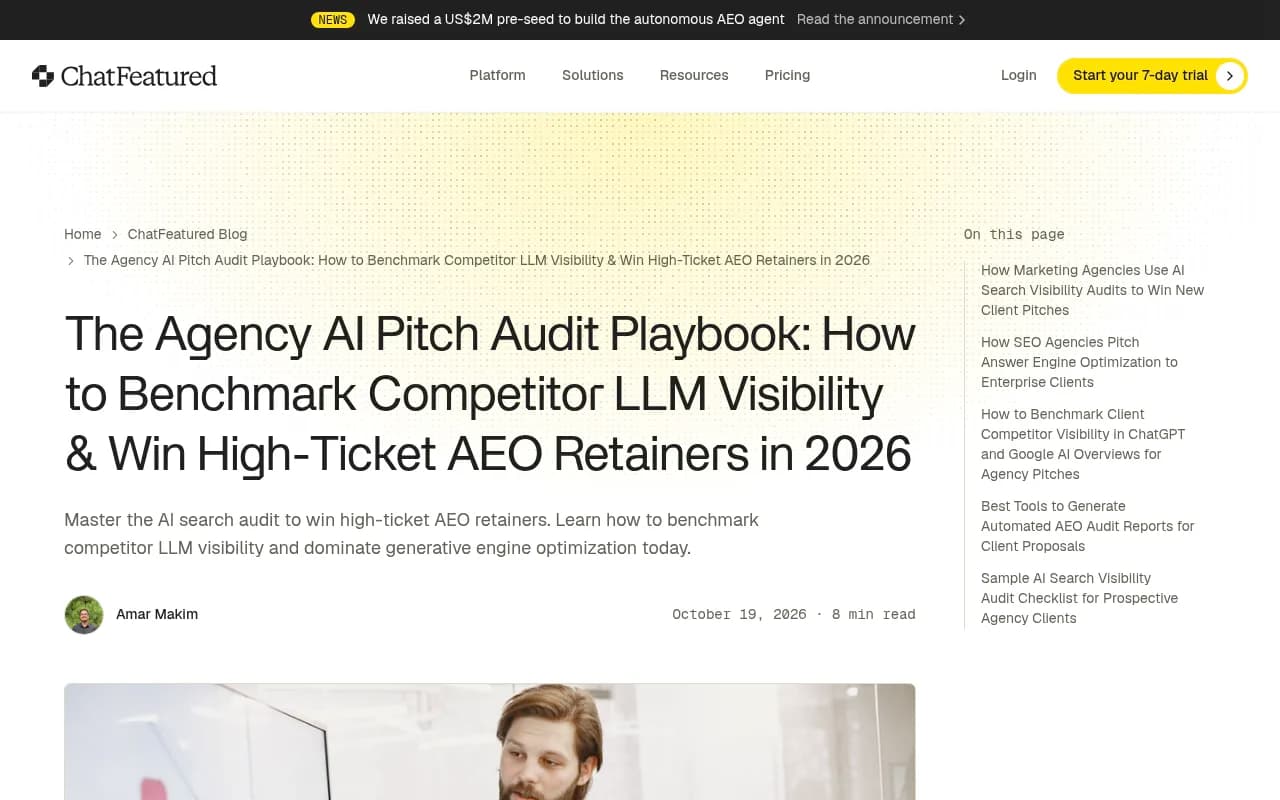
Some vendors package this as a scored rubric. ChatFeatured's playbook, for example, proposes a 100-point checklist across crawler accessibility, structured data, content extractability, earned media, and multi-engine share of voice. That is one vendor's framework, not a standard, but a fixed rubric does make the readout easier to repeat across prospects.
Small samples lie: read the data honestly
This is the part most agencies skip, and it is where pitches go wrong.
3RD published first-party data from 111 brands it tracks: the median brand's daily visibility moved 12.5 points between its best and worst day in a single month with no change to its prompts. Brands with fewer than about 100 AI answers a day swung about twice as much as brands with 230 or more (median standard deviation 4.5 vs 2.1 points). A pitch workspace with 5 to 25 prompts on one or two models sits at the noisy end. That is vendor data from a company that sells a competing product, so attribute it that way, but it matches what anyone sees running small prompt sets.
Promptwatch's own data shows why one prompt tells you little. In Promptwatch Data's unique domains report (Sep 28 to Oct 4, 2026), 47.6% of cited ChatGPT responses named 10 or more different domains. For organic prompts that rose to 52.5%. With answers drawing on that many sources, a single snapshot is an anecdote.
Three rules that survive the noise:
- Show the gap, not the score. A named competitor in a specific answer is evidence. A percentage from 20 prompts is a guess.
- Show at least two models. 3RD found that for 37 of 60 brands, a different competitor led on different assistants for the same questions. One model can make a prospect look fine or hopeless.
- Commit to the plan, not the number. Promise a first diagnosis and ranked plan in month one. Promise movement after a baseline.
There is also a difference between being mentioned and being recommended. 3RD's data across 60 brands had the median brand mentioned in 19.8% of AI answers but recommended in 0.2%. Clients care about the second number, so check whether your tool separates them.
A ten-minute call script
You do not need a polished demo. You need a structure.
- Minute 0 to 2. Ask who their customers compare them with. Enter those competitors live.
- Minute 2 to 6. Run three or four of the buyer questions on two models while they watch. Narrate who is named.
- Minute 6 to 8. Show one cited source that is not their site and explain why that page is helping a competitor.
- Minute 8 to 10. Say plainly that this is a snapshot, then offer the next step: a full audit with a ranked plan.
Handle the snapshot objection before they raise it. A prospect who hears you admit the sample is small trusts the rest of what you say.
Tool options for pitching
Pitching is mostly solved across the category, so pick on what happens after the pitch. Here is how the options in this research compare.
| Tool | Pitch workflow | Agency angle | Watch for |
|---|---|---|---|
| Promptwatch | Pitch projects via app, API, MCP | Unlimited projects and seats on agency plans, crawler logs, content agents on Enterprise | Content Agent and white-label portal need Business or Enterprise |
| Peec AI | Free 7-day pitch projects outside client quota | Unlimited seats, Looker Studio, MCP | Basic tracking; no crawler logs or content generation |
| Profound | Agency Mode for multi-client delivery and pitching | Strong for technical teams with enterprise clients | Higher price point |
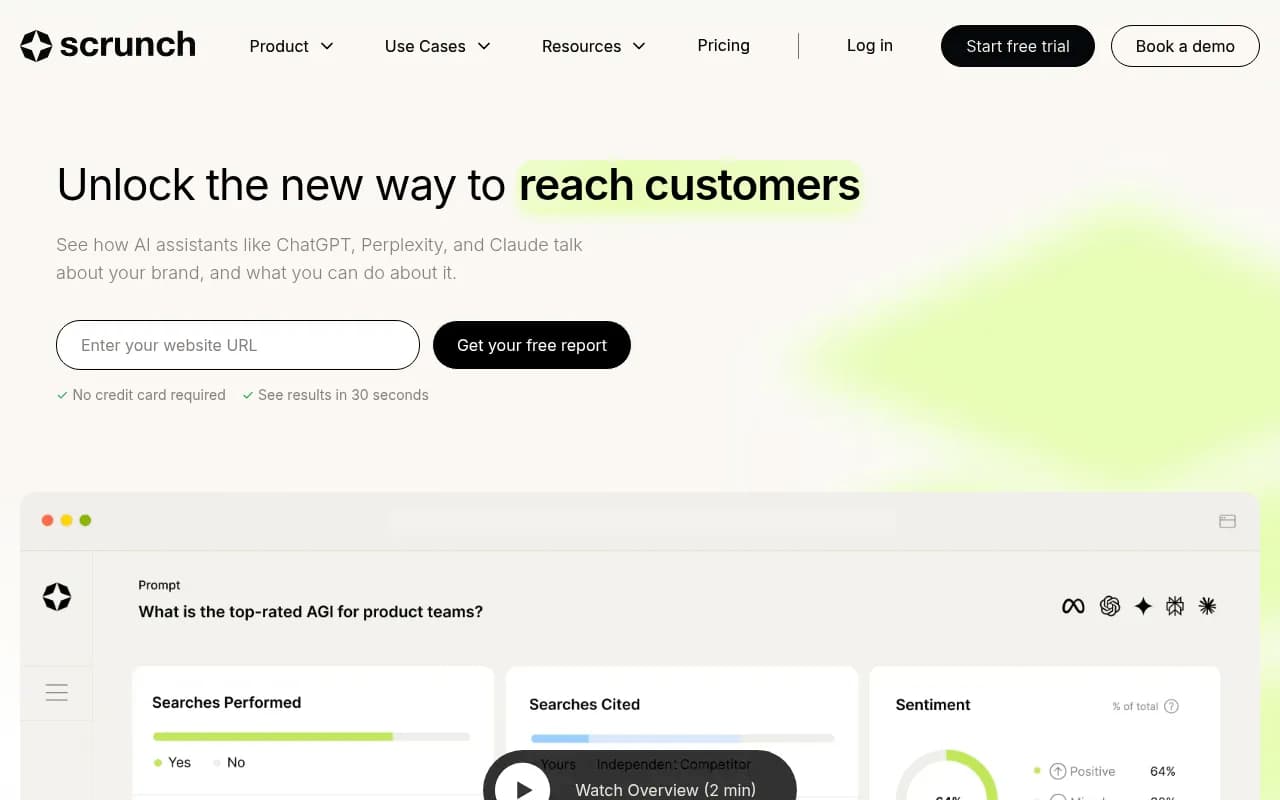
| Scrunch AI | Agency tier | From $500/month per Brandlight's guide | Monitoring-focused |
| AthenaHQ | Free tier produces enough for a pitch | Light entry point | Fewer delivery tools |
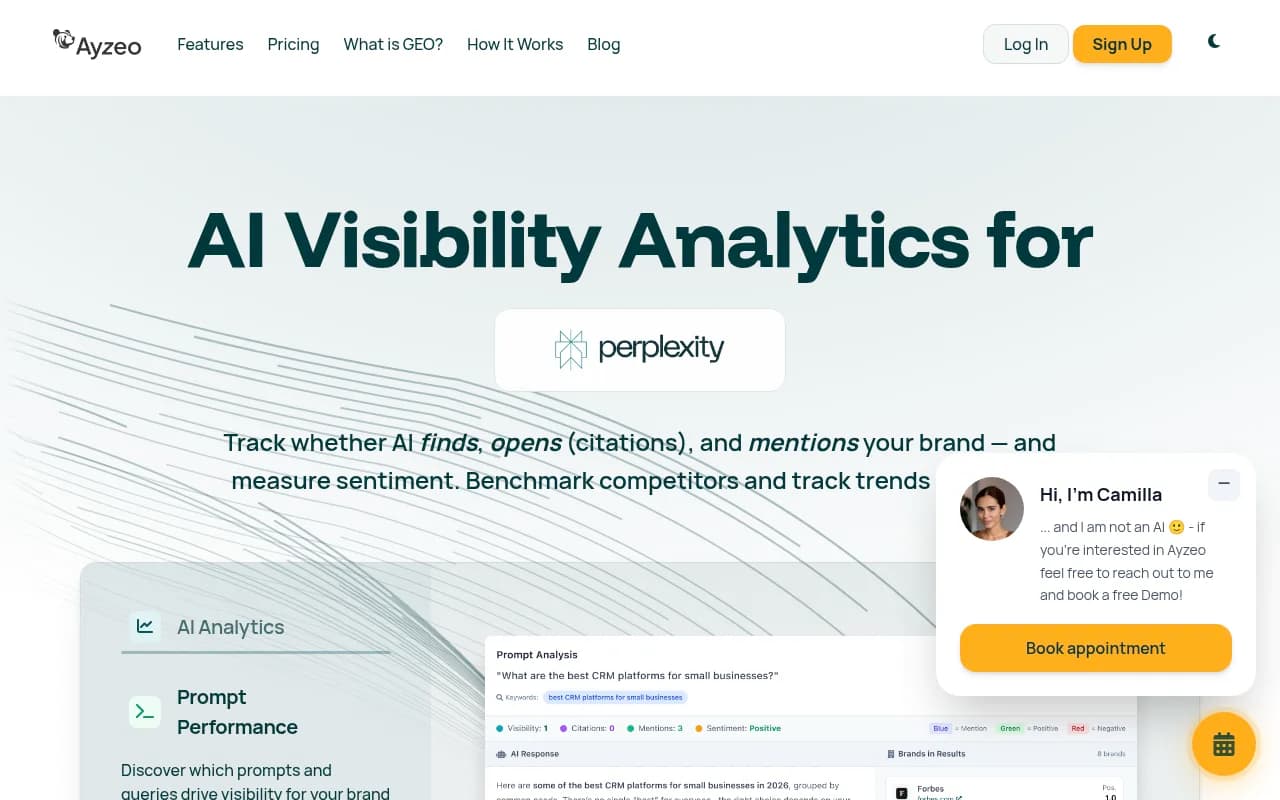
| Ayzeo | Prospect Scanner, 30 monthly scans on Pro and Enterprise | White-label reports and viewer seats | Website-focused scope |

Profound


If you want to browse more platforms by category, the GEO software directory at bestgeosoftware.com is a good starting point.
A practical test before you commit: run the same pilot on two platforms with one real client, the same 20 buyer questions, at least two models, over two weeks. Then compare the hours it took your team to get from "here is your gap" to "here is what we shipped."
What the client holds when the call ends
The scan is cheap. What you sell is the readout. Lighthouse Local's reselling guide puts it well: the fee pays for reading findings against that client's business and turning them into a scoped, priced plan.
Leave behind:
- A branded report with the overall picture and category breakdown
- Ranked findings in impact order, each explained in a sentence
- A short scope: groups of fixes with an owner, a price, and a date
- One paragraph on what the fixes can and cannot be expected to change
- The baseline date, so a second scan has something to be measured against
Here is a plain email you can adapt for existing clients:
Subject: What AI can and can't read on yourclient.com

Hi [Name],

We ran yourclient.com through our AI visibility audit this week. Two findings stand out: [finding one] and [finding two].

More of your customers now ask an AI assistant who to hire, and those assistants build answers partly from what they can read on your site.

I'd like to walk you through the full report on a 45-minute call. You'll leave with every finding ranked, a fixed quote for each group of fixes, and our view on which to do first. The audit and call are [your price].

Does [day] work?

[Your name]
It opens with their situation, names two findings (enough to prove the scan is real), and states the price up front.
Promise the fix, not the mention
No one can promise an assistant will name a client. Say which findings are strong and which are not.
Crawler access is concrete. Structured data needs a careful pitch: Ahrefs tracked 1,885 already-cited pages as they added schema against 4,000 matched controls and reported no clear positive or negative effect on citation frequency. Pages with zero citations were not in the test, so schema is not ruled out, but do not sell it as a switch.
Also keep the site audit and the AI answers separate. A site can score well on classic SEO and still be thinly named by assistants. Telling a client that early builds trust for everything that follows.
Three objections that kill these deals
"We already pay you for SEO." Show the gap between a strong rankings picture and an absent AI picture on the same site. The audit reads things a rankings report does not.
"There is no budget." Often true. UPrinting's survey of 1,000 small business people found 57.6% had flat or lower marketing budgets in 2026. A one-time fixed-scope audit is an easier yes than a new monthly line. Sell the audit first. This is also why bolting AI visibility onto an existing SEO retainer as a free line item erodes margin: the tool cost goes up and the fee does not.
"Can't I run a free one myself?" Yes, and say so. A form cannot decide which six of sixteen findings matter this quarter, price the work, and answer for it.
From pitch to delivery
Winning the pitch is the easy half. Delivery is where agencies either scale or stall: someone has to turn "AI does not mention you" into briefs, pages, outreach, and tickets for every client.
A few things worth checking when you shortlist:
- Isolation. Client A's competitive set must never leak into client B's dashboard.
- Pricing model. Per-client pricing punishes growth. Model it against your real roster.
- Branding. Whether the client sees your logo or the vendor's on the monthly report.
- Third-party work. Brandlight's argument is that most citations that build an AI answer sit on pages neither you nor the client owns: review sites, editorial, Reddit threads, retailer pages. Ask any vendor to show a ranked list of the specific external pages driving a client's category, live, with real data.
This is where platforms that go past monitoring earn their keep. Promptwatch's Content Agent plans, writes, and publishes against visibility gaps (Business and Enterprise), and IP-verified crawler logs show whether AI bots actually read what you shipped. The agency solution page covers the workflow, and Monks' case study shows an enterprise agency turning citation gaps into client content roadmaps. Agency plans do not include the Content Agent or white-label portal, so agencies needing those should look at Enterprise.
For more on tracking tools built for agencies, the directory at ai-rank-tools.com lists rank trackers by use case.
The second scan is where the retainer starts
An audit sold once is a project. Run twice, it becomes a service. After fixes ship, scan again and put the two reports side by side. The client sees movement, and you have earned the right to ask the question the audit cannot answer: are the assistants naming them now?
A monthly report should include:
- Visibility and recommended rate, by model and market
- What you shipped, task by task
- What moved, read against prompts you did not touch
- Prompt-level wins and losses: three gained, three lost, and why
The control matters. If everything moved, the tool or the model changed, not your work. If your pages moved more than the rest, you can say so with a straight face. If they did not, say that too.
When traffic data is available, tie it to revenue. Peec's agency page pitches attribution of AI-referred visits to conversions, and Promptwatch's visitor analytics does the same for traffic from ChatGPT, Perplexity, Gemini, and others. One caveat: ChatGPT stopped sending a referrer on October 8, 2026, so tagged links such as utm_source=chatgpt.com are needed to count that traffic reliably.
Timing also matters. A 2026 Moxo report on mid-market and enterprise B2B companies found 43% of client churn happens in the first 90 days. Local clients are a different population, but put the audit in onboarding, not only in your upsell calendar, so month one has something visible.
A simple pitch-to-retainer checklist
- Create a pitch project with the prospect and three to five real competitors.
- Run 15 to 25 buyer prompts on at least two models.
- Note the five clearest gaps and one cited third-party source per gap.
- Check crawler access and basic site readability.
- Present the gaps live and say the sample is small.
- Send the branded readout with a scoped, priced plan and a baseline date.
- Convert the pitch project to a client project and keep the history.
- Scan again after the first fixes and report against a control.
Where this leaves you
Pitch workspaces are cheap now, so the pitch itself is not the advantage. The advantage is what you do around it: honest sampling, a gap the client understands in one look, a plan you can price, and a second scan that proves the work. If you want to try the loop, Promptwatch's 7-day free trial works on monthly Essential, Professional, Business, and agency plans, and you can compare against the rest of the field using the 2026 platform comparison. Run it on one real prospect this week and see how the conversation changes.