Key takeaways
- Hall AI users are switching primarily to platforms that combine monitoring with content optimization — not just dashboards that show data.
- The GEO community in 2026 is split between brands that want full-stack AI visibility tools and those that just need lightweight tracking.
- 40% of AI users now trust AI search results more than traditional search, making AI visibility a real business priority, not a nice-to-have.
- The most common complaint driving Hall AI departures: it shows you where you're invisible but doesn't help you fix it.
- The tools getting the most traction as replacements range from enterprise-grade platforms to lean, affordable trackers depending on team size and budget.
If you've been using Hall AI and started wondering whether you're getting enough out of it, you're not alone. The GEO community — the marketers, SEO teams, and agencies who've made AI search visibility a core part of their work — has been pretty vocal in 2026 about what's working and what isn't.
This guide pulls together what people are actually switching to, why, and which tools make sense depending on what you need. No fluff, just the patterns that keep coming up.
Why people are leaving Hall AI
The core issue isn't that Hall AI is broken. It's that the category has moved on.
When AI search monitoring first became a thing, just knowing whether your brand appeared in ChatGPT or Perplexity felt like enough. That was 2023 and early 2024. Now, with 40% of AI users trusting AI-generated answers more than traditional search results (per Incremys's 2026 GEO statistics report), the stakes are higher. Brands aren't just curious about AI visibility anymore — they need to improve it.
That's the gap Hall AI users keep hitting. The tool tells you where you stand. It doesn't tell you what to do about it. And in a market where the global number of AI tool users is projected to grow by 826 million between 2025 and 2031 (Master of Code, 2026), "we're tracking it" is no longer a strategy.
The switching patterns from the GEO community break down into a few distinct groups:
- Teams that need a full action loop (find gaps, create content, track results)
- Teams that want better prompt intelligence and competitor data
- Agencies that need multi-client management and white-label reporting
- Smaller teams that just want something cheaper and more focused
Here's where each group is landing.
The full-stack switch: platforms that go beyond monitoring
The biggest wave of Hall AI departures is going to platforms that don't just track visibility — they help you improve it. This is the "action loop" crowd: marketers who've realized that a dashboard full of red metrics is useless without a clear path to fixing them.
Promptwatch
Promptwatch is the name that comes up most often in this category, and for good reason. It's built around a three-step cycle: find the gaps, create content that fills them, and track whether it worked.

The Answer Gap Analysis feature shows you exactly which prompts your competitors are appearing for that you aren't. Not vague categories — specific questions and topics that AI models are already answering for your competitors. From there, Content Agents generate articles, comparisons, and briefs grounded in real prompt data and citation patterns. Then page-level tracking shows whether the new content actually gets cited.
It also has AI Crawler Logs, which is something most competitors don't offer at all. You can see when ChatGPT or Perplexity crawled a specific page, what errors they hit, and how long it took for a crawl to turn into a citation. That kind of transparency is genuinely useful for diagnosing why content isn't getting picked up.
Promptwatch monitors 10 AI models (ChatGPT, Perplexity, Google AI Overviews, Claude, Gemini, Grok, DeepSeek, Copilot, Meta AI, Mistral) and covers Reddit and YouTube tracking — two channels that directly influence AI recommendations but get ignored by most tools.
Pricing starts at $99/month for the Essential plan (1 site, 50 prompts, 5 articles), with Professional at $249/month and Business at $579/month.
AthenaHQ
AthenaHQ is a solid monitoring platform that's picked up some Hall AI refugees, particularly teams that want clean data without the complexity of a full optimization suite. It's more monitoring-focused than Promptwatch — you get good visibility tracking across AI engines, but you won't find content generation or crawler logs here.

Worth considering if your team has a separate content operation and just needs reliable data to feed it.
Profound
Profound targets enterprise teams and has a strong feature set for tracking brand mentions across 9+ AI search engines. The price point is higher, and it doesn't include Reddit tracking or ChatGPT Shopping monitoring, but for large brands that need depth of coverage, it's a legitimate option.
Profound

The competitor intelligence switch
Some Hall AI users aren't leaving because they want content tools — they want better competitive data. They want to know not just "are we visible?" but "who's beating us and why?"
Otterly.AI
Otterly.AI has become a popular choice for teams that want a clean, focused monitoring experience. It tracks brand mentions across ChatGPT, Perplexity, and Google AI Overviews, and the interface is straightforward. The limitation is that it's monitoring-only — no content generation, no crawler logs, no prompt volume data.
Otterly.AI

Scrunch AI
Scrunch AI is another monitoring-focused platform that's picked up users looking for competitive heatmaps and brand mention tracking. It's in a similar position to Otterly.AI: good for tracking, less useful for acting on what you find.
Peec AI
Peec AI is a lightweight option that's gotten traction with smaller marketing teams. It covers the basics of AI search visibility tracking without a lot of overhead.

The agency switch
Agencies have specific needs that consumer-focused tools often don't address: multi-client management, white-label reporting, and the ability to show clients clear before/after data.
Rankscale
Rankscale is built with agencies in mind and has been picking up users who need to manage multiple clients' AI visibility from one place. The reporting is clean and client-presentable.
Search Party
Search Party takes a different angle — it's more of an AI automation consultancy that builds custom workflows. Some agencies are going this route when they want bespoke solutions rather than off-the-shelf tools.
Search Party
Conductor
Conductor has added AI citation tracking to its traditional SEO platform, which makes it a reasonable choice for agencies already using it for conventional SEO work.
The budget switch
Not everyone needs enterprise-grade tooling. Smaller teams and solo practitioners who were using Hall AI for basic monitoring are often switching to lighter, cheaper alternatives.
LLM Pulse
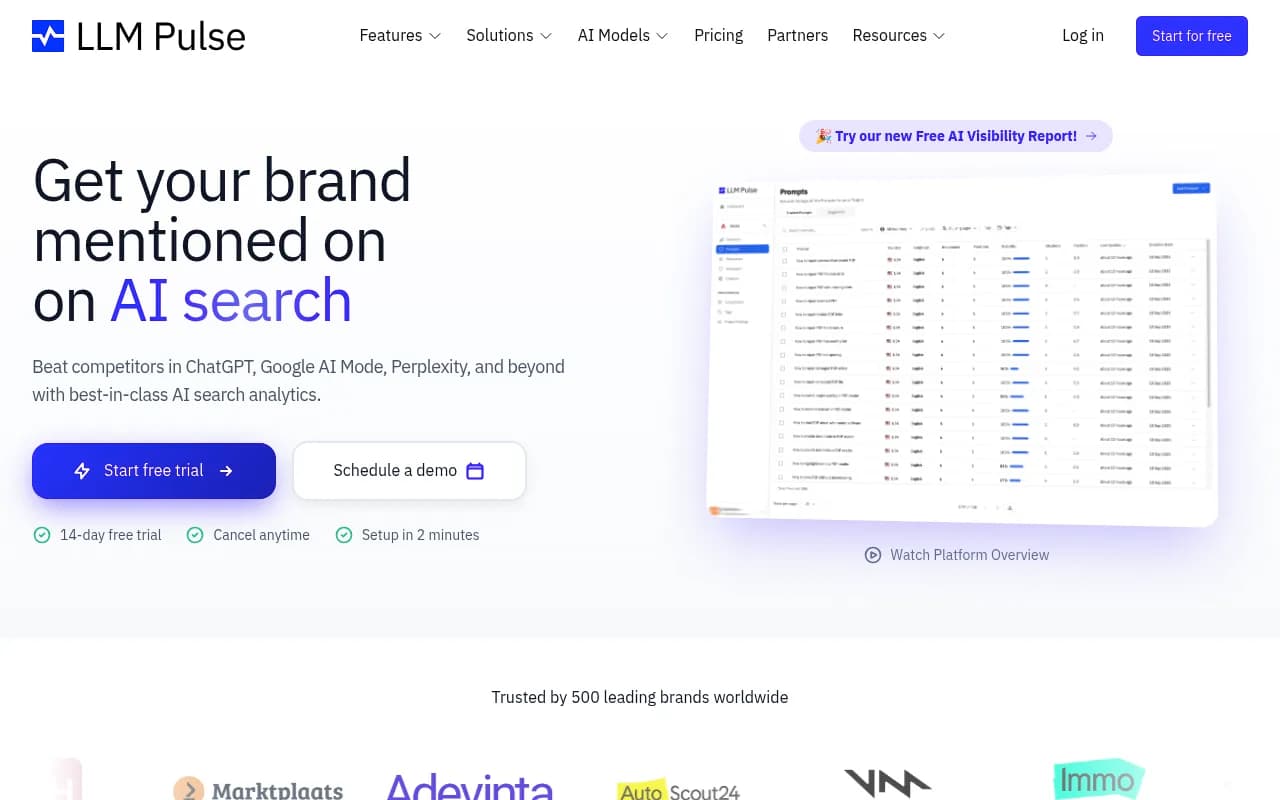
LLM Pulse tracks brand visibility across ChatGPT, Perplexity, and other AI engines at a price point that works for smaller teams. It's not going to replace a full GEO platform, but for basic monitoring it does the job.
Rankshift
Rankshift focuses specifically on ChatGPT, Perplexity, and AI search tracking. Clean interface, reasonable pricing, and it covers the most important AI engines for most brands.

Goodie AI
Goodie AI is a lightweight monitoring option that's picked up some traction as a Hall AI alternative for teams that just need to know when their brand gets mentioned in AI answers.
Tool comparison: Hall AI alternatives at a glance
| Tool | Monitoring | Content generation | Crawler logs | Reddit/YouTube | Best for |
|---|---|---|---|---|---|
| Promptwatch | Yes (10 models) | Yes | Yes | Yes | Full action loop |
| AthenaHQ | Yes | No | No | No | Clean monitoring |
| Profound | Yes (9+ models) | No | No | No | Enterprise tracking |
| Otterly.AI | Yes | No | No | No | Simple monitoring |
| Scrunch AI | Yes | No | No | No | Competitive data |
| Rankscale | Yes | No | No | No | Agency reporting |
| LLM Pulse | Yes (basic) | No | No | No | Budget monitoring |
| Rankshift | Yes | No | No | No | Small teams |
What the GEO community is actually saying
The conversations happening in GEO Slack groups, LinkedIn threads, and marketing forums in 2026 have a consistent theme: monitoring alone isn't enough anymore.
The teams getting real results from AI search are the ones treating it like a content channel, not a vanity metric. They're identifying specific prompts where competitors appear and they don't, creating content that directly addresses those gaps, and watching their citation rates improve over weeks and months.
That's a fundamentally different workflow than checking a dashboard once a week to see if your brand score went up.
The Stanford AI experts' 2025 predictions turned out to be right: 2026 is the year AI confronts its actual utility. For brands, that means the question isn't "are we on AI search?" but "are we winning on AI search?" And winning requires action, not just awareness.
How to choose your Hall AI replacement
Here's a simple decision framework based on what we're seeing in the community:
If you want to improve your AI visibility, not just track it: Promptwatch is the clear choice. The combination of gap analysis, content generation, and crawler logs is unique in the market, and the action loop approach is what actually moves the needle.
If you have a content team and just need data: AthenaHQ or Profound give you solid monitoring without paying for features you won't use.
If you're an agency managing multiple clients: Rankscale or Conductor are worth evaluating, with Promptwatch's agency/enterprise tier as the premium option.
If you're a small team on a tight budget: Rankshift or LLM Pulse cover the basics at a price that makes sense.
If you're experimenting before committing: Most of these tools offer free trials. Promptwatch has one, and so do several of the monitoring-only options.
One thing worth knowing before you switch
Whatever tool you pick, the data is only as useful as what you do with it. The GEO community's most common mistake in 2026 isn't choosing the wrong platform — it's choosing any platform and then treating it like a reporting tool instead of an optimization tool.
AI search visibility is a content problem. The brands appearing in ChatGPT and Perplexity answers aren't there by accident. They've published content that directly answers the questions people are asking AI, and they've built enough authority that AI models trust them as sources.
That's the work. The right tool just helps you figure out where to start and whether it's working.