Key takeaways
- AI perception is the picture an LLM reconstructs of your brand from training data, live search results and cited sources. It decides whether you get named, where you land in an answer, and what the model says about you.
- The same brand can score very differently across models. One early study measured 21.86 points of drift for a single brand between GPT-4o and Claude Sonnet.
- LLMs are colder than people. They reward verifiable facts, statistics and clear structure, and they flatten brands that only offer marketing language.
- Branded prompts lean on your own product and landing pages, so your site is the most direct lever you have. Reviews, FAQs and public docs matter too.
- Treat perception as a measurement problem: track prompts, claims, sentiment and sources per model, then fix the pages and third-party sources that feed the wrong answer.
What AI perception actually means
AI perception is how a large language model represents your brand when someone asks about it, or asks a question where you could plausibly appear. It covers four things: whether you are mentioned, how prominently, in what tone, and which claims the model attaches to your name.
That last part is easy to overlook. A model does not just say "Acme is a CRM." It says "Acme is affordable for small teams but its reporting is limited." Those claims get repeated across thousands of buyer conversations, and most brand teams have never read them.
There is no feeling involved. The model has no loyalty and no nostalgia for your brand. It compresses whatever it has seen about you into a short answer, and the shape of that answer depends on what evidence was available and how consistent it was.
This is a different problem from rankings. In classic search, a buyer sees ten links and decides for themselves. In AI search, the model has already done the weighing. If you want a deeper look at how that weighing works across platforms, Promptwatch maintains an Academy guide on how it collects AI data from the real interfaces of each model.
Where a model's opinion comes from
An LLM draws on two broad sources, and brands tend to forget one of them.
Training data (what the model believes)
This is the baseline memory. Years of web text, documentation, reviews, news and forum threads got folded into the model's weights. You cannot edit it directly, and it updates only when the provider ships a new version. It explains why a brand that rebranded or changed pricing two years ago can still be described the old way.
Live retrieval (what the model fetches)
ChatGPT Search, Perplexity, Google AI Overviews and AI Mode run web searches at answer time, then synthesise the results. Here the sources are visible, and they shift quickly. Promptwatch Data found that reddit.com's share of ChatGPT citations fell from roughly 4% to 0.5% on August 14, 2026, while AI Overviews and AI Mode declined more gradually. Promptwatch flags the size of the drop as provisional, but the direction matters: a source that shaped your perception in July may barely count in September.
The practical split is simple. Training data is slow and mostly out of your hands. Retrieval is fast and responds to what you publish and what others say about you.
The sources that shape branded answers
If you want to know what a model says when someone asks about you directly, look at what it cites for branded prompts. Promptwatch Data's analysis of ChatGPT citations by content type (Sep 28 to Oct 4, 2026) breaks this down for branded queries such as "is HubSpot good for startups":
| Content type | Share of branded citations | What it tells you |
|---|---|---|
| Product pages | 23.3% | Your pricing and specs get quoted directly |
| Landing pages | 22.8% | Positioning copy shapes the narrative |
| Reviews | 5.6% | More than 3x their share across all prompts |
| FAQ pages | 4.8% | Plain-language answers get reused |
| Social posts | 3.0% | Almost 4x their overall share |
| Press releases | 2.1% | Small but present |
Product and landing pages together make up almost half of branded citations. That is good news, because those are pages you control. It is also a warning: if your product page is vague, thin or contradicts your pricing page, the model will quote that mess.
For commercial prompts like "best CRM for small businesses," the mix changes. Product pages (26.0%), landing pages (20.6%), listicles (15.0%) and comparisons (7.9%) account for almost 70% of citations. So perception is formed in two places at once: when someone asks about you, and when someone asks about your category and you either show up or don't.
Why LLMs judge brands harder than people do
Here is the part that surprises marketing teams. Human brand strength and AI brand strength do not line up neatly.
In a webinar hosted by BERA.ai and covered by The Marketing Cloud, Levi's placed in the 94th percentile for brand love among human consumers. Ask an LLM the same kind of question and the feedback is noticeably harsher. BERA's Janu Lakshmanan said that for over a dozen brands she had examined, "the AI models have a different perception than consumers."
The reason is structural. People carry mental availability, nostalgia and emotional association. A model carries text. If your online footprint is full of slogans like "cutting-edge tech that surpasses the competition" and short on evidence, the model has nothing to hold onto. The result is what the same coverage calls brand drift or narrative flattening: a market leader reduced to generic category language.
I find this a little humbling. Decades of brand building can be invisible to a system that only reads what is written down and verifiable.
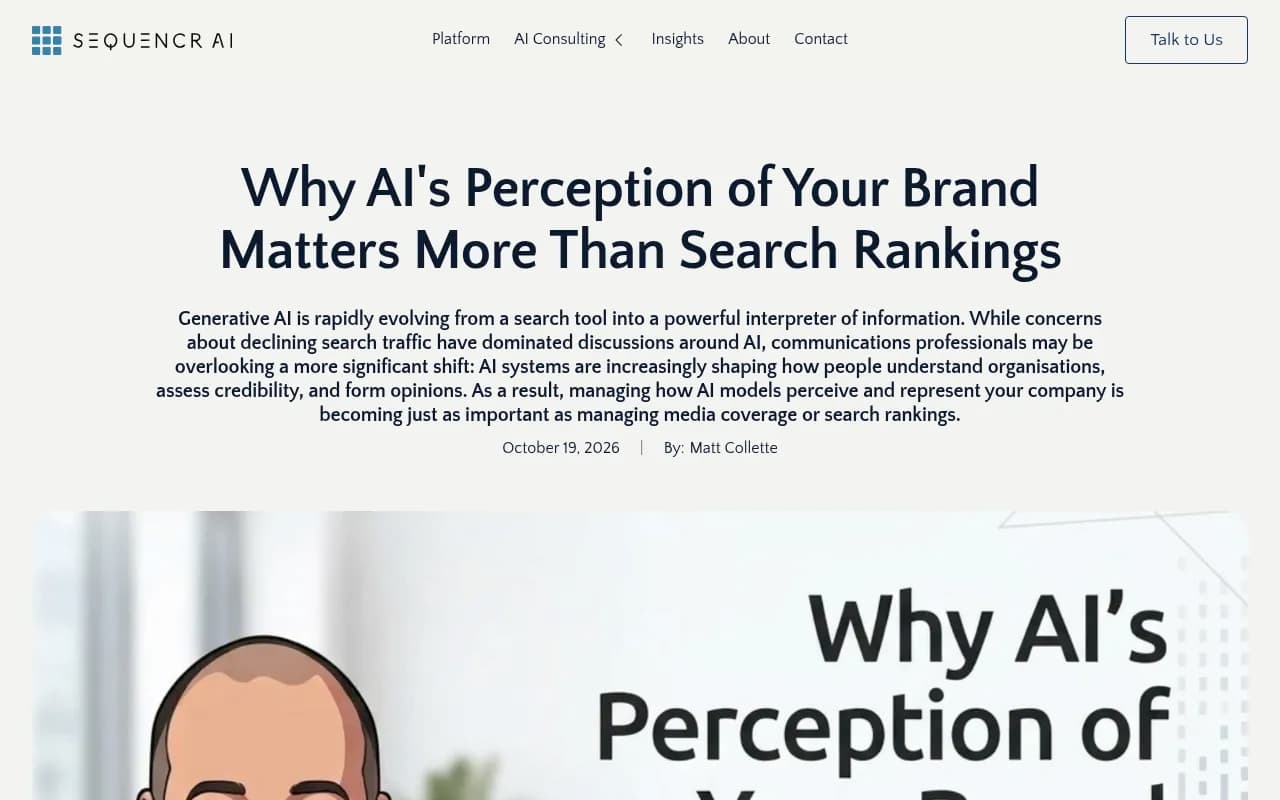
Sequencr makes a related argument: where you rank matters less than what AI systems say about you once they decide to mention you.
What the early research shows
Two pieces of research are worth knowing, with caveats about each.
The AI Perception Index
Faruk Tugtekin's AI Perception Index 2026 on SSRN is described as the first empirical measurement of brand perception across LLMs. It analysed six brands across GPT-4o and Claude Sonnet using 8 standardised prompts. Three findings stand out:
- A 36-point gap on the author's MPI metric separated dominant brands from emerging ones.
- A brand with $29M in funding scored nearly the same as bootstrapped firms. Money did not buy perception.
- Cross-model drift reached 21.86 points for the same brand across different AI systems.
Treat it with care. It is an 8-page report with six brands and two models, and the author discloses that he founded ARGEO, one of the six brands studied. It is a useful early signal, not settled science. Still, the cross-model drift finding matches what practitioners see every day.
The GEO paper
The peer-reviewed "GEO: Generative Engine Optimization" study from researchers at Princeton, Georgia Tech, IIT Delhi and the Allen Institute for AI tested tactics across a benchmark of 10,000 queries. Adding hard statistics produced a 31% to 37% citation uplift, direct expert quotations 30% to 41%, and inline primary sources 30% to 40%. Combined, these tactics lifted visibility by up to 40%, and lower-ranked authoritative sources gained as much as 115%.
The pattern is consistent: models prefer content they can verify and lift cleanly into an answer.
Why perception differs across models
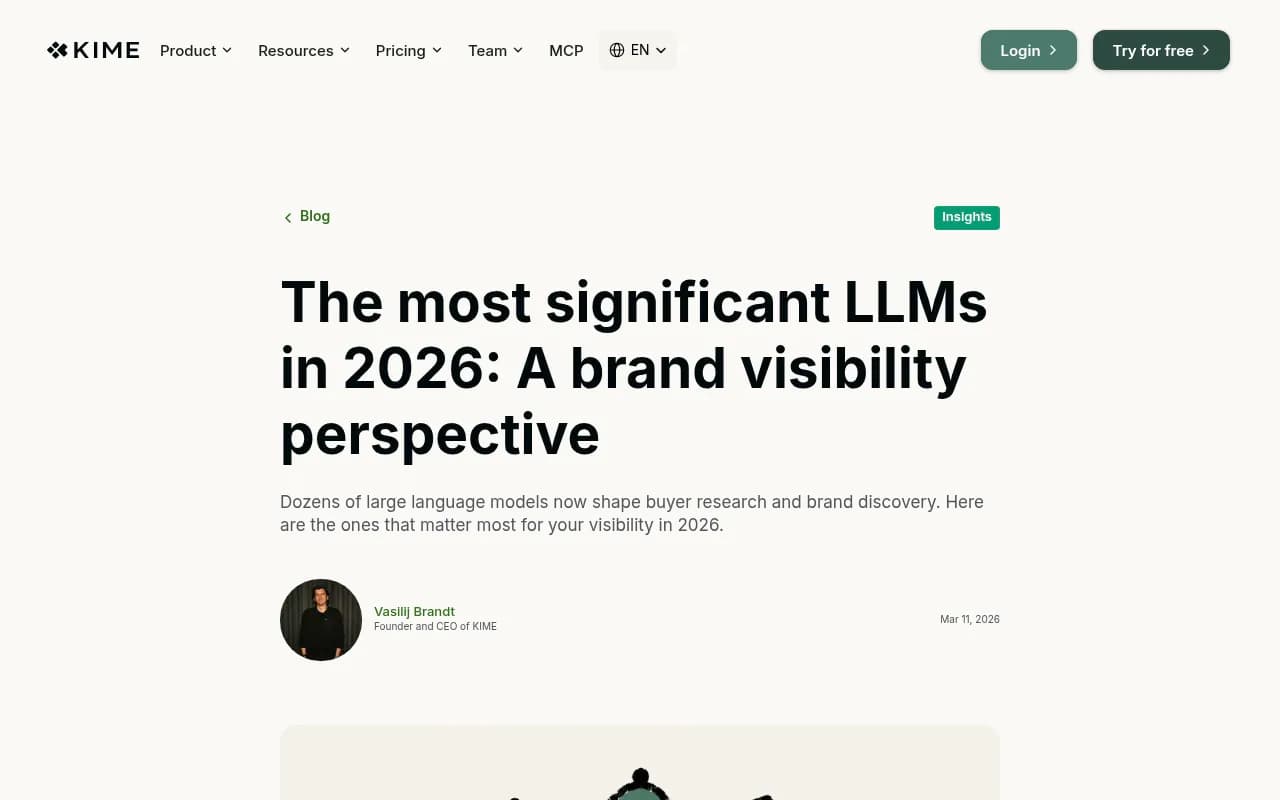
A kime.ai guide on the LLM market makes a point that is easy to skim past: visibility on one platform does not carry over to another. Each model has its own training data, its own retrieval layer and its own update cycle.
Three consequences follow:
- Hallucinations are model-specific. A brand described correctly in Claude can be misrepresented in Gemini.
- Open models such as Llama, Qwen and Gemma power apps that never touch ChatGPT, so some audiences see a version of your brand you never audited.
- Enterprise models sit inside internal tools and shape decisions you will never see in a consumer dashboard.
Citation behaviour differs too. Promptwatch Data's social media citations report found that from Sep 28 to Oct 4, 2026, ChatGPT drew just 0.46% of its citations from social platforms, while Google AI Overviews drew 12.2%. A brand with a strong Reddit and YouTube presence may look healthy in AI Overviews and thin in ChatGPT.
And freshness cuts both ways. Promptwatch's content half-life study tracked pages ChatGPT cited on July 6, 2026 for 90 days: landing pages and docs stayed cited longest, while news lost half its pages within 36 days. A launch announcement fades fast. Your core product page sticks around.
How to measure AI perception
You cannot manage what you have not read. A workable measurement routine has five parts.
- Build a prompt set that mirrors your buyers: branded prompts ("is X good for Y"), category prompts ("best X for small teams") and competitor comparisons.
- Run it across several models, in each country and language you sell in, and keep the raw responses.
- Score mentions, position and sentiment, then extract the individual claims the models make about you.
- Record which sources each model cites for those claims.
- Repeat on a schedule, because answers drift when models update.
On reading the numbers: low share of voice is a coverage problem, late position is a prominence problem, mentions with no citations to your own domain point to a content or crawlability problem, and weak sentiment is a reputation problem. Promptwatch's metrics overview explains each of these.
Tools for tracking perception
The category is crowded, and the tools differ a lot in what they do after the dashboard.
| Tool | Monitoring | Fixes the gap | Notable angle |
|---|---|---|---|
| Promptwatch | Yes, real UIs across many models | Yes, content agent, action board | Claim-level Brand Narrative and Fact Check, crawler logs |
| Profound | Yes | Limited | Enterprise monitoring |
| Otterly.AI | Yes | No | Basic prompt tracking |
| Peec AI | Yes | No | Prompt tracking for marketing teams |
| BERA LLM Brand Rankings | Yes | Advisory | Compares AI perception with consumer brand equity |
| LLMClicks | Yes | Limited | Hallucination detection |
Promptwatch is the one I would start with for perception work specifically. Its Brand Narrative feature pulls the individual claims AI makes about you and competitors, groups repeated ones, and files them under themes such as pricing, features, support and reputation, each with a 0 to 100 score. Fact Check then lets you mark a claim as inaccurate and finds the pages on your site that state it or its opposite, so you know where the model is learning the wrong thing.

On the monitoring-only side, these are worth a look depending on budget:
Profound

Otterly.AI


For a broader view of options, the GEO software directory at bestgeosoftware.com lists many more.
How to shape what AI says about you
Measurement is the easy half. These are the levers that move perception, in rough order of payoff.
Make your own pages quotable
Since product and landing pages make up almost half of branded citations, start there. Keep pricing, specs and positioning complete and factual. State numbers. Remove claims you cannot back up. If your pricing page says one thing and a blog post says another, models will repeat whichever they find.
Add proof, not adjectives
The GEO research points the same way every time: statistics, quotations and primary sources get cited more. Replace "industry-leading" with a figure and a source.
Collect reviews where your category looks
Reviews are 5.6% of branded citations, more than three times their overall share. Get them on the sites buyers and models already trust, such as G2, Capterra or Trustpilot for software.
Write a plain FAQ about your brand
FAQ pages show up in 4.8% of branded citations. A plain question-and-answer page about who you serve, what you cost and how you compare gives models clean material.
Keep docs public and crawlable
For software prompts, documentation and help centers earn the largest share of ChatGPT citations, according to Promptwatch's software citation report. If a bot cannot read your docs, it cannot cite them. Checking AI crawler access is the first technical task; Promptwatch's free Agentic Readiness Check is a quick way to see which crawlers can read your site.
Fix third-party sources
A wrong claim often traces to an old directory listing, a stale comparison article or an outdated review. Find the cited source, correct it or get it updated, then check whether the answer changes.
A short example
Say a mid-sized project management tool finds that Gemini calls it "best for small teams" while ChatGPT says "limited integrations." The second claim is wrong; the product added 40 integrations last year. Tracing the citations shows ChatGPT keeps pulling an outdated comparison article and a two-year-old review. The fix is not a rewrite of the homepage. It is an updated integrations page with a clear list, a request to update the comparison article, and fresh reviews. Then you rerun the same prompts a few weeks later and see whether the claim moved.
That loop of monitor, trace, act and measure is what separates a perception program from a one-off audit.
Who should own this
AI perception sits between brand, SEO, content and PR, which is exactly why it gets dropped. Brand teams care about the narrative, SEO teams own crawlability and structured content, and PR owns third-party mentions. Pick one owner and give them the data.
Smaller teams without that bandwidth can bring in outside help. 1001 SEO Media is the agency that publishes this site, and it covers technical SEO, content and AI search optimization for brands that want to be cited accurately in ChatGPT, Gemini, Perplexity and Google AI Overviews.
What to do this week
- Write 20 to 30 prompts your buyers would ask, branded and unbranded, and run them across at least three models.
- Read the responses as a skeptical buyer. List every claim and mark the wrong ones.
- Trace the citations behind the top three wrong claims.
- Audit your product pages, pricing page and FAQ for facts that are vague or contradictory.
- Rerun the same prompts in 30 days and compare.
The free starting point is a one-time check of how the major models currently describe you. Promptwatch's free AI visibility report gives you a baseline without a login, and its 7-day free trial lets you track prompts across models if you want to go further. Confirm current plans at promptwatch.com/pricing.
AI perception is not mysterious. It is the sum of what is written about you, how verifiable it is, and which sources each model trusts this month. You can read it, and you can change it.