Key takeaways
- ChatGPT and other AI models give location-specific recommendations, meaning a brand visible in New York may be completely absent from results in Los Angeles for the same query.
- This geo-variance is driven by training data distribution, local review signals, Bing ranking data, and how AI models interpret geographic context in prompts.
- Research from SparkToro found that AI models are "highly inconsistent" when recommending brands -- the same prompt can return entirely different brand sets across models and sessions.
- Tracking this requires geo-specific prompt testing, not just generic brand monitoring. Most basic tools don't support this.
- Platforms like Promptwatch let you monitor AI responses by city, state, country, and persona -- so you can see exactly where you're visible and where you're not.
The problem most marketers haven't noticed yet
Ask ChatGPT "What's the best personal injury law firm in New York?" and then ask the same question about Los Angeles. You'll get different answers. That's obvious -- those are different markets.
But here's the less obvious version: ask "What's the best CRM for small businesses?" from a New York IP address versus a Los Angeles IP address, and you might still get different answers. Not because the products are different, but because AI models pick up on geographic signals -- sometimes subtle ones -- and adjust their outputs accordingly.
This is geo-variance in AI search, and in 2026 it's one of the most undertracked problems in brand visibility.
The stakes are real. According to a widely cited projection making rounds in marketing communities, AI search engines are expected to account for a significant share of brand discovery by the end of 2026. If ChatGPT recommends your competitor in Chicago but not you, and you have no idea that's happening, you're losing customers you never knew were looking.
Why AI models give different answers by location
Training data isn't evenly distributed
AI models learn from the internet, and the internet is not geographically neutral. New York and Los Angeles have massive, dense online footprints -- millions of reviews, local news articles, Reddit threads, Yelp listings, and blog posts. Smaller cities have far less. When a model is trained on this data, brands with strong representation in specific city-level content naturally appear more often in responses tied to those cities.
A restaurant chain that's been reviewed 50,000 times on Yelp in NYC but only 3,000 times in Phoenix is going to show up more confidently in New York-related queries. The model has more evidence to draw on.
Bing's influence on ChatGPT recommendations
A case study published by Search Engine Land found something striking: brands that ranked well in Bing were significantly more likely to appear in ChatGPT recommendations. In some cases, top brands disappeared from ChatGPT responses entirely when they lacked a Bing presence.
This matters for geo-variance because Bing's local search index is not uniform. A brand that ranks well in Bing for "best accounting software" in Texas might rank differently in California. Those Bing signals feed into ChatGPT's outputs, creating location-specific recommendation patterns that mirror Bing's own geographic biases.
How prompts get interpreted geographically
When someone types "best coffee shops near me" into ChatGPT, the model uses location context -- either from the user's stated location, their account settings, or inferred signals -- to shape the response. But even prompts that don't mention a city can trigger geographic reasoning.
If a user's ChatGPT account is set to a US location, or if they've previously asked location-specific questions in the same session, the model may weight local signals more heavily. This means two users asking the identical question can get meaningfully different brand recommendations based on nothing more than where they are.
Freshness and citation velocity
Neil Patel's 2026 analysis of ChatGPT algorithm changes highlighted "freshness and citation velocity" as emerging ranking signals. Brands that are being actively discussed -- in news, forums, social media -- in a specific city right now are more likely to get cited in responses tied to that city. A brand launching a major campaign in LA this month might suddenly appear in LA-specific AI recommendations even if it had no presence there before.
This creates a dynamic, shifting landscape where your AI visibility in any given city can change week to week.
The inconsistency problem is bigger than location
SparkToro published research showing that AI models are "highly inconsistent" when recommending brands. The same prompt, run multiple times, can return different brand sets. Different AI models (ChatGPT vs Claude vs Google AI) recommend different brands for the same query. And location is just one of several variables driving this inconsistency.
A separate analysis of 21,311 brand mentions across ChatGPT, Claude, and Perplexity found that 85% of brand visibility in AI search comes from a relatively small number of sources. If your brand isn't represented in those sources -- the specific websites, Reddit threads, and review platforms that AI models draw from -- you're invisible regardless of how good your product is.
The practical implication: you can't just check once whether ChatGPT mentions your brand. You need to check across:
- Multiple cities and regions
- Multiple AI models
- Multiple prompt phrasings
- Multiple times (because responses vary even within the same model)
What geo-variance looks like in practice
Here are some real patterns that show up when brands start tracking their AI visibility by location:
A national retail chain finds it's consistently recommended in Chicago and Houston but almost never appears in Seattle responses, despite having stores there. The reason: their local PR and review activity is concentrated in the Midwest, and their Seattle locations have thin online footprints.
A SaaS company discovers that Claude recommends them in responses to "best project management tools" in the UK but not in the US -- because they have strong coverage in UK tech publications but minimal US press.
A law firm ranking #1 on Google in their city finds they're not mentioned in ChatGPT responses at all, because their website is technically strong but they have almost no presence in the third-party sources (Reddit, legal forums, review sites) that AI models actually cite.
These aren't edge cases. They're the norm for brands that haven't specifically optimized for AI search visibility.
How to track geo-specific AI visibility in 2026
Manual testing (free but slow)
The simplest starting point is manual prompt testing. Open ChatGPT and ask the same question multiple times, varying the geographic context. For example:
- "What's the best [your category] in New York?"
- "What's the best [your category] in Los Angeles?"
- "What's the best [your category] for someone in Chicago?"
- "I'm in Seattle looking for [your category] -- what do you recommend?"
Document the results in a spreadsheet. Note which brands appear, how prominently, and whether your brand is mentioned. Run this across ChatGPT, Claude, Perplexity, and Google AI Overviews.
This approach works for a quick sanity check but doesn't scale. You can't run hundreds of prompts across 10 cities and 5 AI models manually every week.
Automated geo-tracking tools
Several platforms now support location-specific AI visibility monitoring. The key features to look for:
- City and state-level prompt customization
- Multi-model tracking (not just ChatGPT)
- Persona-based testing (a 35-year-old in LA vs a 50-year-old in NYC might get different recommendations)
- Historical tracking so you can see visibility changes over time
Promptwatch supports all of this. You can set up prompts with specific geographic contexts, run them across 10+ AI models, and track how your visibility changes by location over time. The Professional plan ($249/mo) includes state and city-level tracking specifically.

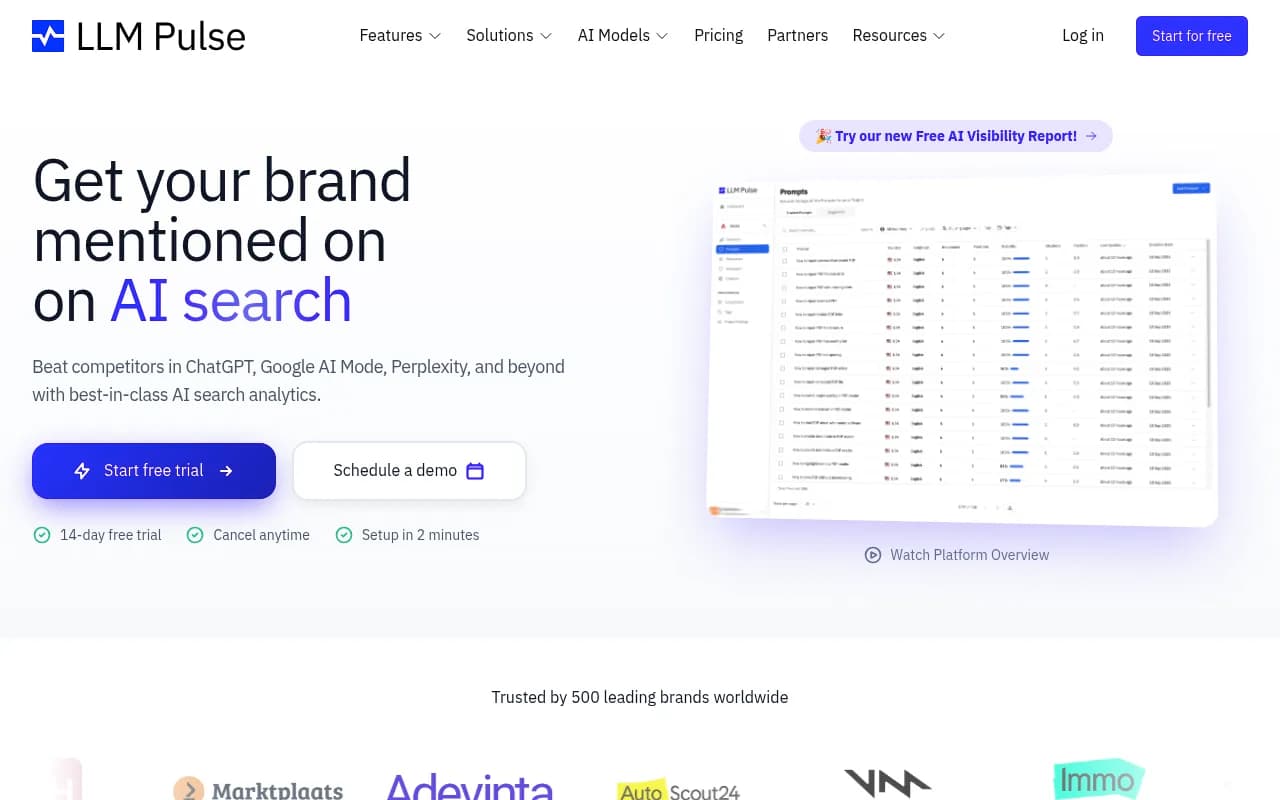
For teams that want a simpler starting point, tools like Rankshift and LLM Pulse offer basic multi-model monitoring, though they don't go as deep on geographic segmentation.

Otterly.AI covers ChatGPT, Perplexity, and Google AI Overviews with a clean interface, though its geographic customization is more limited.
Otterly.AI

Comparison of geo-tracking capabilities
| Tool | City/state tracking | Multi-model | Persona targeting | Content gap analysis |
|---|---|---|---|---|
| Promptwatch | Yes (Pro+) | 10+ models | Yes | Yes |
| Rankshift | Limited | 3 models | No | No |
| LLM Pulse | No | 4 models | No | No |
| Otterly.AI | No | 3 models | No | No |
| Profound | Limited | 9+ models | No | Limited |
What drives geo-specific AI visibility (and how to improve it)
Once you know where you're visible and where you're not, the next question is what to do about it. The answer depends on why you're invisible in a given location.
Build local third-party presence
AI models don't just read your website. They read Reddit, review platforms, local news, industry forums, and YouTube. If you're invisible in Seattle, the fix probably isn't tweaking your homepage -- it's getting mentioned in the places AI models actually cite for Seattle-related queries.
Practical steps:
- Get reviewed on Google, Yelp, and industry-specific platforms in target cities
- Engage in local Reddit communities (r/Seattle, r/LosAngeles, etc.)
- Pitch local tech/business publications for coverage
- Sponsor or participate in local events that generate online mentions
Create geo-specific content
Content that explicitly addresses a specific city or region gives AI models a clear signal to associate your brand with that location. This doesn't mean thin "we serve Los Angeles" landing pages -- it means substantive content that answers questions people in that city are actually asking.
For example, a B2B software company might publish "How LA-based agencies use [product] to manage remote teams" -- a piece that's genuinely useful and creates a geographic association in the training data.
Fix your Bing presence
Given the evidence linking Bing rankings to ChatGPT visibility, it's worth auditing your Bing performance by city. Bing Webmaster Tools can show you where you're ranking and where you're not.
If you're strong on Google but weak on Bing, that gap might be directly causing your ChatGPT invisibility in certain markets.
Monitor citation sources
Promptwatch's citation analysis shows which specific pages, Reddit threads, and domains AI models are citing when they answer queries in your category. This tells you exactly where to focus your content and PR efforts -- not just "be on Reddit" but "be in this specific subreddit thread format that AI models keep citing."
The measurement challenge: connecting AI visibility to revenue
Tracking AI visibility by location is only half the problem. The other half is knowing whether it actually drives business.
This is harder than it sounds. When someone discovers your brand through ChatGPT and then visits your website, that traffic often shows up as direct or dark social in your analytics. There's no UTM parameter attached to an AI recommendation.
A few approaches that work:
- Server log analysis: AI crawlers (GPTBot, ClaudeBot, PerplexityBot) leave traces in your server logs. Analyzing these shows which pages AI models are reading, which correlates with what they recommend.
- Traffic attribution tools: Platforms like Promptwatch offer a code snippet or Google Search Console integration that helps identify traffic originating from AI search engines.
- Geo-segmented conversion tracking: If you're running geo-specific AI visibility campaigns, watch for corresponding changes in direct traffic and branded search volume from those cities.
A practical 30-day plan for tracking geo-variance
If you're starting from zero, here's a realistic sequence:
Week 1: Manual audit. Pick 5 cities that matter to your business. Run 10 prompts per city across ChatGPT and Perplexity. Document which brands appear and whether yours does. This gives you a baseline.
Week 2: Set up automated tracking. Get a tool running that will monitor these prompts consistently. Even a basic setup is better than manual checks you'll forget to do.
Week 3: Audit your citation sources. Find out which pages, forums, and domains AI models are citing for your category in each city. Identify the gaps.
Week 4: Start filling the gaps. Prioritize the one or two cities where you're closest to being visible -- where competitors are mentioned but you're not. Create or earn the content that's missing.
Then track the results over the following 60-90 days. AI visibility changes aren't instant, but they're measurable.
The bottom line
ChatGPT recommending different brands in New York versus Los Angeles isn't a bug -- it's how these systems work. They're trained on geographically uneven data, they pull from Bing's location-sensitive index, and they respond to local signals in ways that create real, measurable differences in brand visibility across cities.
Most brands have no idea this is happening to them. The ones that figure it out first -- and build the local content, citations, and presence to show up where it matters -- will have a significant advantage as AI search continues to grow as a discovery channel.
The tools to track this exist. The strategies to fix it are straightforward. The only question is whether you start measuring before or after your competitors do.