Key takeaways
- All-in-one SEO platforms like Finseo, Semrush, and Ahrefs treat AI visibility as an add-on module bolted onto a traditional rank-tracking core, which caps how deep the data and the action layer can go.
- ChatGPT cites roughly 5 sources per response versus 10 for Google AI Overviews and Perplexity, and mid-authority domains (DR 46-75) now earn almost half of all ChatGPT citations, undercutting the domain-authority logic most SEO suites are built around.
- Query fan-outs, citation type mixes, and even which AI crawlers are hitting your site shift week to week, faster than a bundled SEO tool's roadmap typically moves.
- Reddit's ChatGPT citation share collapsed from about 4% to 0.5% almost overnight on August 14, 2026, the kind of structural shift a generalist dashboard is unlikely to flag in time.
- Teams that outgrow the all-in-one model usually move toward a dedicated AI visibility platform that combines crawler logs, citation analytics, and automated content action instead of just another reporting tab.
The bundling problem, explained
Every SEO suite eventually adds an "AI visibility" tab. Semrush did it in September 2025. Ahrefs sells Brand Radar as an add-on. Finseo built its whole pitch around being an AI-native version of the same bundle. On paper, this looks efficient: one login, one invoice, one vendor to manage.
In practice, I keep seeing the same pattern play out with growth teams who start there. They onboard, get a visibility score, feel good about it for a quarter, and then hit a wall. The tool tells them they're "underperforming" in ChatGPT but can't say why. It shows a handful of prompts but won't reveal which of their own pages are actually getting crawled by GPTBot or ClaudeBot, let alone whether those crawls ever turn into citations. That's the ceiling of a bolted-on feature versus a platform built for this from day one.
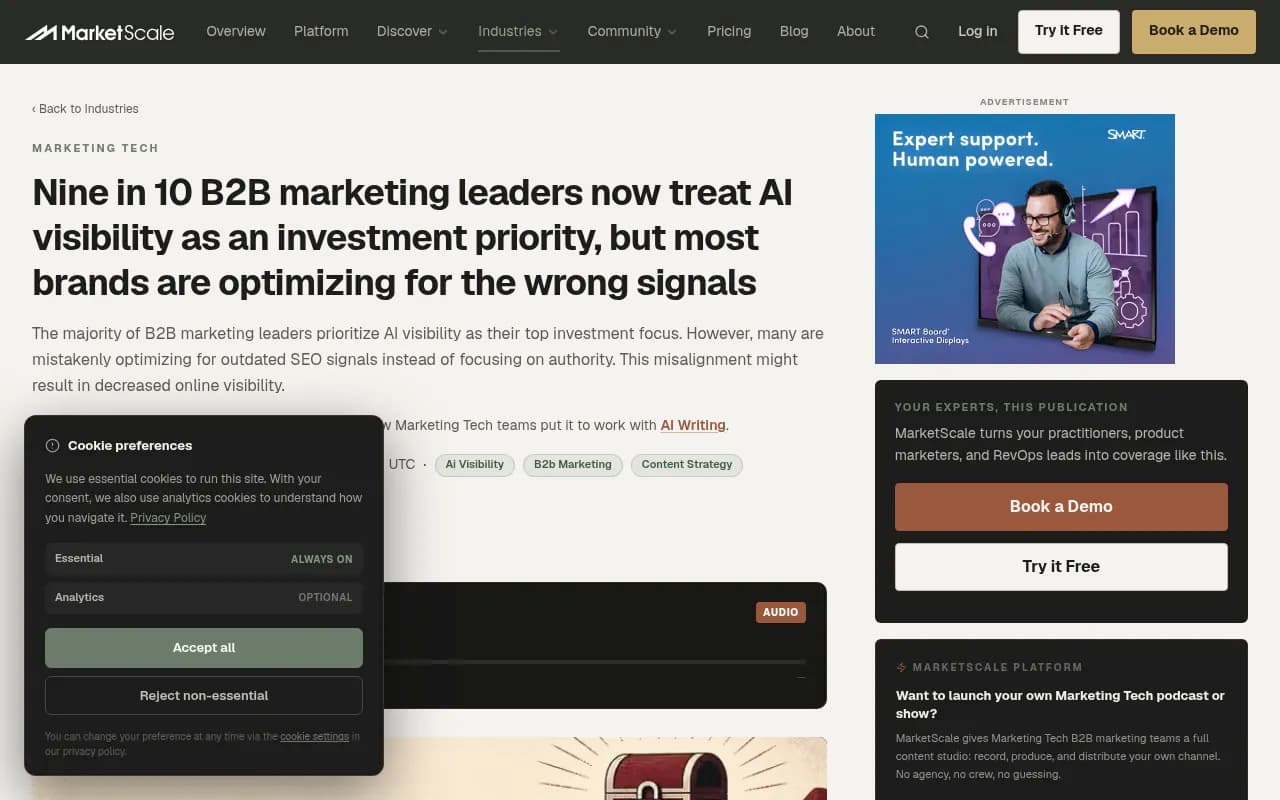
Nine in 10 B2B marketing leaders now treat AI visibility as an investment-level priority, according to a report covered by MarketScale, but the same piece makes an important point: most brands are optimizing for the wrong signal, chasing content volume when authority and relevance matter more. That's exactly the trap an all-in-one tool encourages, because its business model rewards more content, more pages, more keywords tracked, not necessarily smarter, narrower AI-specific work.
Where Finseo and its peers hit their limits
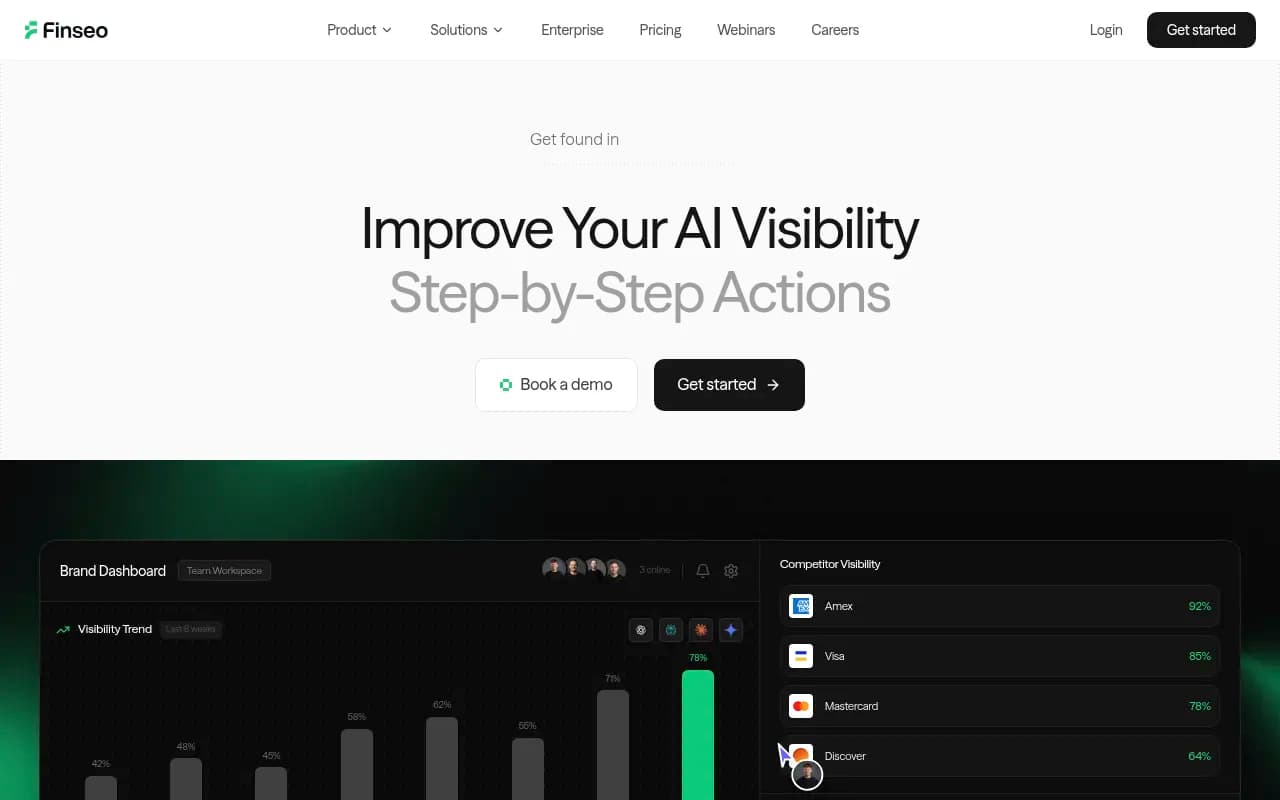
Finseo is a decent example of the category, not a bad product. It's a German, bootstrapped platform tracking 20 AI surfaces (ChatGPT, Claude, Gemini, Perplexity, Copilot, and more), with pricing that starts around €84/month for its Starter tier and scales to €479/month for Growth. It has real customers, including Kellogg's and Lidl, and decent review scores, though G2's sample size is tiny.
The issue isn't whether Finseo works. It's what happens once your AI visibility needs outgrow "track prompts and get a score." A few specific gaps show up consistently:
No crawler-log depth. Finseo checks crawlability, which is useful, but it doesn't give you the kind of log-level view that shows exactly which pages GPTBot, ClaudeBot, PerplexityBot, or the newer Meta-WebIndexer actually read, and whether those visits convert into citations. Meta-WebIndexer's share of tracked AI crawler traffic jumped from about 2% to nearly 38% between mid-July and August 9, 2026, per Promptwatch Data's crawler tracking research. If your visibility tool doesn't even track that crawler, you're missing a growing chunk of the picture.
Content action is thin. A visibility score tells you where you stand. It doesn't write the brief, generate the fix, and publish it to your CMS. Teams that treat AI visibility as a monitoring exercise stay stuck reading dashboards instead of shipping content.
Pricing that escalates with usage, not depth. Finseo's tiers jump from 50 prompts at the Starter level to 350 at Growth, at €479/month, still without unlocking the kind of citation-trend or crawler-log analysis that a dedicated platform includes lower down its own pricing ladder. Ahrefs Brand Radar has the same problem in a more extreme form: it requires an existing Ahrefs plan plus a separate $398-$699/month add-on, pushing full coverage to $527-$1,148/month for what is still, fundamentally, a reporting layer.
Why the underlying data has moved past what bundled tools were built for
This is the part that generalist SEO tools struggle with structurally, not just as a feature gap. AI search behaves nothing like Google's ten blue links, and it changes fast.
ChatGPT cites around 5 sources per web-search response, roughly half of what a traditional SERP offered, while Google AI Overviews and Perplexity settle closer to 10, according to Promptwatch's research on sources per response. Microsoft Copilot is the wildcard, swinging from under 2 to nearly 17 sources per response within weeks as Microsoft keeps re-architecting retrieval. Fewer, more contested citation slots mean you need prompt-level precision, not broad keyword coverage.
Then there's the fan-out behavior. ChatGPT doesn't run one search per prompt, it breaks a single question into multiple sub-queries, and the character of those queries has changed dramatically. Promptwatch's query fan-out data shows average query length dropping from roughly 117 characters in December 2025 to about 53 by April 2026, less than half, meaning ChatGPT increasingly searches in short keyword fragments rather than full sentences. On August 8, 2026, ChatGPT Search started using the site: operator at scale, jumping from about 0.4% to 17% of fan-out queries overnight, per Promptwatch's site-operator report. A tool that refreshes its "best practices" quarterly can't react to a shift like that.
Domain authority assumptions get upended too. In August 2026, mid-authority domains with a DR of 46-75 earned almost half of all ChatGPT citations, while DR 91-100 sites, the giants that legacy SEO tools are built to chase, fell from about 7% of citations in week one to roughly 3% by mid-August and stayed there. That's a real problem for any tool whose core logic is "build more backlinks, raise your domain rating." It's simply not the lever that matters most for AI citations anymore.
And content mix keeps moving under everyone's feet. Product pages led ChatGPT citations in August 2026 at close to 29% on average but slipped from 30% down to 25% by month's end. How-tos more than doubled their citation share in the same window, and documentation nearly tripled. Social posts collapsed from 4.4% to under 1% right after August 14, the exact day Reddit's ChatGPT citation share fell from about 4% to 0.5% almost overnight, per Promptwatch's Reddit citation report. If your monitoring tool updates its content-type breakdown once a quarter, you'll be optimizing for last month's AI search, not this week's.
What a dedicated AI visibility platform actually adds
The honest answer to "why outgrow Finseo" isn't that Finseo is bad software. It's that AI visibility, done properly, needs four things working together that a bundled SEO tool rarely ships all of at once: crawler-log visibility, citation-source detail (including Reddit and YouTube, which most tools ignore), traffic attribution tied to actual conversions, and an action layer that writes and publishes fixes rather than just flagging problems.
Promptwatch was built around that stack from the start rather than as an add-on to an existing rank tracker. It's used by 1,840+ brands and agencies, including Duolingo, Yelp, Typeform, and agencies like Monks and WPP, and is rated 4.7/5 on G2.

A few specifics worth knowing if you're evaluating the move:
Agent Analytics gives real-time crawler logs, showing when ChatGPTBot, ClaudeBot, PerplexityBot, GoogleOther, and 400+ other crawlers hit your pages, what they read, and whether they error out, with a citation rate calculated per page. That's the "why" behind a visibility score that most tools never explain.
Citation analytics break down which of your pages get cited and classify every citation into 22 content types and 20 source types, plus dedicated Reddit and YouTube citation reports, the exact channels that just went through the kind of overnight shift described above. Content Agents then plan, write, and publish GEO-optimized content to Webflow, Framer, or WordPress on a schedule, either through a review inbox or fully automated, closing the loop from "you're not cited" to "here's a published fix."
Crisp, one of Promptwatch's customers, scaled to 5-10 published articles a day using this workflow and saw 2x higher conversion rates from AI traffic compared to traditional channels. That's a different kind of outcome than a monthly visibility percentage in a dashboard tab.
Comparing the options
| Platform | Model | Starting price | Crawler logs | Content generation + publishing | Reddit/YouTube tracking |
|---|---|---|---|---|---|
| Finseo | AI visibility bolted onto SEO suite | ~€84/mo | Crawlability checks, no log-level data | Content scoring, limited generation | No |
| Semrush AI Visibility Toolkit | Add-on to core SEO platform | Bundled into Semrush One ($199/mo+) | No | No | No |
| Ahrefs Brand Radar | Paid add-on to existing Ahrefs plan | $398-$699/mo add-on | No | No | No |
| Profound | Purpose-built AEO platform | $499/mo (Lite) | Limited | Some, enterprise-gated | Limited |
| Promptwatch | End-to-end AI visibility + GEO platform | $95/mo (Essential) | Yes, 400+ crawlers with citation rate per page | Yes, Content Agents + CMS publishing | Yes, dedicated reports |
The pattern across nearly every independent comparison out there is consistent: bundled or bolt-on tools deliver convenience, and dedicated platforms deliver depth, faster iteration, and an actual path from insight to published fix. Semrush's own move after being acquired by Adobe for $1.9 billion in August 2026 illustrates the trend, it discontinued its free AI Visibility Toolkit tier and folded AI visibility into paid plans, forcing adoption rather than earning it on feature depth.
When it still makes sense to stay all-in-one
This isn't a blanket argument against bundled tools. If you're a small team running classic technical SEO audits, rank tracking, and basic content optimization, and AI visibility is a nice-to-have rather than a growth channel, a tool like Finseo, Semrush, or Ahrefs covers the basics without adding a second subscription. The math changes once AI-driven traffic becomes measurable in your analytics and leadership starts asking pointed questions about why you're invisible in ChatGPT for prompts you clearly should win.
That's usually the trigger point. Teams don't decide to "outgrow" a tool on a schedule, they hit a specific moment: a competitor shows up in an AI Overview where they don't, a crawler log they can't see is clearly blocking citations, or leadership wants attribution numbers the bundled dashboard simply can't produce. At that point, the conversation shifts from "which tool has the most features" to "which tool can actually explain and fix what's happening."
Getting the transition right
If you're planning the move, a few practical steps help:
Start by auditing what your current tool can't answer. If you can't see crawler-level data, citation source breakdowns, or content type trends updated weekly rather than quarterly, that's your gap list.
Run a dedicated platform in parallel for 30-60 days before cancelling anything. Most offer trials, Promptwatch's Essential tier has a 7-day free trial, and Explore is free with 10 prompts on ChatGPT only, enough to sanity-check the data against what you're already seeing.
If you want a broader view of the category before committing, the GEO software directory at bestgeosoftware.com is a reasonable starting point for comparing platforms side by side, and the AI rank tracking directory at ai-rank-tools.com covers the narrower monitoring-only tools if that's genuinely all you need right now.
The short version: all-in-one SEO tools aren't wrong, they're just built for a different job. AI search moves on a weekly cadence, rewards mid-authority relevance over raw domain size, and increasingly demands content that gets written and published fast, not just measured. Once that becomes your team's actual priority, the bundle starts showing its seams.