Key takeaways
- AI search engines like ChatGPT don't crawl the web in real time -- they rely on training data, citations, and third-party sources, which means good Google rankings don't automatically translate to AI visibility.
- The most common reasons brands are invisible in ChatGPT include thin content, poor backlink profiles, lack of mentions on authoritative third-party sites, and technical crawl barriers.
- Fixing AI visibility requires two things: understanding where the gaps are, and creating content specifically engineered to be cited by AI models.
- Dedicated GEO (Generative Engine Optimization) tools exist to track, diagnose, and improve your AI search presence -- and they work very differently from traditional SEO platforms.
- The tools below range from full-stack optimization platforms to lightweight trackers, so there's an option for every budget and team size.
You've done the SEO work. Your site ranks. Traffic is solid. Then someone on your team asks ChatGPT for a recommendation in your category and your brand isn't there. A competitor you've never heard of shows up instead.
This is happening to a lot of brands right now, and it's not a fluke. AI search is a fundamentally different system from Google, and the rules for appearing in it are different too. The good news: the problem is diagnosable and fixable. Here's what's actually going on, and the tools that can help.
Why ChatGPT doesn't know your brand exists
AI models don't crawl -- they remember
ChatGPT and other large language models don't search the web when someone asks a question. They draw on patterns from their training data, which was collected up to a specific cutoff date. If your brand wasn't well-represented in that data -- through your own content, third-party mentions, reviews, forum discussions, and citations -- the model has no strong signal to associate you with your category.
This is the core disconnect. Strong Google rankings tell Google's algorithm you're authoritative. They don't automatically tell GPT-4o or Claude anything. Those models learned from a snapshot of the internet, and if your brand was quiet, thin, or poorly cited during the period that snapshot covers, you're effectively invisible.
The sources AI models actually trust
When AI models do cite sources, they tend to pull from:
- High-authority editorial sites (industry publications, major news outlets)
- Review aggregators (G2, Capterra, Trustpilot, Reddit)
- Wikipedia and structured knowledge bases
- YouTube and podcast transcripts
- Well-structured, comprehensive blog content on authoritative domains
If your brand isn't mentioned in these places -- or is mentioned only on your own site -- you have a citation problem, not just a content problem.
Your content might be technically fine but structurally wrong
There's a difference between content that ranks on Google and content that gets cited by AI. Google rewards keyword density, backlinks, and user engagement signals. AI models reward clarity, specificity, and answer-readiness.
Content that's written for pageviews -- with vague intros, buried answers, and lots of filler -- doesn't get extracted well by language models. Content that directly answers a question, defines terms clearly, and uses consistent terminology is far more likely to end up in an AI response.
Technical barriers that block AI crawlers
Some brands are invisible in AI search not because of content quality but because AI crawlers can't access their content at all. JavaScript-heavy sites that don't pre-render, pages blocked by robots.txt, slow load times, and poor internal linking can all prevent AI crawlers like GPTBot (OpenAI), ClaudeBot (Anthropic), and PerplexityBot from reading your pages.
This is a technical SEO problem, but it shows up as an AI visibility problem.
The 8 tools that can actually fix this
The tools below cover the full spectrum: some track your visibility across AI engines, some help you find the content gaps causing your invisibility, some generate the content to fill those gaps, and some handle the technical side. A few do all of the above.
1. Promptwatch -- the full-stack GEO platform
Promptwatch is the most complete option on this list. It monitors your brand across 10 AI engines (ChatGPT, Perplexity, Claude, Gemini, Google AI Overviews, Grok, DeepSeek, Copilot, Meta AI, and Mistral), but the monitoring is really just the starting point.
What separates it from most tools is the action loop: it shows you which prompts your competitors appear for that you don't, then helps you create content to close those gaps. The built-in AI writing agent generates articles grounded in real citation data from over 880 million citations analyzed. You're not getting generic blog posts -- you're getting content engineered around the specific prompts and topics AI models are actively citing.
It also has AI crawler logs, which show you exactly which pages GPTBot, ClaudeBot, and PerplexityBot are reading, how often they return, and what errors they hit. Most brands have no idea their most important pages are being skipped by AI crawlers. Promptwatch surfaces that.

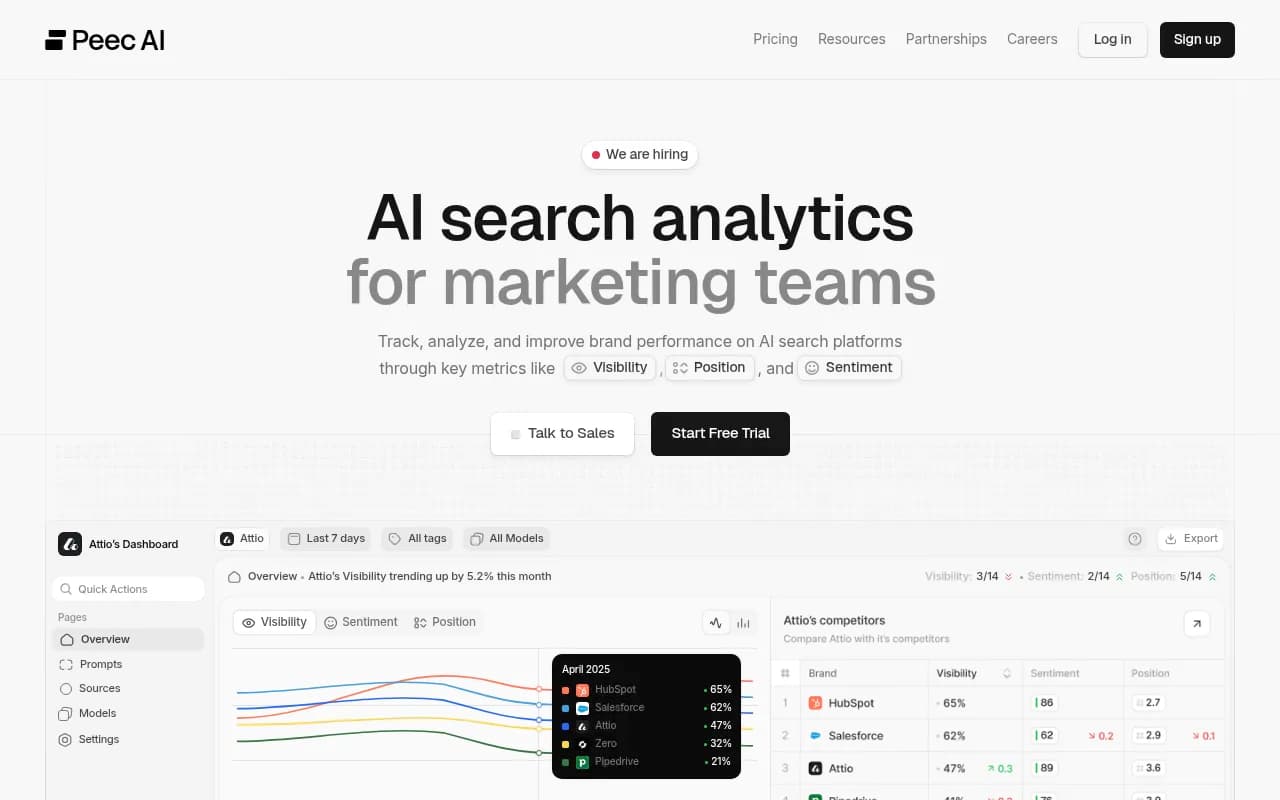
2. Peec AI -- clean and focused tracking
Peec AI tracks your brand visibility across ChatGPT, Perplexity, and Claude with a clean interface that's easy to get started with. It's a good option for teams that want straightforward monitoring without a steep learning curve.
It won't help you fix what it finds -- there's no content generation or gap analysis -- but for teams that just want to know where they stand before investing in a full GEO stack, it's a reasonable starting point.
3. Otterly.AI -- monitoring with prompt tracking
Otterly.AI monitors brand mentions across ChatGPT, Perplexity, and Google AI Overviews, with prompt tracking that lets you see how specific queries are performing over time. It's been around long enough to have a decent user base and solid core functionality.
Like Peec AI, it's primarily a monitoring tool. It tells you what's happening but doesn't tell you what to do about it. For teams that already have a content strategy and just need visibility data to inform it, that's fine.
Otterly.AI

4. Profound -- enterprise-grade AI visibility
Profound is built for larger organizations that need depth and reliability. It tracks brand mentions across nine-plus AI search engines and provides competitive benchmarking that's genuinely useful for enterprise marketing teams.
The pricing reflects the enterprise positioning -- it's not the right fit for small teams or agencies managing multiple smaller clients. But for a single large brand that needs serious AI visibility data, it's one of the stronger options.
Profound

5. AthenaHQ -- competitive intelligence focus
AthenaHQ leans into competitive analysis, which makes it useful if your primary question is "why is my competitor showing up and I'm not?" It tracks brand and competitor mentions across AI engines and surfaces patterns in how different models respond to category-level queries.
It's monitoring-focused, so you'll still need to take the insights somewhere else to act on them. But the competitive framing is genuinely helpful for teams trying to understand the gap before they start closing it.

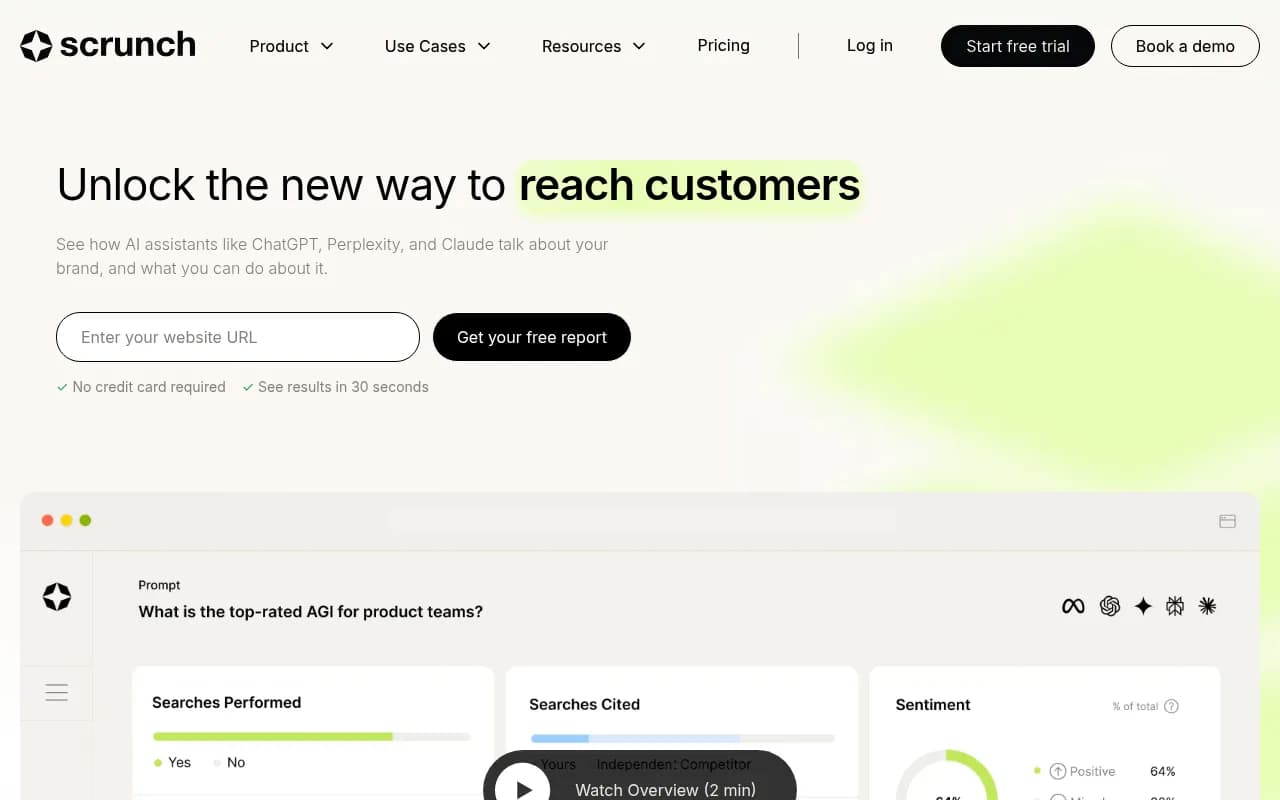
6. Scrunch AI -- mid-market tracking with decent depth
Scrunch AI sits in the middle of the market: more capable than the basic trackers, less expensive than the enterprise platforms. It tracks AI visibility across major LLMs and provides some competitive context.
It's a reasonable option for growth-stage companies that have outgrown simple monitoring tools but aren't ready for enterprise pricing. The feature set is solid without being overwhelming.
7. Semrush -- traditional SEO with AI search features
Semrush has been adding AI search tracking to its platform, which makes it relevant here if you're already using it for traditional SEO. The advantage is consolidation: one platform for Google rankings, backlink analysis, and some AI visibility data.
The limitation is that Semrush's AI search features use fixed prompts, which means you're tracking a predetermined set of queries rather than the specific prompts your customers are actually using. For teams that want AI visibility as a supplementary signal alongside their existing SEO work, it's convenient. For teams where AI search is the primary focus, the fixed-prompt approach is a real constraint.
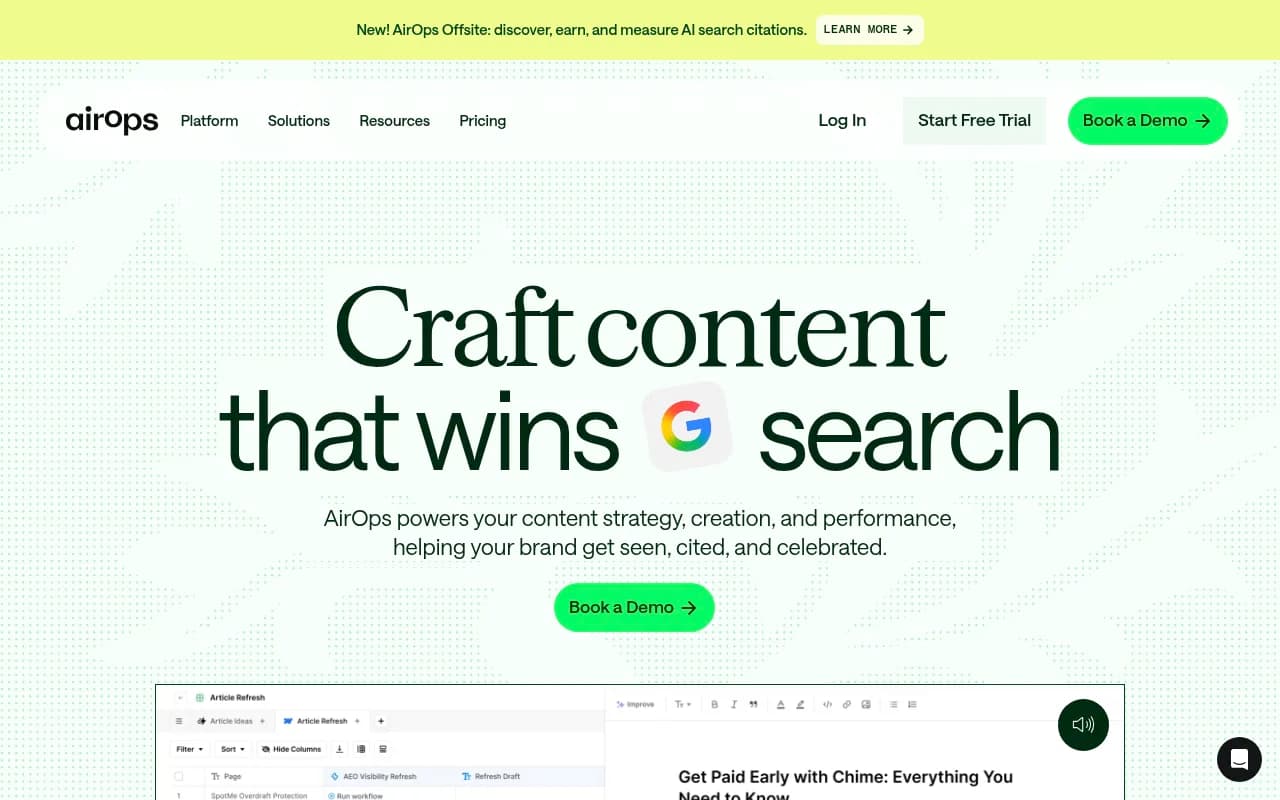
8. AirOps -- content engineering for AI search
AirOps takes a different angle: it's an end-to-end content engineering platform built specifically for AI search visibility. Rather than tracking where you are, it focuses on building the content infrastructure that gets you cited.
It's particularly strong for teams that have already diagnosed their visibility gaps and need to execute at scale. The platform helps you research, brief, write, and publish content that's structured for AI extraction -- not just SEO optimization.
How these tools compare
| Tool | Tracks AI visibility | Content gap analysis | Content generation | Crawler logs | Best for |
|---|---|---|---|---|---|
| Promptwatch | Yes (10 engines) | Yes | Yes | Yes | Full-stack GEO optimization |
| Peec AI | Yes (3 engines) | No | No | No | Simple monitoring |
| Otterly.AI | Yes (3 engines) | No | No | No | Prompt-level tracking |
| Profound | Yes (9+ engines) | Limited | No | No | Enterprise brands |
| AthenaHQ | Yes | No | No | No | Competitive intelligence |
| Scrunch AI | Yes | Limited | No | No | Mid-market tracking |
| Semrush | Limited (fixed prompts) | No | No | No | Traditional SEO + AI signals |
| AirOps | No | Yes | Yes | No | Content execution at scale |
What to actually do about your AI visibility
Knowing the tools is one thing. Here's the practical sequence that works.
Start with a visibility audit
Before you can fix anything, you need to know where you stand. Pick a set of prompts that represent how your customers would ask about your category -- "best [product type] for [use case]", "what is [your brand]", "[your brand] vs [competitor]" -- and run them across ChatGPT, Perplexity, and Google AI Overviews. Note where you appear, where competitors appear, and what sources get cited.
This takes about an hour manually. Tools like Promptwatch or Peec AI automate it and give you structured data to work with.
Fix your technical crawlability first
If AI crawlers can't read your pages, nothing else matters. Check whether GPTBot is blocked in your robots.txt (many sites accidentally block it). Make sure your key pages aren't JavaScript-rendered without a pre-rendered fallback. Run a basic crawl audit to find pages with slow load times, broken internal links, or missing structured data.
This is boring work, but it's the foundation. A brand with mediocre content that AI crawlers can fully access will outperform a brand with great content that's technically blocked.
Build your third-party citation footprint
AI models trust third-party mentions more than self-published content. That means getting your brand mentioned in the places AI models actually cite: industry publications, G2 and Capterra reviews, Reddit discussions in relevant subreddits, YouTube videos, and authoritative comparison articles.
This isn't a quick win -- it takes months of consistent effort. But it's the single highest-leverage thing you can do for long-term AI visibility.
Create content that answers questions directly
Go through your target prompts and ask: does my site have a page that directly and comprehensively answers this question? If not, that's a content gap. The content you create to fill these gaps should lead with the answer, use clear headers, define terms consistently, and avoid filler.
The goal isn't to write for AI -- it's to write clearly enough that AI can extract and cite your answer. Those are usually the same thing.
Track, iterate, and close the loop
AI visibility changes as models update their training data and as competitors publish new content. The brands that win in AI search over time are the ones that treat it as an ongoing process, not a one-time fix. Set up regular monitoring, review which new content is getting cited, and keep filling gaps as they appear.
A note on timeline
If you're expecting to fix your AI visibility in a week, you'll be disappointed. AI models update their training data on cycles that can range from weeks to months. Content you publish today might not appear in ChatGPT responses for a while, depending on when the next training update incorporates it.
That said, some AI engines (particularly Perplexity and Google AI Overviews) use real-time retrieval, which means well-structured content can start appearing in those results much faster. Starting with retrieval-augmented engines is a reasonable way to see early wins while the longer-term training data work plays out.
The brands that are most visible in AI search in 2026 started working on this in 2024 and 2025. The second-best time to start is now.