Key takeaways
- Yext, Uberall, and SOCi are purpose-built for local listing management and multi-location execution -- they're strong at keeping location data consistent across directories and Google Business Profiles, but they weren't designed for the new wave of AI search (ChatGPT, Perplexity, Claude, Gemini).
- Promptwatch is the only platform in this comparison built specifically for AI search visibility -- tracking how your brand appears in LLM responses, identifying content gaps, and generating content engineered to get cited by AI models.
- For franchise brands in 2026, the real risk is a split problem: your locations might be perfectly listed on Google Maps but completely invisible in ChatGPT and Perplexity, where a growing share of purchase decisions now start.
- The right answer for most large franchise brands isn't one platform -- it's understanding which layer each tool covers, and filling the AI visibility gap deliberately.
- If you're only running one of these four tools, you're probably missing something important.
The problem franchise brands face in 2026
Running local marketing for a franchise brand with 200, 500, or 2,000 locations is genuinely hard. You're not just managing one brand presence -- you're managing hundreds of them simultaneously, each with slightly different hours, services, staff, and local nuance.
For years, the core challenge was listing consistency: making sure every location showed the right address, phone number, and hours across Google, Yelp, Apple Maps, and dozens of other directories. Platforms like Yext, Uberall, and SOCi were built to solve exactly that.
But something shifted in 2024 and accelerated through 2025. Customers started asking ChatGPT "what's the best pizza franchise near downtown Austin?" or "which car rental company has the best reviews in Miami?" instead of typing those queries into Google. AI search engines don't pull from directory listings -- they pull from web content, citations, and what they've learned about brands from crawling the web.
That creates a new visibility layer that listing management platforms weren't designed to address. Your locations can be perfectly maintained on Google Business Profile and still be completely absent from AI-generated recommendations.
This comparison breaks down what each platform actually does well, where each one falls short, and how to think about the full picture.
What each platform is actually built for
Before comparing features, it helps to be honest about the fundamental design intent behind each platform.
Yext is a digital presence platform built around a structured Knowledge Graph -- a centralized database of location data that syncs to publishers, powers location pages, and feeds review management. It's a self-service tool: the platform gives you the infrastructure, but your team (or your franchisees) has to do the work. Strong for data governance at scale. Less strong for continuous local execution.
SOCi is an execution platform. It was built specifically for multi-location brands that need someone (or something) to actually do the local marketing work -- publishing posts, responding to reviews, optimizing profiles -- across hundreds of locations without requiring each franchisee to become a local marketing expert. Its AI agents handle a lot of the repetitive execution work automatically.
Uberall sits between the two. It combines listing management with local pages, review management, and increasingly, AI-powered local search optimization. It's strong in Europe and has good coverage across international markets, which matters for global franchise brands.
Promptwatch is a different category entirely. It's an AI search visibility platform -- built to track, analyze, and improve how your brand appears in ChatGPT, Perplexity, Google AI Overviews, Claude, Gemini, and other LLMs. It doesn't manage your Google Business Profile. What it does is tell you which AI-generated answers mention your brand, which ones mention your competitors instead, and what content you need to create to change that.

Feature-by-feature comparison
| Capability | Yext | SOCi | Uberall | Promptwatch |
|---|---|---|---|---|
| Listing management (Google, Apple, Yelp, etc.) | Yes -- core feature | Yes | Yes -- core feature | No |
| Google Business Profile optimization | Yes | Yes (agentic) | Yes | No |
| Review management | Yes | Yes (AI responses) | Yes | No |
| Local landing pages | Yes | Yes | Yes | No |
| Social media publishing | Limited | Yes | Limited | No |
| AI search tracking (ChatGPT, Perplexity, etc.) | Limited/basic | No | No | Yes -- 10 AI models |
| Content gap analysis for AI visibility | No | No | No | Yes |
| AI content generation for LLM citations | No | No | No | Yes |
| AI crawler log monitoring | No | No | No | Yes |
| Prompt volume & difficulty scoring | No | No | No | Yes |
| Reddit/YouTube citation tracking | No | No | No | Yes |
| ChatGPT Shopping tracking | No | No | No | Yes |
| Multi-location governance | Yes | Yes | Yes | Partial (multi-site plans) |
| Franchisee-level permissions | Yes | Yes | Yes | Agency/Enterprise plans |
| International/multi-language | Yes | Limited | Yes (strong in EU) | Yes |
| Traffic attribution (AI to revenue) | No | No | No | Yes |
Yext: the knowledge graph approach
Yext's core value proposition is data accuracy at scale. The Knowledge Graph lets you define every attribute of every location -- categories, hours, services, photos, FAQs -- and push that data to 200+ publishers simultaneously. When a franchisee changes their hours, it propagates everywhere.
That's genuinely useful. Inconsistent NAP (name, address, phone) data across directories is still a real problem for large franchise networks, and Yext handles it well.
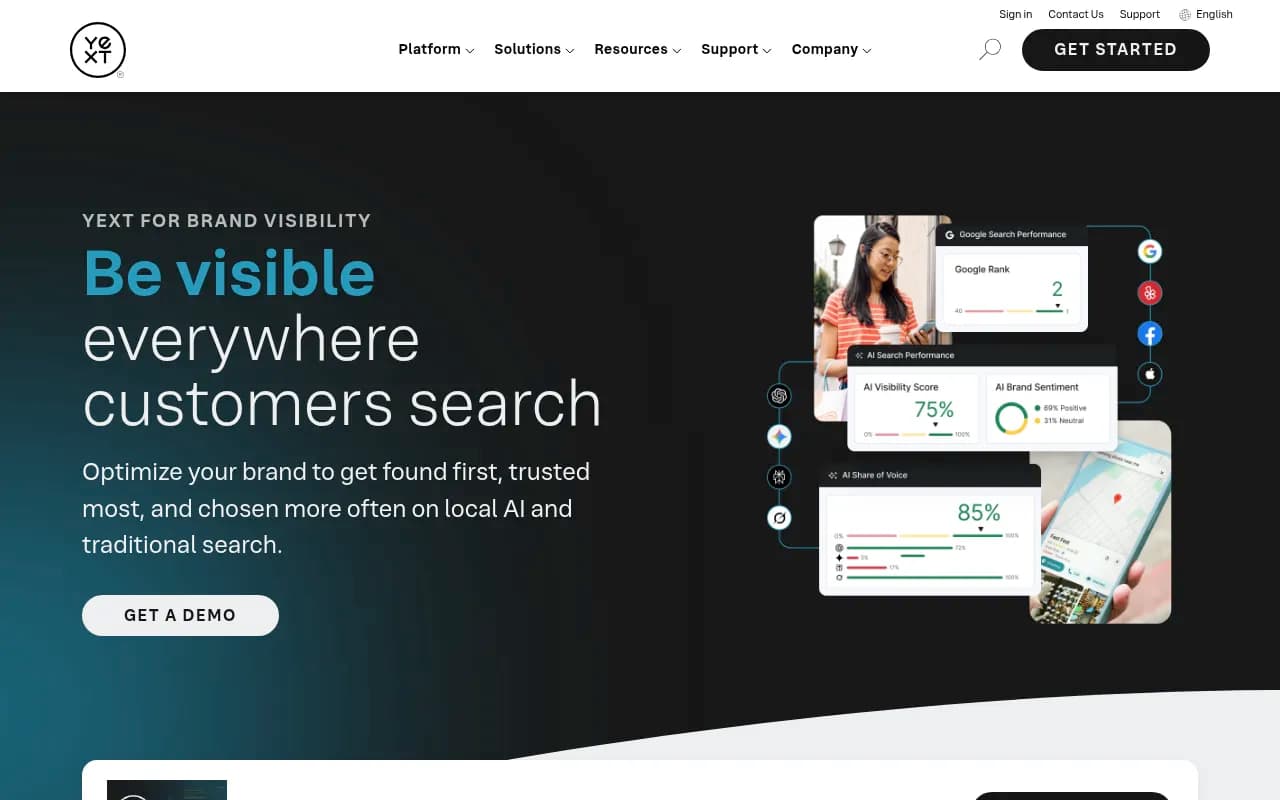
Where Yext gets complicated is execution. It's a self-service platform, which means someone has to actually use it. For franchise brands with 500 locations and varying levels of franchisee engagement, that's a real operational challenge. The platform enables the work -- it doesn't do it for you.
On AI search visibility, Yext has started adding features in this direction, but it's not the core product. Their AI search features are more about structured data and entity optimization for traditional search than about tracking and improving visibility in ChatGPT or Perplexity responses.
Best for: Franchise brands that need a centralized source of truth for location data, have a dedicated marketing ops team to manage it, and are primarily focused on traditional local search.
SOCi: execution at scale
SOCi's pitch is compelling for franchise brands that struggle with franchisee participation. Instead of hoping each location manager logs in and publishes posts or responds to reviews, SOCi's AI agents handle a lot of that automatically -- within guardrails set by corporate.
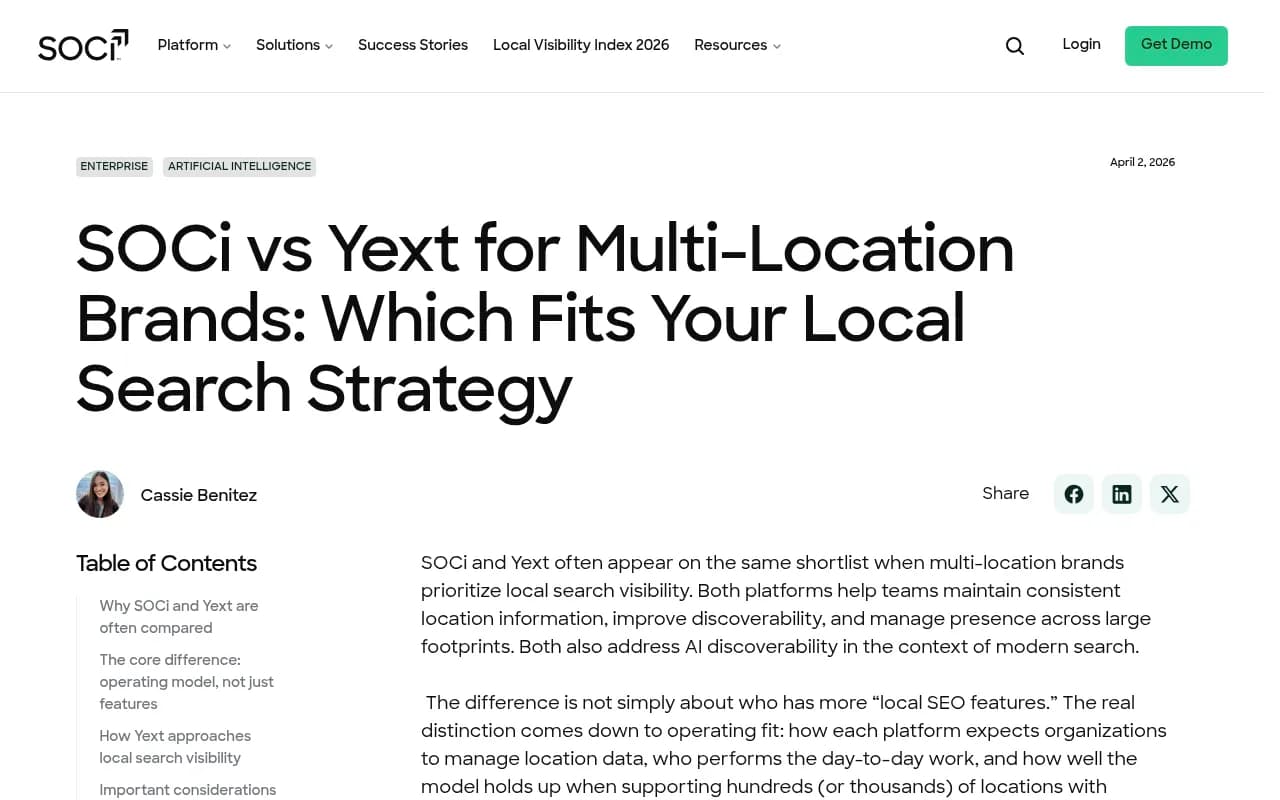
The platform covers listings, reviews, social, and local pages in one system. Its "Genius" AI features generate location-specific content, respond to reviews, and surface optimization opportunities. For franchise brands where the problem is uneven local execution rather than data governance, SOCi often fits better than Yext.
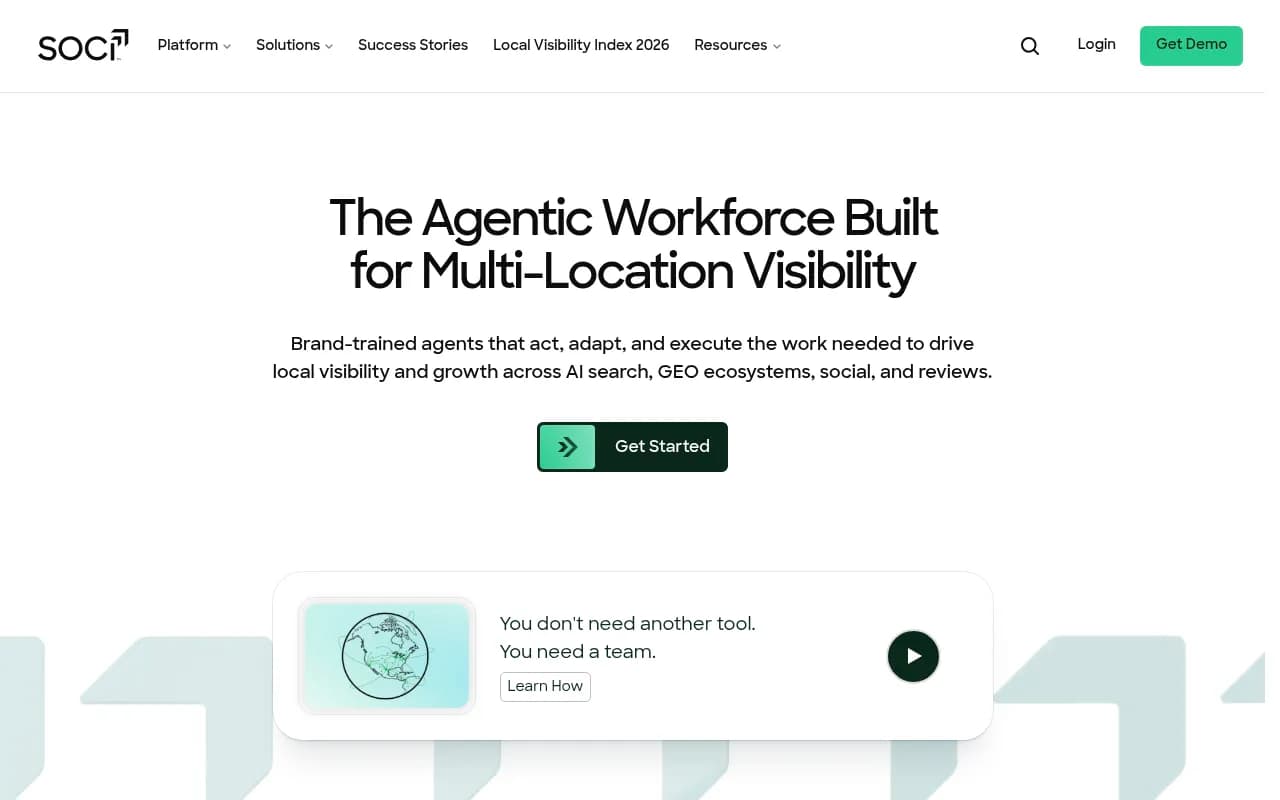
The limitation is that SOCi is still fundamentally a local marketing platform for traditional search and social. It doesn't track how your brand appears in AI-generated answers, doesn't analyze which prompts your competitors are winning, and doesn't help you create content specifically engineered to get cited by LLMs.
Best for: Multi-location brands with 100+ locations that need automated local execution -- especially franchises where individual location managers can't be relied on to do local marketing consistently.
Uberall: strong on listings, growing on AI local search
Uberall's strength is listing management with particularly good coverage in European markets -- important for global franchise brands operating across the EU. It handles the core local SEO stack: listings, reviews, local pages, and analytics.
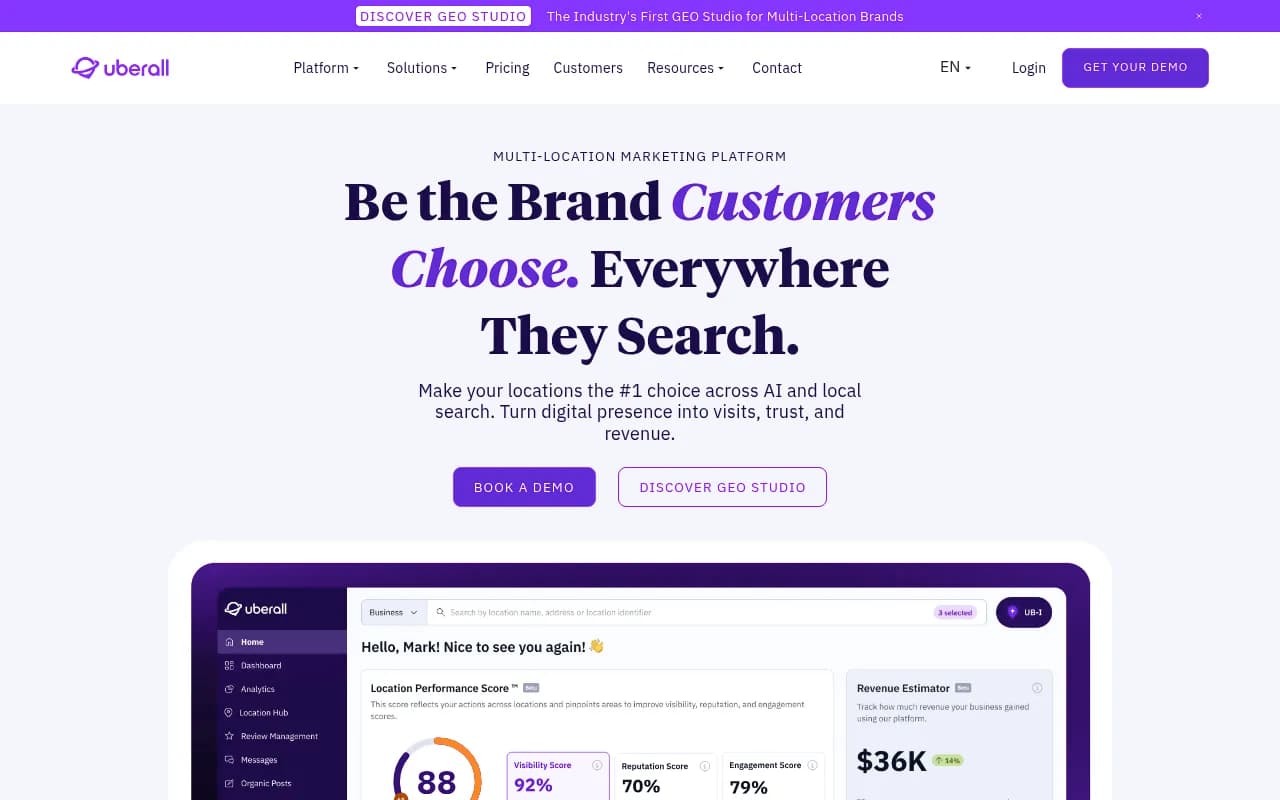
Uberall has been investing in AI-powered local search features, including tools to optimize for Google's AI-generated local results. That's a meaningful step -- Google AI Overviews and Google AI Mode are increasingly influencing which local businesses get recommended, and Uberall is building toward that.
But like SOCi and Yext, Uberall's AI search capabilities are focused on Google's ecosystem. Tracking visibility across ChatGPT, Perplexity, Claude, and other LLMs isn't what the platform was built for.
Best for: Global franchise brands with significant European presence that need strong listing coverage across international markets.
Promptwatch: the AI search visibility layer
Promptwatch is solving a different problem than the other three. It's not trying to manage your Google Business Profile or sync your hours to Apple Maps. It's tracking and improving how your brand appears when someone asks an AI engine a question.
That matters more than most franchise marketing teams currently realize. A customer asking ChatGPT "which fast casual burger chain has the best value in Chicago?" is getting an answer based on what ChatGPT knows about your brand from web content -- not from your Google Business Profile. If your brand isn't mentioned, or if a competitor is mentioned more favorably, that's a visibility problem that no listing management platform can fix.
Promptwatch's approach has three stages. First, it shows you exactly where you're invisible -- which prompts your competitors appear in that you don't, which AI models are citing them, and what content is driving those citations. Second, it helps you create content specifically designed to get cited: articles, listicles, and comparisons built around real citation data from 880M+ citations analyzed. Third, it tracks whether that content is working -- page-level citation tracking shows which pages are being cited by which AI models, and traffic attribution connects AI visibility to actual revenue.
For franchise brands, there are some specific capabilities worth noting. Promptwatch tracks AI visibility across 10 models: ChatGPT, Perplexity, Google AI Overviews, Google AI Mode, Claude, Gemini, Meta/Llama, DeepSeek, Grok, and Mistral. It supports multi-language and multi-region monitoring, which matters for international franchise networks. The AI crawler logs show which pages AI engines are actually reading on your site -- useful for understanding why some locations or content types get cited and others don't.
The gap for franchise brands is that Promptwatch doesn't replace listing management. It doesn't sync your hours to Google or manage franchisee-level review responses. It's an additional layer on top of your local marketing stack, not a replacement for it.
Best for: Franchise brands that already have listing management handled and want to understand and improve their visibility in AI-generated search results. Also strong for brands that are starting to see AI search drive meaningful traffic and want to measure and optimize it.
The AI visibility gap most franchise brands are ignoring
Here's the uncomfortable reality: most franchise marketing teams are optimizing for a search behavior that's declining in share while ignoring the one that's growing.
Google traditional search is still important. But according to data from multiple sources, AI-assisted search queries have grown dramatically since 2024. ChatGPT alone processes hundreds of millions of queries per day. Perplexity has become a default research tool for a significant portion of younger consumers. Google AI Overviews now appear for a large share of informational and local queries.
The franchise brands that will win in AI search are the ones creating content that answers the questions AI models are being asked. That means detailed comparison content, location-specific guides, FAQ pages that address real customer questions, and authoritative brand content that AI models can cite confidently.
None of the listing management platforms help you do that. Promptwatch does.
How to think about your stack
For most franchise brands, the answer isn't choosing one of these four platforms -- it's understanding which layer each one covers.
Layer 1: Listing accuracy and local execution. You need one of Yext, SOCi, or Uberall here. Which one depends on your operating model:
- If you have a strong central marketing team and need data governance: Yext
- If you need automated local execution across franchisees: SOCi
- If you're a global brand with significant European presence: Uberall
Layer 2: AI search visibility. This is where Promptwatch fits. Once your listing foundation is solid, the next frontier is making sure your brand appears in AI-generated answers -- and that requires a different kind of tool.
The brands that treat these as separate problems and solve both deliberately will have a significant advantage over those still treating "local SEO" as synonymous with "listing management."
Pricing and accessibility
| Platform | Starting price | Model | Free trial |
|---|---|---|---|
| Yext | ~$199/mo (single location) | Self-service, per-location pricing | Yes |
| SOCi | Custom (enterprise) | Managed/agentic, per-location | Demo only |
| Uberall | Custom (enterprise) | Managed, per-location | Demo only |
| Promptwatch | $99/mo (Essential) | Self-service, per-site | Yes |
Promptwatch's pricing is notably more accessible than the enterprise listing platforms. The Essential plan at $99/month covers one site with 50 prompts and 5 AI-generated articles. The Professional plan at $249/month adds crawler logs, city-level tracking, and 15 articles per month. For franchise brands needing multi-site coverage, Business ($579/month for 5 sites) and Agency/Enterprise plans are available.
Yext, SOCi, and Uberall all use per-location pricing that scales quickly for large franchise networks -- a 500-location brand can easily be looking at five- or six-figure annual contracts.
Which platform wins for franchise brands?
There's no single winner here because the platforms aren't competing for the same job.
If your franchise network has inconsistent listing data, poor review response rates, and franchisees who aren't doing local marketing -- SOCi or Uberall will move the needle faster than anything else.
If you need a centralized data governance layer and have the internal team to manage it -- Yext is the most mature option.
If you want to understand and improve how your brand appears when customers ask AI engines about your category -- Promptwatch is the only platform in this comparison built specifically for that.
The franchise brands worth watching in 2026 are the ones treating AI search visibility as a distinct discipline, investing in content that gets cited by LLMs, and measuring AI-driven traffic as a real channel. That's a Promptwatch-shaped problem, and the listing management platforms aren't going to solve it.
Most franchise marketing teams are about 18 months behind on this. The ones that move now will be the ones that show up in ChatGPT's recommendations when a customer asks which franchise to visit.