Key takeaways
- Crawler log analysis is one of the most underrated features in AI visibility platforms -- it tells you which AI bots are actually reading your pages, how often, and what they're missing.
- Of the four platforms compared here, only Promptwatch and Scriptbee offer dedicated AI crawler log monitoring as a core feature.
- ZipTie focuses on monitoring plus content optimization recommendations, but lacks deep crawler-level diagnostics.
- Evertune is built for enterprise GEO with strong brand perception tracking, but crawler log analysis isn't a primary capability.
- If you want to close the loop from "AI bots are crawling my site" to "here's the content I should create to get cited," Promptwatch is the most complete platform of the four.
Why crawler logs matter more than most teams realize
Most conversations about AI visibility focus on the output side: is my brand mentioned in ChatGPT? Does Perplexity cite my pages? Those are valid questions. But there's an earlier, more fundamental question that often gets skipped: are AI crawlers even reading my content in the first place?
This is where crawler log analysis comes in. AI search engines -- ChatGPT's GPTBot, Perplexity's PerplexityBot, Claude's ClaudeBot, and others -- all send crawlers to index web content before they can cite it. If those bots are hitting your site and encountering JavaScript rendering failures, blocked pages, or slow load times, your content might as well not exist from their perspective.
Traditional SEO teams have used server log analysis for years to understand Googlebot behavior. The same logic applies to AI search, but most AI visibility platforms haven't caught up. They track citations and brand mentions, but they don't tell you what's happening at the crawl layer.
The four platforms in this comparison sit at different points on that spectrum. Let's break down where each one stands.
The four platforms at a glance
| Feature | ZipTie | Promptwatch | Scriptbee | Evertune |
|---|---|---|---|---|
| AI crawler log monitoring | No | Yes | Yes | No |
| Brand mention tracking | Yes | Yes | Yes | Yes |
| Content gap analysis | Yes | Yes | Limited | Limited |
| AI content generation | Yes | Yes | No | No |
| Traffic attribution | No | Yes | No | No |
| Reddit/YouTube tracking | No | Yes | No | No |
| ChatGPT Shopping tracking | No | Yes | No | No |
| Prompt volume/difficulty | No | Yes | No | No |
| Multi-LLM coverage | 3 models | 10+ models | Multiple | Multiple |
| Pricing (entry) | Not public | $99/mo | Unlimited domains | Enterprise |
| Best for | SMB monitoring + optimization | Full-cycle GEO teams | Dev/agency crawler focus | Enterprise brand tracking |
ZipTie
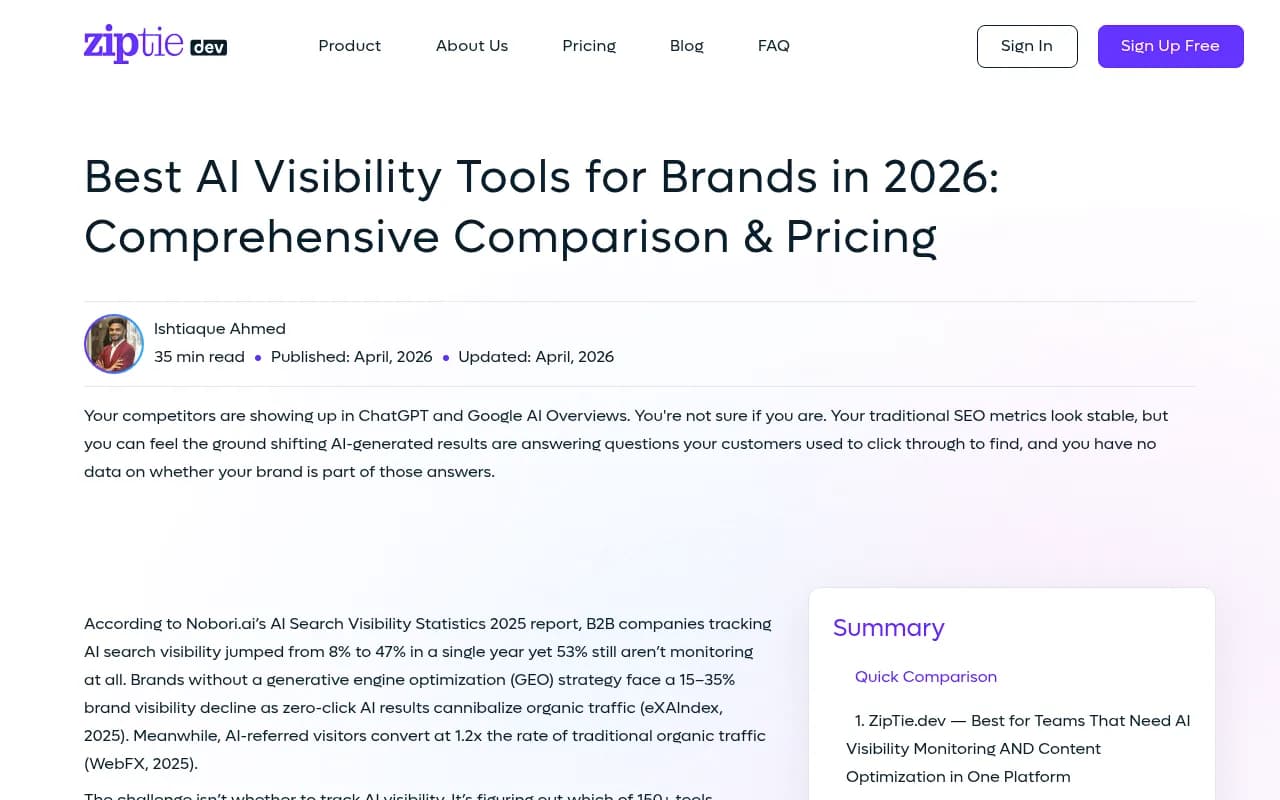
ZipTie positions itself as a platform that combines monitoring with content optimization recommendations -- a step beyond pure tracking tools. It scans AI responses in real time (rather than using cached data), which is a meaningful differentiator from tools that run scheduled queries on a delay.
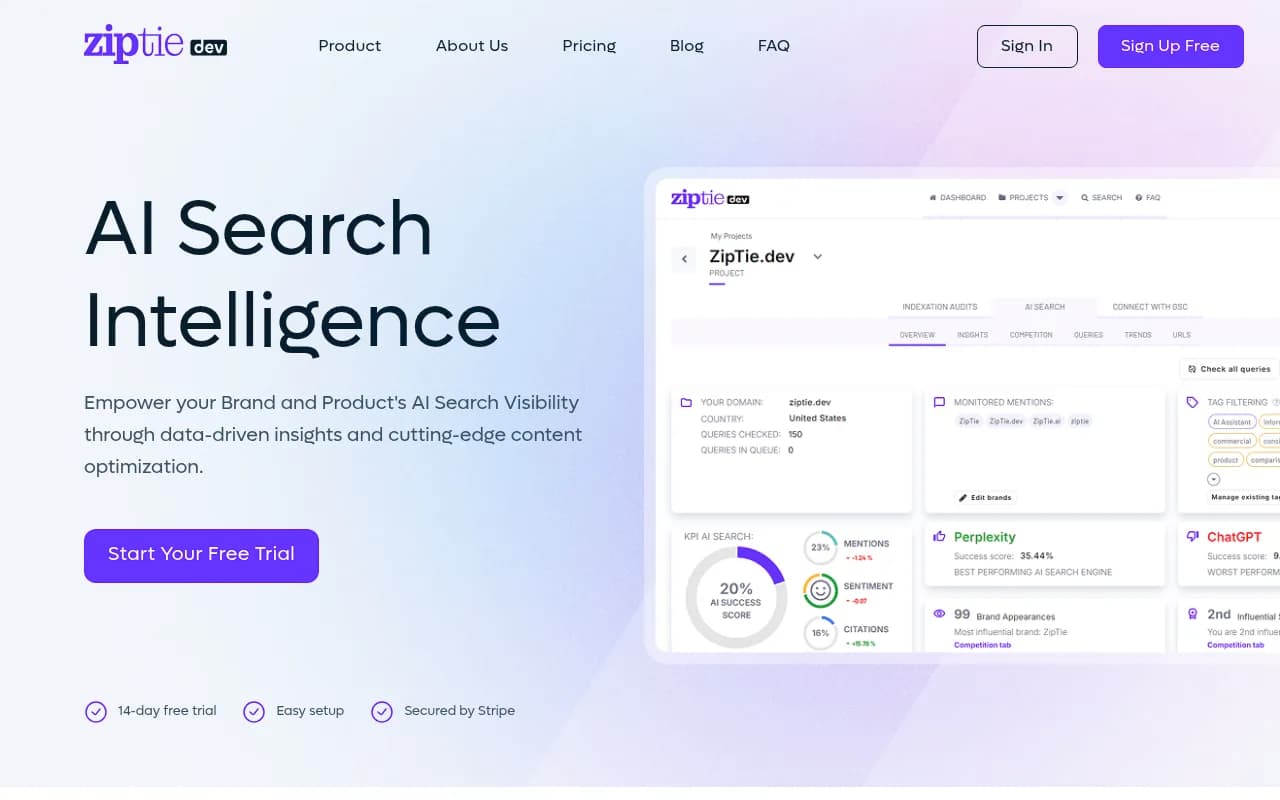
Where ZipTie stands out is in its built-in optimization recommendations. After showing you where your brand appears (or doesn't), it surfaces specific suggestions for what to fix. That's closer to the "action" side of the spectrum than most monitoring-only tools.
The limitations are real though. ZipTie tracks three AI platforms -- ChatGPT, Perplexity, and one other -- which is narrow compared to platforms covering 10+. Pricing isn't publicly listed, which makes it harder to evaluate for budget-conscious teams. And despite the optimization angle, there's no built-in AI content generation, so you're still doing the writing yourself after getting the recommendations.
Crawler log analysis is not part of ZipTie's feature set. If you want to understand how GPTBot or ClaudeBot is behaving on your site, you won't find that here.
Best for: Smaller teams that want monitoring plus actionable recommendations without needing deep technical diagnostics.
Promptwatch
Promptwatch covers the full cycle: find gaps, create content, track results. That loop is what separates it from most competitors in this comparison.

On the crawler log side specifically, Promptwatch provides real-time logs of AI crawlers hitting your website -- which pages they read, errors they encounter, how often they return. This is the kind of data that lets you diagnose why a page isn't getting cited even when the content looks good on the surface. Maybe GPTBot is hitting a JavaScript wall. Maybe ClaudeBot is crawling a page but the content structure is confusing it. Crawler logs surface these issues directly.
Beyond that, Promptwatch tracks 10+ AI models (ChatGPT, Perplexity, Claude, Gemini, Google AI Overviews, Grok, DeepSeek, Copilot, Meta AI, Mistral), which is the broadest coverage of the four platforms here. Its Answer Gap Analysis shows exactly which prompts competitors rank for that you don't -- with the specific content topics your site is missing. The built-in AI writing agent then generates articles, listicles, and comparisons grounded in citation data from 880M+ analyzed sources.
Traffic attribution is another area where Promptwatch goes further. You can connect AI visibility to actual revenue through a code snippet, Google Search Console integration, or server log analysis. Most platforms in this space don't attempt this at all.
Pricing is transparent: $99/mo for the Essential plan (1 site, 50 prompts, 5 articles), $249/mo for Professional (2 sites, 150 prompts, 15 articles, crawler logs, city/state tracking), and $579/mo for Business (5 sites, 350 prompts, 30 articles). Crawler logs are available from the Professional tier up.
Best for: Marketing and SEO teams that want to go from "we don't know what AI thinks of us" to "we're publishing content that gets cited and tracking the revenue impact."
Scriptbee
Scriptbee takes a different angle. Its headline differentiator is unlimited domains -- you can monitor as many sites as you want without per-domain pricing penalties. That's genuinely useful for agencies managing large client portfolios or enterprise teams with multiple brand properties.
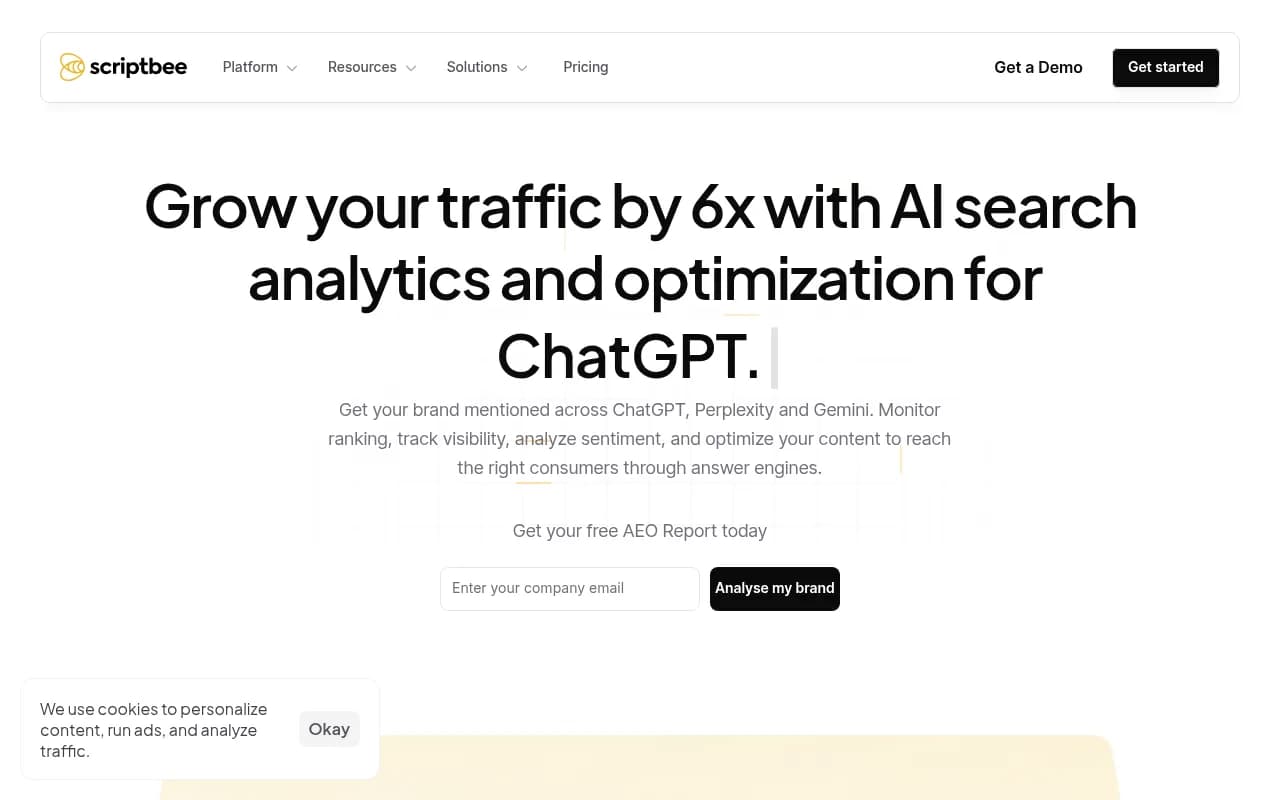
On the crawler log front, Scriptbee does offer AI crawler monitoring, which puts it in the same category as Promptwatch for technical diagnostics. This is a real capability gap that most competitors ignore entirely, so credit where it's due.
What Scriptbee doesn't have is the content side of the equation. There's no built-in content generation, no answer gap analysis that surfaces specific missing topics, and no traffic attribution. It's more of a monitoring and diagnostics platform than an optimization one. You'll get solid data on what AI bots are doing on your site, but the "now what?" question is left to you.
The unlimited domains model is the main draw. If you're an agency running 50+ client sites and need crawler-level visibility across all of them without the pricing scaling linearly, Scriptbee is worth a serious look.
Best for: Agencies and enterprise teams with large domain portfolios who need crawler diagnostics at scale without per-site pricing.
Evertune
Evertune is built for enterprise GEO with a strong emphasis on brand perception -- not just whether you're mentioned, but how you're portrayed. It tracks sentiment, messaging consistency, and how AI models characterize your brand across different query types.
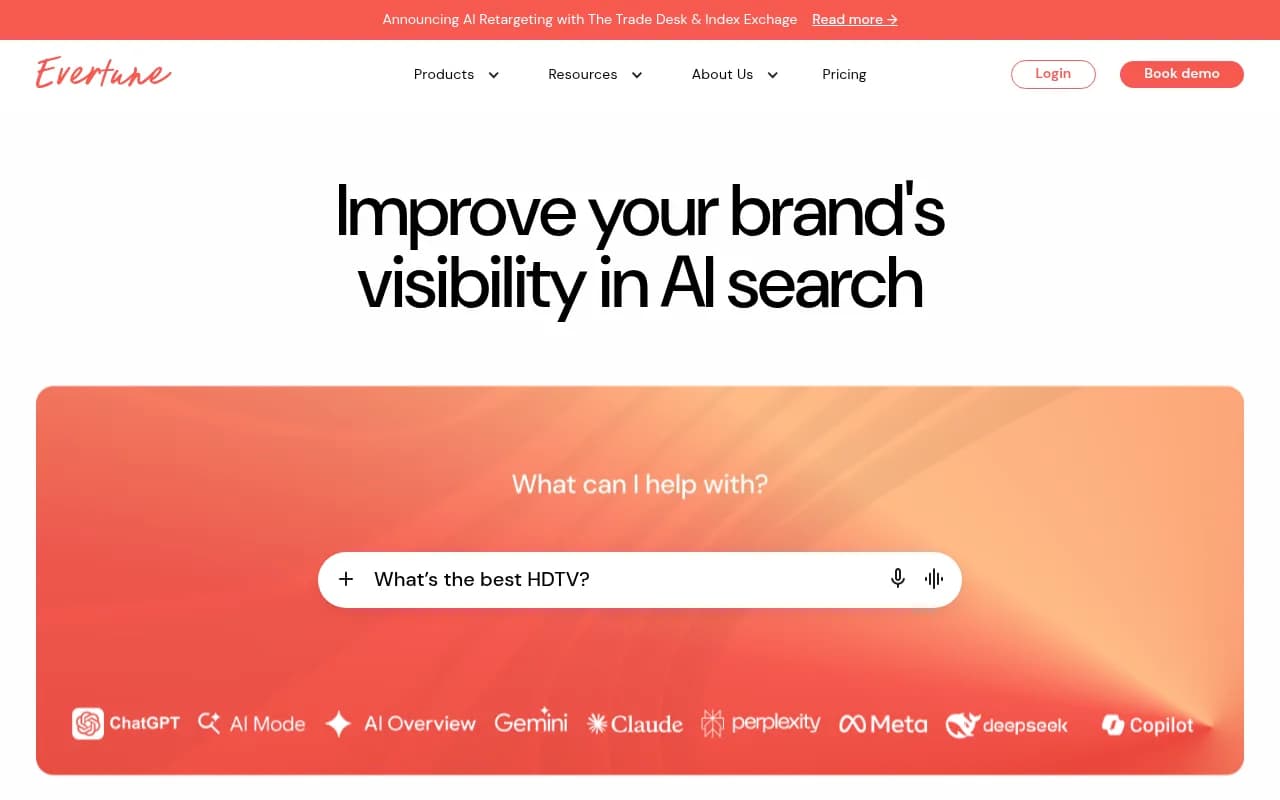

That's a genuinely different angle from the other three platforms here. For Fortune 500 brands where the question isn't just "are we mentioned?" but "are we being described accurately and favorably?", Evertune addresses something the others mostly don't.
The tradeoff is that Evertune is less focused on the technical and content optimization layers. Crawler log analysis isn't a core feature. Content gap analysis and AI content generation aren't primary capabilities. It's a brand intelligence platform more than a GEO optimization engine.
Pricing is enterprise-tier, which means it's not the right fit for most SMB or mid-market teams. The target customer is a large brand with a dedicated GEO or brand strategy team.
Best for: Enterprise brands that need deep brand perception tracking across AI models, particularly where messaging accuracy and sentiment matter as much as citation frequency.
How to choose between them
The right platform depends on what problem you're actually trying to solve.
If your main question is "why aren't AI bots citing my content even though I have good content?", you need crawler log analysis. That narrows the field to Promptwatch and Scriptbee. Promptwatch adds content generation and traffic attribution on top; Scriptbee adds unlimited domains and a cleaner per-domain cost model.
If your main question is "what content should I create to get cited more?", ZipTie and Promptwatch both address this, but Promptwatch goes deeper with prompt volume data, competitor gap analysis, and actual content generation built in.
If your main question is "how is our brand being portrayed in AI responses, not just mentioned?", Evertune is the most purpose-built tool for that.
For most marketing and SEO teams in 2026, the most common situation is: we're not sure what AI models think of us, we don't know why, and we want to fix it. That's the scenario Promptwatch is most directly built for -- it covers the diagnostic layer (crawler logs), the gap analysis layer (what content is missing), the creation layer (AI writing agent), and the attribution layer (connecting it to revenue).
A note on what "crawler log analysis" actually means in practice
It's worth being specific here because the term gets used loosely. Real crawler log analysis means your platform is reading your server logs (or a code snippet equivalent) and surfacing which AI user agents visited which URLs, at what frequency, with what HTTP response codes.
That's different from a platform that simply tells you "GPTBot crawls sites like yours." Actual log data shows you things like:
- GPTBot crawled your homepage 47 times last month but never visited your product comparison pages
- ClaudeBot hit your pricing page and got a 403 error
- PerplexityBot crawled a page that was redirected, so it may have indexed the wrong version
This kind of diagnostic is what lets you take concrete technical action. Without it, you're optimizing content without knowing whether the bots can even read it.
Both Promptwatch and Scriptbee offer this at a real level. ZipTie and Evertune don't, which is fine if your content is technically accessible -- but if you're seeing citation gaps you can't explain, the crawler layer is often where the answer lives.
Bottom line
The AI visibility platform market has matured enough in 2026 that "we track brand mentions" is table stakes. The meaningful differentiation is now in three areas: how deep the technical diagnostics go (crawler logs), how actionable the content recommendations are (gap analysis plus generation), and how well the platform connects visibility to business outcomes (traffic attribution).
On all three dimensions, Promptwatch covers the most ground. Scriptbee is the strongest alternative if unlimited domains and crawler diagnostics without the content layer is what you need. ZipTie is a solid mid-market option if you want recommendations without deep technical diagnostics. Evertune serves a specific enterprise use case around brand perception that the others don't really address.
None of these platforms are identical, and the "best" one is the one that matches your actual workflow -- not the one with the longest feature list.