Key takeaways
- Crawler log monitoring -- seeing which AI bots visit your site, which pages they read, and how often they return -- is one of the most diagnostic features in any AI visibility platform, yet most tools don't offer it at all.
- Of the four platforms compared here, Promptwatch and Scriptbee both include crawler log monitoring; ZipTie focuses on UI simulation accuracy; Evertune targets enterprise brand tracking at scale.
- Promptwatch is the only platform that connects crawler data to a full optimization loop: find content gaps, generate AI-targeted content, then track whether visibility improves.
- Evertune suits Fortune 500 teams that need breadth and executive reporting; Scriptbee suits teams that want unlimited domain coverage at a low price; ZipTie suits teams that prioritize tracking accuracy over breadth.
- If you want to move from "we know we're invisible" to "we fixed it," Promptwatch is the clearest path.
AI visibility platforms have multiplied fast. Two years ago there were maybe a dozen. Now there are closer to a hundred, and most of them look similar at first glance: a dashboard, some brand mention counts, a few competitor comparisons. The real differences show up in the technical layer underneath.
One feature in particular separates the serious platforms from the monitoring-only dashboards: crawler log monitoring. This is the ability to see when AI crawlers (GPTBot, ClaudeBot, PerplexityBot, and others) actually visit your website, which pages they read, which pages they skip, and how frequently they return. Without this data, you're guessing whether AI engines can even access your content. With it, you can diagnose indexing failures, prioritize pages for optimization, and understand the relationship between crawl frequency and citation frequency.
This guide compares four platforms -- ZipTie, Scriptbee, Evertune, and Promptwatch -- specifically on how they handle crawler log monitoring, and more broadly on depth, accuracy, and what you can actually do with the data they surface.
What crawler log monitoring actually means
Before comparing tools, it's worth being precise about what "crawler log monitoring" means, because vendors use the term loosely.
At the basic level, some tools simply detect whether a known AI bot user-agent has appeared in your server logs. That's useful but shallow. A more complete implementation tells you:
- Which specific AI crawler visited (GPTBot vs ClaudeBot vs PerplexityBot vs Googlebot-AI)
- Which URLs were crawled and when
- HTTP status codes returned (200, 404, 403, 503) -- critical for diagnosing access issues
- Crawl frequency and recency trends
- Which pages are being ignored entirely
- Whether JavaScript-heavy pages are being rendered or skipped
The last point matters more than most people realize. AI crawlers often struggle with JavaScript-rendered content. A page that looks fine in a browser may return a blank HTML shell to a bot. Without crawler log data, you'd never know.
The four platforms
ZipTie
ZipTie positions itself around tracking accuracy rather than crawler diagnostics. Its core differentiator is UI simulation: instead of querying AI APIs directly (which can return different results than what users actually see), ZipTie simulates a real browser session to capture what ChatGPT and Perplexity actually show. According to ZipTie's own published comparison, API-based tracking matched manually verified results only about 60% of the time in independent testing -- a meaningful gap if you're making optimization decisions based on that data.
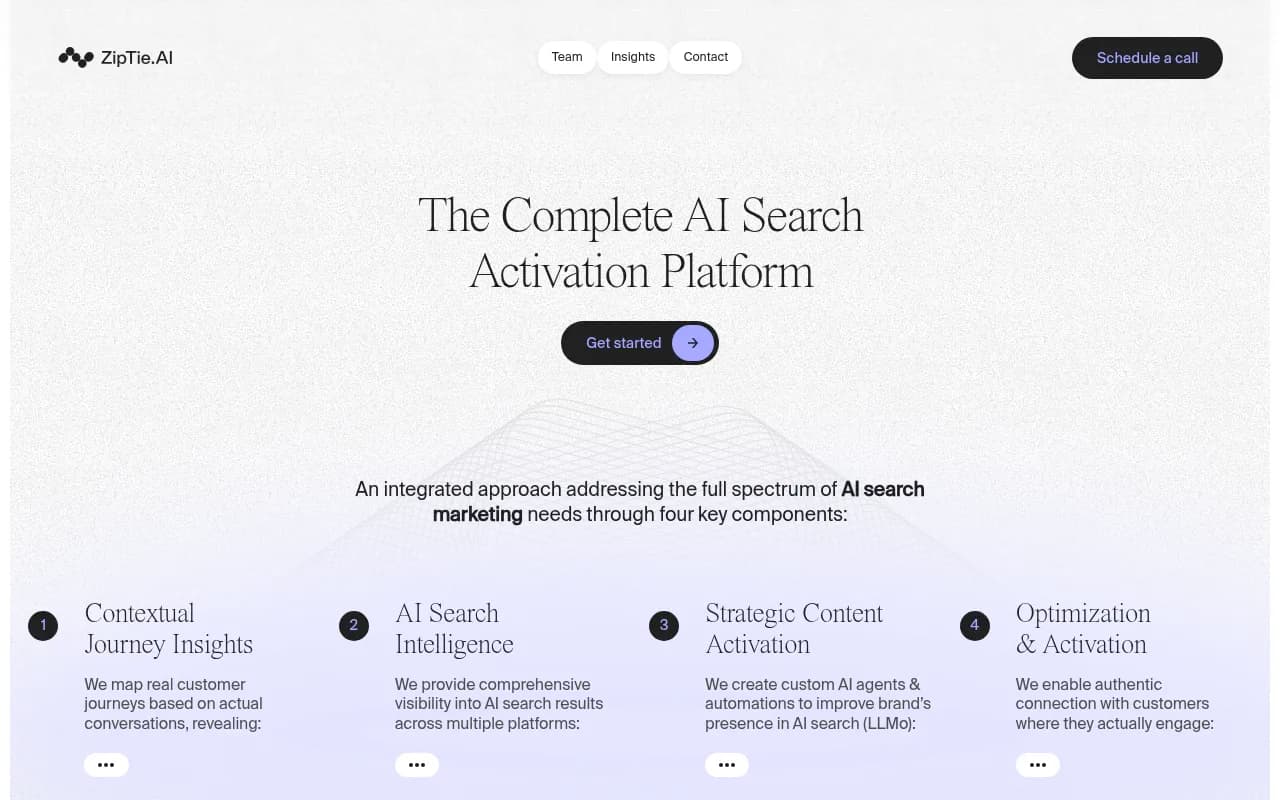
ZipTie covers three AI engines (ChatGPT, Perplexity, and Google AI Overviews) and six monitoring regions. Its AI Success Score gives you a single metric for brand visibility performance. The platform is priced accessibly -- entry-level plans are among the cheapest in the category -- and is genuinely useful for teams that want accurate, verified tracking without enterprise overhead.
What ZipTie doesn't do: it doesn't include crawler log monitoring. There's no visibility into which AI bots are crawling your site, which pages they're hitting, or what errors they're encountering. For teams that need to diagnose technical crawlability issues, that's a real gap.
Scriptbee
Scriptbee takes a different angle. Its headline differentiator is unlimited domain monitoring -- you can track as many websites as you want under a single plan, which makes it attractive for agencies managing large client portfolios. It also includes AI crawler log monitoring, which puts it in a smaller subset of platforms that actually surface bot-level data.
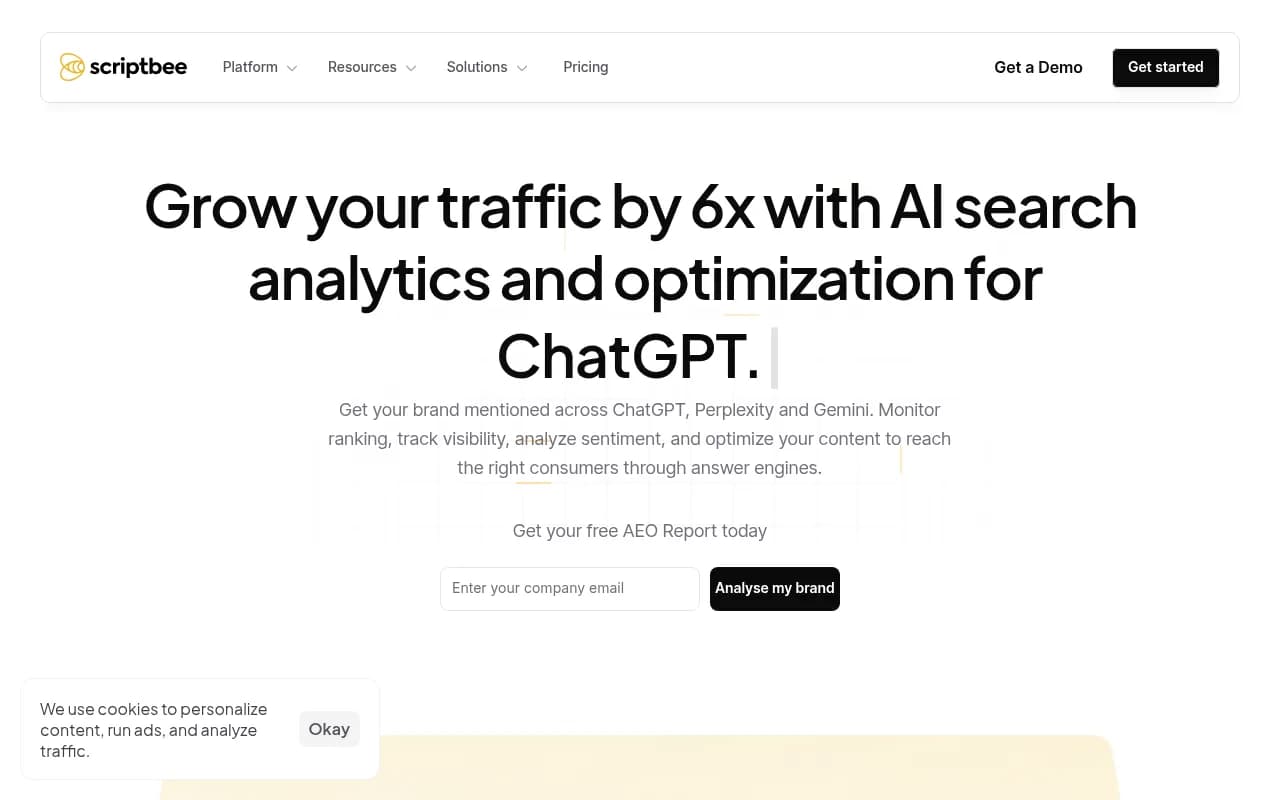
The crawler monitoring in Scriptbee shows which AI bots have visited your domains and provides a basic log view. It's not the deepest implementation in the market -- the analysis layer is relatively thin compared to what Promptwatch offers -- but it's present, which already puts Scriptbee ahead of the majority of competitors.
Scriptbee's broader feature set is solid for the price: brand mention tracking, citation analysis, and competitor comparisons across multiple AI engines. The unlimited domain model is genuinely useful if you're running more than two or three sites. The main limitation is that Scriptbee is primarily a monitoring platform. It surfaces data but doesn't provide a structured path to acting on it -- there's no built-in content generation, no gap analysis workflow, and no traffic attribution.
Evertune
Evertune targets a different buyer entirely. It's built for Fortune 500 brands and enterprise marketing teams that need AI visibility data at scale, with the kind of governance, reporting, and integrations that large organizations require.
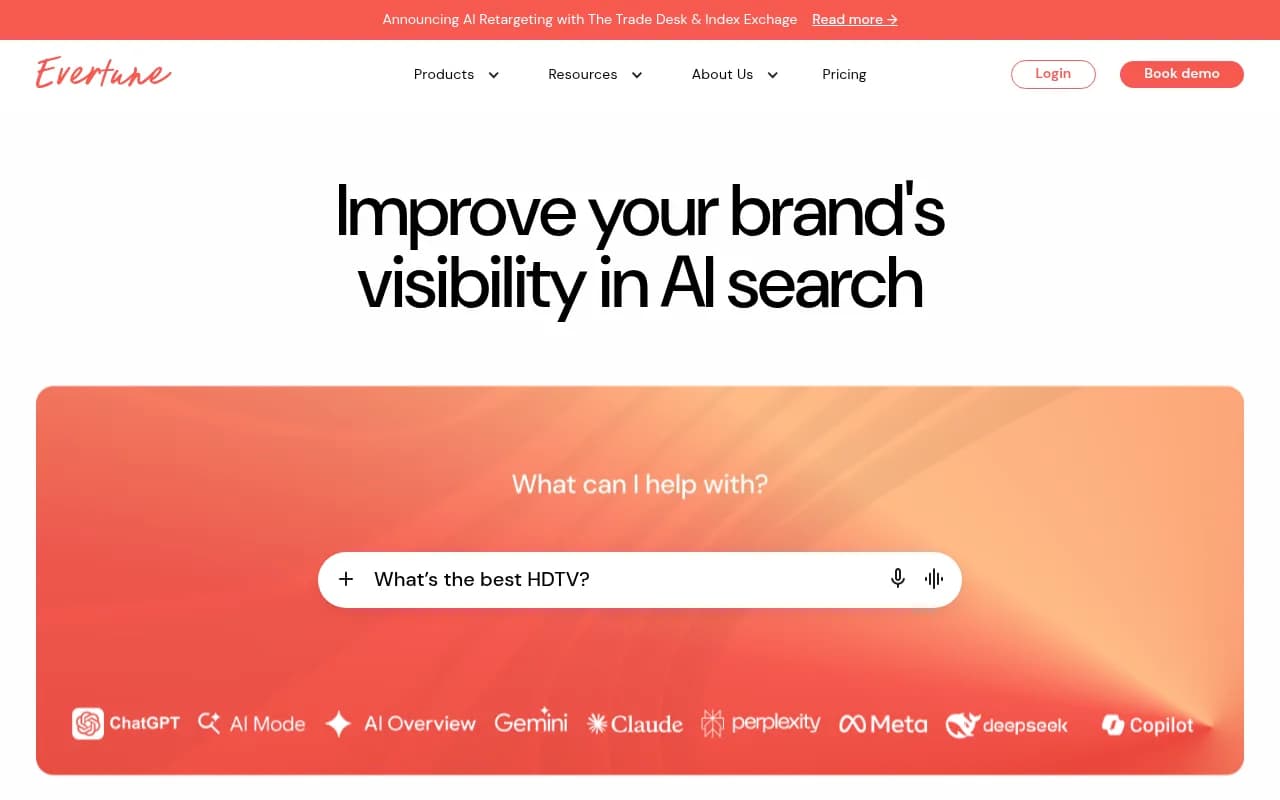
Evertune's strengths are breadth and executive reporting. It tracks brand mentions across a wide range of AI engines, provides competitive benchmarking at scale, and produces the kind of polished outputs that work in board-level presentations. It also integrates with enterprise data stacks.
On crawler log monitoring specifically, Evertune's focus is less on the technical crawl layer and more on the output layer -- what AI engines are saying about your brand, how sentiment and share of voice shift over time. This is valuable for brand teams, but it's a different use case than diagnosing why your product pages aren't being cited.
Evertune is expensive. It's priced for enterprise budgets, and smaller teams will find it hard to justify. If you're a mid-market company or an agency, it's likely overkill.
Promptwatch
Promptwatch is the platform that most directly addresses the full problem: not just tracking where you're visible, but diagnosing why you're not visible and then helping you fix it.

On crawler log monitoring, Promptwatch provides real-time logs of AI crawlers hitting your website -- GPTBot, ClaudeBot, PerplexityBot, and others. You can see which pages each bot visited, what HTTP status codes were returned, how frequently they return, and which pages they're skipping entirely. This is the diagnostic layer that most platforms lack. If a bot is hitting your homepage but never crawling your product pages, you'll see it. If your JavaScript rendering is causing bots to receive empty HTML, the 200 status with no content will show up in the logs.
But crawler logs are just one piece of what makes Promptwatch different. The platform is built around an optimization loop rather than a monitoring dashboard:
- The Answer Gap Analysis identifies which prompts your competitors are being cited for that you're not. You see the specific topics and questions AI models want to answer but can't find on your site.
- The built-in AI writing agent generates content -- articles, listicles, comparisons -- engineered to get cited by ChatGPT, Claude, Perplexity, and other models. This isn't generic SEO content; it's grounded in 880M+ citations analyzed across the platform.
- Page-level tracking shows whether your new content is actually being cited, by which models, and how often. Traffic attribution (via code snippet, GSC integration, or server log analysis) connects visibility to actual revenue.
Promptwatch monitors 10 AI models: ChatGPT, Perplexity, Google AI Overviews, Google AI Mode, Claude, Gemini, Meta/Llama, DeepSeek, Grok, Mistral, and Copilot. It also includes Reddit and YouTube tracking (discussions that directly influence AI recommendations), ChatGPT Shopping monitoring, prompt volume and difficulty scoring, and multi-language/multi-region support.
Pricing starts at $99/month for the Essential plan (1 site, 50 prompts, 5 articles). The Professional plan at $249/month adds crawler logs, state/city tracking, and 15 articles per month. The Business plan at $579/month covers 5 sites and 30 articles.
Feature comparison
| Feature | ZipTie | Scriptbee | Evertune | Promptwatch |
|---|---|---|---|---|
| AI engines monitored | 3 | Multiple | Multiple | 10 |
| Crawler log monitoring | No | Yes (basic) | No | Yes (real-time, detailed) |
| UI simulation (vs API-only) | Yes | No | No | No |
| Content gap analysis | No | No | No | Yes |
| Built-in content generation | No | No | No | Yes |
| Traffic attribution | No | No | No | Yes |
| Reddit/YouTube tracking | No | No | No | Yes |
| ChatGPT Shopping tracking | No | No | No | Yes |
| Prompt volume/difficulty scores | No | No | No | Yes |
| Unlimited domains | No | Yes | No | No (up to 5 on Business) |
| Enterprise/Fortune 500 focus | No | No | Yes | No |
| Starting price | ~$49/mo | Low | Enterprise | $99/mo |
| Free trial | Yes | Yes | No | Yes |
How to choose
The right platform depends on what problem you're actually trying to solve.
If tracking accuracy is your primary concern, ZipTie's UI simulation approach is genuinely differentiated. API-based tracking misses a meaningful percentage of what users actually see, and if you're making optimization decisions based on inaccurate data, you're working with a distorted picture. ZipTie's three-engine coverage is a limitation, but within those three engines, the data is more reliable than most competitors.
If you manage many domains and need basic crawler visibility, Scriptbee's unlimited domain model is hard to beat on price. The crawler log monitoring is basic but present. For agencies running 10+ client sites on a budget, this is a reasonable starting point.
If you're a Fortune 500 brand that needs executive-grade reporting, Evertune is built for you. The price reflects that. Don't expect deep technical diagnostics -- expect polished brand tracking at scale.
If you want to actually improve your AI visibility, not just measure it, Promptwatch is the clearest choice. The crawler logs tell you what's broken technically. The Answer Gap Analysis tells you what content is missing. The AI writing agent helps you create it. The page-level tracking tells you whether it worked. That's a complete workflow, not a dashboard.
The distinction matters more than it sounds. Most teams that buy a monitoring-only tool end up with a dashboard they check occasionally and no clear path to action. The data is interesting but not actionable. Promptwatch is designed around the assumption that you want to close the loop -- find the gap, fix it, verify the fix.
A note on crawler log monitoring depth
Not all crawler log implementations are equal, and this is worth spelling out because vendors rarely do.
A basic implementation logs bot visits by user-agent and URL. Useful, but limited. A deeper implementation adds:
- HTTP status code analysis (so you can see 403s that indicate your robots.txt is blocking AI bots, or 404s on pages you thought existed)
- Crawl frequency trends (is GPTBot visiting more or less often after you published new content?)
- Page-level coverage gaps (which pages have never been crawled by any AI bot?)
- JavaScript rendering detection (are bots getting the rendered page or the empty shell?)
- Correlation with citation data (do pages that get crawled more frequently get cited more often?)
Promptwatch's crawler log implementation covers these dimensions. Scriptbee's is more basic. ZipTie and Evertune don't offer this layer at all.
For teams doing serious technical GEO work -- the equivalent of technical SEO but for AI search -- the depth of crawler log data is often the deciding factor.
The broader context
It's worth stepping back for a moment. The AI visibility platform category is still young, and the tools are evolving fast. What's true in April 2026 may look different by the end of the year.
That said, a few structural patterns seem durable. Monitoring-only platforms will keep proliferating -- they're relatively easy to build and easy to sell. But the teams that actually improve their AI visibility will be the ones using platforms that close the loop between data and action. Crawler logs are part of that loop: they tell you whether AI engines can access your content at all. Content gap analysis tells you whether you have the right content. Generation tools help you create it. Attribution tells you whether it worked.
The platforms that connect all four of those steps are still a small minority. Right now, Promptwatch is the most complete implementation of that workflow in the market.
For teams evaluating this category seriously, the question to ask any vendor is: "After I see the data, what does your platform help me do about it?" The answer tells you a lot about whether you're buying a dashboard or a tool.