Levity AI Review 2026
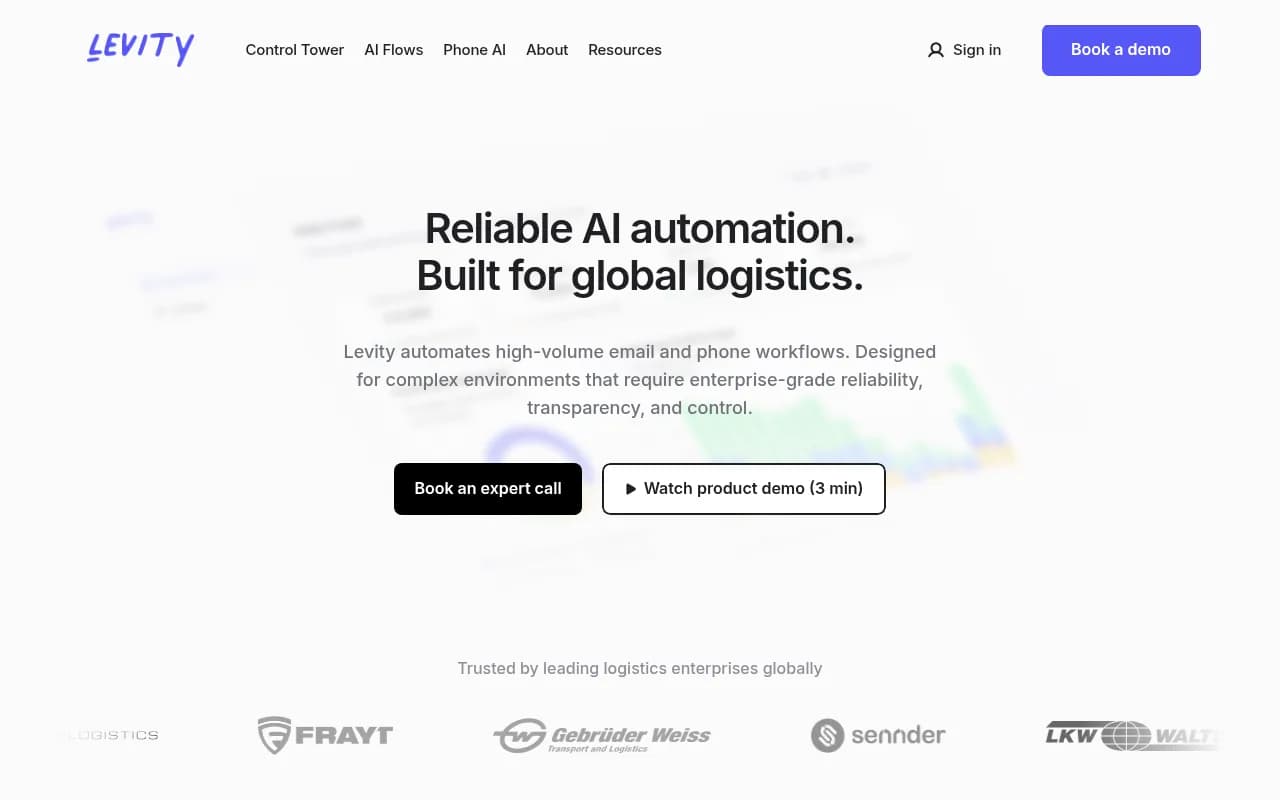
Levity AI automates high-volume email and phone workflows for global logistics enterprises. Built for freight forwarders, 3PLs, and supply chain operations teams drowning in manual communication tasks, it combines AI classification, data extraction, and workflow automation to handle spot quoting, tr
Key Takeaways:
- Enterprise AI automation platform purpose-built for logistics and freight operations, not a generic workflow tool
- Handles email classification, document extraction, and phone call automation for spot quoting, tracking, and order entry workflows
- Used by major logistics enterprises including Gebrüder Weiss, FRAYT, and other global freight forwarders
- Combines AI with rule-based logic and fallback mechanisms to achieve >99% production-grade accuracy
- Pricing starts at $99/month; requires demo/consultation for implementation
Levity AI is an enterprise automation platform designed specifically for logistics and freight operations teams struggling with high-volume email and phone workflows. Founded in 2018 and based in Berlin, Germany, the company has carved out a focused niche automating the repetitive communication tasks that bog down freight forwarders, 3PLs, and supply chain operations teams. Unlike generic automation tools that require extensive customization, Levity ships with pre-built workflows for common logistics use cases like spot quoting, shipment tracking, document collection, and order entry.
The platform is built around three core products that work together: Control Tower for operations visibility, AI Flows for email automation, and Phone AI for call handling. This isn't a self-service tool you sign up for and configure yourself — Levity positions itself as a white-glove implementation partner that builds custom automation workflows tailored to each customer's systems and processes. The target customer is mid-to-large logistics enterprises (think 100+ employees) dealing with thousands of emails and calls per day, not small freight brokers or individual operators.
Control Tower: Operations Intelligence
Control Tower is Levity's analytics and monitoring layer that turns unstructured email and phone communication into quantifiable data. It connects to your email systems (Gmail, Outlook, proprietary platforms) and analyzes every incoming message to categorize it by type (spot quote request, tracking inquiry, invoice question, etc.), extract key data points (origin, destination, weight, commodity), and measure response times and bottlenecks.
The value proposition here is visibility. Most logistics operations teams have no idea how many spot quote requests they receive per day, how long it takes to respond, or which types of inquiries consume the most staff time. Control Tower surfaces this data in real-time dashboards so you can identify which workflows are worth automating and measure ROI after implementation. It tracks metrics like average time-to-quote, quote volume by lane, response time by inquiry type, and staff workload distribution.
This isn't just passive monitoring — Control Tower feeds directly into AI Flows by identifying patterns and edge cases that inform automation rules. For example, if Control Tower shows that 40% of spot quote requests are for LTL shipments under 10,000 lbs on specific lanes, you can build an AI Flow that auto-quotes those loads based on your rate tables without human intervention.
AI Flows: Email Workflow Automation
AI Flows is where the actual automation happens. It's a hybrid system that combines large language models (for understanding natural language in emails and attachments) with rule-based logic (for deterministic decision-making) and human-in-the-loop fallbacks (for edge cases the AI can't handle confidently).
Here's how it works in practice for a spot quoting workflow:
- Email arrives requesting a quote for a shipment
- AI classifies it as a spot quote request (vs. tracking inquiry, invoice question, etc.)
- AI extracts load details: origin ZIP, destination ZIP, weight, commodity, pickup date, special requirements
- Rule engine checks if this load matches auto-quote criteria (specific lanes, weight ranges, commodities you've pre-approved)
- If yes: AI generates quote email using your rate tables and sends it automatically
- If no: Email routes to appropriate team member with extracted data pre-filled
- All actions logged in Control Tower for monitoring and improvement
The key differentiator vs. generic AI tools is the logistics-specific intelligence. Levity's models are trained on freight industry language and understand terms like "TONU," "detention," "lumper fees," "reefer," and "drayage" without needing custom training. The platform handles multi-language emails (English, German, Spanish, French, Dutch, Polish, and others) and can extract data from messy email threads, PDFs, Excel attachments, and scanned documents.
Other common AI Flow use cases:
- Track & Trace: Auto-respond to "where's my shipment" emails by pulling tracking data from your TMS and sending status updates
- Document Collection: Identify missing PODs, BOLs, or customs paperwork and send automated follow-up requests to carriers
- Order Entry: Extract shipment details from customer emails and create orders directly in your TMS/ERP
- Invoice Follow-ups: Detect overdue invoices and send payment reminders with attached copies
Each workflow includes confidence scoring — if the AI is less than 95% confident in its classification or extraction, it routes to a human for review rather than acting automatically. This hybrid approach is how Levity achieves >99% accuracy in production environments where mistakes are costly.
Phone AI: Call Automation
Phone AI handles outbound and inbound call workflows that don't require complex negotiation or relationship-building. Think load check-ups ("Has the driver picked up yet?"), tracking updates ("What's the ETA for shipment #12345?"), invoice follow-ups ("We haven't received payment for invoice #67890"), and appointment scheduling.
The system makes calls on your behalf, navigates phone trees, speaks naturally with carriers/customers/drivers, extracts information, and logs results in your TMS. For inbound calls, it can answer common questions, route complex inquiries to the right team member, and capture caller information for follow-up.
Phone AI supports the same languages as AI Flows and integrates with common phone systems (RingCentral, Aircall, Twilio, etc.). It's not trying to replace your entire customer service team — it's handling the repetitive, low-value calls that consume hours of staff time without requiring human judgment.
Integrations & Technical Architecture
Levity integrates with the major TMS/ERP platforms used in logistics: Descartes, McLeod, TMW, SAP, Oracle, Microsoft Dynamics, and others. It also connects to common business tools like Gmail, Outlook, Slack, Microsoft Teams, Salesforce, HubSpot, Zapier, Make, and various proprietary systems via API or webhook.
The platform is API-first, so if you have custom internal systems, Levity's team will build connectors as part of the implementation. This is a key selling point for enterprise customers with complex tech stacks — you're not forced to rip and replace existing systems.
Data residency is configurable. Levity runs on servers in the EU (for GDPR compliance) and US (for customers who require US-based data storage). The company is ISO 27001 and SOC 2 certified, which matters for enterprise procurement processes.
Who Is It For
Levity is built for mid-to-large logistics enterprises (freight forwarders, 3PLs, asset-based carriers, customs brokers) with operations teams of 20+ people handling thousands of emails and calls per day. Specific personas:
- VP of Operations at a 500-person freight forwarder drowning in spot quote requests and looking to scale without adding headcount
- Director of Customer Service at a 3PL trying to improve response times for tracking inquiries and reduce staff burnout
- COO of a regional carrier wanting to automate load check-ups and detention claims
- Head of Digital Transformation at a global logistics enterprise tasked with AI adoption but struggling to move pilots into production
This is NOT for:
- Small freight brokers (under 10 employees) — the pricing and implementation model assumes enterprise scale
- Companies with low email/call volume (under 500 emails per day) — not enough volume to justify the investment
- Teams looking for a self-service DIY tool — Levity requires professional implementation and ongoing optimization
Pricing & Implementation
Levity doesn't publish transparent pricing on its website. Based on third-party sources and typical enterprise automation platforms, expect:
- Entry-level: ~$99-499/month for basic email classification and routing (likely limited to 1-2 workflows)
- Mid-tier: ~$500-2,000/month for multiple AI Flows, Phone AI, and Control Tower analytics
- Enterprise: Custom pricing for global rollouts, high-volume operations, and extensive integrations
Implementation is not instant. Expect 4-12 weeks from kickoff to production, depending on complexity. Levity's team handles the heavy lifting: data integration, workflow design, AI training on your specific use cases, testing, and deployment. You're assigned a dedicated implementation manager and ongoing support.
There's no free trial in the traditional sense — you book a demo, discuss your use case, and if it's a fit, Levity runs a paid pilot (typically 1-3 months) to prove ROI before committing to a full rollout.
Strengths
- Logistics-specific intelligence: Unlike generic AI tools, Levity understands freight industry terminology, document types, and workflows out of the box
- Hybrid AI + rules approach: Achieves >99% accuracy by combining AI with deterministic logic and human fallbacks, not relying on AI alone
- White-glove implementation: You're not left to figure it out yourself — Levity's team builds, tests, and deploys workflows for you
- Enterprise-grade security: ISO 27001, SOC 2, GDPR compliance, and configurable data residency matter for large organizations
- Proven ROI: FRAYT case study shows 86% time savings on quoting and 4,000+ additional quotes per month without adding headcount
Limitations
- Not self-service: You can't sign up and start automating today — requires sales process, demo, and professional implementation
- Pricing opacity: No transparent pricing makes it hard to budget without a sales conversation
- Niche focus: If you're not in logistics/freight, this platform isn't built for you (unlike Zapier or Make which work for any industry)
- Implementation time: 4-12 weeks to go live is longer than plug-and-play automation tools
Bottom Line
Levity AI is the right choice for mid-to-large logistics enterprises serious about automating high-volume email and phone workflows at production-grade accuracy. If you're a freight forwarder, 3PL, or carrier operations team drowning in spot quote requests, tracking inquiries, and document collection, and you have the budget and patience for a professional implementation, Levity delivers measurable ROI. Best use case in one sentence: automating repetitive logistics communication workflows (quoting, tracking, document collection) for operations teams handling 1,000+ emails per day who need >99% accuracy and enterprise-grade reliability.
Similar and alternative tools to Levity AI