MeetEdgar Review 2026
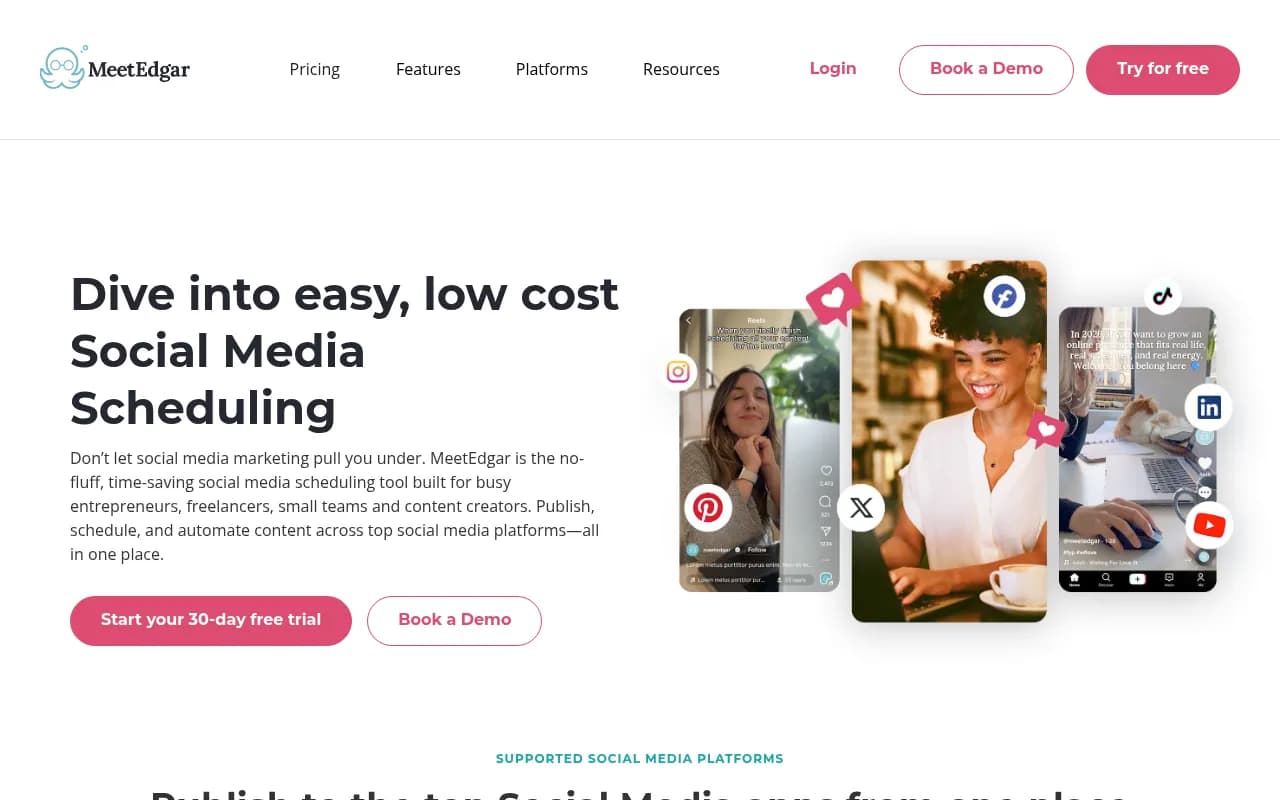
Uses an AI curator to continuously recycle and reschedule evergreen posts, built for content-heavy creators and bloggers.
Key takeaways
- MeetEdgar's category-based recycling queue is still the best answer to "I ran out of things to post" — your content library never empties, and old posts resurface automatically on a schedule you set once.
- Pricing is simple and honest: $29.99/month (Eddie, 5 accounts) or $49.99/month (Edgar, 25 accounts), both with unlimited scheduled posts and 20 team members. Annual billing drops those to $24.91 and $41.58.
- The AI assistant, Inky, is fine for breaking writer's block, but it's credit-capped (15 or 50 credits/month depending on plan) and competitors like SocialBee give unlimited AI use at similar prices.
- Analytics are thin. If you need deep reporting, competitor benchmarking, or robust engagement tools beyond the Edgar plan's Social Inbox, look elsewhere.
- Best fit: solo bloggers, coaches, consultants, and small content teams who publish evergreen material on 5–10 platforms and want social media to run itself after one weekly batching session.
What MeetEdgar actually does
Most social schedulers work like a conveyor belt: you load posts, they publish, the posts vanish, and you start over. MeetEdgar's whole pitch is that the conveyor belt is wasteful. Instead, Edgar keeps every post you've ever written in a library and recycles it indefinitely.
The mechanics are simple once you get your head around them. You sort posts into categories — think "blog tips," "promotional," "behind the scenes" — and assign each category time slots in your weekly schedule. When Edgar runs out of fresh posts in a category, it reaches back into the library and reposts older content, either in last-in-first-out order or shuffled. Add text variations to a post and each recycle can look different from the last one.
This sounds trivial. It isn't. The category system is the reason Edgar customers are so loyal: you spend an hour on a Friday loading the library, and then you genuinely don't think about social media for weeks. One customer, author Tim Grahl, credits the tool with a 95% jump in social traffic. Your mileage will vary, but the underlying workflow — batch, categorize, walk away — is the product, and it works.
The company has been at this a long time. Laura Roeder founded MeetEdgar in 2014, SureSwift Capital acquired it in January 2022, and the homepage claims 10,000+ entrepreneurs, 32 million pieces of content created, and 27,000+ connected social accounts. Ten years in, this is a mature product, not a startup scrambling to keep up with API changes.
Inky, the AI sidekick
The "AI content recycler" framing in Edgar's marketing comes down to Inky, an AI caption generator built on OpenAI's models and launched in early 2024 inside the Content Composer. It generates captions and hashtag suggestions in a handful of tones — Professional, Academic, Contemplative, Colloquial, Optimistic.
I'd call Inky useful rather than impressive. It's good at turning a link into a serviceable caption when you're staring at a blank box, and the company itself describes it as a starting point, not a replacement for your own writing. The real limitation is the credit system: 15 credits a month on Eddie, 50 on Edgar, with extra blocks of 100 credits at $2.50. SocialBee's marketing team has made hay out of this, pointing out that they offer unlimited AI use. If you generate captions daily, the cap will annoy you. If you use AI occasionally to unstick a draft, it's fine.
The genuinely smart automation in this product isn't the AI. It's the auto-import system, which pulls new posts nightly from RSS feeds, WordPress, YouTube, Medium, Vimeo, Etsy, Pinterest, and podcast feeds. Pair that with category recycling and Edgar becomes a machine that turns your existing content output into a perpetual social presence with almost no ongoing effort.
Platforms and integrations
Edgar supports ten networks: Facebook, Instagram, LinkedIn, Pinterest, X/Twitter, TikTok, Threads, YouTube Shorts, Google Business Profile, and Bluesky. That's a broader list than most small-business schedulers, and Bluesky support in particular is ahead of the curve. The catch is that some of these are shallow connections — YouTube is Shorts-only, and Instagram posting has historically required workarounds (the mobile apps exist largely to handle Instagram's publishing requirements).
Integrations cover the practical stuff: a Chrome extension and bookmarklet for saving links into your library while browsing, Zapier for piping content in from Pocket or Feedly, Canva for exporting designs directly, Bitly and Rebrandly for branded short links, and a Shopify app for pulling product links into your queue. There's no free-form API, which is a fair complaint if you like building your own workflows.
One thing to know from the review forums: Edgar removed its built-in link shortener, and some long-time users are still sore about it. You'll want Bitly or Rebrandly set up if short links matter to you.
Pricing
Two plans, no per-user fees, 30-day free trial with no credit card required.\n
- Eddie — $29.99/month (or $24.91/month billed annually): 5 social accounts, unlimited scheduled posts, 10 weekly automations, 4 content categories, 20 team members, 15 Inky credits. No Social Inbox.
- Edgar — $49.99/month (or $41.58/month billed annually): 25 social accounts, 1,000 weekly automations, unlimited categories, Social Inbox included, 50 Inky credits.
Extra social accounts run $3.99–$4.99/month on Eddie and $1.99–$2.99/month on Edgar. Nonprofits, charities, and military families get discounts, though the site doesn't publish the percentage.
The Eddie plan's 4-category limit is the gotcha worth knowing about. The category system is the entire product, and four categories is tight if you run more than a couple of content themes. Many users will end up on Edgar for the unlimited categories alone, which makes the real price $49.99 for most serious use. Reviewers on Capterra and Software Advice consistently rate value-for-money as Edgar's weakest sub-score (4.1/5), and I think that's the right read: the product is good, but the cheaper tier is deliberately cramped.
Strengths and limitations
Strengths
- The recycling queue is genuinely unique. No other scheduler at this price keeps and reuses your content this elegantly.
- Learning curve is short. G2 reviewers (4.3/5 across 57 reviews) consistently praise how fast new users get productive.
- Customer support scores well everywhere — 4.6/5 on Software Advice — and the company has a reputation for actually answering.
- 20 team members on both plans, with no per-seat fees, is unusually generous for this price range.
- Auto-import from blogs, YouTube, and podcasts means your queue fills itself from work you're already doing.
Limitations
- Analytics are basic: engagement dashboards, click tracking, and variation performance, but nothing approaching the reporting depth of Sprout Social or even Buffer's newer tooling. No competitor benchmarking, no exportable client-ready reports worth the name.
- Inky's credit cap makes the AI feel like an upsell rather than a feature.
- No free plan, and the entry tier's category limit pushes most users toward the $49.99 plan.
- Scheduling is category-driven, so users who want precise, one-off time slots for individual posts find it rigid. Research.com's review flags exactly this.
- No open API, and the removal of the built-in link shortener still stings for long-time customers.
Who it's for
The ideal Edgar user is a content-heavy solo operator: a blogger with an archive of posts, a coach or consultant with a steady stream of evergreen advice, a realtor with listings and local tips, a nonprofit with a small team and no social staff. If you produce material that stays relevant for months, Edgar will squeeze more mileage out of it than anything else on the market.
It's also a solid pick for a small agency running a handful of client accounts, mainly because of the 25-account ceiling and 20 free seats on the Edgar plan.
Skip it if you're an enterprise social team that lives in analytics dashboards, or if your strategy depends on real-time reactive posting — Edgar's model is built around planning ahead, not jumping on trends. And if unlimited AI writing is your priority, SocialBee undercuts Edgar on that specific point.
Bottom line
MeetEdgar is a one-trick product in the best sense: it solved the content-recycling problem a decade ago, and nobody has beaten it at that trick since. The pricing tiers have some friction and the AI and analytics are middle-of-the-road, but the core promise — set up categories once, never have an empty queue again — is delivered reliably. For freelancers, bloggers, and small teams drowning in social media maintenance, $29.99 to $49.99 a month buys back hours every week. If you're comparing options across the broader social media tool category, the directory at surferstack.com has side-by-side reviews of Edgar's main rivals to help you decide.
Tags:
Frequently asked questions
How much does MeetEdgar cost?
How does MeetEdgar's content recycling work?
What social media platforms does MeetEdgar support?
Is MeetEdgar's AI assistant Inky unlimited?
Does MeetEdgar have good analytics?
Who is MeetEdgar best for?
Similar and alternative tools to MeetEdgar