Radarkit AI Review 2026
An AI search monitoring tool built for agencies and SEO professionals. Tracks brand appearances in AI-generated answers, supports multi-client reporting and competitor analysis.
Key takeaways
- Radarkit AI covers the full loop from tracking to content creation -- it monitors AI visibility across 6+ major AI platforms and includes a content writing tool grounded in citation data and Google SERP analysis.
- Lacks several capabilities that Promptwatch offers, including AI crawler logs, traffic attribution beyond basic LLM referral counts, prompt volume and difficulty scoring, query fan-out depth, Reddit/YouTube-specific tracking, ChatGPT Shopping monitoring, and offsite citation analysis.
- Pricing is competitive at $79/mo for the Popular plan, making it one of the more affordable options in the GEO space.
- Best suited to small-to-mid-size SEO agencies and in-house teams that want a single tool covering both monitoring and basic content optimization without a large budget.
- Multi-language and multi-region support is a genuine strength -- residential IP-based prompting gives more realistic, localized results than API-only approaches.
Radarkit AI is a relatively new entrant in the AI search visibility space, positioning itself as a combined tracking and content optimization platform. Where many competitors in the GEO category stop at showing you a dashboard of brand mentions, Radarkit tries to close the loop by also helping you create content that AI assistants are more likely to cite. The pitch is straightforward: track what AI models say about your brand, analyze which sources they trust, then write content engineered to fill the gaps.
The tool targets SEO professionals and digital agencies who are starting to feel the pressure of AI search eating into traditional organic traffic. It's not built for enterprise procurement cycles -- the interface is lean, the pricing is accessible, and the feature set is focused rather than sprawling. That's a deliberate choice, and for the right user, it works.
Radarkit appears to have launched in 2025 or early 2026, based on the recency of its feature set and the pricing structure visible on its site. It's a smaller operation compared to established players like Profound or Scrunch, but it covers more ground than pure monitoring tools like Otterly.AI or Peec.ai.
Key features
AI platform monitoring across 6+ models
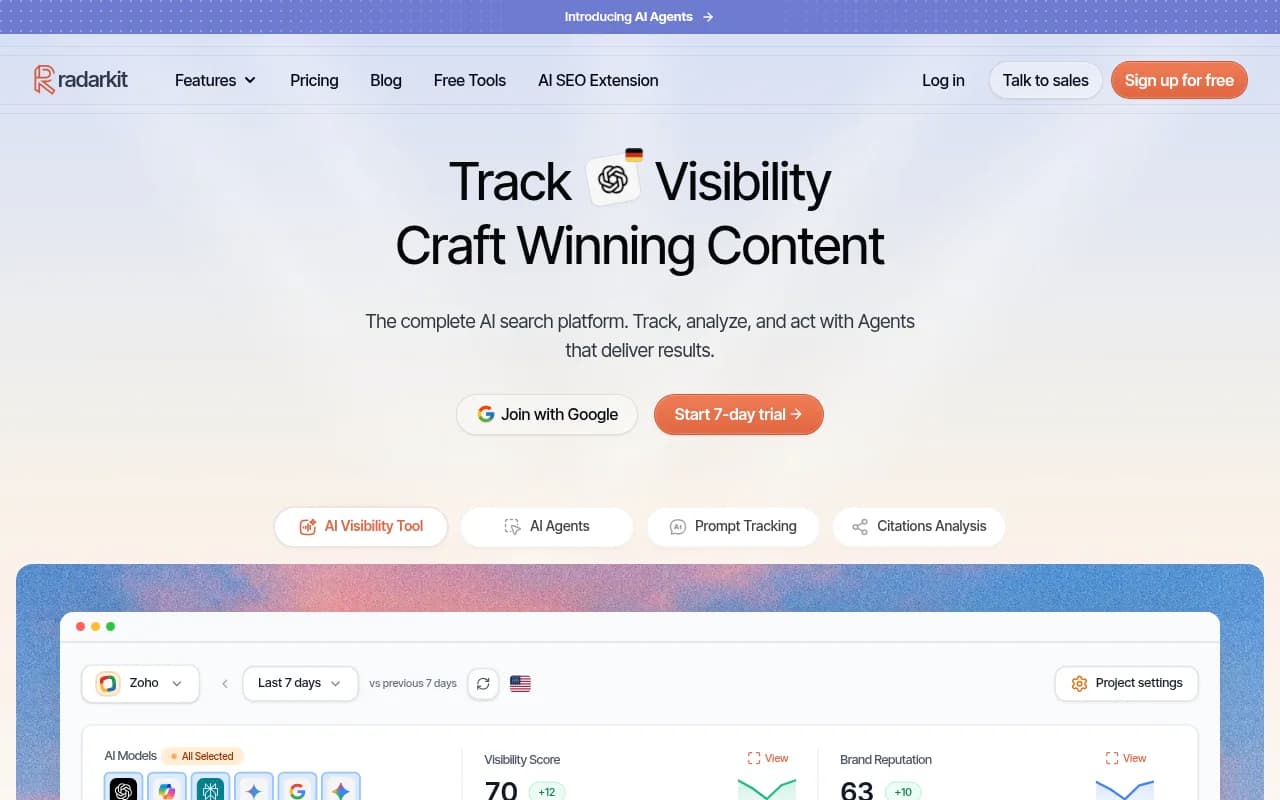
Radarkit tracks brand visibility across ChatGPT, Microsoft Copilot, Perplexity, Google Gemini, Google AI Overview, and Google AI Mode. Crucially, it prompts these platforms directly through their actual user interfaces rather than through APIs -- which matters because AI chat UIs can return different answers, citations, and recommendations than API calls. Residential IPs are used to simulate real user behavior in specific countries, which gives more accurate localized results.
- Visibility Score and Brand Reputation Score are calculated per project
- Average Position tracking shows where your domain ranks in AI responses relative to competitors
- Sentiment analysis breaks down brand mentions into positive, mixed, and negative categories, with specific insight tags like "known for affordability" or "budget-conscious teams"
Citation analysis
This is one of Radarkit's stronger features. For any tracked keyword set, you can see every domain that AI assistants cited, how many times, which models cited it, and what content type the citation came from (listicle, community/forum, guide, product page, etc.). The Citation Rank view shows your domain's position among all cited sources, and you can drill into specific URLs to see which pages are being cited and by which models.
- Export of up to 5,000+ citation URLs per project
- "Links to Competitors" feature: Radarkit visits AI-cited sources and identifies where competitors are mentioned within those pages -- useful for outreach planning
- Content Type Distribution breakdown shows which formats (listicles, Reddit threads, LinkedIn posts, guides) dominate citations for your keyword set
Competitor tracking
You can add competitor domains to any project and compare their AI visibility against your own. The Average Position Rank table shows a side-by-side view of your domain vs competitors across all tracked prompts. Citation share data lets you see how much of the AI citation pie each competitor holds.
Content writing tool
Radarkit's content tool analyzes the top 10 Google SERP results and the most-cited AI sources for a given keyword, extracts key terms and entities, identifies content gaps, and generates a draft with those gaps filled. It also adds fact-checked statistics and trusted source references, which is a meaningful differentiator from generic AI writing tools.
- Content Score with benchmarks (average and top performer scores)
- Word count optimization with suggested range
- Readability scoring
- Terms, Topics, and Entities panels showing what to cover
- Auto-optimize and internal link insertion (no Google Search Console connection required)
- Supports multiple languages -- content can be crafted in English, German, and other languages based on the target market
Query fan-out support
Radarkit captures query fan-out data -- the way a single prompt branches into multiple sub-queries inside AI platforms. Because it uses real browsers rather than API calls, it captures this as it actually happens in the UI. You can export fan-out data or use it directly to inform content structure.
LLM traffic monitoring
A basic traffic analytics view shows sessions referred from AI assistants, broken down by platform (ChatGPT, Perplexity, etc.). You can see total sessions, share of traffic from AI referrals, and period-over-period changes. This is more limited than a full attribution system but gives a directional read on whether AI visibility is translating into actual visits.
Multi-region and multi-language tracking
Prompts can be run from specific countries using residential IPs, which means you get results that reflect what a user in the US, Germany, or another market would actually see. This is particularly useful for brands operating across multiple regions where AI model behavior and citation patterns differ.
Brand reporting
Radarkit generates exportable brand reports formatted for client presentation. For agencies managing multiple clients, this reduces the time spent on manual reporting. Reports include visibility scores, sentiment data, citation rankings, and prompt-level breakdowns.
Agents (Outreach, Reddit, Plan, Content)
The platform includes a set of AI agents accessible from a chat-style interface. The Outreach Agent helps plan link-building and citation campaigns. The Reddit Agent surfaces relevant Reddit discussions. The Plan Agent helps structure content strategy. The Content Agent generates drafts. These are relatively early-stage features based on the UI shown, but they point toward a more automated workflow.
Who is it for
Radarkit fits best for small-to-mid-size SEO agencies managing a handful of client accounts who want a single tool that covers both AI visibility monitoring and content optimization. Think a 5-15 person agency running GEO services for clients in competitive SaaS, e-commerce, or professional services verticals -- teams that need to show clients concrete data on AI brand presence and also need to produce content that improves those numbers.
In-house SEO teams at growth-stage companies (say, 50-500 employees) who are starting to take AI search seriously but don't have the budget for enterprise-tier platforms will also find Radarkit a reasonable fit. The content tool is genuinely useful for teams that want to move from "we should be visible in AI" to actually publishing content optimized for AI citation.
The multi-language and multi-region support makes it particularly relevant for brands with European or international audiences. The German-language content examples in the UI suggest the team has put real thought into non-English markets, which is more than most competitors in this space have done.
Who should probably look elsewhere: large enterprise teams that need deep attribution modeling, AI crawler log analysis, or integration with existing data infrastructure. Also, brands that need to monitor more than 6-7 AI models -- Radarkit's coverage is solid but not exhaustive. If you need ChatGPT Shopping tracking, entity-level monitoring, or prompt volume and difficulty scoring to prioritize which keywords to target, Radarkit doesn't currently offer those.
Integrations and ecosystem
Radarkit's integration surface is currently limited. The platform mentions Gmail connectivity for the Outreach Agent, and Google Search Console data can be used to suggest prompts. Beyond that, the tool appears to be largely self-contained.
- Gmail: Connected for outreach workflows
- Google Search Console: Optional connection for prompt suggestions
- Export: Citation data can be exported (5,000+ URLs per project); brand reports are exportable for client sharing
- No API mentioned: There's no public API documented on the site, which limits custom reporting or data pipeline use cases
- No browser extension or mobile app mentioned
The agent-based interface (Outreach Agent, Reddit Agent, Plan Agent, Content Agent) suggests the team is building toward a more connected workflow, but the ecosystem is early-stage compared to platforms with Zapier integrations, Looker Studio connectors, or webhook support.
Pricing and value
Radarkit's pricing is among the more accessible in the GEO space:
- Popular plan: $79/mo -- covers core tracking, citation analysis, and content features for a single or small number of projects
- Pro plan: $139/mo -- expanded limits, likely more projects and prompts (specific limits not fully detailed on the public site)
- Enterprise: Custom pricing -- contact sales
A 7-day free trial is available. The site also mentions a $29/mo entry point in some external references, which may reflect a starter or legacy tier.
For context, Promptwatch's Essential plan starts at $99/mo and Professional at $249/mo, while Profound and Scrunch sit at higher price points. Radarkit is genuinely cheaper, which matters for smaller agencies and solo practitioners who can't justify $200-500/mo for a monitoring tool.
The value equation depends on what you need. If you want basic AI visibility tracking plus a content tool to act on the data, Radarkit delivers reasonable value at $79/mo. If you need crawler logs, deep attribution, prompt volume scoring, or ChatGPT Shopping tracking, you'll hit the ceiling quickly and need to look at more capable platforms.
Strengths and limitations
What Radarkit does well:
- Real browser prompting: Visiting AI platforms directly rather than using APIs produces more realistic results, especially for localized queries. This is the right approach and not every competitor does it.
- Citation depth: The citation analysis is genuinely detailed -- content type breakdown, competitor link mapping, per-model citation data, and URL-level drill-down give you real intelligence on what AI models trust.
- Content tool integration: Having citation data and content generation in the same platform is a meaningful workflow improvement over switching between a monitoring tool and a separate writing tool.
- Multi-language support: The ability to track and generate content in German and other languages is a real differentiator for international brands.
- Price point: At $79/mo, it's one of the more affordable tools that goes beyond pure monitoring.
Limitations and honest gaps:
- No AI crawler logs: Radarkit doesn't show you when AI crawlers visit your site, which pages they read, or what errors they encounter. This is a significant gap for diagnosing why content isn't getting cited. Promptwatch's crawler log feature addresses this directly.
- Limited traffic attribution: The LLM referral tracking is basic -- session counts by platform, not page-level attribution or revenue connection. You can't trace which specific AI citations are driving conversions.
- No prompt volume or difficulty scoring: There's no data on how often a given prompt is searched or how competitive it is. This makes it harder to prioritize which keywords to focus on. Promptwatch's Prompt Intelligence feature fills this gap with volume estimates and difficulty scores.
- No ChatGPT Shopping or entity tracking: For e-commerce brands or those wanting to monitor product-level AI recommendations, this is a missing capability.
- No Reddit/YouTube-specific tracking: While citation data includes Reddit and YouTube as sources, there's no dedicated Reddit or YouTube insights module for surfacing discussions that influence AI recommendations.
- Thin integration ecosystem: No public API, no Zapier, no Looker Studio connector. For agencies that want to pipe data into their own reporting stack, this is a real constraint.
Bottom line
Radarkit AI is a solid entry-level GEO platform that punches above its price point by combining AI visibility monitoring with a content optimization tool. For small agencies and in-house SEO teams that want to move from "tracking AI mentions" to "publishing content that gets cited," it covers the basics well and does so at a price that's hard to argue with.
That said, teams that need deeper capabilities -- AI crawler diagnostics, prompt volume prioritization, revenue attribution, or ChatGPT Shopping tracking -- will find Radarkit's ceiling relatively low. For those use cases, Promptwatch offers a more complete action loop with content gap analysis, AI crawler logs, and traffic attribution that connects visibility to actual business outcomes.
Best for: Small-to-mid-size SEO agencies and in-house teams wanting affordable AI search monitoring plus content optimization in a single tool, especially for multi-language or European markets.
Tags:
Frequently asked questions
What is Radarkit AI and what does it do?
Which AI platforms does Radarkit monitor?
How much does Radarkit cost?
Does Radarkit have a content generation feature?
How does Radarkit compare to Promptwatch?
Is there a free trial for Radarkit?
Similar and alternative tools to Radarkit AI